
News
DEW endorses dissident ministers’ stand on secret Yugadanavi deal

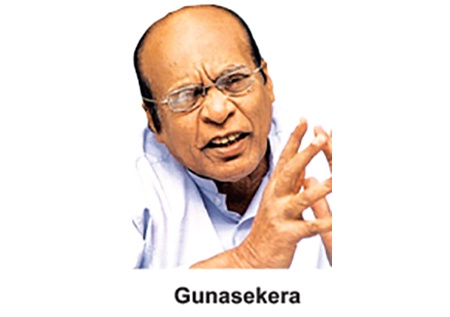
‘It cannot be defended in terms of collective responsibility of Cabinet of Ministers’
By Shamindra Ferdinando
Former Minister D. E. W. Gunasekera says dissident ministers, Vasudeva Nanayakkara, Wimal Weerawansa and Udaya Gammanpila, are right in having thrown their weight behind those who petitioned the Supreme Court against the signing of the sale and purchase agreement for the purchase of 40% of the issued share capital of West Coast Power (Pvt.) Ltd.
Seller Sri Lanka and buyer New Fortress Energy Sri Lanka Power Holding LLC signed the agreement on Sept. 17, 2021 in Colombo.
Gunasekera, who served as the General Secretary of the Communist Party from 2004 till late August 2020, has, in an article published in the party organ, Aththa, in its 02 Jan. edition, emphasised that in spite of being a member of the SLPP Cabinet, the three ministers obviously didn’t want to be respondents in the high profile case. Instead, they have taken a principled stand on the agreement, which was not subjected to proper Cabinet procedure.
Dr. G. Weerasinghe succeeded Gunasekera as the General Secretary of the CP but was denied an SLPP National List slot regardless of an understanding among constituents. First time entrant to parliamentary politics Weerasumana Weerasinghe, longstanding CP member represents Matara District. The CP backs the stand taken by the three ministers, both in and outside Parliament.
Declaring that the ministers opposed the agreement as it had been signed without following proper procedures against their conscience, Gunasekera said that their actions couldn’t be considered a violation of the collective Cabinet responsibility.
The Supreme Court will resume hearing on the case on 10 Jan. The SC bench consists of Supreme Court five-judge-bench comprising Chief Justice Jayantha Jayasuriya, Justices Buwaneka Aluwihare, Justice Priyantha Jayawardena, Justice Vijith Malalgoda and Justice L.T.B. Dehideniya.
The case was heard on Dec 16 and 17. The five-judge-bench put off the case to January 10 after Attorney General Sanjay Rajaratnam, PC, appearing on behalf of the respondents requested that the proceedings not be resumed on Dec 21. The judges wanted to hear the case on Dec 21 and 22.
Gunasekera emphasised that against the backdrop of three Ministers decrying the agreement, President Gotabaya Rajapaksa should have given an opportunity for the cabinet of ministers to discuss the issue at hand. Had remedial measures been taken promptly, the SLPP government could have prevented the problem being exploded into a major political crisis, the former lawmaker said. Gunasekera asserted that the government blundered seriously by its failure to address concerns expressed by a section of the ministers. The former minister declared: “It is the first mistake and the first sin.”
Gunasekera explained how the absence of transparency in the sale of 40 % shares owned by the Treasury to New Fortress Energy, hasty approval of the agreement at the Cabinet level without following due procedure, bringing the power ministry under a new Minister Gamini Lokuge at the expense of Dullas Alahapperuma ahead of the finalization of the agreement, the project being a threat to the country’s sovereignty and inimical to national aspirations and finally the impact on current Geo-political situation undermined stability.
Samagi Jana Balavegaya (SJB) General Secretary Ranjith Maddumabandara, Janatha Vimukthi Peramuna (JVP) former Parliamentarians Sunil Hadunneththi and Wasantha Samarasinghe, Colombo Archbishop Malcolm Cardinal Ranjith and Ven. Elle Gunawansa thera and Viduli Sevaka Sangamaya have challenged the deal in the Supreme Court.
The former minister also examined the SLPP’s continuing failure to grasp the current crisis. Instead of realizing that their economic strategy had failed to meet the desired objectives or challenges, influential sections of the SLPP quite conveniently blamed the crisis on the Covid-19 epidemic, the ex-MP said.
Gunasekera questioned whether the government was considering a taking a turn to the right seeking a new alternative.
The outspoken politician emphasized that the SJB, the UNP and the JVP (JVP contested last general election on the Jathika Jana Balavegaya ticket) hadn’t been able to correctly ascertain the current situation, particularly against the backdrop of the crisis caused by Yugadanavi fiasco. The SJB and the UNP essentially blamed the current situation on incompetence and mismanagement whereas the JVP believed waste, corruption and misappropriation of public funds caused the deterioration of the national economy.
The former minister also drew public attention to the government altogether doing away with price controls. The runaway cost of living should be examined taking into consideration the government ending state intervention in price controls, the ex-lawmaker said, adding that those who asserted that eradication of bribery, corruption and misappropriation of public funds would be the panacea for Sri Lanka’s ills should realize how government strategy and policies contributed to the deterioration.
Gunasekera also questioned the suitability of the majority of those who had received appointments from President Gotabaya Rajapaksa. Categorizing them as believers of disastrous neo liberal policies, Gunasekera said that the current dispensation was in fact a UPFA style administration. They had proved their belief in neo liberalism through their actions, the former MP said.
The former minister declared that the vast majority of lawmakers in the Parliament couldn’t even understand the developments that had taken place since 1956 hence the deterioration of overall parliamentary standards and way of thinking. Taking a genuine anti-imperialistic patriotic stand was no longer attractive to the majority of lawmakers, Gunasekera said, adding that the current lot basically followed the policies of those elected to the Parliament in 1977.
Gunasekera also examined the differences between the current dispensation and the 2005-2015 Mahinda Rajapaksa administration that quite convincingly managed political upheavals both in and out of Parliament. The former minister said that the same couldn’t be said about the current dispensation.


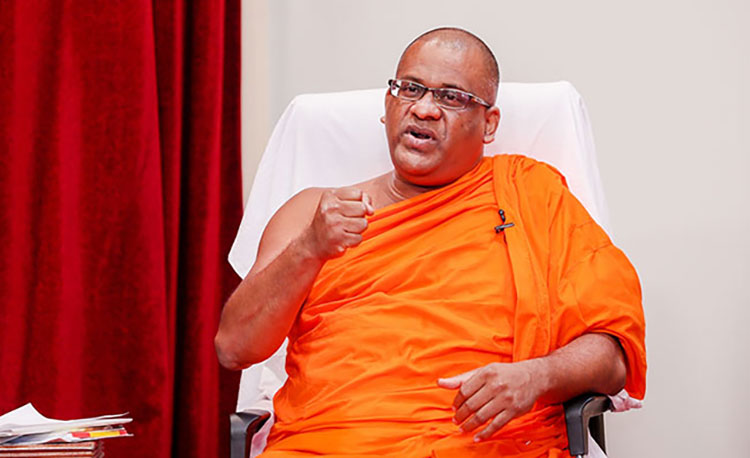
The Mahanayaka Theras of all Nikayas have protested against Bodu Bala Sena (BBS) General Secretary Ven. Galagodaaththe Gnanasara Thera, who is serving a prison sentence for contempt of court, being produced before court in civilian attire.
In a letter to the Commissioner General of Prisons, the Mahanayaka Theras have said they were surprised and concerned by the decision to remove the monk’s robes.
The letter has been signed by Most Ven. Thibbotuwawe Sri Siddhartha Sumangala Thera of the Malwatu Chapter, Most Ven. Warakagoda Sri Gnanarathana Thera of the Asgiri Chapter, Most Ven. Karagoda-Uyangoda Maithri Murthi Thera of the Amarapura Maha Nikaya and Most Ven. Makulawe Sri Wimala Thera of the Ramanna Maha Nikaya.
The Mahanayaka Theras have said they respect the Constitution and the judicial process, but maintained that removing a monk’s robes or ending his status as a member of the Buddhist Order is a matter that should be decided by the Maha Sangha.
They have said the relevant Sangha Council has not determined that Ven. Gnanasara Thera committed a Parajika offence or any other offence warranting his removal from the Buddhist Order.
The Mahanayaka Theras have also referred to Regulation 550 of the Prison Standing Orders, which they say stipulates that convicted prisoners should not be taken to court in prison uniform and should be allowed to wear the type of clothing they normally wore before their conviction. In the case of a Buddhist monk, they have said, this means his monastic robes.
They also referred to the United Nations Standard Minimum Rules for the Treatment of Prisoners, which provide for prisoners taken outside prison to be allowed to wear their own clothing or other unobtrusive clothing.
The Mahanayaka Theras have requested the Commissioner General of Prisons to allow Ven. Gnanasara Thera to wear his robes when appearing in court and to maintain his status as a monk while he remains in prison.
Prisons authorities have said that the clothing decision was made under prison regulations, and the Prisons Department has stated that prisoners serving sentences of more than three years are required to wear prison-issued clothing when produced before court.
The Committee on Public Finance has said that the actual losses suffered by the NDB bank are much more than what was initially reported. When compared with the initial disclosure made by NDB on 6 April 2026, the reported amount of the fraud had increased by Rs. 0.4 billion, from Rs. 13.2 billion to Rs. 13.6 billion, the committee said.
When compared with the amount disclosed by NDB on 26 June 2026, based on the interim report dated 22 June 2026, the additional amount of fraud is Rs. 60 million.
The has committee issued the following statement: The Committee on Public Finance recently summoned officials of the Central Bank of Sri Lanka to Parliament to inquire into the financial irregularities identified at NDB Bank and the final audit report relating to the matter.
The Committee meeting, chaired by Member of Parliament Dr. Harsha de Silva, discussed irregularities identified in NDB Bank’s financial statements, shortcomings in the audit process, and the relevant audit reports.
The meeting was attended by Deputy Ministers Chathuranga Abeysinghe, Dr. Kaushalya Ariyaratne, and Nishantha Jayaweera, as well as Members of Parliament Attorney-at-Law Rauff Hakeem, Ravi Karunanayake, Ajith Agalakada, Nimal Palihena, Wijesiri Basnayake, M.K.M. Aslam, Champika Hettiarachchi, and Attorney-at-Law Lakmali Hemachandra.
The Committee also focused on the findings of the investigation conducted by the Sri Lanka Accounting and Auditing Standards Monitoring Board (SLAAMB), as well as the findings revealed through the investigation conducted by Deloitte Touche Tohmatsu India LLP. In particular, the Committee inquired into the failure of the external auditors to identify irregularities in NDB Bank’s financial statements.
The accountability of senior management with regard to corporate governance and risk management in relation to the financial irregularities was also discussed.
As a significant proportion of NDB Bank’s shares are held by institutions representing public and state funds, the Committee also considered the potential impact of such financial irregularities on public funds and the general public.
The Committee also discussed the progress made by LankaPay in establishing a centralized fraud monitoring system to prevent fraud within the financial system. The need to strengthen fraud monitoring systems at the individual bank level to monitor transactions carried out within each bank was also emphasized.
Accordingly, the following observations are included in the final audit report concerning the financial irregularities at NDB Bank:
1. The audit covers the period from 1 April 2016 to 31 March 2026. The audit report specifically identifies the financial impact arising from fraudulent transactions amounting to Rs. 13,639,664,684 (Rs. 13.6 billion).
2. According to the disclosure made on 29 September 2026, the financial impact arising from the fraudulent transactions is as follows:
· Rs. 1.5 billion for the period prior to 1 January 2025;
· Rs. 9.6 billion during 2025; and
· Rs. 2.5 billion for the quarter ended 31 March 2026.
3. Compared with the initial disclosure made by NDB on 6 April 2026, the reported amount of the fraud has increased by Rs. 0.4 billion, from Rs. 13.2 billion to Rs. 13.6 billion. Compared with the amount disclosed by NDB on 26 June 2026, based on the interim report dated 22 June 2026, the additional amount of fraud is Rs. 60 million.
4. The final audit report has also confirmed the previous disclosures that no customer accounts were affected as a result of the fraud incident.
5. The report has identified several governance failures at NDB relating to the processing of CEFT transactions, user-level activities within the Core Banking System, and the management of user credentials and access information. In addition, shortcomings have been identified in several operational areas, including transaction monitoring, daily account reconciliation, financial compliance, internal audit, branch network management, and operational risk management.
The audit report has made comprehensive recommendations to strengthen the control mechanisms, governance structures, and processes relating to the above-mentioned activities of the bank.
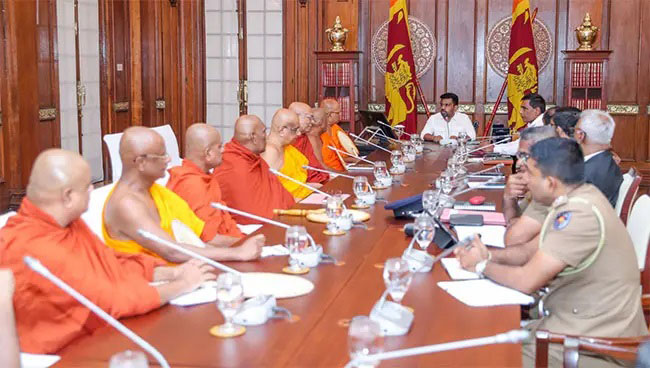
President Anura Kumara Dissanayake has ordered the formation of a committee to review the laws and regulations on how Buddhist monks serving prison sentences are treated, including the procedures that apply when they are taken out of prison.
He revealed this at a special meeting with Maha Sangha representatives held yesterday (8) at the Presidential Secretariat. The meeting was called after concerns were raised over how Ven. Galagoda Aththe Gnanasara Thera was treated when he was taken from prison to court.
The committee will recommend amendments to existing laws and, where needed, new prison standing orders and regulations. Its members will be drawn from the Attorney General’s Department, the Ministries of Justice, Public Administration, and Buddha Sasana, Religious and Cultural Affairs, and the Department of Prisons, including the Commissioner General of Prisons. It has been given two weeks to review the current legal provisions and submit its recommendations. The President added that any changes specific to Buddhist monks would be made in consultation with the Maha Sangha.
Outlining the legal background, the President said prison administration was governed by the Prisons Ordinance of 1877, along with the regulations and standing orders issued under it. That framework mostly addressed prisoners in general, he said, and had few provisions dealing specifically with Buddhist monks.
The meeting was attended by senior Maha Sangha members representing the Siyam, Amarapura and Ramanna Nikayas, along with Minister of Buddhasasana, Religious and Cultural Affairs Hiniduma Sunil Senevi and Minister of Justice Harshana Nanayakkara.

Showers or thundershowers will occur in most part of the island after 1.00 p.m.

Removing monk’s robes matter for Sangha to decide: Mahanayake Theras

NDB fraud Rs 60mn more than reported

President orders review of laws on treatment of imprisoned monks

BHC, Colombo: “LTTE remains a proscribed org. in the UK”

Sri Lanka runs out of essential anti-TB medicines, India comes to rescue

‘Dates have the highest sugar content to fight Coronavirus’

Sunday Island 27 December – Headlines

#SundayIsland 17th December – Headlines

Sunday Island – 28th March

Sunday Island Headlines – 21 March

Sunday Island – 21st February – Headlines
-

 Features5 days ago
The first woman in the foreign service or Ceylon Overseas Service it was then called
-

 Editorial6 days ago
Fuelling discontent and protest
-

 News4 days ago
Geneva takes up Sallay’s case and govt. ignores opportunity to answer accusations
-

 Foreign News6 days ago
Ten injured after car crashes into rugby supporters in Australia
-

 Latest News6 days ago
Tharindu Rathnayake, bowlers secure Asian Games Bronze for Sri Lanka
-

 News5 days ago
Nearly 20 Iranian tankers stranded off Lanka amid US sanctions
-

 Features4 days ago
Sri Lanka Cricket Bill: Governance reform is not yet a cricket strategy
-
 News5 days ago
Lanka enters new phase of prosecutions as hurdles clear