
Business
Cuisine Gastronome by Sri Lankan Catering bags three Gold Awards at the Sri Lanka Packaging Awards 2021

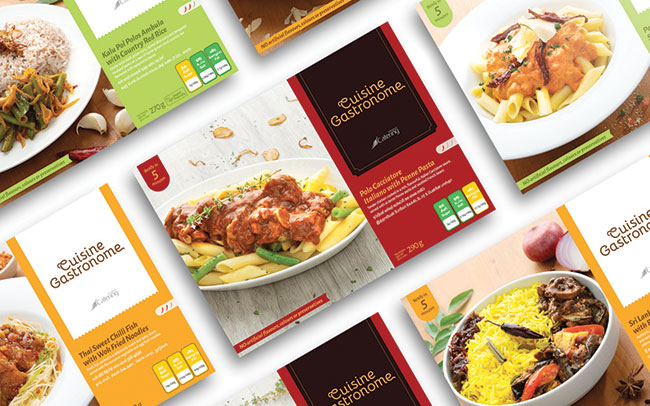
Illustrating the power of storytelling, clear communication and design elegance, ‘Cuisine Gastronome’, the heat and eat gastronomic product of SriLankan Catering, won three Gold Awards for its product packaging at the Sri Lanka Packaging Awards 2021. The packaging concept of Cuisine Gastronome appeals to the target audience with the clear and inspired design conveying a sense of gourmet food and fine dining, in the comfort of one’s home. Cuisine Gastronome clinched the three Gold Awards in the categories; ‘Food Packaging’, ‘Innovation’ and ‘Packaging that Saves the Food’. As a result, Cuisine Gastronome qualified for the World Star and Asia Star awards conducted by the World Packaging Organization.
Prestigious World Star and Asia Star awards honour companies with innovative and creative packaging designs for their products, taking into consideration areas of construction and materials usage, design, innovation technology and environmental consciousness.
“As the sole airline caterer to operate from BIA Katunayake, we at Sri Lankan Catering always exceled in culinary expertise. We have been catering to major international airlines such as Emirates, Qatar and Turkish Airlines. As an award-winning catering company, we remain steadfastly committed to the high quality of food, safety and hygiene standards. Hence, producing high quality consumer products was simply an extension of our existing excellence. We first launched Cuisine Gastronome during the first lockdown, when our revenue sources were fast dwindling due to the pandemic. But, it was challenging to reach out to our new customer base. We knew we had to maximize customer convenience to prepare the food within minutes while also retaining the nutritional integrity and flavours of our products. We are glad to have partnered on this project with the Dentsu Grant team who guided us from the very inception to the execution phase – their support in conducting research and benchmark studies across a number of areas supported us in understanding our audiences during challenging times.
The product soon captured consumer interest and we were able to reach the global market as well. The positioning of Cuisine Gastronome – ‘It’s Fine Home Dining’ beautifully captured the brand essence as well as the product promise we wanted to deliver to a discerning group of consumers,” said Mangala Wijesekara, Chief Executive Officer of SriLankan Catering.
“Packaging is not a communication piece that conveys product information alone. It is the spokesperson for the brand at the point of purchase – the key moment of truth. Packaging has to tie in all the aspects of a brand – the brand positioning, its values, emotional connection, consumer benefits, and the product promise creating a distinct brand experience that the target audience can believe in. It was a great pleasure working with SLC, building the next global Sri Lankan brand,” said Sajith Weerasinghe, Chief Strategy Officer at Dentsu Grant Group.
Sri Lankan Catering first launched Cuisine Gastronome in Sri Lanka. However, within a small-time frame, the product reached international markets, gaining popularity in Australia and the USA. The Company plans on making Cuisine Gastronome available across the globe, especially targeting markets with a sizeable Sri Lankan Diaspora.


The government’s new policy framework to allocate a maximum interest rate for stock market deposits would pave the way for companies and investors to plan their future business activities, a senior stockbroker said.
‘Accordingly, the Colombo Stock Exchange (CSE) has entered a period of strong revival, supported by economic stabilization and rising investor confidence while significant market reforms would support the new policy framework on interest, Assistant Vice President Softlogic Stockbrokers, Eardly Kern, told The Island Financial Review.
He said that the imposition of maximum interest rates for stock market deposits would prevent the interest rates from moving upwards, thus paving the way for investors to invest in stocks with a lot of confidence.
Kern added: ‘The CSE outlook would provide expanding opportunities for investors as Sri Lanka positions itself for market-led investor platforms.
‘Improving macro fundamentals, such as lower interest rates, rising corporate earnings and historically attractive valuations, have been key catalysts in driving investment into the equities market.
‘These tailwinds, together with ongoing economic reforms, have helped re-establish confidence among both local and foreign investors.
‘Over the past two years, the number of CDS accounts has surpassed 949,000, with digital on-boarding through the CSE mobile app driving the latest surge.
‘Further, foreign inflows for 2024 amounted to USD 66.5 million, while Rs 175 billion was raised through capital market activity, including 16 new listings. With a target of 20 IPOs on the horizon, the CSE anticipates several new companies entering the market by early 2026.
‘The All Share Price Index (ASPI) delivered an impressive 49.7 percent return in 2024, ranking the CSE as the second-best performing market in Asia for the year. By November 2025, the index had risen a further 45.65 percent amounting to an extraordinary two-year return of approximately 95 percent.
‘The S&P SL20 Index recorded a parallel recovery, gaining 58.5 percent in 2024 and 31.84 percent so far in 2025.
‘ Despite the rally, the CSE continues to trade below its 10-year average PER and valuations remain significantly more attractive than in regional markets, such as, India, Malaysia, Vietnam, and China.
‘ Turnover has surged to Rs 1.06 trillion in 2025 (as of mid-November), nearly doubling the figure recorded in 2024. Market capitalization grew 34 percent n 2024, despite only around 40,000 active investors capturing most of the gains—highlighting the potential for broader participation.
‘ Corporate earnings have also strengthened markedly. After generating Rs 686 billion in earnings during 2024—a 50% year-on-year increase—listed entities are projected to deliver between Rs 775–800 billion in 2025. Earnings for the first half of 2025 have already grown 57 percent year-on-year.’
By Hiran H Senewiratne

Dialog Axiata PLC, Sri Lanka’s #1 connectivity provider, has reinforced its enduring commitment to preserving national culture by sponsoring the Kelaniya Duruthu Festival, aligning long standing patronage with purposeful community engagement to honour religious heritage, support cultural continuity, and strengthen shared values.
The annual Kelaniya Duruthu Festival, one of Sri Lanka’s most significant religious and cultural observances, was held on 8th, 9th and 11th January 2026, marking a congregation of thousands of devotees and visitors at the historic Kelaniya Raja Maha Vihara. As a long-term patron, Dialog continues to provide sponsorship support, enabling the seamless organisation of the festival while uplifting traditions deeply rooted in the nation’s cultural identity.
Through its continued support of the Kelaniya Duruthu Festival, Dialog underscores its role as a responsible corporate citizen dedicated to safeguarding Sri Lanka’s cultural and religious heritage for future generations. This commitment is further reflected in Dialog’s long-term patronage of national events such as the Kandy Esala Perahara, Nawam Maha Perahara at Gangaramaya, Katharagama Esala Perahara and Gatabaru Esala Perahara. Complementing these efforts, Dialog has also undertaken heritage preservation initiatives including the construction of the vestibule at Dimbulagala Aranya Senasanaya, the launch of a website and directory of Amarapura Maha Nikaya Temples, and the restoration of the Anuradhapura Maha Vihara Sannipatha Shalawa.

A National Breakthrough in Public Transport Digitalization Powered by Ceylon Business Appliances with Nimbus Ventures.
Sri Lanka has taken a historic step forward with the launch of its first Smart Bus Ticketing System, enabling passengers to pay fares using contactless cards, digital wallets, and QR payments. This advancement places the country among global leaders in smart mobility.
The initiative was made possible through collaboration with the Government of Sri Lanka, leading banking partners, and the technology leadership of Ceylon Business Appliances (CBA) and Nimbus Ventures, who serve as the Technology, Software, Hardware, and Operational Partners behind the nation’s first Open Loop Transit Payment System.
For decades, CBA has been at the forefront of Sri Lanka’s digital transformation efforts—bringing modern, global-standard technologies that have strengthened the nation’s digital infrastructure.
Speaking to the media at the launch, Sardha Fernando, Managing Director of CBA, stated:
“This is not just a ticketing upgrade—it is a complete digital evolution of public transport in Sri Lanka. For years, CBA has been committed to introducing advanced technologies to the country, and today, we are proud to bring a globally recognized, secure, and seamless smart transit solution to our people. With every tap, we are enabling convenience, transparency, and a more connected future for all Sri Lankans.”
He added:
“This milestone reflects our ongoing mission: to help build a digitally empowered Sri Lanka that is ready to embrace the technologies shaping the world.”
‘Ruwath Fernando, CEO/Director of CBA, highlighted:
“This project demonstrates that Sri Lanka is ready to adopt and operate on par with global smart mobility technologies. Our commitment has always been to bring the world’s best software systems and innovations into Sri Lanka—solutions that are secure, scalable, and built to international standards.”
He continued:
“By introducing a state-of-the-art open-loop transit payment platform, we are proving that Sri Lanka can not only embrace but also successfully operate advanced digital ecosystems. This is a defining moment in positioning the country as a technology-proof nation prepared to trial and adopt global digital advancements.”
CBA extends heartfelt congratulations to the banking partners who trusted this vision—
Sampath Bank, Commercial Bank, Bank of Ceylon, People’s Bank, and DFCC Bank— on the successful launch of their new ticketing application.
This application integrates seamlessly with the PAX A910S ticketing device, powered by a robust CBA– Nimbus ventures software solution, engineered for scale, reliability, and national deployment..

Fair weather will prevail except for a few showers in the Uva, Eastern, Western and Central provinces and in Galle, Matara and Rathnapura districts

Trump cancels US-Iran meetings, urges protesters to take over institutions

Govt. bows to pressure, shelves Grade 6 reforms

AKD: Govt. agenda on track despite Ditwah disaster

SL to receive 10 helicopters from US

Foreign couple held over alleged biopiracy at Horton Plains

‘Dates have the highest sugar content to fight Coronavirus’

Sunday Island 27 December – Headlines

#SundayIsland 17th December – Headlines

Sunday Island – 28th March

Sunday Island Headlines – 21 March

Sunday Island – 21st February – Headlines
-

 Business3 days ago
Dialog and UnionPay International Join Forces to Elevate Sri Lanka’s Digital Payment Landscape
-

 News3 days ago
Sajith: Ashoka Chakra replaces Dharmachakra in Buddhism textbook
-

 Features3 days ago
The Paradox of Trump Power: Contested Authoritarian at Home, Uncontested Bully Abroad
-

 Features3 days ago
Subject:Whatever happened to (my) three million dollars?
-

 News3 days ago
Level I landslide early warnings issued to the Districts of Badulla, Kandy, Matale and Nuwara-Eliya extended
-

 News3 days ago
65 withdrawn cases re-filed by Govt, PM tells Parliament
-

 News3 days ago
National Communication Programme for Child Health Promotion (SBCC) has been launched. – PM
-

 Opinion5 days ago
The minstrel monk and Rafiki, the old mandrill in The Lion King – II