
News
Controversy over plan to bring Bisons from India

By Ifham Nizam
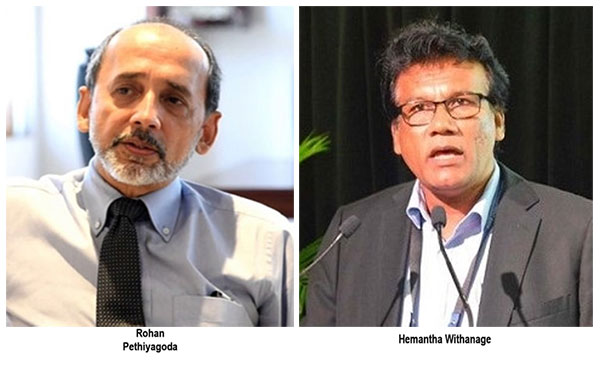
Sri Lankan High Commissioner to India and a Sri Lankan biodiversity scientist as well as a public policy advisor, are working to import six Bisons from India without permission from the Department of Forest Conservation and the Department of Wildlife Conservation, the Centre for Environmental Justice (CEJ) alleged.
CEJ Director and Chief Advisor Hemantha Withanage yesterday said that senior officials of the Department of Forest Conservation and the Department of Wildlife Conservation had denied giving permission for the project.
“The Department of Wildlife Conservation states that these animals are found in the central region of India and there are problems regarding their adaptation to Sri Lanka,” he added.
Sri Lanka’s biodiversity expert, Rohan Pethiyagoda, contacted for comment said, he was under the impression that the CEJ had been misled by the claim in an Indian newspaper that there was a proposal to reintroduce gaur (which became extinct here some centuries ago) to the wild in Sri Lanka.
“The demography of Sri Lanka has changed drastically for that to be feasible, and we have enough and more problems with human-elephant conflict. All I requested High Commissioner Milinda Moragoda was to ascertain whether the Indian government might in principle be willing to entertain a request from Sri Lanka to establish a herd of gaur in our National Zoological Gardens.”
He also said if the Indian authorities had indicate their willingness to entertain such a proposal, then the Department of National Zoological Gardens of Sri Lanka can take a decision whether the latter would make a formal proposal.
“That is all there is to this. Of course, there may be those who are opposed to the idea of the zoo maintaining a herd of gaur. But in my opinion, most Sri Lankans would like such a move. After all, the gaur
is very much a part of our folklore. Imagine, if elephants became extinct in Sri Lanka, would anyone oppose maintaining a herd of captive elephants at Pinnawela? I doubt it. Unfortunately, many people have been misled by this erroneous newspaper article.”
Dr. Pethiyagoda also said that the reintroduction of the species to the wild was a hugely expensive, scientifically complex and time-consuming enterprise (it takes decades of planning, not years). Sri Lanka had not reached the point of considering the introduction of this propsal any time in the foreseeable future, he said. “But I would be astonished if anyone thought there is anything wrong with the last large mammal species to become extinct in Sri Lanka being represented in our national zoo.”
Withanage, who is also the current President of Friends of the Earth International (FOEI), said he did not approve of the move to bring those animals to Sri Lanka. “Do we even have habitats that suit such a species to survive? Withanage asked. He pointed out that reintroducing gaur is a problem. “Only a third of the forests that existed in Sri Lanka 300 years ago remain today.”
Commenting on the conflicts between humans and animals in Sri Lanka, Withanage said that the loss of human lives as well as the loss of animal lives should be taken into consideration. “The country loses about 350 elephants and 100 human lives a year due to the elephant-human conflict, and it is necessary to question the mindset of those who want to bringing in a problem that does not exist in the country.
“While some say that Sri Lanka already could not handle the existing number of elephants here, introducing this species to compete with elephants and feeding them in the limited pastures is something that we should not even think of.”




The National Business Facilitation Centre (NBFC), which is being established under the Presidential Secretariat with the aim of removing administrative and regulatory barriers that exist among government institutions in relation to investment and industry and expediting these processes, will be opened tomorrow (22).
The centre is being established on the President’s initiative with the aim of bringing about a positive transformation in the industrial sector. The centre will provide solutions to issues that arise in dealing with the government machinery when starting and operating a business, while also coordinating with the relevant government institutions to provide the necessary facilities.
The “ViYASA” National Business Facilitation Centre (NBFC) has been established at Building C-80, Hector Kobbekaduwa Mawatha, Colombo 07, and is headed by Senior Additional( Secretary to the President, Seevali Arukgoda.
The centre will be opened under the patronage of Minister of Labour and Deputy Minister of Finance and Planning Dr Anil Jayantha Fernando and Minister of Industry and Entrepreneurship Development Sunil Handunnetti, with the participation of Secretary to the President Dr Nandika Sanath Kumanayake.
The website https://nbfc.presidentsoffice.gov.lk is also scheduled to be officially launched on the occasion.
President’s Media Division)
Latest News
Court of Appeal Judge M. Sri Mevan Anthony Edirimannasuriya Corea appointed as Acting President of the Court of Appeal

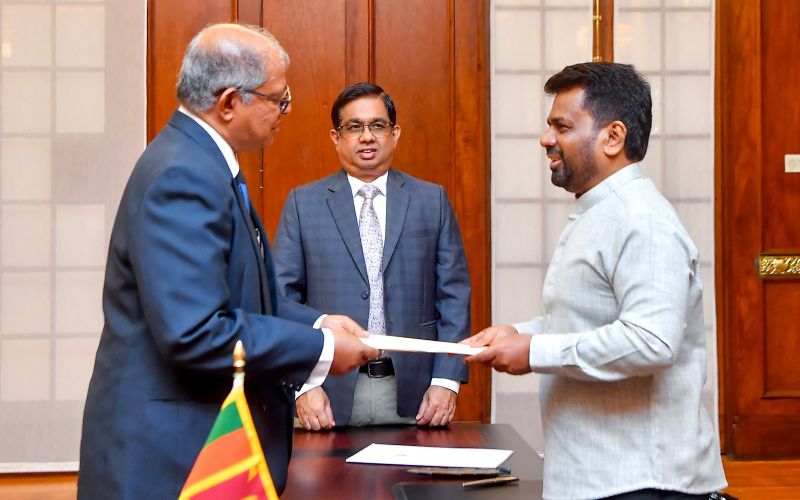
President Anura Kumara Dissanayake has appointed Court of Appeal Judge Mayadunna Sri Mevan Anthony Edirimannasuriya Corea as the Acting President of the Court of Appeal.
The appointment has been made as President’s Counsel Nalin Rohantha Abeysuriya, who currently serves as President of the Court of Appeal, will be overseas until the 24th.
Accordingly Judge Mayadunna Corea was sworn in as Acting President of the Court of Appeal before President Anura Kumara Dissanayake at the Presidential secretariat this morning (21).
Secretary to the President Dr Nandika Sanath Kumanayake was also present at the occasion.
(President’s Media Division)
Latest News
President instructs expediting further measures concerning Sivarasa Anojan, sentenced to death in Saudi Arabia
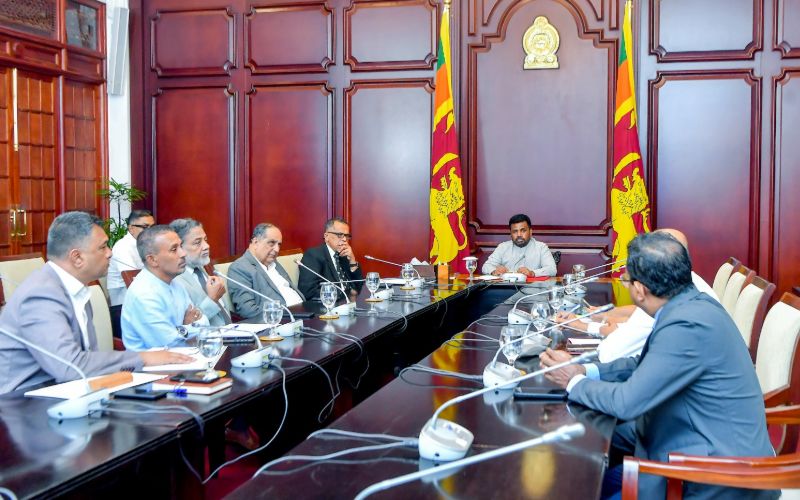
A discussion to review the further measures that could be taken regarding Sivarasa Anojan, a young Sri Lankan national who has been sentenced to death in Saudi Arabia, was held at the Presidential Secretariat this afternoon (21), under the patronage of President Anura Kumara Dissanayake.
The discussion focused on the measures taken to date concerning Sivaraasa Anojan and the further diplomatic and legal steps that could be pursued. Attention was also given to expediting the necessary further measures that could be taken to secure his release.
President Anura Kumara Dissanayake instructed officials to continue the necessary diplomatic engagement with the relevant authorities in Saudi Arabia and to maintain close and continuous involvement in all further measures concerning the case.
Reaffirming the Government’s continued attention to the safety and welfare of Sri Lankans living and working overseas, the President also stressed the need for the relevant ministries and institutions to work in close coordination and pursue all possible measures that could be taken in connection with the case.
Deputy Speaker Rizvie Salih, Deputy Minister of Religious and Cultural Affairs Muneer Mulaffer, Governor of the Western Province Hanif Yusoof, Secretary – Ministry of Foreign Affairs, Foreign Employment and Tourism Aruni Ranaraja, Secretary to the Ministry of Defence Air Vice Marshal Sampath Thuyacontha (Retd), Attorney General Parinda Ranasinghe and officials of the Ministry of Foreign Affairs, Foreign Employment and Tourism were also present at the discussion.
(President’s Media Division)

“ViYASA” National Business Facilitation Centre (NBFC) to be opened tomorrow (22)

Court of Appeal Judge M. Sri Mevan Anthony Edirimannasuriya Corea appointed as Acting President of the Court of Appeal

President instructs expediting further measures concerning Sivarasa Anojan, sentenced to death in Saudi Arabia

It’s Shafali vs Athapaththu as Sri Lanka seek to stop India juggernaut

Trophy row unlikely to repeat in Japan

Powerful explosions at Syrian army site near Aleppo injure at least four

‘Dates have the highest sugar content to fight Coronavirus’

Sunday Island 27 December – Headlines

#SundayIsland 17th December – Headlines

Sunday Island – 28th March

Sunday Island Headlines – 21 March

Sunday Island – 21st February – Headlines
-

 News5 days ago
US embassy won’t comment on IGP’s probe into joint drug raid
-

 News4 days ago
Bid for Basil’s extradition nears final stage: Police
-

 News3 days ago
Shanakiyan urges urgent action over reported death sentence for Lankan in Saudi Arabia
-

 Features7 days ago
The emptying university: why are academics leaving?
-

 Business5 days ago
All-new Bolero MaXX unveiled in Sri Lanka
-
 Opinion7 days ago
Who committed genocide and created mass graves in Sri Lanka?
-

 News2 days ago
Namal Rajapaksa Buddhist gambit fails, bail denied
-

 Opinion5 days ago
A journalist who wrote across the divide