
News
Buddhism is India’s most precious gift to Sri Lanka


Milinda Moragoda urges Special Relationship with India
BY S VENKAT NARAYAN
Our Special Correspondent
NEW DELHI, July 30: Sri Lanka’s High Commissioner-designate to India Milinda Moragoda says Buddhism is India’s “most precious gift” to the island nation, and is keen that a “special relationship” should be established between the two neighbours.
Moragoda pushes for exceptional relations with India in his 10,000-word report titled “Integrated Country Strategy for Sri Lanka Diplomatic Missions in India 2021-2023” to be presented to President Gotabaya Rajapaksa.
Though appointed early last year, he continues to be home-bound due to the coronavirus pandemic and the absence of flights between Colombo and New Delhi. The report was prepared under his guidance by Acting High Commissioner to India Niluka Kadurugamuwa and his senior colleagues at the Deputy High Commission in Chennai and the Consulate General in Mumbai.
The document notes that, being both essentially multi-ethnic, multi-religious, multi-lingual and multi-cultural countries, Sri Lanka and India have much in common. The sharing of their similar experiences is an ongoing process.
Given this backdrop, the report says the overarching goal of the Diplomatic Representations of Sri Lanka in India should be to contribute to the process of continuously maintaining the momentum of the existing partnership. This can be achieved by creating “multi-faceted platforms for strategic level dialogue and cooperation, with the ultimate objective being the elevation of the partnership to a special relationship—one marked by inter-dependence, mutual respect and affection.”
Moraguda says: “The fact that India’s greatest emperor, the Buddhist ruler Dharmashoka, saw fit to send both his son and daughter on separate occasions to our country as emissaries to introduce and spread the teachings of the Blessed One, epitomises the strong and unbreakable civilisational bonds that exist between our two nations.
“In addition, our two countries are bound by circumstances of geography, economics, culture, history, and just as importantly, our democratic values. Against this backdrop, any setbacks to our relationship, however intractable they may appear to be at any given point in time, can only be temporary.”
To achieve this overarching goal, his report suggests that the Sri Lankan diplomatic missions in India must foster political relations at all levels, through constant communication and by building trust. This process has to be carried out at the Central Government level by the High Commission in New Delhi, and by the Deputy High Commission in Chennai and the Consulate General in Mumbai at the level of states, under their respective consular jurisdictions under supervision of the High Commissioner in New Delhi.
It calls for strengthening the bilateral relationship through regular exchange of high-level political visits between the two countries, and enhancing cooperation with India at multilateral and regional level.
There should be an exchange of at least one high-level political visit, such as the Head of State/ Head of Government from either side each year, and also at Foreign Ministerial levels both ways, since it is imperative to maintain constant communication and to develop mutual trust at political level with India.
Additionally, exchanges between line ministers are also important. These exchanges need not necessarily be physical but can be by virtual means. Coordination with India in multilateral and regional fora is important to strengthen the bilateral relations. Foreign Ministry-level coordination should be facilitated for close cooperation in multilateral and regional fora, such as United Nations platforms, SAARC, BIMSTEC and IORA.
The report also suggests boosting parliamentary diplomacy. In addition to strengthening ties at the highest political level, it is important to foster relations between influential members of Parliament of the two countries, as also connectivity between people’s representatives of the two democracies. Exchanges between the Sri Lankan Parliament and the two Houses of the Indian Parliament (Rajya Sabha and Lok Sabha) will be imperative to strengthen this relationship.
It seeks the re-constitution of a functional and vibrant Indo-Sri Lanka Parliamentary Friendship Group in India’s Parliament, consisting of influential parliamentarians drawn from across the political spectrum of both Houses. This will provide the required impetus for the enhancement of political connectivity between the two countries.
The report recommends bilateral visits by Speakers of both Parliaments, a Sri Lanka-India Parliamentary Friendship Group in the Sri Lankan Parliament and mutual visits by MPs.
It seeks expansion of Sri Lanka’s footprint at the state level in India, and favours promoting greater interactions between Sri Lanka and the Indian states considered important from the Sri Lankan perspective. While enhancing political relations at both central government and parliamentary level, the island’s diplomats should endeavour to foster relations at the state level, too.
Interestingly, the cover of the document features an illustration of the Girihandu Seya stupa situated in the Eastern coastal village of Thiriyaya in the Trincomalee district. It is believed to be the world’s first Buddhist stupa, built by seafaring Indian merchant-brothers Tapassu and Bhalluka, enshrining the Buddha’s sacred hair relics.
It is believed that the Buddha gave his hair relics to the two merchants, who were his first lay disciples, and who offered him alms on the 50th day after his enlightenment. Chronicles say that soon after, in one of their trade voyages, the two brothers brought the sacred hair relics to Sri Lanka and built the stupa enshrining them.
The original stupa was built during the Buddha’s life time over 2,500 years ago. The present structure or the ruins of the ‘Vatadage’ (circular shrine house) consisting of a small stupa encircled by two concentric circles of stone pillars and a retaining wall of stone slabs, is believed to have evolved with time.
The stupa predates the advent of Buddhism in Sri Lanka and stands as an epitome of one of the earliest recorded interactions between Sri Lanka and India.



Former first lady Shiranthi Rajapaksa, wife of former President Mahinda Rajapaksa was produced before the Hulftsdorp court, after being arrested by officers of the Commission to Investigate Allegations of Bribery or Corruption (CIABOC) and produce
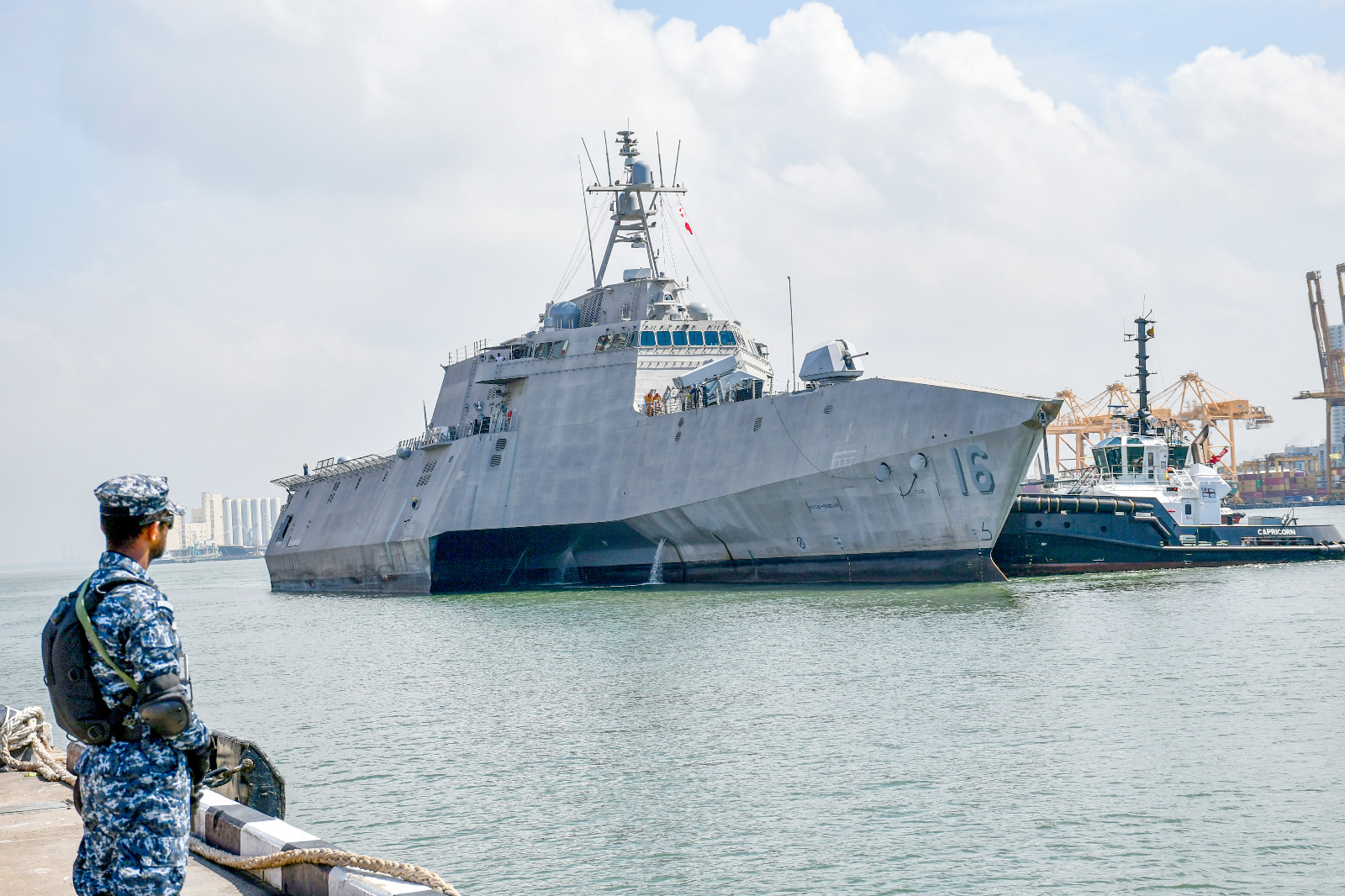
The U.S. Navy ship USS Tulsa (LCS 16) arrived at the Port of Colombo this morning, 7 October 2026 for replenishment purposes.
The visiting ship was welcomed by the Sri Lanka Navy in accordance with naval traditions.
The 127.7-metre-long platform is a Littoral Combat Ship commanded by Commander BM Wanier. Commissioned on 16 February 2019, USS Tulsa has since been in service with the US Navy.
The ship previously made a port call in Sri Lanka on 27 August 2025.
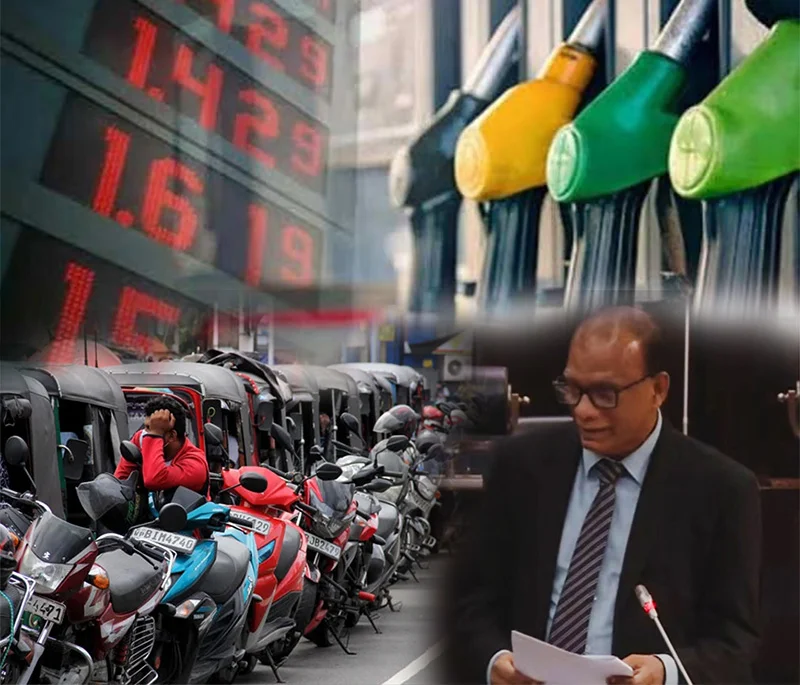
Govt. tells fuel distributors to maintain stocks to ensure uninterrupted supplies
by Saman Indrajith and Norman Palihawadane
The government had instructed private fuel distributors to maintain minimum stocks and ensure uninterrupted supplies to the market, Energy Minister Anura Karunathilaka told Parliament yesterday (06).
Karunathilaka said the Ministry of Energy Secretary had notified the relevant companies of the requirement, following a reduction in supplies by some private distributors, amid higher international fuel prices.
The Minister said private companies had informed the government that they were facing losses because international prices had risen while fuel was being sold, locally, at prevailing prices. As a result, some companies had reduced the volumes released to the market.
The reduced supplies had increased the burden on the Ceylon Petroleum Corporation (CPC), whose share of the diesel market had risen from about 54% to 82%, the Minister said.
“The CPC currently holds an 82% share of the market,” he said, adding that it had increased its supplies, compared with February, to compensate for the reduction by private distributors.
Karunathilaka said the government could not, under the existing agreements with private companies, specify the quantities they should supply to individual filling stations. However, it could require them to maintain minimum stocks in the country.
The Minister said the Energy Ministry had already instructed companies that had failed to maintain the required stocks to take steps to prevent supply disruptions.
The Minister attributed the queues reported at some filling stations to reduced supplies from private distributors, as well as normal variations in fuel distribution. He also said demand for CPC fuel had increased because private companies generally did not provide fuel to dealers on credit, while the CPC offered a three-day credit facility.
“We expect that, as the Ceylon Petroleum Corporation takes on this additional burden, the problem will ease to some extent by Wednesday or Thursday,” Karunathilaka said.
He said instructions had also been issued to increase supplies to CPC filling stations. A special discussion on the issue is scheduled for today (07), with officials of the Energy Ministry and CPC expected to participate,
along with President Anura Kumara Dissanayake.
Meanwhile, Petroleum Dealers’ Association officials have called for an early solution to the supply issue. Association Chairman D.V. Shantha Silva said queues had been reported at many filling stations, mainly those operated by private distributors.
He said the situation was not due to an overall shortage of fuel, but was linked to reduced orders by Lanka IOC, Sinopec and R.M. Parks amid concerns over losses incurred on fuel sales.
The Ceylon Petroleum Private Tanker Owners Association has urged motorists to refrain from panic buying, saying there was no nationwide disruption to fuel supplies.
The government earlier increased fuel prices and introduced a per-litre diesel subsidy following concerns raised by distributors over rising international prices.

Former first lady Shiranthi Rajapaksa arrested by CIABOC

U.S. Navy ship USS Tulsa arrives in Colombo for replenishment visit

Smriti Mandhana appointed India captain across formats

Ronaldo apologizes for Portugal walkout; says Jesus broke promise

Showers in the Western, Sabaragamuwa, Central, Uva, North-western and Southern provinces and in Anuradhapura and Mannar districts

Fuel crunch looms

‘Dates have the highest sugar content to fight Coronavirus’

Sunday Island 27 December – Headlines

#SundayIsland 17th December – Headlines

Sunday Island – 28th March

Sunday Island Headlines – 21 March

Sunday Island – 21st February – Headlines
-

 News7 days ago
US-assisted ‘Ice’ detection: NPC to examine IGP’s move to transfer drug-busting team
-

 Editorial6 days ago
Colombo Port drug bust: The plot thickens
-

 Editorial7 days ago
Drug busting, transfers and trust deficit
-

 Features4 days ago
The first woman in the foreign service or Ceylon Overseas Service it was then called
-
 News7 days ago
Sri Lankan facing death penalty in Saudi Arabia: Mano G appeals to Crown Prince
-

 Editorial5 days ago
Fuelling discontent and protest
-

 News3 days ago
Geneva takes up Sallay’s case and govt. ignores opportunity to answer accusations
-

 Latest News5 days ago
Tharindu Rathnayake, bowlers secure Asian Games Bronze for Sri Lanka