
Latest News
Bowlers, Gardner hand Royal Challengers Bengaluru third defeat at Chinnaswamy


A close finish was in the offing. Gujarat Giants were stifled early in a small chase. Then came an expensive ninth over that went for three fours and a six as Ashleigh Gardner took on rookie Prema Rawat. It turned the scales the Giants way emphatically, as a tricky chase turned into a cruise.
It left RCB winless at home in three games so far this season. It also meant three sides – RCB, Giants and UP Warriorz – are now tied on four points. This lights up the prospect of a tight finish to the group stages next week in Lucknow and Mumbai.
She came into the tournament under a hip injury cloud, but her batting form didn’t seem to suggest any problem. Coming in on the back of 90*, 81, 7 and 57, Ellyse Perry was out for her first duck in her WPL career when she mistimed Gardner to Tanuja Kanwar at square leg off her fourth ball. That wicket coming on the back of Danni Wyatt-Hodge’s lbw in the first over to Deandra Dottin left RCB 16 for 2 in two overs.
It was an uneasy stay at the crease for Smriti Mandhana, repeatedly squared up and beaten on the outside edge by 21-year-old Kashvee Gautam, one of the brightest Indian fast-bowling prospects in WPL 2025. Mandhana struggled against late movement as Gautam’s first two overs went for just four. All that pressure led to a wicket at the other end when Mandhana was predictably out to spin yet again when she slog-swept Kanwar to Harleen Deol at deep midwicket for 10 off 20 balls.
During the season spent away at rehabilitation from a back injury last year, Kanila Ahunja set herself clear goals. She didn’t want to be known as a “five-ball batter” in the WPL anymore. She worked hard on her power game, shades of which were on display on Thursday as she laid into Priya Mishra, the legspinner.
She read the googly off the hand and her manner of stepping out to imperiously loft her twice in the over, including the first six of the innings, spoke volumes of her growth as a batter. Ahuja would repeat that two overs later when she stepped out to launch Gardner. Her 33 off 27 before falling to Kanwar led to another RCB slip-up. Georgia Wareham’s cameo of 20 then helped them to 125 for 7, their joint lowest total in the WPL.
Giants went with a third opening combination in five games. Dayalan Hemalatha, the latest to join the roulette, did little to repay the faith despite the backing following scores of 9, 0 and 4 in her precious three innings. Having been reprieved early when Wyatt-Hodge misjudged a catch at mid-off, she was out stumped looking to heave Renuka Singh for 11. Mandhana’s decision to bowl Renuka out up top paid dividends when Beth Mooney holed out to deep midwicket as Giants were reduced to 32 for 2 in the seventh.
A 19-run over off Rawat in the ninth turned the tide for the Giants as Gardner fed off Rawat’s inexperience, expertly using the depth of the crease to pull, while also showing her imperious driving abilities when the ball was tossed up. The surge in momentum was such that even Deol’s brain fade in trying to hit out against Wareham didn’t lead to any panic.
This didn’t affect her tempo or her propensity to be adventurous, which also greatly helped Gardner, who hit Wareham for back-to-back sixes en route to her third half-century of the season, this time off 28 balls. Gardner and Litchfield’s 51-run stand off just 36 ensured the match was won with 21 balls to spare, greatly helping Giants boost their net run rate even though they would stay fifth.
Brief scores:
Gujarat Giants Women 126 for 4 in 16.3 overs (Beth Mooney 17, Dayalan Hemalatha 11, Ashleigh Gardner 58, Phoebe Litchfield 30*; Renuka Singh 2-24, Georgia Wareham 2-26) beat Royal Challengers Bengaluru Women 125 for 7 in 20 overs (Smriti Mandhana 10, Kanika Ahuja 33, Raghvi Bist 22, Georgia Wareham 20, Kim Garth 14; Deandra Dottin 2-31, Ashleigh Gardner 1-22, Kashvee Gautam 1-17, Tanuja Kanwar 2-16) by six wickets
[Cricinfo]


The United Nations General Assembly has voted to recognise the enslavement of Africans during the transatlantic slave trade as “the gravest crime against humanity”, a move advocates hope will pave the way for healing and justice.
The resolution – proposed by Ghana – called for this designation, while also urging UN member states to consider apologising for the slave trade and contributing to a reparations fund. It does not mention a specific amount of money.
The proposal was adopted with 123 votes in favour and three against – the United States, Israel and Argentina.
Fifty-two countries abstained, including the United Kingdom and European Union member states.
Countries like the UK have long rejected calls to pay reparations, saying today’s institutions cannot be held responsible for past wrongs.
Unlike UN Security Council resolutions, those from the General Assembly are not legally binding, though they carry the weight of global opinion.
“Let it be recorded that when history beckoned, we did what was right for the memory of the millions who suffered the indignity of the slave trade and those who continue to suffer racial discrimination,” Ghana’s President John Mahama told the assembly ahead of the vote.
”The adoption of this resolution serves as a safeguard against forgetting. It also challenges the enduring scars of slavery,” he said.
Earlier, his foreign minister, Samuel Okudzeto Ablakwa, told the BBC’s Newsday programme: “We are demanding compensation – and let us be clear, African leaders are not asking for money for themselves.
“We want justice for the victims and causes to be supported, educational and endowment funds, skills training funds.”
The campaign for reparations has gained significant momentum in recent years – “reparatory justice” was the African Union’s official theme for 2025 and Commonwealth leaders have jointly called for dialogue on the matter.
Ablakwa also said that, with the resolution, Ghana was not ranking its pain above anyone else’s, but simply documenting a historical fact.
Between 1500 and 1800, around 12-15 million people were captured in Africa and taken to the Americas where they were forced to work as slaves. It is estimated that over two million people died on the journey.
[BBC]

A Los Angeles jury has handed down an unprecedented win for a young woman who sued Meta and YouTube over her childhood addiction to social media.
Jurors found that Meta, which owns Instagram, Facebook and WhatsApp, and Google, owner of YouTube, intentionally built addictive social media platforms that harmed the 20-year old’s mental health.
The woman, known as Kaley, was awarded $6m (£4.5m) in damages, a result likely to have implications for hundreds of similar cases now winding their way through US courts.
Meta and Google said separately that they disagreed with the verdict and would both appeal. Meta said: “Teen mental health is profoundly complex and cannot be linked to a single app.
“We will continue to defend ourselves vigorously as every case is different, and we remain confident in our record of protecting teens online.”
A spokesperson for Google said: “This case misunderstands YouTube, which is a responsibly built streaming platform, not a social media site.”
Jurors found that Kaley should receive $3m in compensatory damages and an additional $3m punitive damages, because they determined Meta and Google “acted with malice, oppression, or fraud” in the way the companies operated their platforms.
Meta will be expected to shoulder 70% of Kaley’s damages award, with Google the remaining 30%.
Parents of other children, who are not part of Kaley’s lawsuit but claim they also were harmed by social media, were outside the courthouse on Wednesday, as they had been many days throughout the five-week trial.
When the verdict came through, parents like Amy Neville were seen celebrating, and hugging other parents and supporters who had been waiting for a decision.
The LA verdict came a day after a jury in New Mexico found Meta liable for the way in which its platforms endangered children and exposed them to sexually explicit material and contact with sexual predators.
Mike Proulx, a research director for Forrester, said the back-to-back verdicts underline a “breaking point” between social media companies and the public.
In recent months, countries such as Australia have imposed restrictions for children to stop or limit their use of social media. The UK is currently running a pilot program to see how a ban of social media for people aged under 16 may work.
“Negative sentiment toward social media has been building for years, and now it’s finally boiled over,” Proulx said.
During his appearance before the jury in February, Mark Zuckerberg, Meta’s chairman and chief executive, relied on his company’s longstanding policy of not allowing users under the age of 13 on any of its platforms.
When presented with internal research and documents showing that Meta knew young children were, in fact, using its platforms, Zuckerberg said he “always wished” for faster progress to identify users under 13. He insisted the company had reached the “right place over time”.
While Google, as the owner of video-sharing site YouTube, was also a defendant in the case, most of the trial proceedings focused on Instagram and Meta.
Snap and TikTok were also initially defendants, but both companies reached undisclosed settlements with Kaley prior to trial.
As for Kaley’s lawyers, they argued that Meta and YouTube had built “addiction machines” and failed in their responsibility to prevent children from accessing their platforms.
Kaley said she started using Instagram aged nine and YouTube aged six, and encountered no attempts to block her because of her age.
“I stopped engaging with family because I was spending all my time on social media,” Kaley said during her testimony.
Kaley said she was 10-years-old when she started having feelings of anxiety and depression, disorders for which she would be diagnosed years later by a therapist.
She also started to obsess about her physical appearance and began using Instagram filters that would change the way she looked – making her nose smaller and her eyes bigger – almost as soon as she started using the platform as a child.
Kaley has since been diagnosed with body dysmorphia, a condition which causes people to worry excessively about their physical appearance and prevents them from seeing themselves as others do.
Her lawyers argued that features of Instagram, like infinite scroll, were designed to be addictive.
Meta’s growth goals were aimed at getting young people to use its platforms, Kaley’s lawyers said.
Using testimony from experts and former Meta executives, they argued the company wanted young users because they were more likely to stick with its platforms for longer stretches of time.
When lawyers for Kaley told Adam Mosseri, the head of Instagram, that her longest single day of use of the platform stretched to 16 hours, he denied that it was evidence of an addiction.
Instead, he called a teenager spending most hours of the day on Instagram “problematic”.
Lawyers for Kaley said Wednesday that the jury’s verdict “sends an unmistakable message that no company is above accountability when it comes to our children.”
Another case against Meta and other social media platforms over their alleged harms to children is poised to begin in June in California federal court.
[BBC]
Latest News
Heat Index at ‘Caution level’ in the Western, Sabaragamuwa, Southern and North-western provinces and in Anuradhapura, Mannar, Vavuniya and Monaragala districts
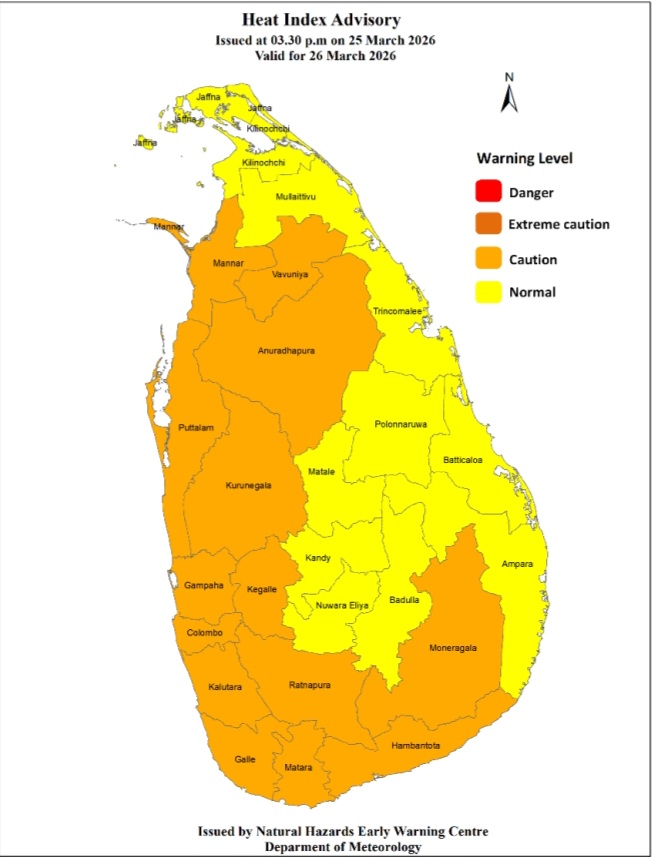
Warm Weather Advisory
Issued by the Natural Hazards Early Warning Centre of the Department of Meteorology
at 3.30 p.m. on 25 March 2026, valid for 26 March 2026.
The Heat index, the temperature felt on human body is likely to increase up to ‘Caution level’ at some places in the Western, Sabaragamuwa, Southern and North-western provinces and in
Anuradhapura, Mannar, Vavuniya and Monaragala districts.
The Heat Index Forecast is calculated by using relative humidity and maximum temperature and this is the condition that is felt on your body. This is not the forecast of maximum temperature. It is generated by the Department of Meteorology for the next day period and prepared by using global numerical weather prediction model data.

Effect of the heat index on human body is mentioned in the above table and it is prepared on the advice of the Ministry of Health and Indigenous Medical Services.
ACTION REQUIRED
Job sites: Stay hydrated and takes breaks in the shade as often as possible.
Indoors: Check up on the elderly and the sick.
Vehicles: Never leave children unattended.
Outdoors: Limit strenuous outdoor activities, find shade and stay hydrated.
Dress: Wear lightweight and white or light-colored clothing.
Note:
In addition, please refer to advisories issued by the Disaster Preparedness & Response Division, Ministry
of Health in this regard as well. For further clarifications please contact 011-7446491.

UN votes to recognise enslavement of Africans as ‘gravest crime against humanity’

Meta and YouTube found liable in landmark social media addiction trial

Showers expected in the Western and Sabaragamuwa provinces and in Galle and Matara districts after 2.00 pm.

Heat Index at ‘Caution level’ in the Western, Sabaragamuwa, Southern and North-western provinces and in Anuradhapura, Mannar, Vavuniya and Monaragala districts

US dodges question on AKD’s claim SL denied permission for military aircraft to land

No decrease in remittances from workers due to Gulf conflict, but significant drop in tourist arrivals – CB Governor

‘Dates have the highest sugar content to fight Coronavirus’

Sunday Island 27 December – Headlines

#SundayIsland 17th December – Headlines

Sunday Island – 28th March

Sunday Island Headlines – 21 March

Sunday Island – 21st February – Headlines
-

 Features3 days ago
Trincomalee oil tank farm: An engineering marvel
-

 News6 days ago
CIABOC tells court Kapila gave Rs 60 mn to MR and Rs. 20 mn to Priyankara
-

 Features6 days ago
Science and diplomacy in a changing world
-

 Features3 days ago
The scientist who was finally heard
-

 News1 day ago
Senior citizens above 70 years to receive March allowances on Thursday (26)
-

 News1 day ago
Japanese boost to Sri J’pura Hospital, an outright gift from Tokyo during JRJ rule
-

 News5 days ago
Colombo, Oslo steps up efforts to strengthen bilateral cooperation in key environmental priority areas
-

 News1 day ago
CEB Engineers warn public to be prepared for power cuts after New Year