
News
Bid to use private member’s motion to put off LG polls alleged

By Shamindra Ferdinando
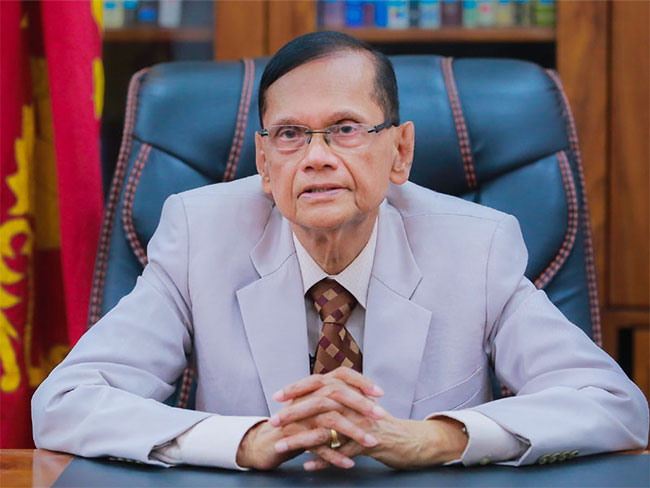
Former Foreign Minister Prof. G. L. Peiris has questioned the rationale behind President Ranil Wickremesinghe’s warning that the military will be deployed to curb protest vis-a-vis a Foreign Ministry undertaking to boost foreign trade and investment.
Addressing the Parliament, during the Budget committee stage debate, on 28 Nov., Prof. Peiris said the Foreign Ministry couldn’t expect to succeed in economic diplomacy while the government was resorting to repressive measures.
Prof. Peiris asked who would want to invest in a country where the people were warned of dire consequences if they held protests, and elections were arbitrarily postponed.
Referring to the long overdue Provincial Council polls, Prof. Peiris discussed how postponement of scheduled Local Government polls could further jeopardise Sri Lanka’s standing among the international community.
Prof. Peiris alleged that the government was planning to use private members’ motion submitted by Attorney-at-Law Premanath C. Dolawatta (SLPP, Colombo District) to put off scheduled Local Government polls further. The ex-Minister claimed that the motion meant to enhance youth representation in governance would be utilised to delay the polls indefinitely. He recalled how the Yahapalana government had postponed the Provincial Council elections indefinitely.
The rebel SLPP Chairman pointed out that the government had chosen MP Dolawatta’s motion, handed over recently, though SJB’s Imthiaz Bakeer Markar submitted a private member’s motion on the same lines much earlier.
MP Dolawatta handed over a copy of his motion to President Ranil Wickremesinghe on Oct 31. Prof. Peiris said that they wouldn’t find fault with the lawmaker for making proposals which the academic said were timely.
Prof. Peiris warned Foreign Minister Ali Sabry, PC, that Sri Lanka wouldn’t be an appealing destination for investments unless the government adopted tangible measures to curb corruption. Shocking disclosures at parliamentary watchdog committees underscored that corruption was at unprecedented level and needed immediate attention.
Speaking on behalf of the breakaway SLPP faction, Nidahasa Jathika Sabhawa aka Freedom People’s Congress Prof. Peiris said that the recent declaration by the World Bank that it would audit the procurement and distribution of fertiliser here meant that the world had no faith in our system.
Commenting on assurances given by the government that a new Anti-Corruption Bill would be introduced soon, Prof. Peiris said that existing laws were quite sufficient. The issue at hand is absence of political will to battle corruption, the former Minister said, meant flight of professionals and intolerable increase in taxes on business wouldn’t encourage Foreign Ministry’s drive.
At the onset of his speech, lawmaker Peiris asked whether the government was genuine about the recent declaration that the national issue could be resolved by the enactment of a new Constitution by the next Independence Day. Who would take such a promise seriously against the backdrop of all previous attempts undertaken by far more stable governments failing to achieve the desired results? the former law professor asked. The former minister also questioned the feasibility of forming an apparatus on the lines of the Truth and Reconciliation Commission of South Africa. Prof. Peiris asked whether those now at the helm really had the wherewithal to meet the South African standards.


News
Establishment of an Institutional Framework to Inagurate Upper Hydro Catchment Areas Management Authority

Policy approval of the Cabinet of Ministers was granted at their meeting held on 08.06.2026 to establish the Upper Hydro Catchment Areas Management Authority for identification and
execution of a formal and long – lasting remedy to secure the central hills including the upper hydro catchment areas enabling them to sustain amidst extreme weather conditions
due to natural calamities and human activities as well as to be used for the sustainable development of the country.
Accordingly, a concept paper has been prepared including
institutional structure, activities, powers, active subject area as well as administrative and coordination mechanism for the proposed authority by an expert technical committee appointed by the Secretary to the President.
Based on the said concept paper, the Cabinet of Ministers granted approval to the resolution furnished by the President to instruct the Legal Draftsman to prepare a draft bill including legal provisions required for the establishment of Upper Hydro Catchment Areas Management Authority.
News
Introduction of Flora and Fauna (Regulation of actions of the Indigenous Community within the nominated areas) Regulations
With the objective of securing the traditional livelihood and the eco system of the indigenous community, it has been recognized the necessity of introducing a formal regulation methodology to secure their engagement in livelihood activities by being more sensitive to the existing laws.
Thereby, the Fauna and Flora (regularizing) regulations under the Fauna and Flora Protection Ordinance (Authority 469) have been prepared so that nominated activities within the prescribed area to a member of the indigenous community
who has been registered for securing the rights acquired from law or custom or usage or traditional stance to execute an act within a certain state land that is fundamental to the survival of the indigenous community permission can be granted
Accordingly, the Cabinet of Ministers granted approval to the resolution furnished by the Minister of Environment to publish the said regulations in the government gazette notification and thereby submit to the Parliament for its concurrence.
Latest News
M. M. D. J. Senarathne, appointed Director General of the Department of National Botanical Gardens
The Cabinet of Ministers approved the resolution furnished by the Minister of Environment to appoint M. M. D. J. Senarathne, who is the senior most officer in Grade I of Sri Lanka Scientific Service se

Establishment of an Institutional Framework to Inagurate Upper Hydro Catchment Areas Management Authority
Introduction of Flora and Fauna (Regulation of actions of the Indigenous Community within the nominated areas) Regulations
M. M. D. J. Senarathne, appointed Director General of the Department of National Botanical Gardens

Harmanpreet Kaur steps down as India captain

Turkiye, Pakistan agree Saudi Arabia military deployment under Mecca pact

Rumesh Tharanga among nominees announced for World Athlete of the Year 2026

‘Dates have the highest sugar content to fight Coronavirus’

Sunday Island 27 December – Headlines

#SundayIsland 17th December – Headlines

Sunday Island – 28th March

Sunday Island Headlines – 21 March

Sunday Island – 21st February – Headlines
-

 Latest News7 days ago
Gold winner Tharanga gets brand-new Honda Vezel from SLAAJ
-

 News6 days ago
US-assisted ‘Ice’ detection: NPC to examine IGP’s move to transfer drug-busting team
-

 Features7 days ago
Why Sri Lanka needs an Inclusive Civic Nationalism – urgently
-

 Editorial5 days ago
Colombo Port drug bust: The plot thickens
-

 News7 days ago
Civil society activist accuses govt. of favouring Ven. Gnanasara
-
 Midweek Review7 days ago
Dappula’s Easter Sunday ‘grand conspiracy’ claim demolished
-

 Editorial7 days ago
When crime bosses rise above law and shrines
-
Editorial6 days ago
Drug busting, transfers and trust deficit