
Features
Appropriate time to appreciate Abraham Kovoor and his son Aries


By Prof.Kirthi Tennakone
(Email: ktenna@yahoo.co.uk),
National Institute of Fundamental Studies
Abraham Kovoor and his son, Aries Kovoor, rendered an exemplary service to the nation; it is now largely forgotten and not acknowledged to the extent they deserve. They were unassuming characters whose ideals stand pre-eminently important in the context of retrograde tendencies in the present day society.
A resurgence in actions, based on superstitions and myths rather than rational argument seems to be escalating as evident from recent happenings in our society. Rituals and quackeries have stood in the way of the efforts to contain the pandemic. Deities not known to exist are said to have prescribed cures and disclosed causes of the illness. Listening to folk healers and soothsayers, people suffer or die in situations where a doctor would have cured their condition permanently. Children are made to feel inferior because of their horoscopes. On the eve of the Grade Five Scholarship Examination they are taken to shrines dedicated to various deities. Decisions based on superstition engender harm to individuals and the society and cause backwardness and misery.
Abraham Kovoor stood against superstitious beliefs, debunked occult practices and equated hoaxers to criminals, demanding their prosecution.
Aries Kovoor, following in the footsteps of his illustrious father, upheld rationalistic views and denounced extravagance. His main concern was why Sri Lanka and many other developing countries continued to remain weak in science? Hence the need to determine causes and adopt remedial measures. He was also critical of institutional empire building – the expansion or enhancing the authority of organisations, for purposes made to appear as development, even though in reality, the outcome turned out to be largely the opposite.
Abraham Kovoor: A born rationalist
Abraham Kovoor was born to an acclaimed Christian family in Kerala in 1898, His father was the Vicar General of the Thomma Syrian Church of Malabar. Despite his religious upbringing, he began to question dogmas of faith from childhood. He contracted flu, when he was eight years old, and his mother gave him a syrup, asking him to sip it while praying. The child opposed the instruction, saying, “If I take the medicine while praying, I cannot decide which cured the cough – whether it is the medicine or praying. Therefore, I will first consume the syrup and pray later if the cough had not been relieved.”
Abraham received basic education in a Christian Seminary and earned a degree in Biology from the Bengabasi College, Calcutta. After graduation, he served as a lecturer in Botany at CMS College, Kerala, for a short period, and migrated to Sri Lanka in 1928, accepting a teaching assignment at the Jaffna College. Subsequently, he held similar positions at Richmond College, Galle; S. Thomas’ College, Mount Lavinia and Thurstan College, Colombo.
Throughout his career, Abraham Kovoor pointed out the fallacies of superstition and obscurantism and the need for enlightening the society. In one of his books, Abraham Kovoor wrote “All those who claim to possess psychic, para-psychic and spiritual powers are either hoaxers or mentally deranged persons suffering from cryptesthesia (psychological disorder of abnormal perceptions). Nobody has and nobody ever had supernatural powers. They exist only in the pages of scripture and sensation mongering newspapers”.
After retirement, Abraham Kovoor invigorated his effort to curb superstition, presenting challenges to be answered by those who believe or indulge in such practices. In 1968, he offered a reward of Rs. 25,000 to anyone who could reveal the serial number of a currency note concealed in an envelope. Later, the value of the reward was increased to Rs. 1000,000. Understandably, none came forward to take up the challenge! A large majority of persons who claim paranormal capabilities, being frauds, fear exposure.
Supernatural powers do not exist to perform feats ruled out by rational logic. All phenomena determined to exist with certainty have been explained in terms of science or under its scrutiny. Everything observable comes under domain of science. The muddle-headed argument that there exist unobservable things, entails no meaning.
Abraham Kovoor, who said “I do not believe that I have a soul or spirit to survive my death and go to heaven or hell, or to roam about as my ghost, or even to be reborn”, passed away 18th September 1978.
Aries Kovoor questioned why science was weak in Sri Lanka
Aries Kovoor, born March 3, 1927 completed basic education in Jaffna and pursued a degree course in Botany at the Madras University. Thereafter, he returned to Sri Lanka and worked as a teacher at S. Thomas College. The principal of the school Dr. R.L. Hayman, persuaded him to continue research, making arrangements for him to visit Tata Institute, India, where he studied biological effects of radiation, in a laboratory headed by the nuclear physicist Homi Bhabha. In 1952, he succeeded in earning a research position at Sorbonne University, Paris, later ascending to a professorial rank at the National Centre for Scientific Research, France. He was also Professor at the Institute of Fundamental Studies, Sri Lanka and served as the Advisor on Scientific Affairs to the President of Sri Lanka from 1996-2005.
Aries Kovoor in his capacity as science advisor to the President, analyzed scientific performance of Sri Lanka adopting international norms of judging scientific research.
Scientists are supposed to publish their findings in scholarly journals. Normally, journals accept articles for publication after a strict review by experts in the respective areas of study. Thus, being able to publish in such periodicals, indicate the worthiness of the work. The evidence that your work is read and cited by other authors, further strengthens the recognition of what you have done. Today, there are data bases providing statistics pertaining above criteria determining the quality of research. Aries Kovoor used these data bases to analyze research performance in Sri Lanka. He didn’t fully advocate consensus prevalent in the country that our scientific weakness was a consequence of poor material facilities.
Instead, he believed lack of emphasis on quality of research, institutional bureaucracies and how they were manned, played a bigger role.
Aries Kovoor, opposed institutional empire building, another malady that silently dampens developmental plans and social progress. Empire building means expansion of organisations in terms of material possessions and personnel to meet egos of an individual or group in deviance with the purpose of their establishment. Incompetency, insecurity and seeking undue publicity, prompt empire building. Failure or underperformance, corruption and wasteful consumption of resources are often the causes of empire building.
Aries Kovoor cautioned that the funds allocated to an academic and research institution to achieve an objective should not be utilised to build an extravagant and redundant infrastructure with glorified officials and shining tables. He advocated contractual modes of hiring with higher perks and performance based renewals to ensure elimination of deadwood. The countries where scientific research flourishes have adopted similar strategies.
Aries Kovoor pioneered the establishment of the National Research Council (NRC) of Sri Lanka to accommodate ideals essential for uplifting scientific research and provide funding. He was of the opinion that in order to boost research and higher education, all appointments to academic and research institutions such as Chairmanships, Directors and Members of Governing Boards should be based on their accomplishments. Therefore, he adopted statistics based scholarly publications to recommend the membership of the managing board of NRC. He maintained the view that heads of academic and research institutions should be active researchers, who read write and publish; otherwise, they are unfit to hold such positions. He emphasised that talented Sri Lankan researchers should strive to become leaders in their discipline, and not mere assistants to collaborators overseas.
Aries Kovoor managed NRC as the elected chairman with the help of one single assistant and no other officers. He was always available in office and readily accessible without intervention of a third party, who would truly or falsely say he was not in office or was busy.
The true personality of Aries Kovoor is apparent from the following incident. Once he met with a minor road mishap because he could not properly manoeuvre his old car, when the engine suddenly developed a problem. Although he apologised the aggrieved party expressing willingness to compensate, police took vehicle into custody to check its road worthiness. He was sitting on a bench in the police station for hours. When his official driver arrived, a police officer arrogantly said, “Who this insane man is, he gave a private residential address in Wellawatta and declared he had no religion”. When the driver replied, “He is the Science Advisor to the President”, police officer replied “Sir, why didn’t you tell me all this earlier?”
Aries Kovoor too humble and unassuming in all his dealings, loved to work in the laboratory and amusingly interacted with his students as a primus inter pares. He was a listener, observer and avid reader, rather than talker. At official forums, he spoke mostly when his response pertained to an important decision or a clarification. Unlike his father, he never made public appearances, but was keen to engage in intellectual dialogue with students and colleagues. His attitude was not to work tirelessly to gain credit for himself, but to encourage and praise the good work of others. Unfortunately, such persons do not shine manifestly in the society; many whose success owes much to them, rarely recollect and fail to acknowledge.
Aries Kovoor remained active in his research and mentorship until he reached the age 80 years. He passed away peacefully on 1st December, 2006.




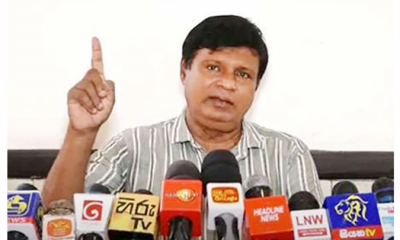


Representatives of almost all the main opposition parties were in attendance at the recent book launch by Pivithuru Hela Urumaya leader Udaya Gammanpila. The book written by the PHU leader was his analysis of the Easter bombing of April 2019 that led to the mass killing of 279 persons, caused injuries to more than 500 others and caused panic and shock in the entire country. The Easter bombing was inexplicable for a number of reasons. First, it was perpetrated by suicide bombers who were Sri Lankan Muslims, a community not known for this practice. They targeted Christian churches in particular, which led to the largest number of casualties. The bombing of Sri Lankan Christian churches by Sri Lankan Muslims was also inexplicable in a country that had no history of any serious violence between the two religions.
There were two further inexplicable features of the bombing. The six suicide bombings took place almost simultaneously in different parts of the country. The logistical complexity of this operation exceeded any previously seen in Sri Lanka. Even during the three decade long civil war that pitted the Sri Lankan military against the LTTE, which had earned international notoriety for suicide attacks, Sri Lanka had rarely witnessed such a synchronised operation. The country’s former Attorney General, Dappula de Livera, who investigated the bombing at the time it took place, later stated, upon retirement, that there was a “grand conspiracy” behind the bombings. That phrase has remained central to public debate because it suggested that the visible perpetrators may not have been the only planners behind the attack.
The other inexplicable factor was that intelligence services based in India repeatedly warned their Sri Lankan counterparts that the bombings would take place and even gave specific targets. Later investigations confirmed that warnings were transmitted days before the attacks and repeated again shortly before the explosions, yet they were not acted upon. It was these several inexplicable factors that gave rise to the surmise of a mastermind behind the students and religious fanatics led by the extremist preacher Zahran Hashim from the east of the country, who also blew himself up in the attacks. Even at the time of the bombing there was doubt that such a complex and synchronised operation could have been planned and executed by the motley band who comprised the suicide bombers.
Determined Attempt
The book by PHU leader Gammanpila is a determined attempt to make explicable the inexplicable by marshalling logic and evidence that this complex and synchronised operation was planned and executed by Zahran himself. This is a possible line of argumentation in a democratic society. Competing interpretations of public tragedies are part of political discourse. However, the timing of the intervention makes it politically more significant. The launch of the PHU leader’s book comes at a critical time when the protracted investigation into the Easter bombing appears to be moving forward under the present government.
The performance of the three previous governments at investigating the bombing was desultory at best. The Supreme Court held former President Maithripala Sirisena and several senior officials responsible for failing to act on prior intelligence and ordered compensation to victims. This judicial finding gave legal recognition to what victims had long maintained, that there was a grave dereliction of duty at the highest levels of the state. In recent weeks the investigation has taken a dramatic turn with the arrest and court production of former State Intelligence Service chief Suresh Sallay on allegations linked directly to the attacks. Whether these allegations are ultimately proven or disproven, they indicate that the present phase of the investigation is moving beyond negligence into possible complicity.
This is why the present moment requires political sobriety. There is a danger that the line of political division regarding the investigation into the Easter bombing can take on an ethnic complexion. The insistence that the suicide bombers alone were the planners and executors of the dastardly crime makes the focus invariably one of Muslim extremism, as the suicide bombers were all Muslims. This may unintentionally narrow public attention away from the unanswered questions regarding intelligence failures, possible political manipulation, and the allegations of a broader conspiracy that remain under active investigation. The minority political parties representing ethnic and religious minorities appear to have realised this danger. Their absence from the book launch was politically significant. It suggests an unwillingness to be drawn into a narrative that could once again stigmatise an entire community for the crimes of a handful of extremists and their possible handlers.
Another Tragedy
It would be another tragedy comparable in political consequence to the havoc wreaked by the Easter bombing if moderate mainstream political parties, such as the SJB to which the Leader of the Opposition belongs, were to subscribe to positions merely to score political points against the present government. They need to guard against the promotion of anti-minority sentiment and the fuelling of majority prejudice against ethnic and religious minorities. Indeed, opposition leader Sajith Premadasa in his Easter message said that justice for the victims of the 2019 Sri Lanka Easter Sunday attacks remains a fundamental responsibility of the state and noted that seven years on, both past and present governments have failed to deliver accountability. He added that building a society grounded in trust and peace, uniting all ethnicities, religions and communities, is vital to ensure such tragedies do not occur again.
Sri Lanka’s post war history offers too many examples of how unresolved security crises become vehicles for majoritarian mobilisation. The Easter tragedy itself was followed by waves of anti-Muslim suspicion and violence in some parts of the country. Responsible political leadership should seek to prevent any return to that atmosphere. There are many other legitimate issues on which the moderate and mainstream opposition parties can take the government to task. These include the lack of decisive action against government members accused of corruption, the passing of the entire burden of rising fuel prices on consumers instead of the government sharing the burden, and the failure to hold provincial council elections within the promised timeframe. These are issues that touch the daily lives of citizens and the health of democratic governance. They offer the opposition ample ground on which to build credibility as a government in waiting.
The search for truth and justice over the Easter bombing needs to continue until all those responsible are identified, whether they were direct perpetrators, negligent officials, or political actors who may have exploited the tragedy. This is what the victim families want and the country needs. But this search must not be turned into a partisan and religiously divisive matter such as by claiming that there are more potential suicide bombers lurking in the country who had been followers of Zaharan. If it is, Sri Lanka risks replacing one national tragedy with another. coming together to discredit the ongoing investigations into the Easter bombing of 2019 is an unacceptable use of ethno-religious nationalism to politically challenge the government. The opposition needs to find legitimate issues on which to challenge the government if they are to gain the respect and support of the general public and not their opprobrium.
by Jehan Perera

* The new duty-free regime for Africa, announced by Chinese President Xi Jinping in February, is the most generous unilateral nonreciprocal trade concession offered by any country to developing countries since the beginning of the modern rule based international trading system.
* Yet, it is a clear violation of the cornerstone of the multilateral trade law, the Most-Favoured-Nation (MFN) principle.
* Hence, its implications on developing countries, without duty-free access to China, will be extremely negative. Sri Lanka is one of the few developing countries without duty-free access to China.
On 14 February, 2026, Chinese President Xi Jinping announced that China will grant zero-tariff treatment to 53 African nations, effective 01 May, 2026. Under this new unilateral policy initiative, China would eliminate all import tariffs on all goods imported from all the countries in Africa, except Eswatini. China already enforces a zero-tariff policy for 33 Least Developed Countries (LDCs) in Africa. Now this policy would be extended to non LDCs as well. This policy initiative clearly aims at reducing the continuously expanding trade deficit between China and Africa. In 2024, China’s trade surplus against Africa was recorded at US $ 61 billion.
This trade initiative, a precious gift amidst ongoing global trade tensions, is the most generous unilateral nonreciprocal trade concession given by any country to developing countries, since the beginning of the modern rule based international trading system.
Though this landmark announcement has far-reaching implications on global trade, as much as President Trump’s “Liberation Day” tariffs, it was almost overlooked by the global media.
Implications for Global Trade
This Chinese policy initiative, though very generous, is a clear violation of the Most-Favoured-Nation (MFN) principle and the “Enabling Clause” of the International Trade Law. The MFN principle is the cornerstone of the multilateral trading system under the World Trade Organisation (WTO) and is enshrined in Article I of the General Agreement on Tariffs and Trade (GATT). It mandates that any trade advantage, privilege, or immunity granted by a WTO member to any country must be extended immediately and unconditionally to all other WTO members. Though, the GATT “Enabling Clause” allows developed nations to offer non-reciprocal preferential treatment (lower tariffs) to developing countries without extending them to all WTO members, this has to be done in a non-discriminatory manner. By extending tariff concessions only to developing countries in Africa, China has also breached this requirement.
This deliberate violation of the MFN principle by China occurs less than 12 months after the announcement of “Liberation Day” tariffs by President Trump, which breached Article I (MFN) and Article II (bound rates) of the GATT. However, it is important to underline that the objectives of the actions by the two Presidents are poles apart; the US objective was to limit imports from all its trading partners, and China’s objective is to increase imports from African countries.
Though the importance of the MFN principle of the WTO law had eroded over the years due to the proliferation of preferential trade agreements and unilateral preferential arrangements, the WTO members almost always obtained WTO waivers, whenever they breached the MFN principle. Now the leaders of the main trading powers have decided to violate the core principles of the multilateral trading system so brazenly, the impact of their decisions on the international trading system will be irrevocable.
Implications for Sri Lanka
China’s unilateral decision to provide zero-tariff treatment to African countries will have a strong adverse impact on Sri Lanka. Currently, all Asian countries, other than India and Sri Lanka, have duty-free access, for most of their exports, into the Chinese market through bilateral or regional trade agreements, or the LDC preferences. Though Sri Lanka, India and China are members of the Asia Pacific Trade Agreement (APTA), preferential margins extended by China under APTA to India and Sri Lanka are limited.
The value of China’s imports from Sri Lanka had declined from US$ 650 million in 2021 to US$ 433 million by 2025. However, China’s exports to Sri Lanka increased significantly during the period, from US$ 5,252 million to US$ 5,753 by 2025. This has resulted in a trade deficit of US$ 5,320 million. Sri Lanka’s exports to China may decline further from next month when African nations with duty-free access start to expand their market share.
Let me illustrate the challenges Sri Lanka will face in the Chinese market with one example. Tea (HS0902) is Sri Lanka’s third largest export to China, after garments and gems. Sri Lanka is the largest exporter of tea to China, followed by India, Kenya and Viet Nam. During the last five years the value of China’s imports of tea from Sri Lanka had declined significantly, from US$76 million in 2021 to US$ 57 million by 2025. Meanwhile, imports from our main competitors had increased substantially. Most importantly, imports from Kenya increased from US$ 7.9 million in 2021 to US$ 15 million in 2025. For tea, the existing tariff in China for Sri Lanka is 7.5% and for Kenya is 15%. From next month the tariff for Kenya will be reduced to 0%. What will be its impact on Sri Lanka exports? That was perhaps explained by a former Ambassador to Africa, when he urged Sri Lankan exporters to “leverage duty free access from Kenya” to expand their exports to China!
(The writer is a retired public servant and a former Chairman of WTO Committee on Trade and Development. He can be reached at senadhiragomi@gmail.com)
by Gomi Senadhira

 Jeevarani Kurukulasuriya was a famous actress and her name still rings a bell with many. And now in the spotlight is her daughter Senani Wijesena – not as an actress but as a singer – and she has been singing, since the age of five!
The plus factor is that Senani, now based in Australia, is also a songwriter, plays keyboards and piano, dancer, and has filmed and edited some of her own music videos.
Says Senani: “I write the lyrics, melody and music and work with professional musicians who do the needful on my creations.”
Her latest album, ‘Music of the Mirror’, is made up of 16 songs, and her first Sinhala song, called ‘Nidahase’, is scheduled for release this month (April) in Colombo, along with a music video.
‘Nidahase’,
says Senani, is a song about Freedom … of life, movement, love and spirit. Freedom to be your authentic self, express yourself freely and Freedom from any restrictions.
In fact, ‘Nidahase’ is the Sinhala translated version of her English song ‘Free’ which made Senani a celebrity as the song was nominated for a Hollywood Music in Media Award in the RnB /Soul category and reached the Top 20 on the UK Music weekly dance charts, as well as No. 1 on the Yes Home grown Top 15, on Yes FM, for six weeks straight.
Senani went on to say that ‘Nidahase’ has been remixed to include a Sri Lankan touch, using Kandyan drums and the Thammattama drum, with extra music production by local music producer Dilshan L. Silva, and Australia-based Emmy Award winning Producer and Engineer Sean Carey … with Senani also in the scene.
The song was written (lyrics and melody) and produced by Senani and it features Australian musicians, while the music video was produced by Sri Lanka’s Sandesh Bandara and filmed in Sri Lanka.

First Sinhala song scheduled for release this month … in Colombo
Senani’s music is mostly Soul, Funk and RNB – also Fusion, using ethnic sounds such as the tabla, sitar, and sarod – as well as Jazz influenced.
“I also have Alternative Music songs with a rock edge, such as ‘New Day’, and upcoming releases ‘Fly High’ and ‘Whisper’“, says Senani, adding that she has also recorded in other languages, such as Hindi and Spanish.
“As much of my fan base are Sri Lankans, who have asked me to release a song in the Sinhala language, I decided to create and release ‘Nidahase’ and I plan to release other original Sinhala songs in the future.
Senani has a band in Australia and has appeared at festivals in Australia, on radio and TV in Australia, and Sri Lanka.
She trained as a vocalist, through Sydney-based Singing Schools, as well as private tuition, and she has 5th Grade piano music qualifications.
And this makes interesting reading:
“I graduated from the University of Newcastle in Australia with a Bachelor of Medicine and I work part time as a doctor (GP) and an Integrative Medicine practitioner, with a focus on nutrition, and spend the rest of the time dedicated to my music career.”
Senani hails from an illustrious family. In addition to her mum, Jeevarani Kurukulasuriya, who made over 40 films, including starring in the first colour movie ‘Ranmuthu Duwa’, her dad is Dr Lanka Wijesena (retired GP) and she has two sisters – all musical; one is a doctor, while the other is a dietitian/ psychotherapist.

Sun directly overhead Dehiwala, Maharagama, Pannipitiya, Padukka, Eheliyagoda, Maskeliya, Siyambalanduwa and Pottuvil at about 12:13 noon. today (07th)

will occur at several places in the Northern, North-central, Central, Sabaragamuwa, Uva and Southern provinces after 1.00 p.m.

Heat Index at Caution Level in the Northern, North-central, North-western and Eastern provinces and Monaragala and Hambantota districts.

SJB: Litro, Laugfs making a killing by selling old stocks at inflated prices

UN Regional Director launches SL’s first Country Gender Equality Profile during official visit

Programme to expand cadet corps in schools to promote national reconciliation

‘Dates have the highest sugar content to fight Coronavirus’

Sunday Island 27 December – Headlines

#SundayIsland 17th December – Headlines

Sunday Island – 28th March

Sunday Island Headlines – 21 March

Sunday Island – 21st February – Headlines
-

 News5 days ago
2025 GCE AL: 62% qualify for Uni entrance; results of 111 suspended
-

 Features2 days ago
Ranjith Siyambalapitiya turns custodian of a rare living collection
-

 News2 days ago
Global ‘Walk for Peace’ to be held in Lanka
-
 Business6 days ago
Hour of reckoning comes for SL’s power sector
-

 Editorial5 days ago
Search for Easter Sunday terror mastermind
-
 Opinion4 days ago
Hidden truth of Sri Lanka’s debt story: The untold narrative behind the report
-
Editorial6 days ago
Ideological confusion and identity crisis
-

 Opinion5 days ago
Is there hope for Palestine?