
Sports
An approach to improve school athletes’ present and future performance

by Nagalingam Ethirveerasingam. Ph.D.
Increasing Opportunities for Competition
Athletes in schools and those out-of-school do not currently have enough opportunities to participate in competitions. Scheduling competitions between schools within districts, and between districts for those who are out-of-school, will provide athletes with more opportunities to develop their skills and achieve a higher standard of performance. Factors that may present an obstacle to competitions include: 1) cost of ground preparation; 2) availability of qualified officials to conduct weekly dual athletic/sports meets between schools within the Education Zones; 3) lack of space for a 400m or 200m track in many schools; and 4) tradition requires the expensive practice of awarding certificates and trophies/medals in a formal presentation soon after the competition.
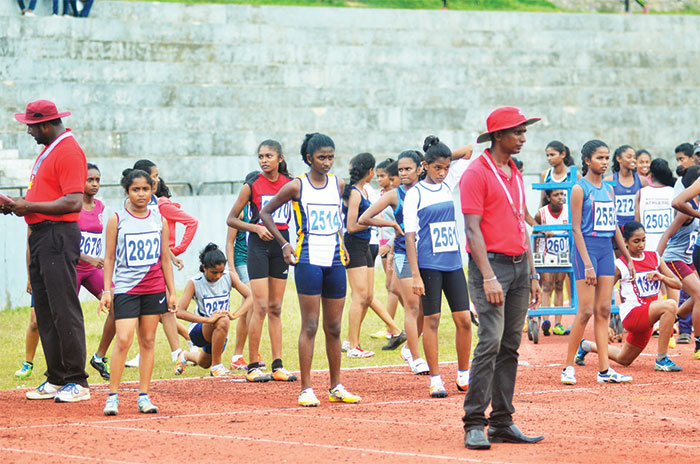
Many students now compete in the Inter-House athletic meets during the first term. Potential future athletes are identified at this time. The first three in an event compete in the Zonal or District meet. The first three from those meets are selected to compete in the Provincial school meet and those who place in the first three move on to compete in the National School Meet. Such an arrangement gives only one chance for an athlete to compete at the next level. The athlete who fails at the Inter-House meet or at any of the next levels has to wait another year to demonstrate his talent.
The National and the Public Schools athletic meets are conducted during the Second and Third Term. In effect a school athlete will at most have only three or four athletic meets a year. In the 1940’s and 1950’s I had only 4 meets per year. Those were: the Inter-House, the Jaffna School Sports Association meet, the Junior National meet, and the Open National meet.
In contrast school athletes in California (USA), then and now, have track meets between schools every week from February to April each year. That is about 12 meets during their track season. During the off-season they engage in conditioning and strengthening activities.
All schools in Sri Lanka have the traditional yearly Inter-House sports meet. Students engage in erecting and decorating sheds for their houses. It is a fun-filled school function where teachers and students interact outside the classroom. It includes the awarding of medals and certificates for winners and a lot of long speeches by dignitaries. Students get the experience oforganising an event and executing it by cooperating with fellow students and teachers.
Such a large-scale event and festive atmosphere is not needed for‘Dual Meets’ between schools. In secondary schools two school teams can compete, the results of the events are recorded, announced, and published. There is no need for speeches, certificates, medals, or trophies. The important thing is for the student to test his skills in competition with others of his age.
A New Approach
It is important for schools in the provinces to prepare Dual/Triangular athletic meet schedules for all schools including 1AB schools in their province at least twoyears in advance. The provinces should also prepare such a sports schedule for schools in other sports within their province. Any sports schedule prepared by the National Associations in sports such as cricket, athletics, or football should be in consultation with the Provincial Departments of Education and the schools. Provincial Departments of Education should ensure that the schedule of travel outside their provinces for sports events by school teams is structured in such a way to ensure that student class attendance is maximised and that classroom learning is not negatively affected.
Advent of Professionalism in sports
Since the time professional sportspersons were permitted to compete in the Olympic Games, athletes of national and international standard have been paid to take part and compete for prize money in their sports. The term “amateur” was dropped from international and national organizations names. The Sri Lanka Amateur Athletic Association, for example, was renamed Sri Lanka Athletics.
Athletes can now also receive sponsorship from shoe, clothing, or equipment manufacturers.
Although athletes in school are not currently permitted to lend their names to sporting goods and apparel manufacturers, the school/team can receive such sponsorship in the form of equipment and uniforms or monetary compensation. Schools also are able to garner funds by allowing businesses to advertise their products or services on the school grounds for a recurrent fee. Such income supplements the meagre allocation for sports from the Ministry of Education.
Athletes over 18 do not earn any income unless they are performing at national level. Many national level athletes in Sri Lanka can join the Sri Lanka Army, Air Force, or Police teams and get paid a monthly stipend of approximately Rs. 30,000. The only requirement is that the athlete regularly trains three to four hours per day and competes for them. The Sri Lanka Athletic Association provides similar monetary grants for selected national level athletes who are not paid by the armed forces. The three organisations depend on government funding for such programs. Some organisations in the business sector also sponsor athletes with varied requirements.
Promotion of Athletics at District Level
To promote District Athletics, it is important for District Athletic Associations to be funded by the government or the private sector. They could sponsor the first two athletes, in each event, who have potential to achieve national standing but do not have any sponsorship or other means of support. Payment of a monthly living allowance for the first two performers in each event in the district, similar to what the Army and Air Force pays the athletes who are enrolled with them, will help the district athlete to continue to develop their skills. This will allow the district level athlete to practice three to four hours a day and also attend job oriented tertiary courses. Such practice will ensure more opportunities for district level athletes to achieve National, South Asian, and Asian level standards. In exceptional cases the athlete may also be able to attain Olympic standards. It will also give opportunities for district level athletic coaches, who should also receive a stipend, to improve their coaching skills. An additional benefit is that the number of athletic officials will increase and they will acquire higher levels of organisational and officiating skills.
Promotion of Athletics at School Level
Since 2017, those who are not successful at the GCE O/L at age 16 and are thus not able to enter Grade 12, are required to continue in the Vocational Technical Program in 1AB schools. That is, a student who fails GCE O/L cannot dropout or be ‘Pushed Out’ at age 16. In effect education is compulsory for all until they are 19 years old. The above requirement was a recommendation made by the 2014 Northern Education System Review (NESR) and was adopted by the Northern Provincial Council. It was also adopted by the National Education Commission as a National Education Policy and accepted by the National Institute of Education (NIE). All athletes can now stay in school until they are 19 and benefit from continuing education while developing their skills in their respective sports. The NIE has prepared an excellent Vocational Technical Education Program for such students enrolled in Grade 12 and 13. Some 1AB schools have already adopted it. Others should do so in the near future. School age sportspersons can now continue their sports activities, even if they fail GCE O/L, and acquire skills to make them more employable.
School sports and athletic competitions are the responsibility of the Assistant Director of Education in the Provincial Department of Education. The Sri Lanka Athletic Association and the National Olympic Committee have no direct responsibility. However, they can provide advice, guidance, and distribute the funding that they receive from their respective international organisations such as the IAAF and International Olympic Committee.
(The writer Nagalingam Ethirveerasingam represented Sri Lanka at the 1952 and 1956 Olympic Games and is the first Sri Lankan to win an Asian Games gold)


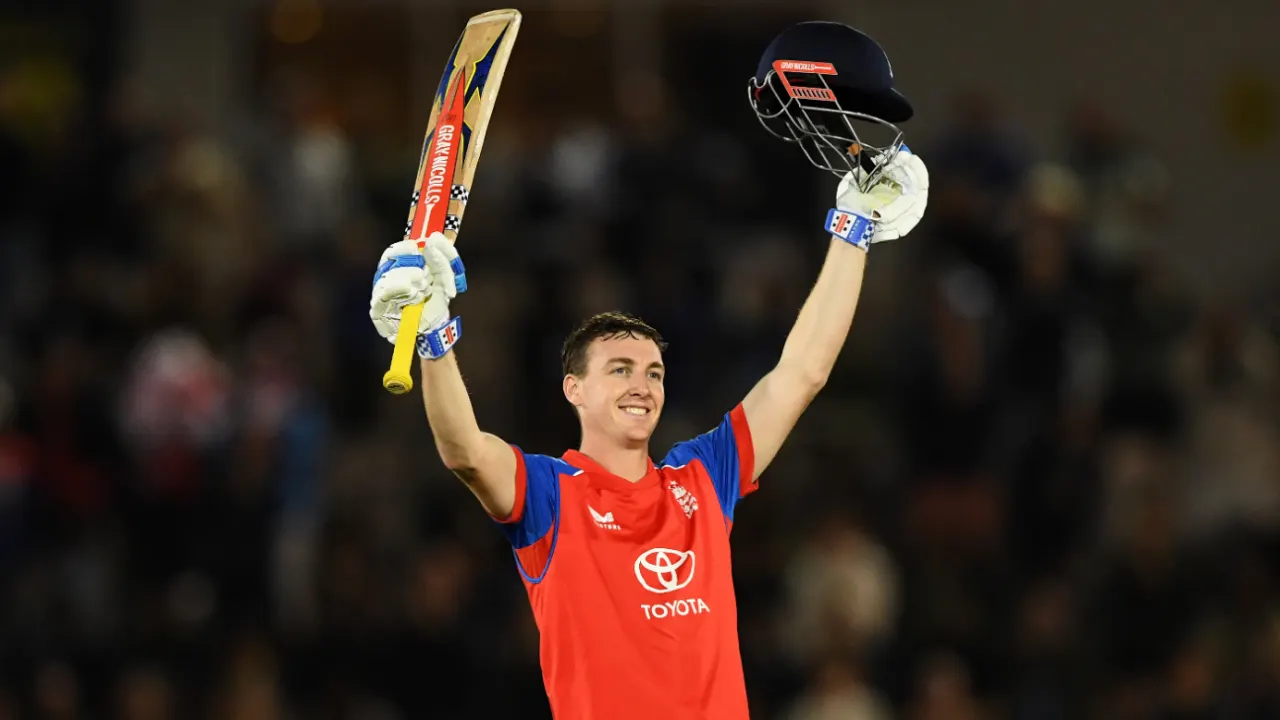
Harry Brook led from the front with his second and fastest T20I century as England sent Sri Lanka swirling down the Utilita Bowl with victory by 119 runs in the first T20I.
The limited-overs skipper’s 42-ball effort – quicker than every Englishman bar Phil Salt’s 39 baller almost a year ago to the day against South Africa – took England to 254 for 4, compelling former Test captain Ben Stokes to wax lyrical on social media.
Stokes’ post sounded as confused as Sri Lanka’s bowling plans. But the underlying sentiment was that Brook’s unbeaten 114 showed he possesses more genius than Kevin Pietersen.
It is a sketchy claim. But perhaps tonight, England’s new mentor will happily cede to the 27-year old after his third white-ball century of the year, and second in T20Is after his maiden effort against Pakistan at the T20 World Cup. In reply, Sri Lanka mustered just 21 more than Brook’s new career-best between them, bowled out for 135 with an over to spare.
England’s first innings fell three runs short of the total they made in their last T20I against India on this very ground. The similarities between this evening and that July afternoon included the opposition skipper – on this occasion, Charith Asalanka – inserting England after winning the toss.
Shreyas Iyer had made that mistake two months earlier, and likewise, he was also made to pay by Brook and Jos Buttler, who this time had to settle for 80 from 44 deliveries, rather than consecutive hundreds.
Captain and former captain combined in a stand of 128 from 60 deliveries, the first part of which included England’s second-highest powerplay of 90 for 1. That was kicked off by a breezy 12 from 5 for debutant Aneurin Donald, who became the first Glamorgan product to feature for England since Simon Jones in 2005.
Things were getting away from Sri Lanka as early as the fifth over when Dunith Wellalage was taken for 30 by Brook. And when Buttler was dropped on 45 three overs later, by Eshan Malinga – over-running a sliced heave down the ground at long off – it was clear, not even a quarter of the way through, that this match was only going one way.
England’s superior power and fitness was never going to be matched. More impressive than their total of 19 fours and 12 sixes were the number of twos. Brook did most of the running; nine of his own along with 12 for his three partners.
Sri Lanka’s chase began with a maiden, bowled by Sonny Baker who went on to take 3 for 12. After struggling on debut across all three formats – including a Test bow earlier this summer against New Zealand – the 23-year old polished his overall numbers with his first limited-overs dismissals at his home ground.
The Hampshire quick got off the mark with a 90mph rasper that beat opener Kamil Mishara, before adding Lahiru Udara four deliveries later when the right-hander’s attempted scoop found Adil Rashid at short backward square. A return from the Pavilion End then saw a 92mph delivery nip away and knock back Theekshana’s off stump.
All six of England’s bowlers registered in the wicket column, feasting on a line-up that – barring Wellalage’s 33 from 21 at No.8 – were all utterly woeful.
In Aneurin Donald, England may well have their answer to Vaibhav Sooryavanshi when it comes to monster strike-rates. Perhaps the quirkiest aspect about that is Donald, as the follower, is technically old enough to be Sooryavanshi’s father.
The 14-year age gap speaks to a difference of cultural attitudes towards the game, particularly in the T20 format: more venerated in India, reluctantly accepted over here. At the age of 29, Donald is England’s oldest T20I debutant in nine years, and was playing his first international match after 112 regular T20s.
With Phil Salt out injured, Donald had big boots to fill, but Brendon McCullum believed he had found the right understudy when watching Donald carve a remarkable 31 from eight deliveries for England Lions at Chelmsford in Sri Lanka’s first warm-up.
The man who capped his assault then – Wellalage – did so here for a more contained 12 off 5. Donald, though, had done his job in his first four balls, closing the the first over of the match by smashing Maheesh Theekshana’s offspin over the midwicket fence, then through cover, and setting England on course for a mammoth score.
The Utilita Bowl is the most criticised of England’s international venues, and it has come under greater scrutiny with the “hows” and “whys” of its allocation of an Ashes Test next year at the expense of Headingley (or anywhere else north of Nottingham).
It is not the easiest ground to get to. And visiting players note how quickly it has aged since opening in 2001. But if there is anyone who will espouse its virtues, it is Buttler.
Following his 131 against India, Buttler now has 211 runs across his last two T20I innings, both in Southampton. By comparison, he had managed a grand total of 212 runs across his first 14 innings in the format at the start of the year.
That run included a torturous T20 World Cup campaign, the kind that made many wonder if we were in the end days for one of English cricket’s most gifted batters.
This time, Buttler was closed to his devastating best. The four boundaries off Dushmantha Chameera to end the second over – the usual stride-and-thwacks over the bowlers’ heads and the trademark wristy, top-spin carve through cover off wide yorkers – were all very familiar.
Buttler turned 36 this time last week. But, as the team around him continues to push the envelope, the chance to focus on his own game, at his own pace – which today meant bringing up 50 from 29 deliveries as the anchor! – should ensure he and England get the most out of what time he has left.
Sri Lanka lacking Plan B
Everyone’s got a plan until they get Brook-ed and Buttler-ed in the face. And unfortunately for Sri Lanka, the plan thumped out of them was leaning on Theekshana to close out a chaotic innings
Few bowlers, let alone slow ones, take as much pride as Theekshana in their thankless tasks in the powerplay and at the death. But after Donald got hold of his first over, and then Buttler found 13 from his second, Asalanka seemingly forgot about the 26-year-old.
You could understand why the stand-in captain would look beyond someone conceding 13.5 an over. The problem, however, was his attempt to make up the difference proved more expensive. Wellalage’s last over (the 14th) went for 16, and Dasun Shanaka’s (17th) 19.
Wellalage looked particularly wayward, his slowness through the air – whether deliberate or not – left him exposed on an ugly surface that skidded rather than gripped. His economy rate of 17 from three overs was comfortably the worst of his career.
Scores:
England 254 for 4 in 20 overs (Jos Buttler 80, Aneurin Donald 12, Harry Brook 114*, Tom Banton 10, Will Jacks 21; Dushmantha Chameera 1-53, Dunith Wellalage 1-51, Eshan Malinga 1-41, Wanidu Hasaranga 1-34) beat Sri Lanka 135 in 19 overs (Pathum Nissanka 12, Kamil Mishara 10, Charith Asalanka 10, Dasun Shanaka 24, Dunith Wellalage 33, Eshan Malinga 13*; Sonny Baker 3-12, Josh Tongue 1-25, Will Jacks 1-21, Liam Dawson 2-23, Adil Rashid 1-31, Jamie Overton 2-20) by 119 runs
[Cricinfo]
Budapest glory to airport heartbreak
by Reemus Fernando
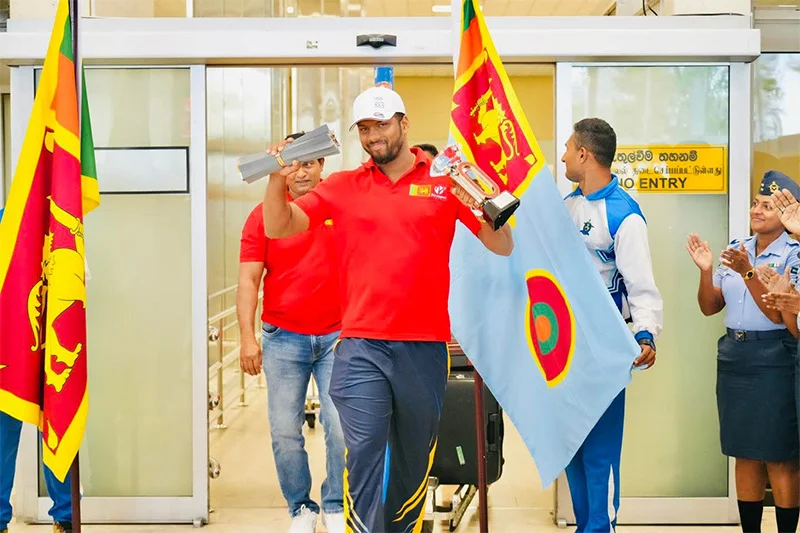
Champion javelin thrower Rumesh Tharanga has received plethora of support from the Sports Ministry to leading businessmen to replace the competition javelins damaged during his retun flight following his historic triumph at the World Athletics Ultimate Championship in Budapest.
While the Sports Ministry has moved swiftly to provide him with a new set of high-quality competition javelins to ensure that the unfortunate incident does not disrupt his preparations for forthcoming Asian Games, social media was abuzz with call for support moments after Tharanga revealed that the javelins he used for a series of victories abroad have been damaged.
Tharanga discovered the damage to his equipment after arriving at the Bandaranaike International Airport.
The 23-year-old was returning with two trophies following his triump at the Diamong League Series final (Brussels) and the Ultimate Championship in Budapest.
The Sri Lanka Airforce athlete created history by winning the men’s javelin title with a 91.09m effort at the World Athletics newly formed global event the Ultimate Championship on Sunday. It was just a week after the world number one clinched the Diamond League title.
The victories he achieved during the Diamond League series, the final and the Ultimate Championship has elevated him to a position where no other Sri Lankan track and field athlete has ever dreamt of reaching and has also earned him a lucrative price bag. He has arguably become the richest track and field athlete in Sri Lanka during his breakthrough season, in which he has established himself as the leading javelin thrower and the number one ranked thrower in the world.
The damaged equipment reportedly included javelins used for his outstanding performances beyond the 90-metre mark, including his winning throw in Budapest and his 92.07m effort in Zurich.
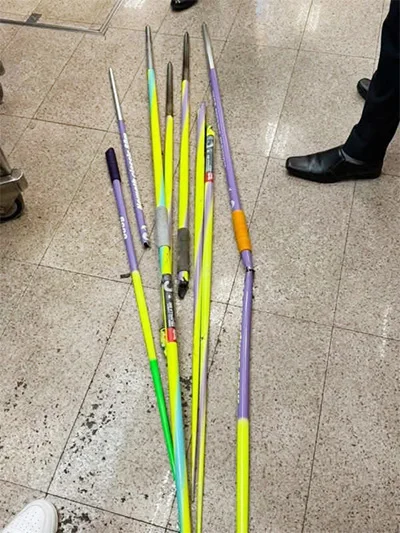 The damage has been estimated to be more than Rs. 2 million.
According to reports Tharanga has lodged a complaint over the incident, while steps are also expected to be taken to seek compensation from the airline responsible for handling the equipment during the journey.
The Sports Ministry’s decision to immediately replace the damaged equipment will ensure that the incident does not interfere with his training ahead of the Asian Games which starts later this week.
Tharanga’s success under coach Tony Prasanna has elevated Sri Lanka’s profile in world athletics, making the protection and provision of proper competition equipment an increasingly important part of his international campaign.
His recent success at international stage has kept the social media abuzz and the reaction to the news of his damaged javelins was overwhelming with pledges of support coming from leading businessmen in the caliber of Dudley Sirisena to general uses of different platforms. A far cry from the days when he had little backing on his journey to the World Junior Championships.
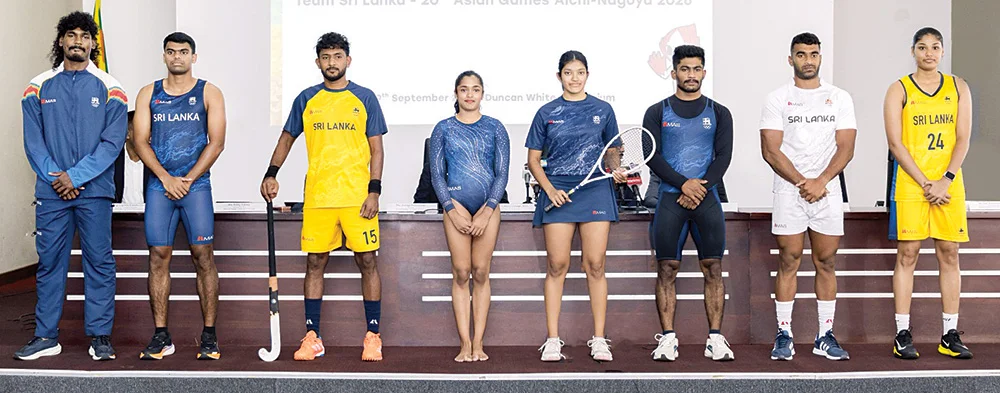
MAS Holdings, the official clothing sponsor for Team Sri Lanka, unveiled and handed over the national contingent’s official kit ahead of the 20th Asian Games, Aichi–Nagoya 2026 last week.
The Games will be held from 19 September to 4 October 2026 in Aichi Prefecture and Nagoya, Japan. Developed in partnership with the National Olympic Committee of Sri Lanka (NOC Sri Lanka), the kits were presented at a press event held last week at the Duncan White Auditorium, Ministry of Youth Affairs and Sports in Colombo.
As the official clothing sponsor, MAS will outfit Team Sri Lanka’s athletes across a wide range of disciplines at the Games, including Archery, Athletics, Badminton, Boxing, Cricket, Golf, Gymnastics, Rowing, Rugby, Sailing, Squash, Surfing, Table Tennis, Beach Volleyball, Weightlifting, Wrestling, Hockey, Basketball, Wushu and Kabaddi.
”Each discipline places different demands on movement, fit and comfort, and the kits were developed with these varying performance requirements in mind, while maintaining a consistent Team Sri Lanka identity across the collection,” a statement from the sponsors said.
The full collection spans four kit types: Casual, Podium, Travel, and sport specific performance kits covering everything from the team’s travel to Japan and training days to competition and podium appearances.
The design draws inspiration from the ocean currents that move around Sri Lanka. The continuous movement and energy of the waves reflect the drive, resilience and momentum of Sri Lankan athletes.
”Our design and innovation teams have worked closely with the NOC to build a range of garments that perform well while displaying a strong sense of Sri Lankan identity,” said Arosh Fernando, Director – Product Innovation at Bodywear, MAS Holdings. “The energy of the ocean currents that surround our island felt like a fitting expression of the momentum and resilience our athletes carry into these Games, and we are honored to stand behind them as they represent the country.”
As one of the world’s leading sportswear manufacturers, over the years, MAS has extended its expertise to national teams across several sporting disciplines.
”Yes, it is about manufacturing capability and expertise, but for us it is also about passion and commitment,” said Rajiv Dharmendra, Chief Executive Officer at Bodywear, MAS Holdings. “As an organisation, we are determined to support local athletes to compete at their best on the international stage. Clothing and performance garments should be an enabler in their achievements, and we are grateful for the opportunity to offer that.”

Showers about 75 mm are likely at some places in the Western, Sabaragamuwa, Central and Southern provinces

Brook, Buttler, Baker star as Sri Lanka slump to 119-run rout

Where is Gnanasara Thera?Police pass buck to court

Russian citizens in Lanka to vote in State Duma elections

Euro 110,000 research drive to tackle plastic waste in food sector

New SAU-RCSS pact to boost South Asian dialogue

‘Dates have the highest sugar content to fight Coronavirus’

Sunday Island 27 December – Headlines

#SundayIsland 17th December – Headlines

Sunday Island – 28th March

Sunday Island Headlines – 21 March

Sunday Island – 21st February – Headlines
-

 Sports5 days ago
DDS set to lose Test captaincy
-

 News5 days ago
Sri Lanka faces new grid challenge as rooftop solar surges: former CEB GM
-

 Latest News5 days ago
Shafali, Deepti power India into sixth T20 Asia Cup final
-

 Latest News4 days ago
Sri Lanka thwart Fatima Sana challenge to secure Asia Cup final spot
-

 News3 days ago
Gnanasara Thero absconding after SC ruling
-

 Features6 days ago
Lost for 90 years: Rare Goby resurfaces in Jaffna
-

 News4 days ago
Ammunition cache found in old Kandy bungalow
-
 Latest News7 days ago
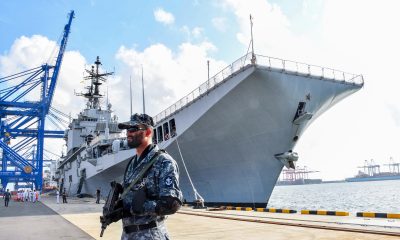
Italian Naval Vessel ‘ITS Giuseppe Garibaldi’ arrives in Colombo