
News
AKD vows to stop allocating funds for ex-presidents, questions Sagala’s role

By Shamindra Ferdinando
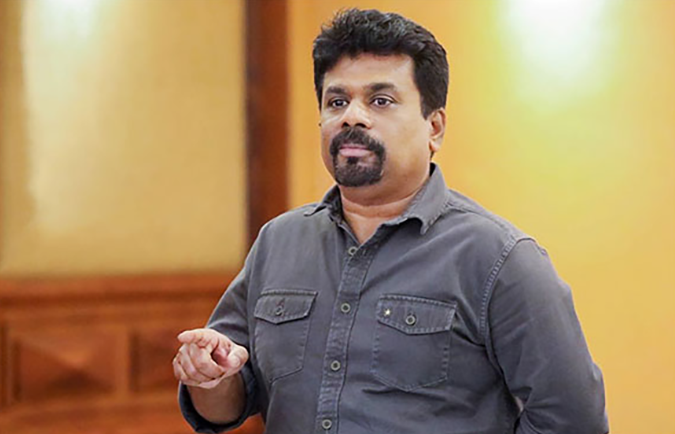
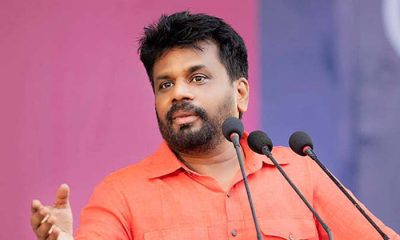
Jathika Jana Balawegaya (JJB) lawmaker Anura Kumara Dissanayake has called for an end to the practice of spending taxpayers’ money to maintain former Presidents and their spouses.
Bankrupt Sri Lanka couldn’t afford to look after political families, MP Dissanayake told a gathering in Colombo on Sunday. Referring to the former first lady Hema Premadasa receiving full state patronage since the assassination of her husband Ranasinghe Premadasa on May Day 1993, the JVP leader asked why successive governments had paid for maintaining what he called the former first lady’s luxury style.
MP Dissanayake said that if the JJB formed a government, such waste would be stopped forthwith.
The JVPer questioned the funds allocated for former Presidents Chandrika Bandaranaike Kumaratunga, Mahinda Rajapaksa, Maithripala Sirisena, and Gotabaya Rajapaksa at a time a vast majority of people were struggling to make ends meet.
Alleging that the government was working overtime to indefinitely put off the Local Government polls, scheduled for March 09, MP Dissanayake said that the growing indications that the JJB would make significant gains at the forthcoming poll jolted the government, and the Opposition, as well. MP Dissanayake alleged that in addition to the SJB and the Opposition Leader’s group, the Maithripala Sirisena-Dayasiri Jayasekera camp were thoroughly disturbed by the public response, received by the JJB.
Colombo District lawmaker Dissanayake said that the so called VIPs and VIP groups hadn’t experienced such a threatening situation before. The JVP leader asked the gathering whether they could think of one justifiable reason for the bankrupt government to allocate funds for ex-Presidents and ex-Presidents now serving as members of Parliament. Dissanayake said that the allocation of over Rs 10 mn each for ex-presidents couldn’t be accepted, under any circumstances.
MP Dissanayake also questioned the significant allocations made for two of President Ranil Wickremesinghe’s closest associates and presidential advisors, Sagala Ratnayake and Akila Viraj Kariyawasam.
In spite of both of them being rejected by the people at the last general election, held in August 2020, they received special treatment, MP Dissanayake said, claiming that Ratnayake, one-time Law and Order Minister, received a Rs 150,000 as monthly salary, Rs 81,400 fuel allowance, Rs 50,000 transport allowance and Rs 7,500 telephone allowance. Akila Viraj Kariyawasam received Rs 100,000 monthly salary, Rs 66,825 fuel allowance and an expensive SUV.
MP Dissanayake said that those in the government, and the Opposition, threatened by the rapidly changing political environment, ganged up against the JJB for obvious reasons.
The JVP leader said that they had been greatly strengthened by the sizable number of ex-military personnel, including senior officers, throwing their weight behind the growing political movement. Referring to former Eastern Commander, Maj. Gen. K.P. Anura Jayasekera, declaring his support for the JJB, MP Dissanayake said that though the military generally was opposed to left political parties, there was a significant and unexpected shift in response to the post-Gotabaya developments.
In the wake of Maj. Gen. Jayasekera’s declaration of support to the JJB, Field Marshal Sarath Fonseka has alleged that the extremist group, led by Zahran Hashim, stepped up activity during Jayasekera’s tenure as the Easter Commander. Lawmaker Dissanayake dismissed what he called the Field Marshal’s childish attempt to tarnish the former Eastern Commander’s name. Jayasekera received appointment as the Eastern Commander, in Nov. 2018.
How could the public have faith in a system where a person who killed a political opponent, during an election campaign, and was found guilty by courts, received appointment as State Minister, MP Dissanayake asked. The JVPer said that those who exercised political power realized that their days were numbered.
Referring to the Colombo High Court ruling, given in June 2022, pertaining to Housing Minister Prasanna Ranatunga, who is also the Chief Government Whip, MP Dissanayake said that Ranatunga was sentenced to two years rigorous imprisonment, suspended for five years, after he was found guilty of one of the charges in a case filed for threatening a businessman.
The Colombo High Court also imposed a fine of Rs. 25 Million on the Minister and ordered him to pay Rs. 1 million as compensation. The Minister has appealed against the HC ruling but how could we ignore the original ruling, the JVPer asked.
The JVPer recalled how the Rajapaksas suppressed investigation into the alleged fake currency printing case, involving Dulanjali Premadasa and former first lady Shiranthi Rajapaksa’s Siriliya case.









Latest News
Cabinet approves relief meaures to persons affected due to the War situation in the Middle East

Approval has been granted at the Cabinet Meeting held on 30-03-2026 to provide relief by granting up to rupees 20/- per litre of 92 Octane Petrol, and up to rupees 100/- per litre of Auto Diesel utilized for public transport to minimize the impact on the day today life of the people and the entire economy as a result of escalation of fuel prices due to the war situation in the Middle East region.
Apart from that, the Cabinet of Ministers approved the resolution furnished by the President in his capacity as the Minister of Finance, Planning and Economic Development to grant the following relief for low – income generators, electricity consumers, farmers, fisheries community, and small tea planters who have been exposed to the direct impact of the energy price hike:
(i) Provision of an additional special allowance for April 2026 to low-income generating categories registered under the ‘Aswesuma’ Programme, irrespective of family size: • Providing rupees 7,500/- to a family in the extremely poor category
Providing rupees 5,000/- to a family in the poor category
Providing rupees 2,500/- to a family in the transitional category
(ii) Instead of transferring the additional cost borne for engaging thermal power plants for generating electricity due to the fuel price hike and prevailing dry weather circumstances to the electricity consumers, the additional cost is to be borne by the Government for a period of 03 months so that a relief can be provided to the electricity consumers utilizing below 90 units.
(iii) Increasing the fertilizer subsidiary of rupees 25,000/- per hectare given at present up to rupees 30,000/- per hectare for the Yala season and increasing the fertilizer subsidiary of rupees 15,000/- per hectare given for additional crops that are cultivated in the paddy fields up to rupees 18,000/- per hectare for the Yala season.
(iv) Provide a 50 kg sack of Urea required for the Yala season at a fixed price of Rupees 10,200/- for farmers through Agrarian Services Centres.
(v) Provide a subsidiary of Rupees 50/- per liter for up to 25 liters per day per single-day fishing vessel, for a maximum of 25 days per month, for a period of three (3) months.
(vi) Provide a one-time payment of Rupees 150,000/- per multi-day fishing vessel engaged in fishing activities during the next three (3) months.
(vii) Provide an additional one-time fertilizer allowance of Rs. 5,000 per 50 kg bag of fertilizer to small tea cultivators, in addition to the existing Rs. 4,000 fertilizer subsidy provided by the Sri Lanka Tea Board.
Under the Finance Act No. 35 of 2018 a tax has been imposed on the telecommunication towers and accordingly an annual tax amount of Rs. 200,000/- is levied from mobile network operators who possess telecommunication towers. However, it has been proposed in the Budget for 2026 that the said tax shall not be levied for a period of five (5) years in respect of telecommunication towers newly erected on or after 2026-01-01.
Accordingly, the Legal Draftsman has formulated a draft bill to amend the Finance Act No. 35 of 2018 including the provisions for taking necessary action, and the Attorney General has granted the clearance in the regard.
Hence, the Cabinet of Ministers approved the resolution furnished by the President in his capacity as the Minister of Finance, Planning and Economic Development to publish the said draft bill in the Government Gazette Notification and thereafter submit the same to the Parliament for its concurrence.
The cabinet of Ministers has approved the resolution furnished by the President in his capacity as the Minister of Finance, Planning, and Economic Development to publish the Value Added Tax (Amendment) Bill in the Government Gazette and thereafter submit it for the concurrence of the Parliament.

Cabinet approves relief meaures to persons affected due to the War situation in the Middle East

Amendments to the Finance Act No. 35 of 2018 to be Gazetted

Value Added Tax (Amendment) Bill to be Gazetted

H.M.J.M.Herath appointed Commissioner General of Registration of Persons

Water Resources Board Act, No. 29 of 1964, to be amended

Securing public sector employment opportunities for Athletes demonstrating National-Level sporting excellence

‘Dates have the highest sugar content to fight Coronavirus’

Sunday Island 27 December – Headlines

#SundayIsland 17th December – Headlines

Sunday Island – 28th March

Sunday Island Headlines – 21 March

Sunday Island – 21st February – Headlines
-

 Features3 days ago
Ranjith Siyambalapitiya turns custodian of a rare living collection
-

 News6 days ago
2025 GCE AL: 62% qualify for Uni entrance; results of 111 suspended
-

 News3 days ago
Global ‘Walk for Peace’ to be held in Lanka
-

 Business7 days ago
Hour of reckoning comes for SL’s power sector
-

 Editorial6 days ago
Search for Easter Sunday terror mastermind
-
 Opinion5 days ago
Hidden truth of Sri Lanka’s debt story: The untold narrative behind the report
-
Editorial7 days ago
Ideological confusion and identity crisis
-

 Opinion6 days ago
Is there hope for Palestine?