
News
AKD says no improvement at Sapugaskanda oil refinery since it went into production in 1969


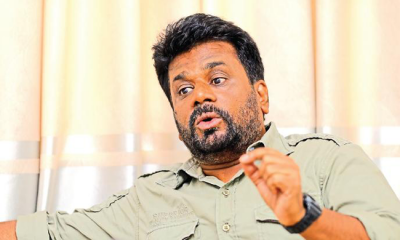
The capacity of the Sapugaskanda Oil Refinery (SOR) has not increased since it was established in 1969, National People’s Power (NPP) leader Anura Kumara Dissanayake says.
Speaking at a public rally recently he that in 1969, the SOR used the most advanced technology available at the time.
“CPC started construction in 1968 and SOR started operations, refining oil, on August 5th, 1969. During that time, the CPC could refine 50,000 MT of crude oil. 55 years later, the capacity remains the same. In 1969, the CPC started with the most advanced technology available at the time. Technology has improved now. We are still refining oil with 1969 technology,” he said.
Dissanayake said that Sri Lanka built a fertiliser factory to use the byproducts of the refinery and, in 1982, a newspaper reported that 5000 MT of urea, produced by that factory, was exported to Pakistan. Today, that factory is closed.
“The CPC also had a nylon factory, as a subsidiary. We built our own nylon thread fish nets. By-products of the refinery were used as pesticides and insecticides for our pineapple and flower production. Those factories were closed, too. We had a candle industry from the by-products, we produced lubricant oil. It was sold to American Caltex. Refinery produced fuel for airplanes. It has the capacity to sell USD 1.4 million worth airplane fuel per day. We can buy crude oil, refine, and sell to ships. These are opportunities we must use to earn foreign currency. Recently this section of the CPC was privatized,” he said.
The ruling class has failed to secure even the most important assets, he said. Agriculture, land, gems, ilmenite, our natural resources, so will these rulers protect what is left, he asked.
“They have absolutely no plan to build this country. Selling our resources, closing down factories and selling valuable machinery is what they know. Every government has taken part in the destruction of the refinery. This is why we need a change in the economy. We need to transform our economy. Only NPP can do that,” he said.
The NPP leader said that the existing constitution concentrates too much power in the hands of the executive president. Sri Lanka has had this executive presidential system for 40 years and executive power was used against the people, repressing them.
“Our economy was destroyed. It has done no good to this country. One man cannot develop the country. Individuals have capacities and limitations. We need to unite our capabilities to govern this country. It’s a collective effort and the NPP is the only party to undertake it. That’s the point of difference. There are talented people from all fields like history, economy, mathematics, law and so on. There are lawyers, university academics and professionals. The government has to unite these capacities and talents to bring optimum results for the country. NPP will do that. For that we have to abolish executive presidency and rewrite the constitution vesting more powers in the Parliament. We will bring about this change,” he said.
Dissanayake said an NPP administration will limit the number of Ministers to 18. He added that crossovers have distorted the democratic system and corrupted the political culture.
“People vote for them in one party but for money and positions they change political allegiance. This has become a public nuisance. Some MPs demand ransom to stay in the party. We will add a provision to the Constitution to ban crossing over,” he said.









Speaker Dr Jagath Wickramaratne yesterday (09) delivered a ruling under Standing Order 27(3), declaring out of order a motion submitted by 31 Members of Parliament to appoint a Select Committee to examine the powers of the Judicial Service Commission (JSC).
The Speaker emphasised that the JSC’s functions constitute the exercise of the People’s judicial power and were protected by constitutional guarantees of judicial independence.
He noted that Parliament had no authority to supervise or review the JSC’s operations, citing the doctrine of separation of powers enshrined in Articles 3 and 4 of the Constitution.
The ruling has stressed that while Parliament holds fiduciary responsibility over public funds, this does not confer hierarchical supremacy over the judiciary.
Wickramaratne concluded that subjecting the JSC to parliamentary oversight would undermine judicial independence and, therefore, cannot be permitted.
“The appointment of a Select Committee of Parliament to examine matters pertaining to the Judicial Service Commission would be a derogation of the independence of the judiciary and thereby a derogation of the judicial power of the People. I extend my sincere appreciation to all Members of this House for their patient and attentive hearing of this lengthy ruling, which, I believe, will stand as a landmark in the parliamentary history of Sri Lanka, strengthening our parliamentary tradition and the dignity of this august Assembly,” he said.
Full statement: Hon. Members, by the mandate vested on me under Standing Order 27(3) of the Standing Order of Parliament, in determining whether a notice in respect of any motion by a Member of Parliament be included in the Order Book for answer, I hereby make a statement concerning a motion submitted by 31 Members of Parliament including Hon. Sajith Premadasa., Hon. R. M. Ranjith Madduma Bandara, Hon. Dayasiri Jayasekara, Hon. Gayantha Karunathilleka, Hon. Ajith P Perera, Hon. D.V. Chanaka, Hon. Dilith Jayaweera, Hon. Rishard Bathiudeen, Hon. Shanakya Rasamanikkam. and Hon. Chamara Sampath Dasanayake. On 21st of November 2025 (hereinafter ‘the Motion’).
The Motion thus submitted calls for an appointment of a Select Committee of Parliament to examine the powers exercised by the Judicial Service Commission in relation to the appointment, promotion, transfer, dismissal and disciplinary control of judicial officers.
Given the serious legal and doctrinal issues raised by the Motion and the potential implications therein, I wish to make a statement detailing reasons for my determination under Standing Order 27(3).
At the outset, it needs to be noted that a similar ruling was issued for the first time in Parliamentary history on 20th of June 2001 by the then Speaker of Parliament Hon. Anura Bandaranaike. The Ruling in 2001 concerned an order issued by the Supreme Court restraining the Speaker from appointing a Select Committee of Parliament regarding a motion for the impeachment of the then Chief Justice. While the factual circumstances evaluated in the 2001 Ruling are not comparable to the facts of the instant occasion, I believe the motion submitted by some of the Honourable Members of Parliament on 21st of November 2025 presents an equally momentous opportunity to reassert the commitment of this House to the doctrine of separation of powers.
While the 2001 ruling concerned the Speaker’s role in facilitating the appointment of a Parliamentary Select Committee, and raised the issue of whether the judiciary could control such an exercise, the present Motion raises the opposite question: should the Speaker, and by extension Parliament, be permitted to control the judiciary’s powers by creating an oversight mechanism for the Judicial Service Commission (JSC).
Before embarking on answering this question, I wish to outline the contents of the Motion submitted on 21st of November 2025.
The Motion calls for the appointment of a Select Committee of Parliament to inquire into the powers of appointment, promotion, transfer, dismissal and disciplinary control of judicial officers, exercised by the Judicial Service Commission and to compile a report assessing the following issues:
1. The exercise of powers by the JSC in relation to all appointments, promotions, transfers, dismissals and disciplinary control of judicial officers during the period beginning from 1st of January 2025 to present;
2. Whether such appointments, promotions, transfers, dismissal and disciplinary control have been conducted according to the Constitution, principles of natural justice and other such relevant laws or guidelines of the JSC;
3. Whether reasons have been recorded and intimated to the judicial officers concerned within the means of law and without bias;
4. Whether, prior to a decision on the transfer, dismissal, or disciplinary control of judicial officers, discussions with such judicial officers were facilitated;
5. Whether, in making decisions on appointments, promotions, transfers, dismissals, and disciplinary control of judicial officers, the Judicial Service Commission took into account extraneous considerations.
6. If so, the impact of such considerations on judicial independence, the administration of justice, and public confidence in the judiciary.
7. Recommendations for Constitutional and statutory amendments, administrative guidelines, appeal mechanisms to counter irregular appointments, promotion, transfers, dismissal and disciplinary control through the JSC.
A cursory glance over the said objectives of the Motion reveals that the proposed Selected Committee of Parliament is exercising what essentially is an oversight function of the JSC and its operations. By scrutinizing the JSC’s decisions on appointments, promotions, transfers, dismissals, and disciplinary control, the proposed Committee would be intruding into the operational sphere of the judiciary, which is the very essence of an oversight function.
A role of oversight structurally presupposes a hierarchical relationship – a regulator possessing the power to review, direct, or correct the actions of another. This gives rise to two integral questions – what is the nature and character of the mechanism (in this case the JSC) sought to be regulated and is such regulation in compliance with the law and spirit of the Constitution of the Republic?
In answering the first question, first I would like to refer to the introduction of the JSC by the Seventeenth Amendment to the Constitution and the Nineteenth Amendment to the Constitution and its character.
CHAPTER XV(15) A of the Constitution titled the JUDICIAL SERVICE COMMISSION was first introduced by the Seventeenth Amendment to the Constitution. The same Chapter was later substituted by the Nineteenth and Twenty First Amendments to the Constitution. As it stands today, Article 111D of the Constitution provides for the establishment of the JSC consisting of the Chief Justice (the Chairman of JSC) and the two most senior Judges of the Supreme Court appointed by the President, subject to the approval of the Constitutional Council. Article 111H sets out the powers of the JSC to include the power to appoint, promote, transfer, exercise disciplinary control and dismiss judicial officers. Article 111K further sets out the JSC’s immunity from legal proceedings and Article 111L explicitly makes interference with the decisions of the JSC an offence.
From both its composition and its conferred functions, it is my opinion that the operations of the JSC are attributable to and exercise of judicial power of the People as envisioned under Article 4(c) read with Article 3 of the Constitution.
The JSC forms an integral part of the judicial branch of government and not an administrative body subordinate to either the Executive or the Legislature. Entrusted with authority over appointments, promotion, transfer, disciplinary control, and dismissal of all judicial officers of the Republic, the JSC functions as an institutional extension of the judiciary itself. The JSC’s powers, exercised through the highest judicial leadership i.e. through the Chief Justice, affirm that the Commission’s role is properly attributable to the judicial arm of government.
By careful consideration of Articles 111D, 111H, 111K, 111L of the Constitution, it is clear that the establishment and functioning of the JSC constitutes a part of the judicial arm of the government and an exercise of the judicial power of the People.
Additionally, under CHAPTER VII -A tiled The Constitutional Council, Article 41C sets out that no person shall be appointed to the JSC by the President without the approval of the Constitutional Council recommendation. The Chapter further refers to other Commissions whose appointments are made upon the recommendations of the Constitutional Council. Article 41B explicitly refers to a list of such Commissions which are answerable to Parliament. However, the JSC has not been mentioned therein. This omission underscores that the JSC, as an extension of the People’s judicial power, stands independent of the executive and the legislature.
Therefore, in answering the first question—what the Motion seeks to regulate—is an exercise of judicial power of the People.
Next, the issue for determination is whether Parliament, through a Select Committee, can exercise oversight over the JSC and its operations, namely the exercise of the judicial power of the People. The guiding principle in answering this question is the doctrine of separation of powers.
The doctrine of separation of powers states that the state’s principal organs (the executive, legislature, and judiciary) are to be constituted as separate and autonomous entities. One of the earliest and clearest statements of the separation of powers was given by Montesquieu in 1748 (The Spirit of Laws) : When the legislative and executive powers are united in the same person, or in the same body of magistrates, there can be no liberty… there is no liberty if the powers of judging is not separated from the legislative and executive… there would be an end to everything, if the same man or the same body… were to exercise those three powers.
The doctrine of separation of powers is enshrined in the Constitution of Sri Lanka vis-à-vis Article 3 and Article 4. Article 3 of the Constitution provides “In the Republic of Sri Lanka sovereignty is in the People and is inalienable. Sovereignty includes the powers of government, fundamental rights and the franchise.” The manner in exercising such power is expressed in Article 4:
“The Sovereignty of the People shall be exercised and enjoyed in the following manner: –
1. the legislative power of the People shall be exercised by Parliament, consisting of elected representatives of the People and by the People at a Referendum;
2. the executive power of the People, including the defence of Sri Lanka, shall be exercised by the President of the Republic elected by the People;
3. the judicial power of the People shall be exercised by Parliament through courts, tribunals and institutions created and established, or recognized, by the Constitution, or created and established by law, except in regard to matters relating to the privileges, immunities and powers of Parliament and of its Members, wherein the judicial power of the People may be exercised directly by Parliament according to law;
4. the fundamental rights which are by the Constitution declared and recognized shall be respected, secured and advanced by all the organs of government and shall not be abridged, restricted or denied, save in the manner and to the extent hereinafter provided; and
5. the franchise shall be exercisable at the election of the President of the Republic and of the Members of Parliament and at every Referendum by every citizen who has attained the age of eighteen years and who, being qualified to be an elector as hereinafter provided, has his name entered in the register of electors.
To that end, the Supreme Court in Jathika Sevaka Sangamaya v Sri Lanka Hadabima Authority (2015) 1 SLR 258 spoke of the doctrine of separation of powers as follows:
“There are three distinct functions involved in a Government of a State -legislative executive and judicial functions. Those three organs are constitutionally of equal status and also independent from one another. One organ should not control or interfere with the powers and functions of another branch of Government and should not be in a position to dominate the others.
The Doctrine of separation of powers is enshrined in Article 4 read with Article 3 of the Constitution – Article 3 is linked with article 4.”
In the same Judgment, the Supreme Court refers to Article 116 of the Constitution as a recognition of the “independence of the judiciary, certain safeguards which enable judicial officers to perform their powers and functions without any interference”. Speaking on Article 111C, the Judgment goes onto quote “Article 111 C of the Constitution is a manifest intention to ensure the judiciary is free from interferences whatsoever.”
At this juncture, it is pertinent to pause and reflect on the framing of Article 4(c) of the Constitution which provides “the judicial power of the People shall be exercised by Parliament through courts…” In fact, the Motion refers to the responsibility of Parliament to allocate funds from the Consolidated Fund to facilitate the operations of the JSC and the ensuing requirement of ensuring the transparent and accountable expenditure of such an allocation.
However, it is my opinion that Parliament’s custody of the public purse, entrusted by the People in trust, confers fiduciary responsibility but not hierarchical supremacy, and cannot justify an automatic encroachment on the constitutional separation of powers and form a derogation of the independence of the judiciary. In fact, the Constitution provides only one permissible avenue for review of JSC decisions – resorting to the Fundamental Rights Jurisdiction under Article 126 of the Constitution read with Article 17 of the Constitution.

Dr Jagath Wickramaratne
Moreover, in the House of Commons, it is a well-established constitutional convention that judicial independence prohibits any form of political accountability being imposed on judges. Consistent with the constitutional principles set out in Erskine May: Parliamentary Practice, and grounded in the doctrines of judicial independence and the separation of powers, the legal position is unequivocal: the establishment of such a committee would be unconstitutional and contrary to long-standing parliamentary practice. Erskine May, further states that judicial independence is a fundamental constitutional convention, and parliamentary actions must not “impair judicial independence.”
Placing the judiciary before a Select Committee — a political body — would subject judges or judicial administrators to political scrutiny, thereby undermining the essential independence required of the judicial branch
Erskine May states that the courts and Parliament are “separate and independent” organs of government. Neither House may exercise judicial power, nor may they review, supervise, or control judicial acts. The administration of the judiciary — including appointments, discipline, case assignment, and internal governance — is an inherent part of judicial independence.
Therefore, it abundantly shows that the parliamentary scrutiny into administrative decisions of the judiciary would breach the constitutional separation of powers.
This proposition is further supported by authoritative English decisions; notably, M v Home Office [1994] 1 AC 377 and Duport Steels Ltd v Sirs [1980] 1 WLR 142, which unequivocally reaffirm the doctrine of separation of powers and the constitutional imperative of preserving judicial independence.
Even in the Sri Lankan Constitution, unlike in the United Kingdom, the principle of the separation of powers is expressly and unequivocally recognised as a foundational constitutional doctrine. The Apex Courts of Sri Lanka have repeatedly affirmed this position. In Premachandra v Major Montague Jayawickrama (1994) 2 SLR 90, the Supreme Court underscored that the separation of powers embodied in Articles 3 and 4 constitutes a fundamental feature of the Constitution, and that neither the Executive nor the Legislature may usurp or encroach upon judicial power; Chief Justice Sharvananda emphasised that each organ of government must function strictly “within the bounds set by the Constitution,” rendering any form of parliamentary supervision over judicial administration unconstitutional. Similarly, in Visuvalingam v Liyanage (1983) 1 SLR 203, although the issue concerned contempt, the Court reiterated that judicial independence is an indispensable constitutional postulate and that the judiciary cannot be subjected to pressure, influence, or control by the other branches of government. This principle was reaffirmed in many reported cases , where the Supreme Court held that the judiciary must remain entirely free from any form of investigation or interference by the Executive or Legislature, noting that the protection of judicial independence is essential for safeguarding the sovereignty of the People. This is further reinforced by in many reported Supreme Court Cases , where the Court held that the JSC enjoys exclusive constitutional authority over judicial administration.
The following passages of recently concluded Judicial Officers’ Tax Case (CA Writ 35/2023-36/2023, & 73/2023 C.A minutes 27th November 2023) explain that sovereignty belongs to the people under the Constitution, and its exercise through the Executive, Legislature, and Judiciary must operate within a strict separation of powers—ensuring strong legislative and executive authority while preserving judicial independence—so that each branch uses its powers responsibly, without overreach, for the wellbeing of society.
It is stated that –
“……………………The Constitution is the supreme law of the land and as per Article 3 of the Constitution, sovereignty lies in the people and is inalienable. Sovereignty includes the government; thus, the power of the people is exercised through the three pillars of the government, namely the executive, legislature and the judiciary. Therefore, the judiciary is only one such pillar of the government which exercises the judicial power of the people. …………………….
………………………………The regulation of taxation by laws passed and implemented by the three pillars of government serves the best interest of society. However, the efficacy of fulfilling such a task lies in the principle of separation of powers enshrined within the Constitution. As the learned DSG states in his submission “the legislature has the purse, the executive has its sword, and the judiciary has the public confidence”: though akin to a slogan, it aptly describes the separation of powers within a government system. Accordingly, the three branches of the government are to operate independently from one another, and there shall be no interference of one in the other. There shall only be checks and balances between these three branches. This principle, which is provided by the Constitution, safeguards the independence of the judiciary in a delicate balance.
……………………………………Contemporary society is constantly changing, with new social upheavals and challenges arising every day. To effectively solve these problems and guarantee positive change, those in power must be equipped with the necessary tools and authority to do so. This means that the legislative and executive power of the government must have adequate and far-reaching powers, free from unnecessary obstruction or interference. It is important to remember that these powers are given to them by the people, and with this trust comes the expectation that they will use their powers responsibly with a sense of justice and for the betterment of people……………………….
…………………………… the independence of the judiciary should be preserved without any obstruction, hindrance or interference. The judiciary plays a vital role in ensuring that justice is served fairly and impartially, and any interference with their independence could compromise the integrity of the judicial system. A delicate balance ought to be struck between both these points for the adequate functioning of society.”
While exercising their powers, all three branches of the government may experience a sense of satisfaction, but they must also remember that using their powers excessively or unjustly is not acceptable. The saying, “It is excellent to have a giant’s strength; but it is tyrannous to use it like a giant” ( William Shakespeare, in his play Measure for Measure, Act 2, Scene 2.) serves as a reminder that those in power must be mindful of the impact of their actions on society and use their powers for the greater good, rather than for personal gain or to oppress others………………”. (@ -94-96 pp)
Building on the jurisprudence outlined above, it is evident that the independence of the judiciary is firmly established and safeguarded under the doctrine of separation of powers. Accordingly, the JSC, whose functions reflect the exercise of the People’s judicial power, enjoys the same protection against encroachment by the legislature or the executive.
Having examined the JSC as an extension of the People’s judicial power and the limits imposed by the doctrine of separation of powers for the protection of such exercise, I now turn to my duty under Standing Order 27(3).
The Motion before me seeks a resolution of Parliament to appoint a Select Committee to oversee the JSC’s functionality and operations. Under Standing Orders 27(3), I, as Speaker, hold the discretion to decide whether such a Motion should be placed on the Order Paper and to rule it either in order or out of order. In exercising this discretion, I must determine whether the objectives of the Motion align with the Constitution of the Republic.
In my opinion, any motion in the exercise of the legislative power that encroaches on the exercise of the People’s judicial power threatening the doctrine of separation, is an affront to the Constitution of the Republic.
As such, for the following reasons, I find the Motion submitted on 21st of November 2025 to appoint a Select Committee of Parliament to examine the powers of the Judicial Service Commission in relation to the appointment, promotion, transfer, dismissal, and disciplinary control of judicial officers out of order:
1. The functions and purpose of the Judicial Service Commission embody the exercise of the People’s judicial power, and therefore enjoy the constitutional protection of judicial independence; and
2. The Constitution does not permit Parliament to encroach upon that power by exercising oversight over the Judicial Service Commission’s operations; this prohibition is reinforced by the doctrine of separation of powers enshrined in Article?3, read with Article?4, of the Constitution; and
3. The custody of the public purse, entrusted to Parliament by the People in trust, confers fiduciary responsibility but not hierarchical supremacy, and cannot justify encroachment upon the constitutional separation of powers; and
4. The Constitution does not provide the Parliament the authority to inquire into, supervise, or review the functions or decisions of the Judicial Service Commission.
The appointment of a Select Committee of Parliament to examine matters pertaining to the Judicial Service Commission would be a derogation of the independence of the judiciary and thereby a derogation of the judicial power of the People. I extend my sincere appreciation to all Hon Members of this House for their patient and attentive hearing of this lengthy ruling, which I believe will stand as a landmark in the parliamentary history of Sri Lanka, strengthening our parliamentary tradition and the dignity of this august Assembly.

A two-year-old elephant calf was killed in a collision with a truck on the Anuradhapura–Padeniya road in the Galgamuwa Mee Oya area.A herd of elephants, returning to the Teak Reserve after nighttime foraging, attempted to cross the road near the Galgamuwa bridge in the Alikele area—an identified elephant crossing point—when the lorry, travelling from Padeniya to Anuradhapura, struck the calf, killing it instantly.
Two people were in the lorry at the time. Local residents said the vehicle had fled the scene after the collision. The calf was later seen lying in the middle of the road, raising concerns among motorists.
Officials from the Galgamuwa Wildlife Officer’s Office have launched an investigation into the incident. Authorities reiterated warnings for motorists to exercise extreme caution when driving through known elephant corridors, especially at night.
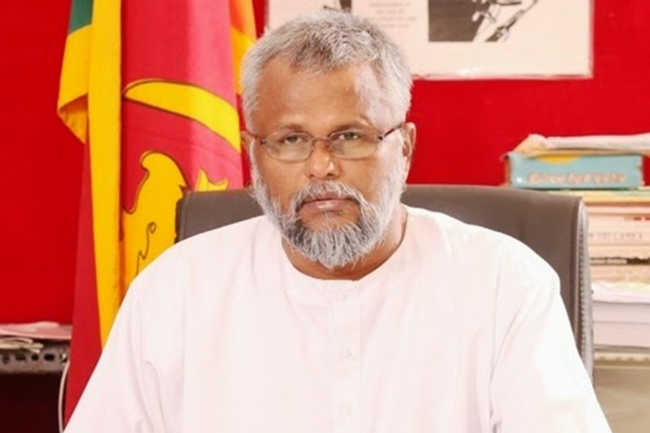
Former Minister Douglas Devananda, who was arrested and remanded in connection with a firearms-related investigation, was granted bail by the Gampaha Magistrate’s Court yesterday.After being produced before Gampaha Magistrate Shilani Perera, Devananda was released on two personal bonds of Rs. 2 million each. The court ordered that the sureties must be two close relatives of the former Minister, and also imposed an overseas travel ban.
The case has been fixed for further hearing on 27 March.
A legal team representing Devananda, including President’s Counsel Saliya Pieris, appeared on his behalf.
Devananda was initially arrested by the CID on 26 December and produced before the Gampaha Magistrate’s Court, which ordered that he be remanded until 09 January, 2026. On 30 December, he was admitted to the Mahara Prison Hospital on medical advice after an assessment of his health condition.
The former Minister was taken into custody in connection with an incident in which his personal firearm had allegedly fallen into the possession of members of an organised criminal gang.
According to police, investigations revealed that a firearm issued to Devananda by the Sri Lanka Army for his personal use in 2001 was recovered following the interrogation of organised criminal figure ‘Makandure Madush’ in 2019. Subsequent verification of the weapon’s serial number confirmed that it had been issued to the former Minister.
The pistol was later found concealed in a forested area near a culvert in Weliweriya, police said.
Following these developments, the CID obtained a 72-hour detention order to question Devananda further. Police also said investigations are continuing into an additional 19 firearms that had reportedly been issued to him by the Army.

Heavy showers above 100 mm are likely at some places in the Northern province

De Klerk comes clutch as RCB steal last-ball thriller against Mumbai Indians

Speaker bars Parliamentary probe into Judicial Service Commission

Elephant calf killed in collision with lorry on Anuradhapura–Padeniya Road

Devananda granted bail

Opposition Leader asserts that Speaker’s ruling amounts to violation of Constitution and sovereignty of the people

‘Dates have the highest sugar content to fight Coronavirus’

Sunday Island 27 December – Headlines

#SundayIsland 17th December – Headlines

Sunday Island – 28th March

Sunday Island Headlines – 21 March

Sunday Island – 21st February – Headlines
-

 News4 days ago
Interception of SL fishing craft by Seychelles: Trawler owners demand international investigation
-

 News4 days ago
Broad support emerges for Faiszer’s sweeping proposals on long- delayed divorce and personal law reforms
-

 Opinion1 day ago
The minstrel monk and Rafiki, the old mandrill in The Lion King – II
-

 Features1 day ago
The Venezuela Model:The new ugly and dangerous world order
-

 News3 days ago
Prez seeks Harsha’s help to address CC’s concerns over appointment of AG
-

 News5 days ago
Private airline crew member nabbed with contraband gold
-

 Latest News2 days ago
Warning for deep depression over South-east Bay of Bengal Sea area
-

 Features1 day ago
From sacred symbol to silent victim: Sri Lanka’s elephants in crisis