
Features
A plea for establishing a transboundary Blue-Green Biosphere Reserve in Gulf of Mannar and Palk Bay

Blue-green land and waterscapes act as ecological corridors across land and water in creating an ecological continuity in order to protect and restore the habitats of native and naturalised species.
In addition, these ecological corridors also help to conserve and improve the habitats of migratory species, as well. One of the main objectives of establishing blue-green land-waterscapes is to reconcile increasing local/regional development and human livelihood challenges in a sustainable manner while, at the same time, safeguard biodiversity and their habitats/ecosystems, as far as possible.
While green landscapes are natural and semi-natural terrestrial vegetation types like natural forests and grasslands, blue waterscapes are aquatic or semi-aquatic vegetation types such as seagrass meadows, mangroves and coastal and other wetlands. These vegetated coastal ecosystems known as ‘blue carbon’ ecosystems are some of the most productive on Earth and located at the interfaces among terrestrial, freshwater and marine environments. They provide us with essential ecosystem services, such as serving as a buffer in coastal protection from storms and erosion, spawning grounds for fish, filtering pollutants and contaminants from coastal waters thus improving coastal water quality and contributing to all important food security.
In addition, they capture and store “blue” carbon from the atmosphere and oceans at significantly higher rates per unit area than tropical forests (Figure 1) and hence act as effective carbon sinks. By storing carbon, these ecosystems help to reduce the amount of greenhouse gas in the atmosphere, thus contributing significantly to mitigate the effects of climate change.

Figure 1: Carbon storage in different vegetation types (Source – What Is Blue Carbon and Why Does It Matter? – Sustainable Travel International)
.Blue-green Carbon Markets
The recognition of blue carbon (BC) ecosystems (primarily mangroves, seagrasses and tidal marshes) as an effective natural climate solution paved the way for their inclusion within carbon markets. Blue carbon is the marine analog of green carbon, which refers to carbon captured by terrestrial (i.e., land-based) plants. The blue-green carbon market involves buying and selling carbon credits from projects that protect and restore coastal and marine ecosystems (blue carbon) and terrestrial ecosystems (green carbon). Since Blue Carbon ecosystems have higher carbon sequestration (capture and store) potential compared to their terrestrial counterparts, blue Carbon credits are worth over two times more than green carbon credits. They offer opportunities for commercial enterprises to offset carbon emissions and in turn support climate action.
Blue Carbon projects are expected to grow twofold in the near future. With the recent surge in international partnerships and funding, there is immense growth potential for the blue carbon market. However, it is critically important to look beyond the value of the carbon sequestered to ensure the rights and needs of local communities that are central to any attempt to mitigate climate change using a blue and green carbon project.
Blue Carbon projects can serve as grassroot hubs for sustainable development by developing nature-based solutions in these ecosystems thus contributing to both climate change mitigation and adaptation. Globally, numerous policies, coastal management strategies, and tools designed for conserving and restoring coastal ecosystems have been developed and implemented. Policies and finance mechanisms being developed for climate change mitigation may offer an additional route for effective coastal management. The International Blue Carbon Initiative, for example, is a coordinated, global program focused on conserving and restoring coastal ecosystems for the climate, biodiversity and human wellbeing.
Until recently, most of these opportunities focus on carbon found in the above ground vegetative biomass and do not account for the carbon in the soil. On the other hand, blue carbon, in particular has the potential for immense growth in carbon capture economics in the near future and can provide significant socioeconomic and environmental benefits. Consequently, blue -green carbon habitats in the Gulf of Mannar – Palk Bay region represent invaluable assets in climate change mitigation and coastal ecosystem conservation and sustainable development.
Gulf of Mannar and Palk Bay Trans-boundary Region
The Gulf of Mannar and Palk Bay region form a transboundary area within the waters of southeastern India and northwestern Sri Lanka. This region supports dense seagrass meadows having a high level of marine biodiversity including marine mammals such as dugong. Sea turtles are frequent visitors to the gulf while sharks, dolphins, sperm and baleen whales too, have been reported from this area. The Mannar region is recognized as an Important Marine Mammal Area (IMMA) of the world by IUCN (Figure 2) and also an Important Bird Area by Birdlife International. This region as a whole is a store house of unique biological wealth of global significance and as such is considered as one of the world’s richest regions from a marine biodiversity perspective.
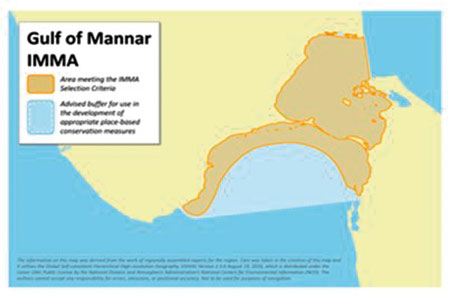
Figure 2. Gulf of Mannar and Palk Bay IMMA (Source – IUCN Joint SSC/WCPA Marine Mammal Protected Areas Task Force, 2022 IUCN-MMPATF (2022)
Gulf of Mannar Biosphere Reserve – India
India has already declared a part of this region as the UNESCO Gulf of Mannar Biosphere Reserve covering an area of 10,500 km2 of ocean with 21 islands and the adjoining coastline. The islets and coastal buffer zone include beaches, estuaries, and tropical dry broadleaf forests, while the surrounding seascape of the Marine National Park (established in 1986) and a 10 km strip of the coastal landscape that include seaweed communities, seagrass communities, coral reefs, salt marshes and mangrove forests form the coastal and marine component of the biosphere reserve on the Indian side of the Gulf of Mannar.
Sri Lankan ‘Proposed’ Biosphere Reserve
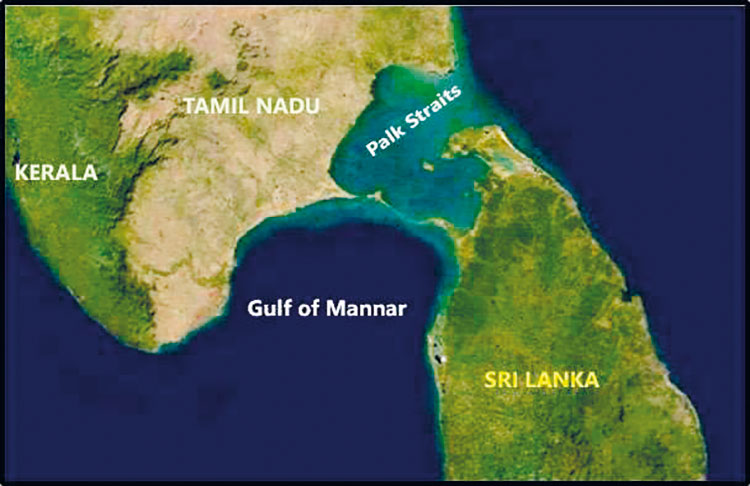
On the Sri Lankan side of the Palk Bay there is a semi-enclosed shallow water body between the southeast coast of India and Sri Lanka, with a water depth maximum of 13 m. To the south, a chain of low islands and reefs known as Adam’s Bridge or Rama Setu (Rama’s Bridge), separates Palk Bay from the Gulf of Mannar. The Palk Bay leads to Palk Strait (Figure 3). Palk Bay is one of the major sinks for sediments along with the Gulf of Mannar. Sediments discharged by rivers and transported by the surf currents as littoral drift settle in this sink.
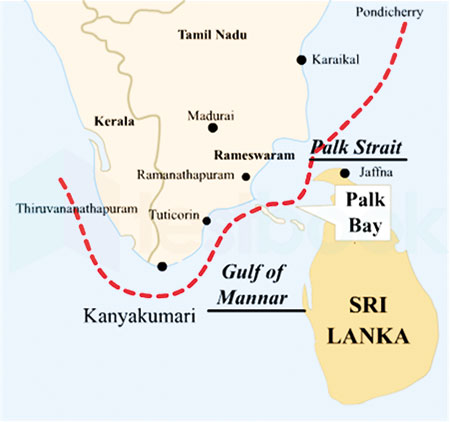
Figure 3: Gulf of Mannar and Palk Straits Source: Drishti IAS & Google Images
On the Sri Lankan side of the Palk Bay, studies are being conducted by the Dugong and Seagrass Conservation Project to establish an additional 10,000 hectares of Marine Protected Area to support the conservation of dugongs and their seagrass habitat in the Gulf of Mannar and Palk Bay. This project will involve the preparation of a multiple-community-based management plan in conjunction with government, fishing communities and the tourism industry.
With this valuable information emerging from projects of this nature, Sri Lanka has real opportunities to create a large marine protected area in the Gulf of Mannar and Palk Bay region and eventually merging them together with the Gulf of Mannar Biosphere Reserve of India to form a trans-boundary biosphere Reserve.
Terrestrial cum Marine Spatial Plan for the Gulf of Mannar and Palk Bay Region
Therefore, an excellent opportunity awaits both the Governments of Sri Lanka and India to collaborate in preparing of a terrestrial and marine spatial plan for this region, a prerequisite before going further on designing and implementing large scale development plans in establishing wind energy farms, mineral sand extraction, fishing industry, oil exploration and tourism development.
Coastal and Marine Spatial Planning (CMSP) is an integrated, place-based approach for allocating coastal and marine resources and space, while protecting the ecosystems that provide these vital resources.
On the Indian side, the Gulf of Mannar Biosphere reserve is well established and functional. On the Sri Lankan side, already there are three DWLC managed protected areas i) Adam’s Bridge Marine National Park (# 29 in the map – 18,990 ha declared in 2015), ii) Vedithalathiv Nature Reserve (# 35 -29,180 ha declared in 2016) and iii) Vankalai Sanctuary ( # 97 -4839 ha declared in 2008) (Figure 4) which can serve as the core zone of the Sri Lankan counterpart of a trans-boundary biosphere reserve. Due to the integrated nature of shallow wetland and terrestrial coastal habitats, Vankalai Sanctuary, in particular is highly productive, supporting high ecosystem and species diversity.
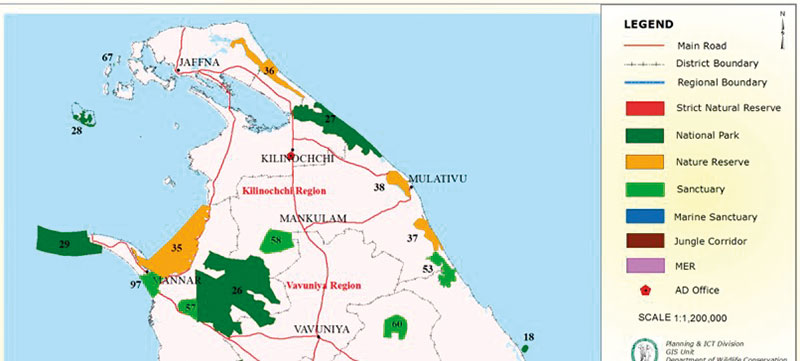
Figure 4: Protected Areas in Norther Sri Lanka Managed by the Department of Wildlife Conservation Source: DWLC
This site provides excellent feeding and living habitats for a large number of water bird species, including annual migrants, which also use this area on arrival and during their exit from Sri Lanka.
Having several coastal and marine protected areas already within the Sri Lankan territory provide an excellent opportunity to establish the Gulf of Mannar – Palk Bay blue-green Biosphere Reserve (Sri Lanka) initially and eventually to join up seamlessly with the already established Gulf of Mannar Biosphere Reserve on the Indian side to create a trans-boundary blue-green biosphere reserve.
This makes perfect sense because unlike sedentary plant species, mobile animal and plant groups (phytoplankton, in particular) do not respect human demarcated territorial boundaries. The provision of a common and unhindered protected coastal and marine passage for their customary movement for food and raising young is therefore of crucial importance in conservation management. Scientific evidence-based selection of additional areas, if necessary and their respective boundaries are best be determined in consultation with expert groups on marine mammals and reptiles, birds, fish, coastal vegetation conservation, sociology and industrial development from both sides of the divide.
Proper spatial planning needs to be done before large-scale development plans are designed and implemented in order to avoid conflicts of interest leading to inordinate delays and teething problems in project initiation. As a priority, the protected blue-green core and buffer regions need to be demarcated for their conservation. This could best be done in this narrow passage of land and water between Sri Lanka and India
( Palk Strait & Gulf of Mannar) by preparing a marine and terrestrial spatial plan along the UNESCO Man and Biosphere conceptual guidelines differentiating core, buffer and transition zones. While the protected areas in the core and buffer zone provide all important ecosystem services that would also serve as breeding ground for fish, crustaceans, marine reptiles, birds and mammals thereby provisioning sustainable industries to be developed in the surrounding transition areas demarcated in the joint spatial plan.
In addition, the Satoyama Global Initiative established by the Japanese at UNESCO as a global effort in 2009 to realise ‘societies in harmony with nature’ in which – Satoumi – specifically referring to the management of socio-ecological production landscapes in marine and coastal regions, is also a good model to be considered for conservation of biodiversity and co-existence between humans and nature.
Final Plea
In order to take this proposal forward from the Sri Lankan side, a number of useful baseline reports are already available including, but not limited to, the following: i. Biodiversity Profile of the Mannar District (CEJ & USAID 2022), ii. The Gulf of Mannar and its surroundings (IUCN 2012), iii) Atlas of Mangroves, Salt Marshes and Sand Dunes of the Coastal Area from Malwathu Oya to Pooneryn in the Northwestern Coastal Region, Sri Lanka (Ecological Association of Sri Lanka, Peradeniya, Sri Lanka, 2020). iv. Integrated Strategic Environment Assessment of the Northern Province of Sri Lanka (CEA 2014).
If this proposal to establish a Trans-boundary Blue-Green Biosphere Reserve in the Gulf of Mannar and Palk Bay is acceptable in principle to the Governments of Sri Lanka and India, it would be ideal if the Man and the Biosphere (MAB) program UNESCO which is an intergovernmental scientific program whose mission is to establish a scientific basis for enhancing the relationship between people and their environments to partner with the relevant Government and non-governmental agencies in both countries in making it a reality. This proposed concept has all the necessary elements for developing a unique sustainable conservation cum industrial development strategy via nature-based solutions while at the same time contributing to both climate change mitigation and adaptation.
by Emeritus Professor Nimal Gunatilleke,
University of Peradeniya

When you look at Sri Lanka, we have many modern figures who created worlds within this country. Men and women whose bones are buried, yet whose works endure and continue to shape generations.
Take the influence of Geoffrey Bawa in architecture, Senarath Paranavitana in archaeology, George Keyt in art, Ediriweera Sarachchandra in drama, Sunil Santha in music, Chitrasena in dance, and Lester James Peries in film.
I would like to say that for literature, Martin Wickramasinghe stands in a similar place. But he was not merely an icon of literature, but a man who constructed a way of seeing. He opened up for us a new vision of our own civilization.
He did not simply write stories. That is what lesser writers do. Wickramasinghe took the Sinhala language, the village mind, the temple, the quiet pride and quieter hypocrisies of our society, and turned them into a mirror. A mirror which, I must warn you, did not always flatter.
Societies enjoy literature… provided it is decorative. Wickramasinghe had the rare ability to make it diagnostic. And in doing so, quite naturally, he became indispensable.
Now, if one wishes to understand the magnitude of such a man, one must look not only at what he wrote, but how others attempted to capture him. This is what I would leave with you before my friend Uditha Devapriya speaks. I believe he perhaps is another man who has the capacity to give a new direction to civilization in Sri Lanka.
Curiously, Sri Lanka’s leading portrait masters, A. C. G. S. Amarasekera and J. D. A. Perera, as far as I am aware, never painted Wickramasinghe. Which is interesting. Because Amarasekera and Wickramasinghe were men of the same generation. Both deeply committed to realism and rooted in tradition. Both suspicious of unnecessary experimentation. In their respective fields, they stood for discipline, clarity, and a certain cultural honesty.
But others attempted the task.
And, in fact, in the matter of being drawn and painted by many hands, Wickramasinghe stands second only to D. S. Senanayake. Which is a curious honour. One man built a nation. The other examined it.
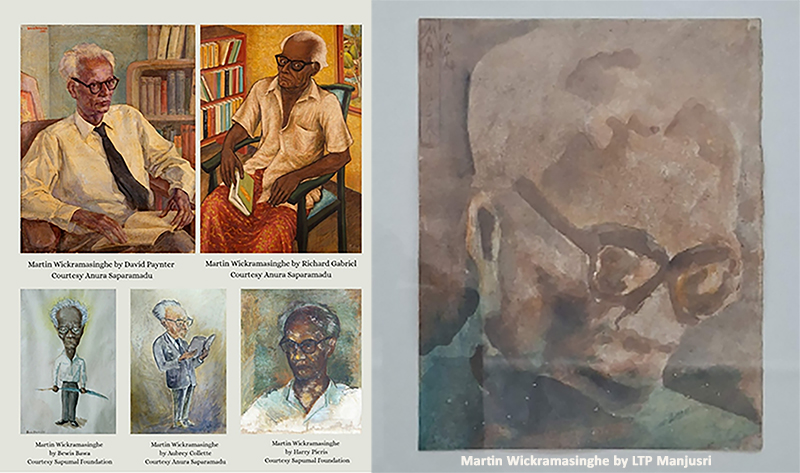
Let us begin with David Paynter. In his work we see Wickramasinghe as the composed intellectual. Seated, book in hand, surrounded by order. This is the presentable version. The man is comfortable and calming. Calm, rational, contained. One almost feels he is about to offer advice—whether one asked for it or not.
Then comes Richard Gabriel. Here the figure is heavier. More grounded. The books remain, but now they carry weight, as we can see Gabriel has labelled them. This is not merely a thinker, this is a man burdened by what he knows. The posture is less elegant, more human, clad in sarong and a simple shirt. One senses fatigue, perhaps even a quiet dissatisfaction with the world he observes.
Bevis Bawa’s depiction refuses all such politeness. He reduces Wickramasinghe into a sharp, almost skeletal caricature. Exaggerated, stripped, slightly uncomfortable. Perhaps this is not admiration, it is exposure. And quite fitting for Wickramasinghe himself stripped society of its pretenses with equal ruthlessness.
Aubrey Collette gives us a different angle. Here is the observer. The man depicted is reading, detached, almost amused. One can imagine him looking up from the page and quietly disagreeing with everything around him. This is wit. Controlled, precise, and slightly dangerous.
Then Harry Pieris offers restraint. A softer, introspective face. No exaggeration. No performance. Just presence. This is perhaps the most interesting of the portraits, because it does not try too hard.
And then we encounter something altogether different. The work by L. T. P. Manjusri. Here, Wickramasinghe is no longer stable. The face dissolves. The colours fade into one another. The features struggle to remain intact. This is not a portrait; it is a memory in the act of escaping.
Now this is deeply inconvenient. Because Manjusri is not concerned with how Wickramasinghe looked. He is concerned with what he did to us. And what he did, quite frankly, was disturb our comfort.
So, across these artists works, we do not see one man. We see six attempts to explain a problem. And Wickramasinghe was, in the best possible sense, a problem. A problem for lazy thinking. A problem for borrowed identities. A problem for any society that prefers praise over truth.
Today, we call him a cultural icon. Which is excellent. It means we have safely placed him on a pedestal, where he can no longer argue with us. And if he were here, I suspect he would find that arrangement deeply amusing.
Or worse, he might begin to write again. And that… would be disturbing for us.
(Following is the text of the opening remarks by the Avishka Mario Senewiratne at Uditha Devapriya’s talk on Martin Wickremasinghe at the Sapumal Foundation)
By Avishka Mario Senewiratne
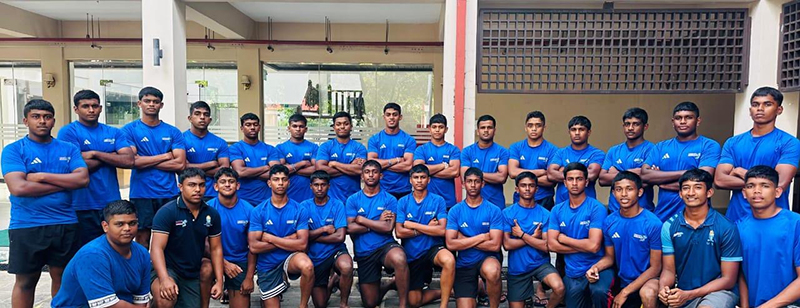
Wariyapola Sri Sumangala College, affectionately known as Summa Rugby, has cemented its place as one of the most dynamic forces in Sri Lankan schools rugby. The historic hill capital school, founded on June 7, 1879, traces its origins to St. Paul’s College near the Sacred Temple of the Tooth Relic and evolved into its current identity following a 1991 relocation. Today, with over 3,000 students and 140 teachers under Principal R.M.D. Rathnayake, the school combines strong Buddhist values with sporting excellence.
Rugby at Summa began in 1993, quickly reaching Division One by 1997. The 2025 season marked a historic turning point for the team. At the U18 Elite Sevens Tournament, Summa secured a landmark Plate Championship with victories over Isipathana College (28–14) and Lumbini College (33–17). Their momentum continued at the All Island 1st XV National Schools Rugby Tournament in Pallekele, registering dominant wins over Ibbagamuwa Central and Ananda College, and a semi-final triumph over Richmond College, before finishing as runners-up to Kingswood College.
Success in the Dialog Schools Rugby League 2025 further highlighted their rise, including a top-division win against Vidyartha College and a thrilling comeback over Thurstan College.
Behind this transformation is a combination of strong leadership and expert coaching. Head Coach K.M. Hettiarachchi, backed by Assistant Coach Asanka Perera and Backs Coach Anush Kolonne, has instilled discipline, structure, and tactical prowess. Captain Sashika Bandara leads on-field with intelligence and composure, supported by Vice Captains Achila Gamage and Tharusha Dilshan.
As the 2026 season approaches, Summa Rugby stands ready to continue its journey, blending legacy, talent, and ambition, and inspiring the next generation of schoolboy rugby in Sri Lanka.
Summa 1XV squad for the season 2026: 1. Resadu Sahas 2) Muditha Gimhan 3) Obasha Iduwara 4) Achila Gamage (VC) 5) Lakvidu Denuwan 6) Pabasara Nirmal 7) Shiwantha Madushan 8) Tharusha Dilshan (VC) 9) Sashika Bandara (C) 10) Abiru Iduwara 11) Shen Akila 12) Maleesha Karunathilaka 13) Ashen Karunathilaka 14) Pasidu Badara 15) Pasidu Samarakoon 16) Lusath Akesh 17) Kaniska Bandara 18) Lakshan Tharusha 19) Sehan Moohanjirin 20) Najana Kodithuwakku 21) Dulanjana Manupa 22) Harshitha Heshan 23) Dinupa Heshan 24) Sahan Gunasekera 25) Sakith Wadyasekara 26) Pasidu Gimhana 27) Preveen Udagedara 28) Abilash Rathnasekara 29) Vimukti Chamodya 30) Lalitha Pramod 31) Gaveesha Rehan 32) Dilshan Kumara 33) Tanesh Deemantha 34) Thanuja Induwara 35) Chamalka Nethma
Text and Pic by SK Samaranayake

The quiet hills of Hantane echoed with the crack of gunfire and the disciplined rhythm of competitive shooting as the Hill Country Sport Shooting Club staged its flagship tournament, Sharp Shooter 2026, from March 26 to 29.
Founded in 1999 by retired Senior Deputy Inspector General of Police Gamini Nawaratne together with Meezan Mohideen, the club has long been regarded as one of Sri Lanka’s premier institutions for sport shooting. Over more than two decades it has played a key role in nurturing shooting talent and promoting discipline and excellence among enthusiasts across the country.
This year’s competition drew more than 275 competitors representing the Sri Lanka Army, Sri Lanka Navy, Sri Lanka Air Force, Sri Lanka Police and 16 civilian shooting clubs, reflecting the growing popularity of practical shooting in Sri Lanka.
A major highlight of Sharp Shooter 2026 was the introduction of a comprehensive four-gun format, incorporating Shotgun, Rifle, Handgun and Pistol Caliber Carbine (PCC). While PCC made its local debut at the previous year’s competition, this was the first time in Sri Lanka that it was integrated into a full four-gun contest, bringing local tournaments closer to international standards.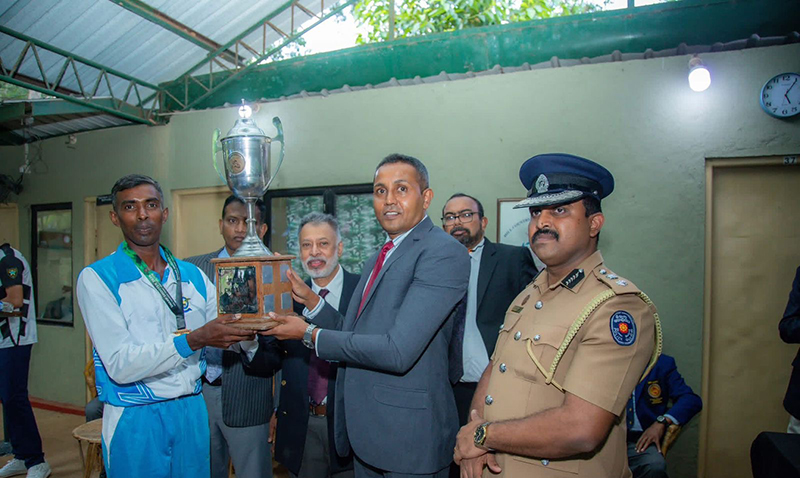


Meezan Mohideen founder of Hill Country Sport Shooting Club
The format required competitors to demonstrate exceptional versatility, switching between different firearm platforms while maintaining accuracy, speed and composure. Carefully designed stages tested not only marksmanship but also agility, quick decision-making and mental focus.
Several shooters delivered standout performances across the various divisions. Representing the host club, Samudra Rangala clinched first place in the Standard Division Shotgun category. W. D. Wijesena of the Sri Lanka Army topped the PCC Iron Sight division with a consistent display of skill.
In the Standard Manual Division Shotgun category, Adrian Daniels of Magnum Shooting Club secured victory after a closely contested event. Meanwhile, IG Suranga of the Sri Lanka Army dominated the Semi-Auto Open Rifle Division.
One of the most coveted honours of the tournament — the Meezan Challenge Trophy for Overall Champion in the Handgun Open Division — was won by Nalin Wijesooriya of the Sri Lanka Air Force.
The awards ceremony was held on the final day with Senior Deputy Inspector General of Police for the Central Province Lalith Pathinayake attending as Chief Guest.
Beyond competition, the event also served as a platform for camaraderie among shooters from the Tri Forces, Police and civilian clubs. Participants shared knowledge and experience, highlighting the increasingly organised and professional nature of Sri Lanka’s shooting community.
With strong participation and the introduction of the four-gun format, Sharp Shooter 2026 has set a new benchmark for practical shooting in the country — a sign that the sport’s future in Sri Lanka is both vibrant and steadily advancing.
By S.K Samaranayake

The Many Faces of Martin Wickremasinghe

Atlas makes learning the perfect New Year gift for young minds

Summa Rugby emerges as a powerhouse in Lankan schools rugby

Sharp Shooter 2026 raises the bar for sport shooting in Lanka

Jetwing Hotels publishes and launches ‘Ceylon in 1907’

Shark and Ray Karawala

‘Dates have the highest sugar content to fight Coronavirus’

Sunday Island 27 December – Headlines

#SundayIsland 17th December – Headlines

Sunday Island – 28th March

Sunday Island Headlines – 21 March

Sunday Island – 21st February – Headlines
-

 News3 days ago
2025 GCE AL: 62% qualify for Uni entrance; results of 111 suspended
-

 News5 days ago
Tariff shock from 01 April as power costs climb across the board
-
 News6 days ago
Inquiry into female employee’s complaint: Retired HC Judge’s recommendations ignored
-
 Features7 days ago
When seabed goes dark: The Persian Gulf, cable sabotage, and race for space-based monopoly
-
 Features6 days ago
New arithmetic of conflict: How the drone revolution is inverting economics of war
-

 Editorial3 days ago
Search for Easter Sunday terror mastermind
-

 Business4 days ago
Hour of reckoning comes for SL’s power sector
-

 Sports6 days ago
Sri Lanka’s 1996 World Cup heroes to play exhibition match in Kuala Lumpur