
Business
Shark and Ray Karawala


When we buy shark dry fish (Mora Karawala), do we really know what species we are consuming? What if endangered sharks are hiding in our meal? Most consumers are unaware.
In Sri Lanka, dried fish is more than food; it is a flavour, a tradition and a way of life. Affordable, long-lasting, and rich in taste, it has become a staple across the island, mainly in rural communities, the dry zone, and hill country. While most fish are eaten fresh, about 14% of the catch is preserved through age-old methods, such as salting, sun drying, smoking and fermentation. Whether served as a main dish (Karawala) or as a flavourful condiment (Umbalakada), dried fish has secured a special place on Sri Lankan plates.
Today, nearly two-thirds of the demand for dry fish is met locally, with dried sharks being the most common and popular in markets. And many people believe that milk sharks are particularly nutritious for lactating mothers.
Typically, part of the excess fish supply in peak seasons, fish arrive late from multiday fishing boats, fish from the bottom of nets, fish that are susceptible to quick spoilage or have low market appeal, are used to produce dry fish rather than letting this resource go to waste. In many coastal villages, drying fish is carried out at the fishing “waadi” (fishing villages/houses) level, often led by women as a means of earning supplementary income.
-

- Salting (not an elasmobranch
-
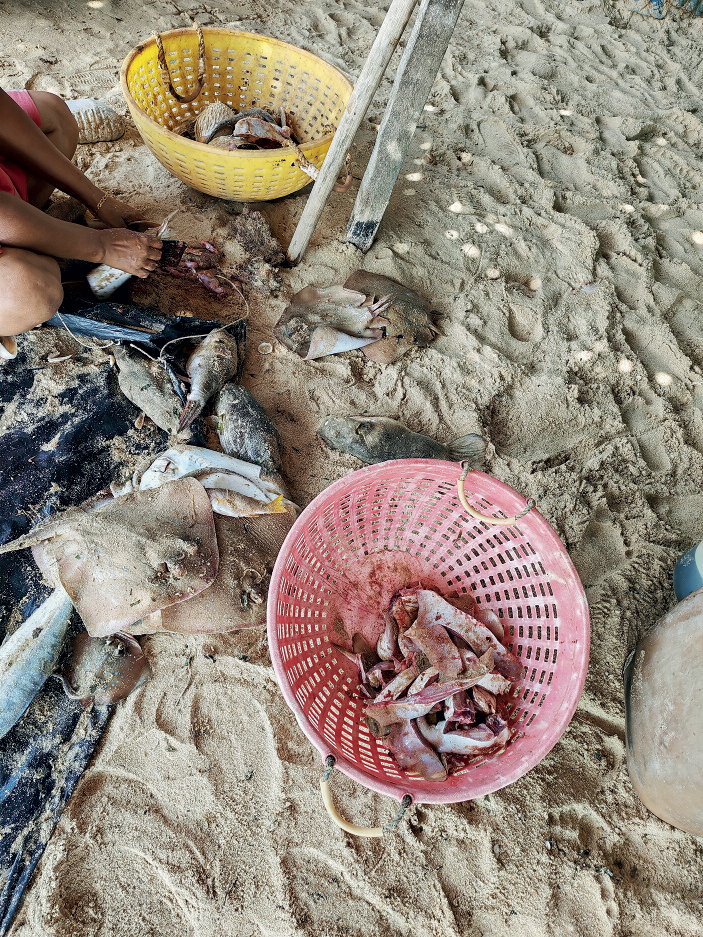
- Cutting rays into pieces prior to salting
But this comes with a cost. Sharks and Rays are slow-growing, late maturing and producing only a few young cannot keep up with rising demand. Sharks and Rays are captured by large-scale artisanal fisheries and often retained as bycatch. Mainly exploited for their meat and other derivatives, including gill plates, fins, and skins. Overfishing has pushed their populations into serious decline.
In Sri Lanka, over 60–70% of shark and ray species are threatened with extinction according to the IUCN Red List, with many others listed as Data Deficient — meaning their true status may be even worse. Only a handful of species might be considered less at risk, but even those assessments are uncertain.

Sun drying of ray meat

Once dried, it becomes nearly impossible to identify which species are being sold. Drying removes distinguishing features, making it impossible to verify the species or ensure sustainability. Labelling is virtually non-existent, and consumers have no reliable way to tell which species they are purchasing.
This means endangered sharks are likely ending up on plates across the country — without anyone realising it. Given the high proportion of threatened species and the lack of transparency, the safest and most responsible choice is to avoid all shark-based dried fish entirely.
By choosing alternative dried fish products made from more sustainable species, we can protect Sri Lanka’s marine biodiversity and ensure that our cultural traditions remain part of a future where sharks still swim in our oceans.
About the Author:
Apsara Rupasinghe, a zoologist with a BSc (Hons) Degree in Zoology, is pursuing MPhil research on shark and ray genetics at BRT-FiPo, with a background in conservation genetics and population genetics. Her work involves combining genetics and conservation to improve species identification and protect endangered elasmobranch species. Apsara pays special attention to the dry fish industry in Sri Lanka as part of her research.
by Apsara Rupasinghe
(Researcher, Fisheries and Policy Programme, Blue Resources Trust)


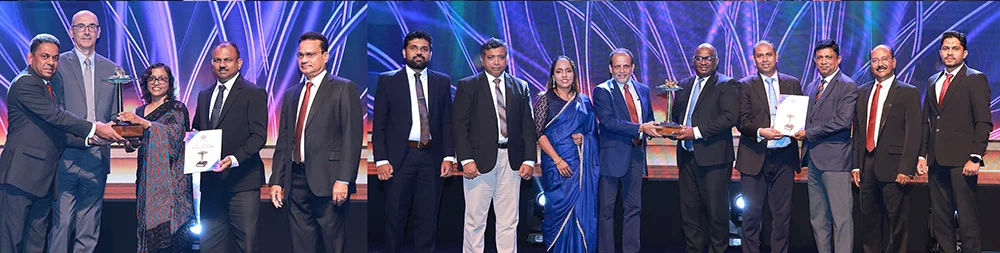
Corporate accolades underscore the alignment between its operational excellence and national development
In an era where national competitiveness is intrinsically tied to digital connectivity, strengthening the country’s digital backbone has become an urgent priority. Within this context, the evolving role of Sri Lanka’s leading telecommunications provider, SLT-MOBITEL, offers valuable insight into how technological infrastructure can underpin broader economic resilience.
Telecommunications and digital networks are foundational to economic transformation. By expanding high-speed broadband access, upgrading enterprise cloud capabilities, and bridging the urban-rural connectivity divide, SLT-MOBITEL helps reduce business transaction costs, streamline supply chains, and enable micro, small, and medium enterprises to reach global markets.
Recent corporate accolades further underscore this alignment between operational excellence and national development. SLT-MOBITEL’s triple triumph at the National Business Excellence Awards 2026 – winning in the Infrastructure and Utilities sector, Performance Management, and ICT Services categories – highlights its growing impact. Notably, the recognition of eChannelling’s contributions to digital healthcare reflects a broader strategic pivot toward integrated technology solutions.
“Institutional efficiency of this nature is critical for attracting foreign direct investment, as global partners increasingly assess a country’s digital maturity and systemic stability before committing capital,” noted industry observers.
Moreover, the company’s transition from a conventional telecom utility to a comprehensive digital solutions provider aligns seamlessly with Sri Lanka’s national digitalisation agenda. As the country pursues public sector modernisation, enhanced e-governance, and a competitive knowledge economy, the private sector must step up to deliver secure, scalable, and future-ready networks. Investments in data centres, cybersecurity frameworks, and advanced ICT infrastructure act as strategic buffers, ensuring that Sri Lanka’s economic apparatus remains agile and resilient amid future global uncertainties.
However, industry experts caution that while these achievements are commendable, SLT-MOBITEL still has a considerable distance to cover in fully enabling a truly digital economy.

Port City Colombo (PCC) took a prominent role as Platinum Sponsor at the second edition of Sri Lanka Beyond Your Dreams, a high-level diplomatic and investment engagement hosted by the Consulate General of Sri Lanka in Dubai and the Northern Emirates. The event, held on 2nd September 2026 at the Hilton Dubai Al Habtoor City, brought together over 400 senior UAE-based business leaders, investors, diplomats, and institutional stakeholders, alongside Sri Lanka’s most senior government representatives.
The gathering was graced by Dr. Thani bin Ahmed Al Zeyoudi, UAE Minister of Foreign Trade, as Guest of Honour, and Vijitha Herath, Sri Lanka’s Minister of Foreign Affairs, Foreign Employment and Tourism. A high-level Sri Lankan delegation – including the Secretary to the Prime Minister, the Chairman of the Board of Investment, the Chairman of the Export Development Board, and the Director General of Commerce – underscored the government’s strong commitment to deepening economic diplomacy with the UAE.
In his keynote address, Minister Herath reaffirmed the centuries-old ties between Sri Lanka and the Arab region, emphasising the UAE’s vital role as a key economic partner. He stressed the urgency of finalising a Comprehensive Economic Partnership Agreement (CEPA) with the UAE, which would establish a robust framework to elevate trade, investment, and bilateral cooperation. Declaring Sri Lanka “open and ready for business,” he positioned Port City Colombo as the physical embodiment of this economic mission – a modern Special Economic Zone (SEZ) with a dedicated legal framework and competitive incentives, offering UAE investors a natural gateway to South Asia while maintaining strong Gulf connectivity.
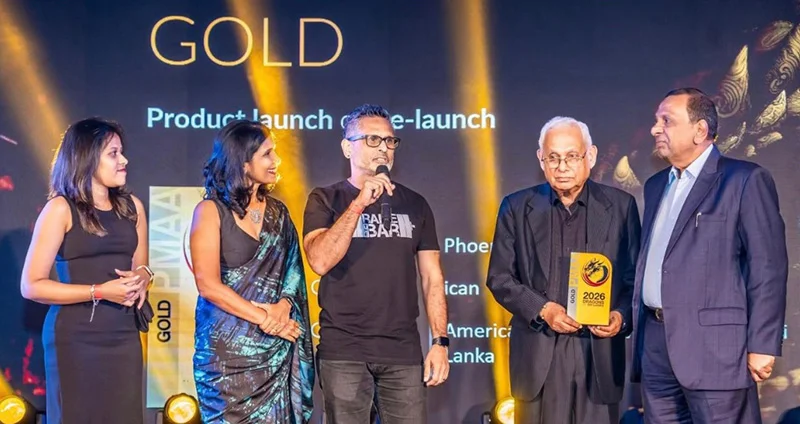
American Premium Water has secured four wins at Dragons of Sri Lanka Awards 2026, including three Gold Dragons and one Black Dragon, marking a significant milestone for the brand following its relaunch last year.
Part of the prestigious Dragons of Asia awards, Dragons of Sri Lanka brings the program’s regional platform to the local market, celebrating creative and effective marketing communications, with entries evaluated on strategic thinking, creativity, execution and impact. Established in 2000, Dragons of Asia is one of Asia’s premier results-driven marketing awards programs.
For American Premium Water, the achievements are particularly significant given that the company’s debut at the Dragons awards has resulted in four Dragons across four categories. In the distinction of Gold Dragons, American Premium Water was recognized across three categories including Product Launch or Re Launch, Cause, Environment or Sustainability and Creative Excellence while the Black Dragon was awarded in recognition of Small Budget.
Competing alongside leading brands and agencies in Sri Lanka, American Premium Water’s four wins demonstrate the strength and effectiveness of its recent work. Winning three Gold Dragons across three distinct categories highlights the breadth of the brand’s achievements, while the Black Dragon for Small Budget further emphasizes its ability to create meaningful impact through focused and efficient investment.

Trump says every adult American will get $5,000 if Republicans win midterms

Protesters mistake Pakistan’s U-19 team for asylum seekers in Portsmouth

Steps are being taken to provide accommodation facilities for 16,000 university students – Prime Minister

Showers will occur in the Western and Sabaragamuwa provinces and in Kandy, Nuwara-Eliya, Galle and Matara districts.


Sri Lanka reiterates its territory won’t be used against India

‘Dates have the highest sugar content to fight Coronavirus’

Sunday Island 27 December – Headlines

#SundayIsland 17th December – Headlines

Sunday Island – 28th March

Sunday Island Headlines – 21 March

Sunday Island – 21st February – Headlines
-

 News5 days ago
Namal remanded until Sept. 18 over Airbus deal investigation
-

 Latest News4 days ago
Tharanga creates history with Diamond League crown in Brussels
-

 News4 days ago
Dispute which triggered listed company director being detained at BIA resolved
-

 Features3 days ago
After the parade: What a traffic OIC’s walk-out tells us
-
 Opinion6 days ago
In Memory of Dr Upatissa Pethiyagoda
-

 Editorial5 days ago
Power vs Equality
-

 Latest News6 days ago
SLPP MP Namal Rajapaksa arrested by CIABOC
-
Editorial3 days ago
Arrests as theatre