
Features
Working as an ASP in various police districts countrywide

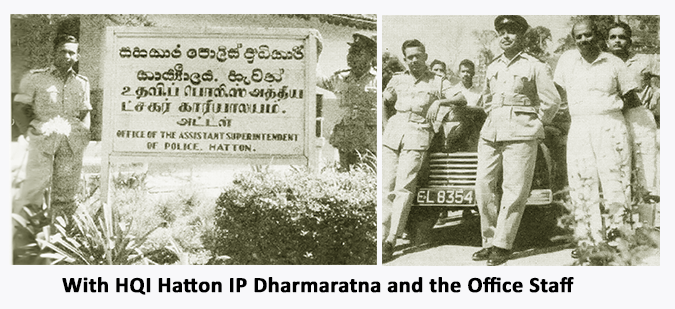
Excerpted from the memoirs of Senior DIG (Retd.)
Kingsley Wickramasuriya
Superintendent of Police Lionel Senanayake was in charge of the Gampaha Police Division. The Police District of Gampaha consisted of eight police stations including Attanagalla where the Prime Minister, Sirimavo Bandaranaike was residing. It appeared that my predecessor Mr. Dharmadasa de Silva had got into some sort of a problem with the PM and that is why I had to replace him.
Gampaha was a very heavy district teeming with crimes. Many a time I had to be pulled out of bed to visit a scene of a ‘D Report’ case where the ASP must visit and give directions. Murders and robberies were some of those cases. With all that I kept the district on its toes with my surprise visits by day and by night.
Veyangoda was a police station area where illicit liquor was rampant. The OIC of the police station was Sub Inspector Yahmapath. He was doing a good job keeping the area under control, particularly that of illicit liquor. There was a petition against him alleging various misdeeds. I had to go into the matter to find some of his subordinates were behind the petition. Although I was of half a mind to help the OIC out of his difficulty as I was convinced of his honesty, I was in a difficult situation myself. Therefore, I had to go to the Superintendent for advice. His advice was typically stereotyped. Before I could complete the investigation, I got transfer orders to the Hatton Police District.
Transfer to Gampaha Division was made at a time when the General Election Campaign was on. Election meetings were being held all over the Gampaha District by the respective political parties. One such meeting was being held by the United National Party (UNP) in Veyangoda town. Veyangoda was a Sri Lanka Freedom Party (SLFP) stronghold and the supporters believed that no one else dare hold any meetings in their territory.
So, when the UNP decided to defy this belief they came in for severe heckling. So much so that it was almost impossible to continue with their meeting. Organizers of the meeting complained to me about their predicament. I decided to have a look and proceeded to the scene. While on the way my constable driver would warn me to let things alone as any interference was wrought with dire consequences. He was giving me friendly advice.
At the scene, I found how unruly the crowds opposed to the meeting were. I tried to persuade the hecklers to leave without results. Since it was bound tc lead to a breach of the peace if the situation was allowed to continue, I summoned a backup party from the Gampaha HQ Station. After a while, a heavy truck with a few men from Gampaha HQ Station appeared on the scene. On seeing the truck, the unruly crowd dispersed and ran helter-skelter. The meeting continued peacefully.
Finally, at the election, the UNP won the Gampha Seat. In the meanwhile, I received transfer orders to proceed to take charge of the Hatton Police District w.e.f. May 1, 1965. On hearing this the newly elected Member of Parliament (MP) of the UNP came over the telephone and spoke to me, and offered to get the transfer canceled in appreciation of my impartial duty performed by me during the election campaign. While thanking him for his sentiments I explained to him politely that the transfer was due to exigencies of services, that I had to make way for a married officer who had school-going children, and that we bachelors are always at the beck and call of the department.
Besides, Hatton Police District was an independent charge with the Superintendent in Kandy. Being still under probation it is a rare opportunity that one gets to go in charge of an independent district. When S.P. Kandy (Ana Seneviratne) agreed to take me under his wing in an independent district, that spoke of the confidence he had placed in me.
Hatton
Hatton Police District came under Kandy Police Division and the Superintendent in charge was Ana Seneviratne. Hatton District had eight police stations spreading from Hatton to Talawakelle bordering Nuwara Eliya on one side, Hatton, Dimbula, Lindula, Norton Bridge, Bogawantalawa, and Maskeliya on the other side, surrounded by tea estates and a rural population. It was entirely a different experience from the previous locations I have had, climate-vice, population-vice, and law enforcement vice.
On reporting at the new district, I found lodgings with two other bachelor public servants – one, a veterinary surgeon, and the other a dental surgeon. Inspector Dharmaratne was the HQI. ASP’s office was staffed by three clerks – the head clerk, and two other clerks. They were like a closely-knit family and very supportive. The inclement cold weather did not deter me from making surprise visits to the far-flung police stations day or night, keeping the district alert. In addition, I would call on the police stations to check whether the scheduled activities like the parade, etc. are being carried out. Night visits were sometimes hindered by the prevailing thick fog. But with the young and experienced police driver attached to me, traveling at night was no problem. He was clever at negotiating even the sharp bends in thick fog.
Prolonged labor strikes in the tea estates were somewhat bothersome problems that we had to face because of the violence that accompanied such labor unrest. In one such instance when I was at my wit’s end not knowing what to do, SP Kandy stepped in and ordered that police be posted temporarily at the estate concerned. That was tantamount to opening a police post at the venue. That was a new approach that I learned from this situation. Otherwise, crime in the district was not a problem. The problem was mostly the illicit sale of liquor and the resulting violence.
In the meanwhile, I got married to my fiance in August 1965 having obtained special permission from the department as any probationer wishing to tie the knot has to do. I found a house on rent and moved in there with my wife leaving my two friends and the boarding. My wife was a graduate teacher attached to a school in Katugastota. On being married 1 had to work out a transfer for her to a school in Hatton. Since then every time I got transferred, I had to arrange a transfer for my wife as well on my own with no assistance forthcoming from the Police Department. So much so, that I finally cultivated a friend in the Education Department in the section dealing with transfers. He was very helpful in working out transfers whenever the need arose.
I was in Hatton only till the end of 1965 when I got caught up on the annual transfer list and was transferred to Ratnapura Police Division on January 1, 1966.
Ratnapura
On transfer, I reported to Superintendent Thalaysingham and took charge of Ratnapura District II. This district too consisted of eight police stations starting from Balangoda, Kahawatte, Embilipitiya, Udawalawe, Rakwana, Pallebedda, Kolnne, and Kuruvita. I had been in the district barely for three months when I was transferred out again to Badulla Police Division on March 15, 1966.
As my usual practice of keeping the district alert, I did a night round to Kolonne Police Station in the early hours of the morning that took those at the police station including the OIC by surprise. After this visit, the word had gone around that I was visiting the police stations at all odd hours. Later on, I came to know that the moment I leave the HQ Station that the police stations in the district were alerted over the phone or the police radio, that I am on my way. So the police stations in the district were kept alert not knowing when and where I would surface.
Kahawatte was a police area where there was an overloading of bus transport. This was an offense coming under the Traffic Ordinance. I came to hear that this was being carried on with the support of SI Traffic of Kahawatte Police Station who was receiving bribes. I had no way of catching him taking bribes. Instead, whenever I visited the area and found overloaded buses, I used to take them to task by offloading the extra passengers. This affected the income of the Traffic SI and the bus owners as well.
One day when I was in the office, the SP called me to his office and confronted me with the MP for Rakwana who was representing the affected bus transport parties. He went on to explain that transport was difficult in the area and that my action was tantamount to harassment of the people. It was then I realized that what I was doing was counterproductive but when the MP learned the reason why I was doing it was to prevent the SI from taking bribes he took no further action.
On my part, I relented considering the difficulties caused due to a dearth of transport facilities in the area. That was a lesson I learned from the MP – to be sensitive to the problems affecting the common man when applying the law strictly by the book.
SP Thalaysingham seems to have taken a liking to me for keeping the district on its toes. One day he sent for me. I had to meet him at the Ratnapura Planters’ Club. While proceeding to the venue I overheard him telling some of his companions about the strict young officer (referring to me) and that he was planning to entrust a disciplinary inquiry against the very same Sl of Kahawatte Police Station to me in the belief that the SI would be properly dealt with. This word must have gotten into the ears of the SI as well.
Not long after I received a message from Police HQ that I should appear before the Inspector-General of Police John Attygalle on the given date. Eventually, I was produced before the Inspector-General by the Deputy Inspector General of Police of the Range AC Dep. I was nonplussed not knowing why I had been called before the Inspector-General. During the interview, the latter appeared to be infuriated for some reason and he turned to me and asked me what I have done to mess up things.
He then appraised me of the complaint against me, that I had been meeting Mrs. Bandaranaike, the Opposition Leader, at the Pathakada Temple along with the chief priest of the temple and plotting against the Dudley Senanayake Government. The complaint had come from Mrs. Sita Molamure Seneviratne, the MP for Balangoda. I was simply flabbergasted by this diabolical lie and I could well imagine who could have made up this concoction.
When I explained to the Inspector—General what I was doing in the district to keep it on its toes he immediately became appreciative of my enthusiastic performance. Before he listened to my story, he was going to transfer me to Batticaloa it seems, but now having listened to me he said he would explain matters to the concerned authorities and not to worry about a transfer. Two weeks after the interview, however, transfer orders came, not to Batticaloa but to Badulla Division with married quarters available.
So I knew that IG was helpless. It had to be done as the orders came from the State Minister — a political decision. But the IG saw to it that the department was fair to me by posting me to a convenient station. The SI had his day but I was richer for the experience.
Badulla
I left Rathnapura Division and reported to the Superintendent of Police Badulla Division in March 1966. Superintendent of Police L.C. Abeysekera (fondly known among his friends as ‘Specy’) was in charge of the Badulla Division.
Badulla Police District extended from Badulla up to Maha Oya on one side, Mahiyangana, and Moneragala on the other. In between were Madulsima, Passara, Lunugala, and Bibile. Mahaoya and Moneragala were elephant-infested areas. The word had been spread that it was dangerous to travel in those parts at night. This kind of story assured that no officer would visit these stations at night. Such scary tales did not deter me from carrying out my duties. Early, middle and late-night visits to these stations were carried out as usual as I did in the other districts.
During these visits, I detected several misdemeanors committed by the staff. Once when I was out on a night round at Badulla I found a constable attached to the Traffic Branch misusing a government motorcycle. He was immediately taken to task. Then in Mahiyangana, a night patrol was found off their patrolling route watching a street drama (Sokari) in the night. When I visited Madulsima police station in the wee hours of the morning, the constable supposed to be on duty at the Charge Room was missing and later found gambling with others in another location. I approached the location on tip-toe with my driver behind me as a witness and caught the entire bunch of constables gambling.
I recorded their statements, signed their pocket notebooks as well as all the Information Books leaving no room for making false entries, made my observations in the Officer’s Visiting Book (OVB), interdicted the lot immediately, and left the station. Similarly, there were other instances too where the constable on duty in the Charge Room was not alert and was found sleeping. In each case, they were appropriately dealt with. Further, when I visit a station at night, I usually check the single men’s barracks too to ensure that all off-duty single men were present and that the roll call had been taken.
Major crimes in the district were few and far between. Once multiple murder was reported in Moneragala. At first, the suspect was unknown. One of the victims of the attack, a young girl who was the only eyewitness would not come out with her story when questioned by the police. The OIC who was investigating was at his wit’s end. When I visited the scene and reviewed the evidence available, I suggested that the girl be confronted by her grandmother. That worked and working on her evidence we were able to unravel the entire story behind the murders and the rape of the victim committed on a sandbank of a stream that led us to the suspect who later confessed to the magistrate. Thus, a C3 case was solved and the accused was brought to book with a little innovative thinking.
At another time a homicide was reported while I was inspecting Mahiyangana Police Station. A man clad in full white came to the police station with the murder weapon and surrendered saying that he killed his wife who was caught with her paramour. I visited the scene immediately with the OIC and a few others at the station and found the victim in a seated posture with the severed head as if she was worshipping her murderer. I left the scene with instructions to carry on with the investigation. The suspect was later produced before the Magistrate where he confessed to the Magistrate. At the end of the prosecution, the accused was found guilty of murder on grave and sudden sudden provocation and was given a life sentence.
The SP was a keen sportsman. He did many things to promote sports in the division. He organized a sports meet at one time, on a grand scale. Much effort had to be put into this project. It was meticulously planned by him and carried out with the support of the OICs of Police Stations and well-wishers. IG John Attygalle was the chief guest at the sports meet ending up with a gala ballroom dance in the night.








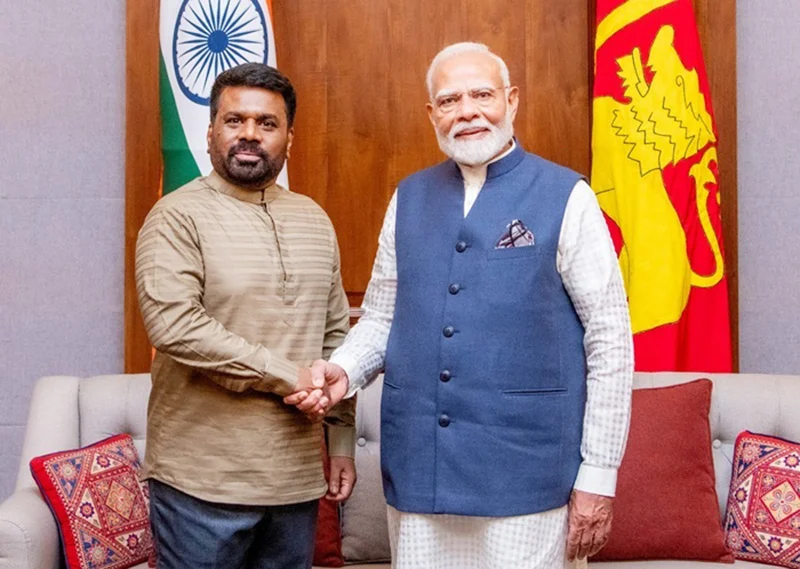
Indian Prime Minister Narendra Modi once again signaled the priority India places on Sri Lanka by swiftly dispatching a shipload of petrol following a telephone conversation with President Anura Kumara Dissanayake. The Indian Prime Minister’s gesture came at a cost to India, where there have been periodic supply constraints and regional imbalances in fuel distribution, even if not a countrywide shortage. Under Prime Minister Modi, India has demonstrated to Sri Lanka an abundance of goodwill, whether it be the USD 4 billion it extended in assistance to Sri Lanka when it faced international bankruptcy in 2022 or its support in the aftermath of the Ditwah cyclone disaster that affected large parts of the country four months ago. India’s assistance in 2022 was widely acknowledged as critical in stabilising Sri Lanka at a moment of acute crisis.
This record of assistance suggests that India sees Sri Lanka not merely as a neighbour but as a partner whose stability is in its own interest. In contrast to Sri Lanka’s roughly USD 90 billion economy, India’s USD 4,500 billion economy, growing at over 6 percent, underlines the vast asymmetry in economic scale and the importance of Sri Lanka engaging India. A study by the Germany-based Kiel Institute for the World Economy identifies Sri Lanka as the second most vulnerable country in the world to severe food price surges due to its heavy reliance on imported energy and fertilisers. Income per capita remains around the 2018 level after the economic collapse of 2022. The poverty level has risen sharply and includes a quarter of the population. These indicators underline the urgency of sustained economic recovery and the importance of external partnerships, including with India.
It is, however, important for Sri Lanka not to abdicate its own responsibilities for improving the lives of its people or become dependent and take this Indian assistance for granted. A long unresolved issue that Sri Lanka has been content to leave the burden to India concerns the approximately 90,000 Sri Lankan refugees who continue to live in India, many of them for over three decades. Only recently has a government leader, Minister Bimal Rathnayake, publicly acknowledged their existence and called on them to return. This is a reminder that even as Sri Lanka receives support, it must also take ownership of its own unfinished responsibilities.
Missing Investment
A missing factor in Sri Lanka’s economic development has long been the paucity of foreign investment. In the past this was due to political instability caused by internal conflict, weaknesses in the rule of law, and high levels of corruption. There are now significant improvements in this regard. There is now a window to attract investment from development partners, including India. In his discussions with President Dissanayake, Prime Minister Modi is reported to have referred to the British era oil storage tanks in Trincomalee. These were originally constructed to service the British naval fleet in the Indian Ocean. In 1987, under the Indo Lanka Peace Accord, Sri Lanka agreed to develop these tanks in partnership with India. A further agreement was signed in 2022 involving the Ceylon Petroleum Corporation and the Lanka Indian Oil Corporation to jointly develop the facility.
However, progress has been slow and the project remains only partially implemented. The value of these oil storage tanks has become clearer in the context of global energy uncertainty and tensions in the Middle East. Energy analysts have pointed out that strategic storage facilities can provide countries with greater resilience in times of supply disruption. The Trincomalee tanks could become a significant strategic asset not only for Sri Lanka but also for regional energy security. However, historical baggage continues to stand in the way of Sri Lanka’s deeper economic linkage with India. Both ancient and modern history shape perceptions on both sides.
The asymmetry in size and power between the two countries is a persistent concern within Sri Lanka. India is a regional power, while Sri Lanka is a small country. This imbalance creates both opportunities for partnership and anxieties about overdependence. The present government too has entered into economic and infrastructure agreements with India, but many of these have yet to move beyond initial stages. This has caused frustration to the Indian government, which sees its efforts to support Sri Lanka’s development as not being sufficiently appreciated or effectively utilised. From India’s perspective, delays and hesitation can appear as a lack of commitment. From Sri Lanka’s perspective, caution is often driven by domestic political sensitivities and concerns about sovereignty.
Power Imbalance
At the same time, global developments offer a cautionary lesson. The behaviour of major powers in the contemporary international system shows that states often act in their own interests, sometimes at the expense of smaller partners. What is being seen in the world today is that past friendships and commitments can be abandoned if a bigger and more powerful country can see an opportunity for itself. The plight of Denmark (Greenland) and Canada (51st state) give disturbing messages. Analysts in the field of International Relations frequently point out that power asymmetries shape outcomes in bilateral relations. As one widely cited observation by Lord Parlmeston, a 19th century prime minister of Great Britain is that “nations have no permanent friends or allies, they only have permanent interests.” While this may be an overly stark formulation, it captures an underlying reality that small states must navigate carefully.
For Sri Lanka, this means maintaining a balance. It needs to clearly acknowledge the partnership that India is offering in the area of economic development, as well as in education, connectivity, and technological advancement. India has extended scholarships, supported digital infrastructure, and promoted cross border links that can contribute to Sri Lanka’s long term growth. These are tangible benefits that should not be undervalued. At the same time, Sri Lanka needs to ensure that it does not become overly dependent on Indian largesse or drift into a position where it functions as an appendage of its much larger neighbour. Economic dependence can translate into political vulnerability if not carefully managed. The appropriate response is not to distance itself from India, but to broaden its partnerships. Engaging with a diverse range of countries and institutions can provide Sri Lanka with greater autonomy and resilience.
A hard headed assessment would recognise that India’s support is both genuine and interest driven. India has a clear stake in ensuring that Sri Lanka remains stable, prosperous, and aligned with its broader regional outlook. Sri Lanka needs to move forward with agreed projects such as the Trincomalee oil tanks, improve implementation capacity, and demonstrate reliability as a partner. This does not preclude it from actively seeking investment and cooperation from other partners in Asia and beyond. The path ahead is therefore one of balanced engagement. Sri Lanka can and should welcome India’s partnership while strengthening its own institutions, fulfilling its domestic responsibilities, and diversifying its external relations. This approach can transform a relationship shaped by asymmetry into one defined by mutual benefit and confidence.
by Jehan Perera
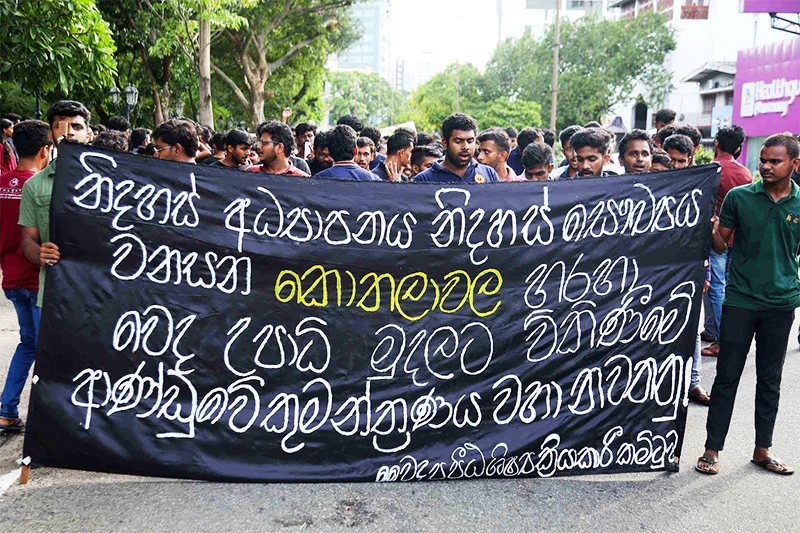
 This Article is formed from listening to university students from across the country for two research initiatives, one on academic freedom and another on higher education policy. In speaking with students, the fears they carry could not be ignored. Students navigate university education, with anxieties about their future and fears that they and their university education are inadequate, all while managing their families’ daily struggles. I explore students’ anxieties and the extent to which we, the public, and higher education policies must take responsibility for their experiences.
The Neoliberal University
For decades, universities have been transforming. Neoliberal policies, promoted by the World Bank, have reduced public education expenditure and weakened the State’s commitment to public institutions. These policies frame individuals as responsible for their success and failure, minimising structural realities, such as poverty and precarity. They instrumentalise education, treat students as “products” for a “competitive’ job market, while education markets feed on students’ insecurities. Students are made to feel lacking in “soft skills”, or skills seemingly necessary to navigate classed-corporate structures, and lacking in technical skills, or those needed to operate technologies used within the private sector.
Student activists and, sometimes teachers, have challenged this worldview, demanding State commitment to free education. Governments sometimes yield but also fear the consequences of student politics and have long waged campaigns to discredit student activism. It is within this context that students pursue education.
Portrayal of students
A Peradeniya student told me student-organised events must meet “high standards”, because of the negative public perceptions of university students. I understood what she meant; I had heard of our ‘ungrateful’, ‘wasteful’, ‘unemployable’, and ‘entitled’ students. The media and decades of government propaganda have reinforced these depictions.
About 10 years ago, when government moves to privatise higher education were strong, a corporate executive, complaining about traffic caused by “yet another useless protest”, was unable to explain why they protested. News coverage, I realised, framed these protests as public inconveniences, rarely addressing students’ demands. A prominent advocate, of neoliberal educational policy, reinforced this narrative, saying “state university students make up just 10 percent of their cohorts”, gesturing dismissively as if to say their concerns were insignificant. Such language belittles student activists and youth, renders them voiceless and allows their concerns, such as classed worldviews, and access barriers to and privatisation of education, to be easily dismissed.
It is in this environment that the conception of the useless university student, fighting for no reason, has developed. Students must carry this misrepresentation, irrespective of their own involvement in activism.
Not being good enough
Attacks on free higher education and the absence of meaningful reforms designed to address students’ problems, now weigh on students’ minds. Students question whether their education is relevant and current, pointing to outdated equipment, software, and curricula. University administrators acknowledge these constraints, which reflect Sri Lanka’s ranking as one of the lowest in the world for the public funding of education and higher education.
Rarely has the World Bank, so influential in driving educational policy, highlighted the public funding crisis and, instead, emphasises technological deficiencies, the public sector’s “monopoly” of higher education and limited private sector involvement. It downplays the reality that few families can privately afford such funding arrangements.
Students are also bombarded with fee-levying programmes, promising skills and access to jobs, preying on students’ insecurities. Many, while struggling to make ends meet, enrol in off-campus pricy professional courses, such as in accountancy, marketing, or English.
The arts student
Some students worry their education is too theoretical and “Arts-focused.” A student from the University of Colombo described having to justify her decision to pursue an arts degree. The public, she said, saw this as a waste of her time and the country’s resources. She courageously wore this identity, yet questioned if she was, in fact, unemployable as she was being led to believe.
She does not, however, draw on the fact that arts education has long been the “cheap” option that governments have offered when pressured to expand higher education. While arts education may need fewer laboratories and equipment, they require adequate investments on teachers, strong on content and pedagogy, to closely engage with individual students; aspects of arts education which have systematically been disregarded.
As access broadens, particularly in the arts, more students from marginalised backgrounds have entered universities; students who may feel alien in systems aligned with corporate interests. Thus, students quite different from the classed conception of the “employable graduate,” whose education has systematically been under-funded, graduate from arts programmes frustrated, diffident, and ill-suited for jobs to which they are expected to aspire.
The dysfunctional university
Students voice criticisms of their teachers, as myopic, unworldly, and unfair. Their perspective reflects the universities’ culture of hierarchy and its intolerance of difference, on the one hand, and the weak institutional structures on the other. They are symptoms of years of neglect and attempts by governments to delegitimise universities, to shed themselves of the burden of funding higher education through anti-public sector rhetoric.
Some students, marginalised for being anti-rag, women, or ethnic minorities, feel an added layer of burdens. Anti-rag students, or more often, students who do not submit to university hierarchies, whether enforced by students or staff, are ostracised, demeaned and sometimes subjected to violence. Students unable to speak the institution’s dominant language face inadequate institutional support. Women describe being ignored and silenced in student union activities and left out of student leadership positions.
Furthermore, quality assurance processes rarely prioritise academic freedom or students’ right to exist as they wish, except when they complement the process of creating a desirable graduate for the job market. These processes focus on moulding professionals and technicians, as one would form clay, disregarding students’ anxieties from being alienated from themselves by such efforts.
Problems at home
Beyond the campus, parents face debt, illness, and precarious work. Students are acutely aware of these struggles. Some describe parents collapsing from the strain and sometimes leaving them to carry the family’s difficulties. A student described feeling guilty for being at the University while his family struggled to survive. To ease the burden on their families, students earn incomes by providing tuition, delivering food, and carrying out microbusinesses.
Tied to their concerns over having to depend on their families, is their fear of being “unemployable”, a term that places the blame of unemployment on students’ skill deficiencies. Little in this discourse connects the lack of decent work and jobs for them and their parents to the weak economy and job markets into which successive batches of graduates must transition. Much of the available jobs in the country are those that require little in the form of education, and those, too do little to provide a living wage. Students must, therefore, compete for a limited number and breadth of frankly not very desirable work. Yet, it is they who must feel the weight of unemployability.
Committing to students
Universities frequently fail to recognise students’ worries. Instead, we, coopt neoliberal discourses, telling students to become more marketable and competitive, do and learn more, be confident, improve English, learn to inhabit those classed spaces with ease; often without the support that should accompany these messages.
We expect these students, insecure and anxious, to think critically, and demonstrate curiosity and higher-order analyses. When they collapse under the pressure, universities respond by providing mental health services. While such services are needed, they risk individualising and pathologising systemic problems. They represent yet again the inherent flaws with solutions that emerge from neoliberal ideological positions that treat individuals as the source of all success and failure. Such perspectives are likely to reinforce students’ anxieties, rather than address them.
As Sri Lanka revisits education policy reforms, there is an opportunity to change our framings of education and to recognise these concerns of students as central to any policy. The state must renew its commitment to free education and move from the neoliberal logic that has guided successive reform efforts; we, as the public, must restore our hope and expectations from free education. Education across disciplines, the arts, as well as STEM (science, technology, engineering and mathematics), must be strengthened. Students’ freedom to inhabit university spaces as they wish, must be respected and protected by institutions. Education policies must be tied to broader economic and labour reforms that ensure families can safely earn a living wage and graduates can access a rich range of decent meaningful work.
(Shamala Kumar teaches at the University of Peradeniya)
Kuppi is a politics and pedagogy happening on the margins of the lecture hall that parodies, subverts, and simultaneously reaffirms social hierarchies.
by Shamala Kumar

 Mihiri Chethana Gunawardena is certainly on the right track, in the music scene.
The plus factor, where Mihiri is concerned, is that she has music deeply rooted in her upbringing, and is now doing her thing in the Maldives.
Her father, Clifton Gunawardena, was a student of the legendary Premasiri Kemadasa and former rhythm guitarist of the Super 7 band.
Mihiri took to music, after her higher studies, and her first performance was with her father, while employed.

Mihiri Chethana Gunawardena
After eight years of balancing both worlds – working and music – she chose to follow her true calling and embraced music as her full-time profession.
Over the years, Mihiri has worked with some of the top bands in the local scene, including D Major, C Plus from Negombo, Heat with Aubrey, Mirage, D Zone Warehouse Project and Freeze.
In fact, she even put together her own band, Faith, in 2017, performing at numerous events, and weddings, before the Covid pandemic paused their journey.
What’s more, her singing career has taken her across borders –performing twice in Dhaka, Bangladesh, with the late Anil Bharathi and the late Roney Leitch, and multiple times in the Maldives, including a special New Year’s Eve performance with D Major.
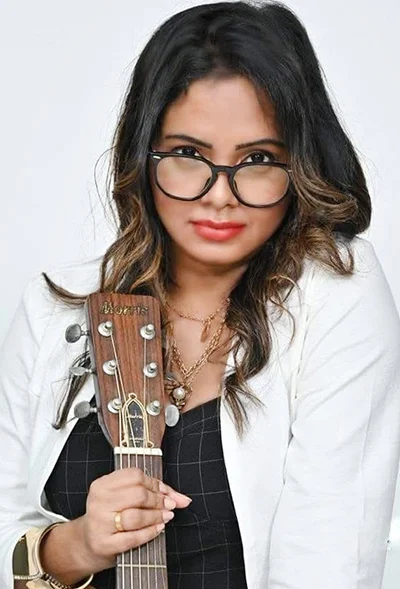
In the Maldives, on a one-month contract
Last year, Mihiri was in Dubai, along with the group Knights, for the Ananda UAE 2025 dance.
She continues to grow as a solo artiste, now working closely with the renowned Wildfire guitarist Derek Wikramanayake, and performing, as a freelance musician, travelling around the world.
Right now, she is in the Maldives, on a one-month contract, marking a new chapter in her evolution as a solo vocalist.
On her return, she says, she hopes to create fresh cover songs and original music for her fans.
Mihiri believes in spreading joy and positivity through her singing, and peace and happiness for everyone around her, and for the world, through music.

Showers may occur at a few places in the Western and Sabaragamuwa provinces and in Galle and Matara districts after 2.00 pm

Burning of low-grade coal at N’cholai plant increases pollution: Parliament

Tariff shock from 01 April as power costs climb across the board

CDL under new management completes major Norwegian ship order

Govt. making arrangements for 3,500 SL Hajj pilgrims

NGO activists warn of ‘democratic dangers’ as PSTA draft bill looms over Parliament

‘Dates have the highest sugar content to fight Coronavirus’

Sunday Island 27 December – Headlines

#SundayIsland 17th December – Headlines

Sunday Island – 28th March

Sunday Island Headlines – 21 March

Sunday Island – 21st February – Headlines
-

 News6 days ago
Senior citizens above 70 years to receive March allowances on Thursday (26)
-

 Features3 days ago
A World Order in Crisis: War, Power, and Resistance
-

 News4 days ago
Energy Minister indicted on corruption charges ahead of no-faith motion against him
-

 News5 days ago
US dodges question on AKD’s claim SL denied permission for military aircraft to land
-

 Business5 days ago
Dialog Unveils Dialog Play Mini with Netflix and Apple TV
-

 News6 days ago
CEB Engineers warn public to be prepared for power cuts after New Year
-

 Sports4 days ago
SLC to hold EGM in April
-
 Latest News5 days ago
A strong Technical and Vocational Education and Training (TVET) system equips individuals with practical, relevant, and future-oriented skills helping to innovate responsibly towards a greener and sustainable future – PM