
Latest News
Delhi Capitals seamers stifle Giants before Jonassen aces the chase

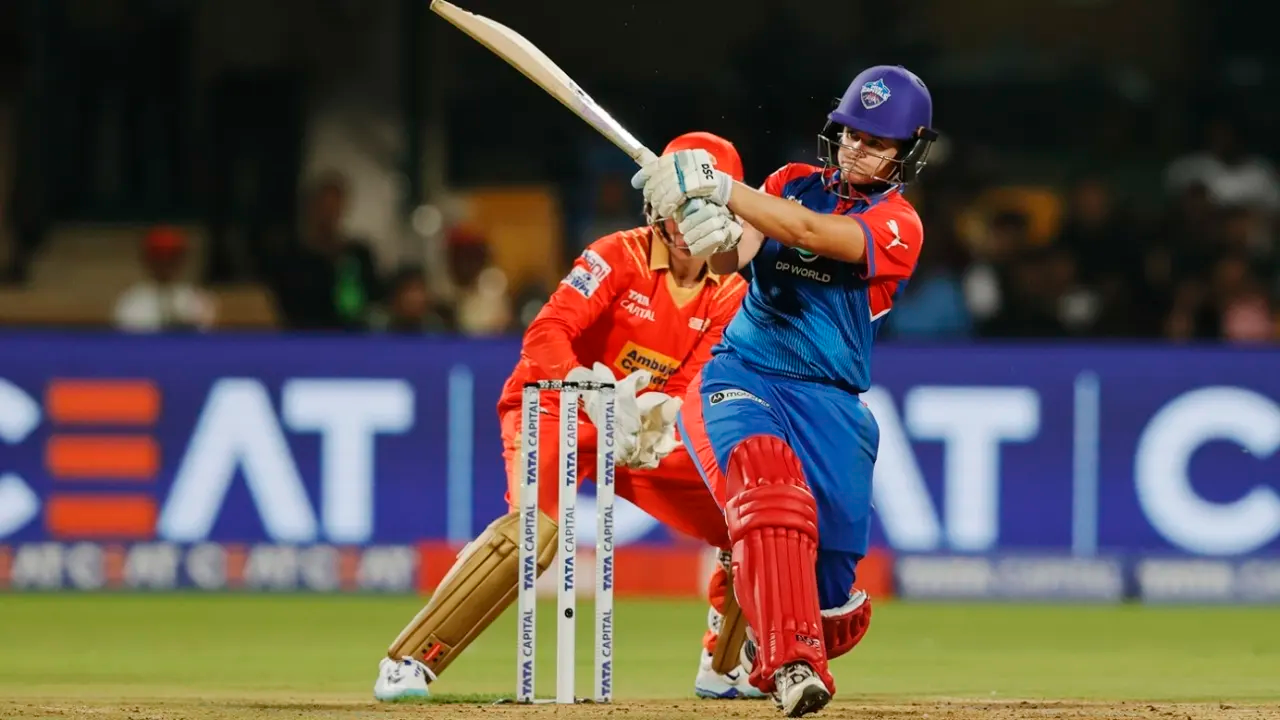
Delhi Capitals (DC) seamers shared seven wickets before Jess Jonassen’s unbeaten 61 off 32 balls made short work of the chase to give her side a six-wicket win over Gujarat Giants (GG). The result lifted DC to the top of the points table at least for the time being. They now have three wins from five outings. GG remain rooted to the bottom with one victory from four matches.
When Meg Lanning put GG in after winning the toss, she hoped for early wickets. Marizanne Kapp and Shikha Pandey did not disappoint their captain. They picked up two each in the powerplay and reduced GG to 20 for 4. Soon it became 60 for 6, and it looked like GG might not even cross 100. But Bharti Fulmali’s 40 not out off 29 balls from No. 8 steered them to 127 for 9.
DC lost Lanning early in the chase but Jonassen, promoted to No. 3, and Shafali Verma added 74 in just 6.1 overs to kill the contest. When Kapp hit the winning boundary, there were still 29 balls left in the match.
As she often does, Kapp got the ball to shape away from right-hand batters consistently. Harleen Deol, opening the innings, nicked one such delivery but the edge fell just short of Lanning at first slip.
Deol could not enjoy her luck for long, as Kapp induced another outside edge in her next over. This time the ball carried comfortably into the gloves of Sarah Bryce. Phoebe Litchfield, who had replaced Laura Wolvaardt in the XI, lasted just three balls; Kapp trapped her lbw for a duck.
Kapp’s double-wicket maiden left GG on 16 for 2 after four overs. In the next over, Pandey made it far worse with back wickets on back-to-back deliveries. Beth Mooney had started the over by crunching Pandey through the covers for four. Pandey switched to around the wicket, and found immediate success as Mooney’s pick-up shot landed into Niki Prasad’s hands at long leg.
Pandey and Prasad combined once again the next delivery to see the back of Kashvee Gautam, whose attempted pull from well outside off stump skied towards deep midwicket. Prasad ran in and dived forward to complete a low catch.
For the hat-trick ball, Pandey went short again. She beat Deandra Dottin on the pull and hit her on the helmet. After a concussion check, Dottin flat-batted the next ball down the ground for four. In the next over, she repeated the shot against Kapp for the same result. Those boundaries lent the score some respectability as GG finished the powerplay on 31 for 4.
In the ninth over, Titas Sadhu castled Ashleigh Gardner, GG’s captain and their in-form batter, for 3 off 9 balls. Two overs later, Annabel Sutherland put an end to Dottin’s counterattack. But Fulmali, playing her first game of the season, led the fightback. In the 15th over, she pulled Minnu Mani over deep square leg for the first six of the innings. Along with Tanuja Kanwar, she added 51 in 40 balls for the seventh wicket and steered the side past 120.
Lanning is the second highest run-getter in the WPL. But apart from her 69 against UP Warriorz, she has struggled this season. Tuesday was no different. After being beaten by Dottin in the opening over, she tried to pull Gautam. But the ball came back in sharply to flatten her off stump. She made 3 off 13 balls.
It has been a case of diminishing returns for Lanning. In the 2023 season, she scored 345 runs at an average of 49.28 and a strike rate of 139.11. The following season, while her runs tally remained almost the same, her strike rate dropped to 123.04. This time, her numbers read: 109 runs from five innings at an average of 21.80 and a strike rate of 103.80.


An estimated 550,000 people took part in demonstrations across France today to protest against teaching conditions in schools, rising fuel prices and the cost of living.
Marches were largely peaceful and took place in several major French cities, including Paris, where 110,000 people attended.
“We just want to study, we just want a future” one student taking part in the protest in the capital told BBC News, while another said they were ” just trying to make things change”.
But French Interior Minister Laurent Nunez said some groups “at the margins of these protests” caused the situation to “degenerate”.
According to the French Prime Minister Sébastien Lecornu, 1200 people were arrested. Officials also reported looting in cities such as Marseille, where masked 8ntruders also entered the city hall. In Lyon, the tourist office was set on fire and shops were damaged.
French President Emmanuel Macron said any vandals and looters would be “prosecuted and punished”, while Jean-Luc Mélenchon, the leader of left-wing party La France Insoumise, said demonstrations had been calmly mobilised.
Meanwhile, firefighters are continuing to battle a blaze at Limoges City Hall after a reported break-in and arson inside the 19th-century building during protests there.
(BBC)

A large fire near a Canadian military base in Alberta has killed and injured some people, the defence minister said, without confirming the number of casualties.
The Canadian Armed Forces were working with local authorities to manage the fire and were looking into what caused it, David McGuinty said, describing the situation as “very, very active and delicate”.
Canada’s Prime Minister Mark Carney said on X that a “serious incident creating a major fire” had occurred, adding his “thoughts are with all the brave women and men affected”.
Canadian Forces Base Wainwright, where the fire broke out, is one of the country’s busiest military training bases.
The blaze “spread rapidly due to high winds” and had torn through the fences of the base, the Municipal District of Wainwright said.
McGuinty told reporters he “cannot recall an incident like this in recent memory”.
It is unclear when the fire broke out, but the district first posted about the incident at about 17:30 local time.
Local authorities have urged residents to avoid the area and give all emergency vehicles right of way.
(BBC)

The Asian Youth Games gold medallist who has run sub four minutes previously returned a time of 3:55.97 seconds to become the first athlete in his age category at these championships to run the distance under four minutes.
Achintha who has a personal best of 3:53.05 from last year was representing Prince College Ratnapura today.
In another impressive 1,500 m feat Tharushi Abhisheka of Lyceum International School, Wattala established a new meet record in the Under-20 Girls’ 1,500m as she returned a time of 4:34.59 seconds to win.
By the end of the second day of the meet seven new meet records had been established.
D. V. C. de Soysa (of Galewela Central College) Under-16 Boys’ Discus Throw – 55.83m.
D. G. Lahiru Achintha (of Ratnapura Kumara Vidyalaya) Under-18 Boys’ 1,500m – 3:55.97 secs.
W. P. Nethula Induwara (Rahula College, Matara) Under-14 Boys’ 100m – 11.70 seconds
K. V. R. Gayesha (Ira Handa Kotuwa Wewa Maha Vidyalaya, Polonnaruwa) Under-16 Girls’ High Jump – 1.70m
H. M. D. S. Herath (Maris Stella College, Thimbirigaskatuwa) Under-20 Boys’ Long Jump – 7.65m
P. M. Amaya Semindi (Vijitha Central College, Dikwella) Under-14 Girls’ High Jump – 1.58m

Record 1,600 students take Russian Classical Ballet examination in Sri Lanka

Half a million people join protests in France, but some turn violent

Deadly fire breaks out at Canada military base

Showers or thundershowers will occur in most parts of the island after 1.00 p.m.

Buddhist hierarchy demands prison perks for monk convicts

Debate on NCM against Speaker postponed indefinitely

‘Dates have the highest sugar content to fight Coronavirus’

Sunday Island 27 December – Headlines

#SundayIsland 17th December – Headlines

Sunday Island – 28th March

Sunday Island Headlines – 21 March

Sunday Island – 21st February – Headlines
-

 Latest News5 days ago
Nissanka’s return headlines Sri Lanka’s Test squad against Pakistan
-

 Latest News7 days ago
Farhan and Sadaqat help Pakistan seal series in style
-
 Features7 days ago
Intake 16: 45 years of duty and honour
-

 News7 days ago
Malwathu Chapter issues statement on talks with President over Gnanasara Thera’s robes
-

 News7 days ago
CP alleges NPP has taken the blame for illegal US sanctions on Iranian vessels
-

 News5 days ago
Sri Lanka, India caught in US-Iran ship crisis
-

 Opinion7 days ago
How long can Sri Lanka remain silent on its demographic crisis?
-

 Latest News5 days ago
Kusal Mendis’ unbeaten 87 hands Sri Lanka consolation win