
News
WNPS files Supreme Court challenge against wind power project in Mannar Island


In a significant move aimed at protecting the unique ecosystem of Mannar Island, environmental protection organization, Wildlife and Nature Protection Society (WNPS), has filed a fundamental rights application in the Supreme Court. This legal action challenges the recent cabinet decision to award a wind power project in Mannar Island to Adani Green Energy Limited of India.
The Petitioner WNPS is represented by President’s Counsel Sanjeeva Jayawardana with Prashanthi Mahindarathe, Revan Weerasinghe and Rukshan Senadheera, instructed by S.W.A Amila Kumara.
WNPS, known for its staunch advocacy for environmental conservation, argues that the project poses a severe threat to the island’s unique biodiversity and pristine landscapes especially in the Mannar Island. The island itself is home to several protected areas such as the Adam’s Bridge National Park, the Viduthalaithivu National Park and the Vankalai Sanctuary.
The former two were declared RAMSAR wetlands only a few months ago by Minister Pavithra Wanniarachchi. In addition, Mannar is the southernmost point of the Central Asian Flyway used by innumerable migratory species, while also being home to several indigenous water bird and bat species.
WNPS contends that the decision to approve the project was made without any appreciation of Mannar’s singular positioning as a biodiversity hub, violating both national environmental protection laws as well as international Conventions. The island’s diverse ecosystems, including mangroves, coral reefs, and wetlands, play a crucial role in maintaining the region’s environmental balance. The organization states that a severe threat exists that the construction and operation of the wind power project could lead to irreversible damage to these ecosystems.
The Petitioner contends that the manner and form of these actions by various authorities grossly abuse the doctrine of public trust reposed in authorities like the Forest Department and Department of Wildlife that have blithely ignored the irreparable ramifications of this project in a protected area replete with vulnerable species and war affected population struggling to survive.
The proposed Adani project will potentially raise the number of turbines on Mannar Island to 82, supplementing the 30 turbines existing as part of the Thambapawani project which has already caused staggering numbers of bird deaths, more than anticipated by the ornithologists consulted on the project. If allowed to continue unabated the extension to the Adani project – titled Phase III – will pockmark Mannar island with 103 turbines across nearly 66% of Mannar’s land mass which has been declared Energy Development Areas.
As one of the oldest conservation organizations in the world, the WNPS challenges the credibility of the Environmental Impact Assessment carried out by the Sustainable Energy Authority of Sri Lanka [SEASL] on behalf of Adani Green Energy. In fact, at page xxi of the Environmental Impact Assessment, it has categorically been admitted that “in the case of Thambapawani Wind Power Project, higher bird collision risks than predicted have occurred, as there are reported bird collision in the transmission lines”.
WNPS argues that this alone should act as a deterrent to proceed with this Project in Mannar, which contradicts the principles of sustainable development. While recognizing the need for renewable energy sources, the organization insists that such projects must be planned and executed in a manner that safeguards environmental integrity. This is particularly so when the EIA itself has identified alternative locations that are more suitable to set up a wind power farm and provides no rationale for how Mannar – the most vulnerable site – was chosen.
The Petitioner highlights a conflict of interest between SLSEA’s role as regulator and their purported role as agent for the Adani group. Given that SLSEA also functions as a regulator, this dual role is inappropriate and raises concerns about the integrity of SLSEA’s actions. The Petitioner deems it shocking that a regulatory body is acting as a project proponent, suggesting that SLSEA’s actions are motivated by extraneous considerations and self-interest.
Under Section 16 of the Sri Lanka Sustainable Energy Act No. 35 of 2007, no entity can undertake an on-grid renewable energy project without a permit from SLSEA. Section 17 grants SLSEA’s project approving committee the authority to issue provisional approvals, and Section 18 mandates this committee to approve or reject final project applications. Thus, SLSEA is the primary licensing authority, making its role as an agent for Adani Green Energy in seeking an EIA particularly inappropriate and illegal.
The Petitioner is also concerned with the SEASL’s line Minister tabling power purchase prices in Parliament far in excess of those assessed in the EIA and entirely disproportionate with regional prices by the same supplier. The Petitioner is concerned that the Minister of Power and Energy Energy intends to approve the project despite lacking the statutory authority to act as the Project Approving Authority, which should be SLSEA.
The EIA estimates the cost of power generation at USD 0.046 per kWh, while the Minister stated it would be USD 0.0885 per kWh. The Petitioner finds the discrepancy alarming, as the contract negotiations are based on a price nearly double the EIA estimate. Despite a later revision to USD 0.0826 per kWh, no valid reasons were provided for this increase. The Petitioner asserts that the project cannot be approved with such escalated costs without overhauling the EIA to reflect the actual cost of power generation.
Finally, the Technical Evaluation Committee recommended a tariff of USD 0.075 per kWh, yet the Cabinet approved a higher cost without explanation, violating procurement procedures. The Petitioner requests the court to call for the recommendations or reports made by the Technical Evaluation Committee and the Cabinet Appointed Negotiation Committee under Article 126 of the Constitution.
The Petitioner notes the project has been portrayed to the public as a Government-to-Government initiative with India, yet no details of contributions, grants, or loans from the Indian government have been disclosed.
Additionally, the project lacks a competitive bidding process, and the Swiss Challenge method has not been followed, violating procurement guidelines. Given the project’s proximity to protected areas, it required assessments and approvals from the Department of Wildlife Conservation (DWC) and the Coast Conservation Department (CCD), which were omitted, rendering the EIA void and unlawful.
WNPS’s legal challenge seeks to ensure that the government adheres to the principles of environmental justice and accountability while supporting the Governments push towards renewable energy. The organization calls for a thorough review of the decision-making process, emphasizing the need for transparency, scientific rigour, and public participation.
As the nation awaits the Supreme Court’s response, the outcome of this case will be closely watched by environmentalists, policymakers, and the general public on whom the tariff burden will eventually rest. The decision will not only impact the future of Mannar Island but also shape the broader landscape of environmental governance in Sri Lanka.








Latest News
Sun directly overhead Kalpitiya, Talawa, Sinharagama, Galkadawala, Nachchaduwa, Padikaramaduwa, Gomarankalla and Verugal about 12.10 noon today (01)


The sun is going to be directly over the latitudes of Sri Lanka from 28th of August to 07th of September due to its apparent southward relative motion.
The nearest places of Sri Lanka over which the sun is overhead today (01) are Kalpitiya, Talawa, Sinharagama, Galkadawala,
Nachchaduwa, Padikaramaduwa, Gomarankalla and Verugal about 12.10 noon.

… stresses need for action if claims were proved false
Samagi Jana Balawegaya (SJB) MP Dayasiri Jayasekera has sought a clarification from Speaker Dr. Jagath Wickremaratne regarding several allegations against Chief Justice Preethi Padman Surasena, in Parliament, recently.
In a letter dated 31 August, Jayasekera has asked the Speaker whether he received any documentary evidence from MPs in support of the allegations at issue. The SJB MP has also inquired about the steps taken by the Speaker regarding the allegations and whether the issue had been taken up with the relevant agencies authorised to probe the assets of the CJ and members of his family.
MP Jayasekera confirmed that he had raised the issue with the Speaker, following the accusations relating to the high profile X-Press Pearl case, which received significant public attention in the recent past.
The Kurunegala District MP has also asked the Speaker whether the latter contemplated taking action in case the allegations were proved false to ensure that the dignity of the Chief Justice and the judiciary was safeguarded.
Among the issues raised by MP Jayasekera are the acquisition of valuable property in Colombo by the CJ’s son, the circumstances in which he was able to procure the property, as well as accusations regarding the CJ’s birth certificate, marriage certificate and birth certificates of his children.
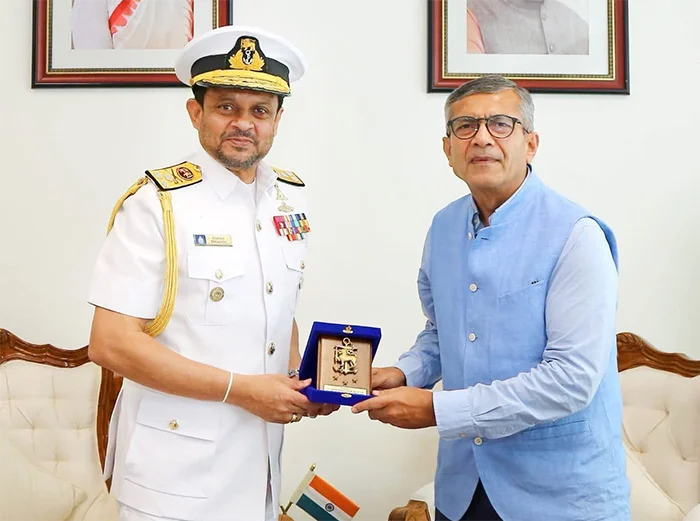
Navy Chief Vice Admiral Damian Fernando held a series of strategic-level discussions with senior Indian defence and military officials during a three-day official visit to New Delhi. He returned on Sunday (30).
Navy Headquarters said that the two sides discussed ways to further strengthen maritime security cooperation between the two Navies in support of security in the Indian Ocean region. They also exchanged views on expanding training opportunities and capacity-building programmes, as well as other areas of bilateral importance.
During his visit to New Delhi, Vice Admiral Fernando also held official discussions with India’s Chief of Defence Staff, General N.S. Raja Subramani, Defence Secretary Rajesh Kumar Singh and Vice Chief of the Air Staff, Air Marshal Ashutosh Dixit and defence industry representatives. Discussions at these meetings focused on bilateral defence cooperation, joint training programmes, and opportunities to enhance air and maritime cooperation in the Indian Ocean Region.
As part of efforts to further expand cooperation in naval training and professional development, Vice Admiral Fernando also met Vice Admiral Sameer Saxena, Flag Officer Commanding-in-Chief of India’s Southern Naval Command, at its headquarters in Kochi, Kerala. The two sides discussed existing naval training exchange programmes and opportunities for introducing and expanding further training initiatives. The meeting followed the Commander of the Sri Lanka Navy’s visit to INS Dronacharya, the Indian Navy’s training establishment where he previously completed the Long Gunnery and Missile Course.

Nahida, Marufa help Bangladesh brush aside Indonesia

Showers will occur in the Western, Sabaragamuwa, Southern and Uva provinces and in Kandy and Nuwara-Eliya districts

Sun directly overhead Kalpitiya, Talawa, Sinharagama, Galkadawala, Nachchaduwa, Padikaramaduwa, Gomarankalla and Verugal about 12.10 noon today (01)

SJB asks what Speaker intended to do about allegations against CJ

Navy Chief attends strategic-level discussions in Delhi

ICRS: Sustained and collective efforts critical to address issue of missing persons

‘Dates have the highest sugar content to fight Coronavirus’

Sunday Island 27 December – Headlines

#SundayIsland 17th December – Headlines

Sunday Island – 28th March

Sunday Island Headlines – 21 March

Sunday Island – 21st February – Headlines
-

 News4 days ago
Eight politicians in drug kingpin probe
-

 Features2 days ago
“Wrap Me Up in My Blazer”— A Gentlemanly Bradby Reminiscence
-

 Business4 days ago
Sri Lanka opens up: A new season of direct connectivity
-

 Features4 days ago
Redefining ageing in Sri Lanka
-
 Features6 days ago
Insights from Chieftains of Uva: Genealogy of two Kandyan Families – Part II
-
 Latest News5 days ago
Nepal-Tibet floods: What happened, what caused them and who is missing?
-

 Editorial6 days ago
Warning of power cuts: El Niño and corruption
-

 Features6 days ago
Export diversification: Missing the wood for the trees – Part I