
Latest News
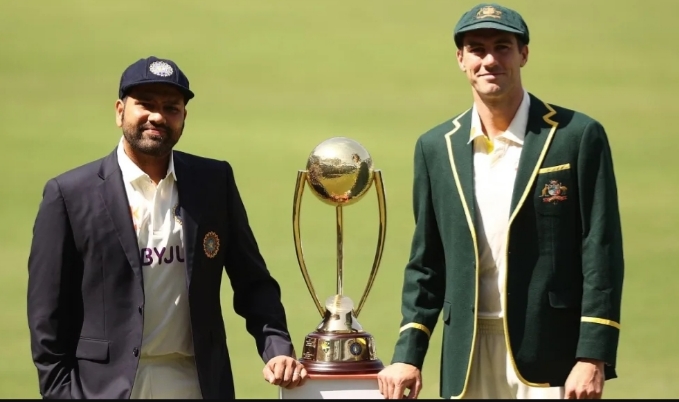
Winners of WTC final between Australia and India to take home US$ 1.6 million








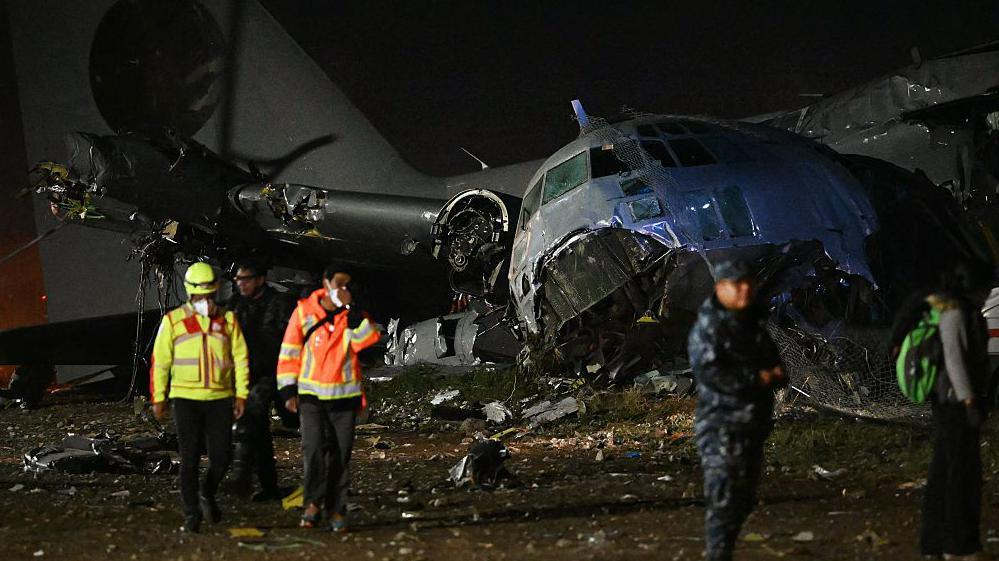
At least 11 people have been killed after a Bolivian air force cargo plane crashed in the western city of El Alto, according to media reports quoting firefighters.
The incident happened at 18:15 local time (22:15 GMT) on Friday as the plane was arriving at El Alto’s airport from the city of Santa Cruz, aviation officials said. It reportedly skidded off the runway and hit nearby vehicles.
The defence ministry later confirmed its C-130 Hercules was involved and that it had been transporting banknotes to the Central Bank of Bolivia. It did not say how many people were on board, and gave no casualty numbers.
Police fired tear gas to disperse crowds allegedly trying to take the scattered banknotes.
Video footage showed people running away from the tear gas and police officers, some holding shields, forming a line. Some in the crowds are seen throwing rocks at police.
The crashed plane can be seen on the ground and badly damaged vehicles can be seen in other videos.
“I want to make it clear to those who are trying to take money from the plane involved in this tragedy that this money has no legal value since it has not been issued by the Central Bank and does not have a serial number, and that attempting to use this money is a crime,” the Minister of Defence, Marcelo Salinas, said.
“We also ask all those who are engaging in acts of vandalism in this area to refrain from doing so and to respect the mourning and grief we are experiencing at this difficult time.”
Firefighters working at the crash site said that at least 20 people were injured, local media reported.
El Alto International Airport was temporarily closed following the crash.
“My sister told me that she was in the car when the plane crashed. The plane’s tire fell on the car, and my sister was injured because the impact of the tire hit her on the head, so we rushed her to the hospital,” a man told the Reuters news agency.
It was not immediately clear what caused the crash, but some witnesses said the weather at the time was treacherous.
“A heavy hailstorm” was falling and “there was lightning” when the plane went down,” a woman whose car was struck by the aircraft wreckage told the AFP news agency.
An investigation into the incident is under way.
[BBC]
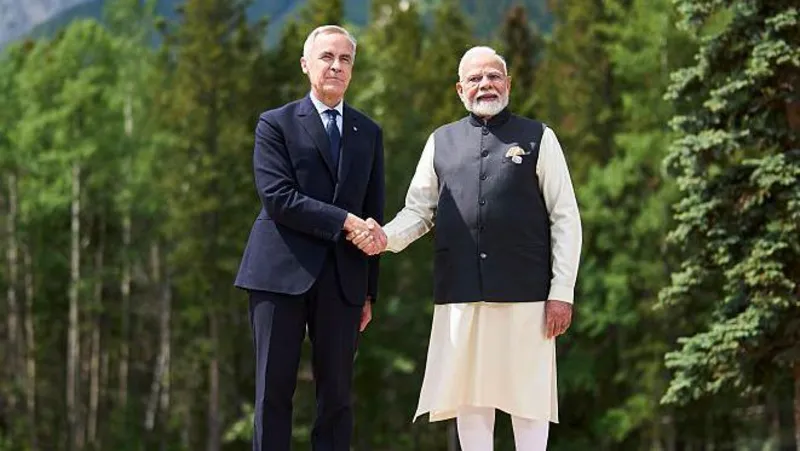
Canadian Prime Minister Mark Carney is in India for a pivotal trip aimed at repairing ties with the world’s largest democracy, as both countries seek to reduce their trade reliance on the US.
Carney began his visit in Mumbai, where he is meeting with business leaders. He will then travel to New Delhi for talks with Prime Minister Narendra Modi.
The trip marks a remarkable turnaround in relations, which had collapsed when Canada accused India of carrying out an extrajudicial killing of a Canadian Sikh separatist on Canadian soil — an allegation India strongly denied.
Both sides now appear ready to move forward.
Here’s what has changed, and what each country hopes to gain as Carney’s trip gets underway.
For Carney, this trip is strictly business, aligned with his broader goal of diversifying Canada’s trade partners to reduce economic dependence on the US.
A big focus will be making progress on a comprehensive free trade agreement with India, which has been discussed on-and-off for the last 15 years.
The latest derailment in trade talks occurred after former Prime Minister Justin Trudeau made a bombshell public accusation against India in 2023, alleging it was involved in the killing of Hardeep Singh Nijjar, a Sikh separatist, who was gunned down in British Columbia. Four men were later charged in his death, and their case is still before the courts.
India has repeatedly denied any involvement.
Now faced with US tariffs, and under Carney’s more “pragmatic” approach to foreign policy, Ottawa is repairing ties with Delhi.
Still, the allegations remain a point of contention for some members of Canada’s Sikh community, who say they continue to be targeted by India through transnational repression, and have criticised Carney for prioritising economic interests over their safety.
It is a situation that will require “delicate handling”, Vina Nadjibulla, vice-president of the Asia Pacific Foundation of Canada, told the BBC.
Asked repeatedly about these concerns, Canadian officials told reporters ahead of Carney’s trip that the two countries are engaged in “robust” discussions on national security and foreign interference.
They added that Canada does not believe the Indian government is currently linked to any violent crimes or threats on Canadian soil, and that they “probably would not be taking this trip” if that were the case.
Not everyone is convinced. Sukh Dhaliwal, an MP from Carney’s Liberal party, told Canadian media that the claim of India no longer being a threat is “disconnected from the reality”.
Canada has made several diplomatic overtures to India since Carney took office last year, beginning with inviting Modi to the G7 summit in Kananaskis, Alberta last summer.
That was followed by a series of meetings between Foreign Minister Anita Anand and her Indian counterpart, S Jaishankar, as well as a visit to Ottawa last month by India’s national security advisor, Ajit Doval.
Carney’s itinerary in India offers some insight into his priorities.
He will stop only in Mumbai, India’s financial hub, to meet with business leaders, and New Delhi, where he will sit down with Prime Minister Modi on Monday.
Unlike Trudeau, Carney will not be visiting cultural sites like the Taj Mahal. Nor will he travel to Punjab, the home state of many of India’s Sikhs, which was a stop for both Trudeau and another former prime minister, Stephen Harper.
Those stops were often seen as nods to Canada’s large Indo-Canadian and Sikh communities. Their omission signals that, this time, Canada’s focus is squarely on trade.
On the agenda will be discussions around energy, technology, artificial intelligence and defence, Carney’s office has said, as well as attracting top talent to Canada.
Carney and Modi are also likely to discuss tariff policies enacted by President Donald Trump, which have had an impact on both their economies.
Heading into the trip, Canada remains the only G7 country that has not reached a preferential trade agreement with India. Nadjibulla of the Asia Pacific Foundation of Canada said that fact “adds urgency” for Carney.
“There is a window of opportunity, and it needs to be seized,” Nadjibulla said.
It was in 2024, not too long ago, that both countries were openly trading barbs, suspending visa services and expelling diplomats.
But a lot has changed since then.
India is now more open for business, which is evident from a flurry of free trade deals that it has signed recently.
Then there is Trump, who has targeted both India and Canada with steep tariffs.
In Carney’s own words, the world is “in the midst of a rupture, not a transition” and “if you are not at the table, you are on the menu”.
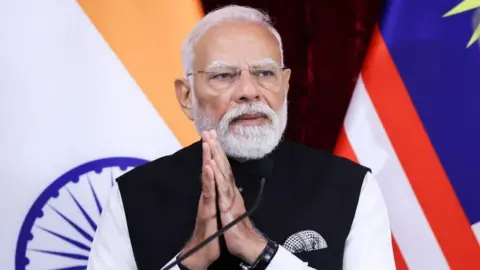
For India’s Prime Minister Modi, a reset with Canada is a win-win situation.
Domestically, the visit will boost Modi’s image as a leader who refused to come under pressure from Canada.
Ottawa has already said it believes India is not currently linked to violent crimes or threats on Canadian soil.
But more broadly, it is the trade potential between the two countries that will drive the outcome of this visit.
[BBC]

Pakistan’s habitual desperate net-run-rate calculations towards the tail-end of a group stage have thrown up another classic. In what is a dead-rubber for already-eliminated hosts Sri Lanka, Pakistan have been given a faint shot at staying alive in the T20 World Cup, thanks to a surprise comeback win for England over New Zealand. New Zealand boast a vastly superior net run rate (1.390) to Pakistan’s (-0.461), so for Salman Agha’s men to progress to the semi-finals, they must win today [Saturday] by around 64 runs, or chase any Sri Lankan target in about 13.1 overs. Those, for Pakistan, are the only numbers that matter in Pallekele.
That should, in theory, change the somewhat conservative approach they have taken through the middle overs. Frankly put, Babar Azam’s place in this T20I set-up was getting hard enough to argue for in regular T20I circumstances, but within these constraints is borderline unjustifiable. He, however, is not the only player whose strike-rate ceiling is limited, with captain Salman Agha similarly struggling this tournament, and indeed over the broader span of his T20I career.
However, Pakistan are yet to show any evidence of an ability to rack up a win of that sort of scale at this tournament so far. Indeed, Pakistan have never won by that margin against a Full Member at a T20 World Cup when batting first, and only once – in 2009 – when chasing. The slower surfaces of Sri Lanka compared to the flatter pitches in India make a path to such a victory more complicated, as does a Pakistani middle order that doesn’t boast elite power hitting, and Saim Ayub’s faltering form. But it’s a chance nonetheless, and at ICC events, sometimes that’s all Pakistan ask for.
There’s little other than pride at stake for Sri Lanka, whose tournament started with such promise, only to peak and fall away after a glorious win over Australia. They have lost their last three matches, and were the first side to be knocked out in the Super Eight. Pakistan’s qualification scenarios mean little to them, and they’ll want to demonstrate they are more than foil for Pakistani glory, or a roadblock to their progression.
The story, though, is of what Pakistan can possibly achieve, and whether they can thwart New Zealand’s progress to yet another ICC tournament semi-final.
A lot of Sri Lankan players will invariably be moved on after this T20 World Cup, but one who is set to form the core of the side for the next generation is Dunith Wellalage. The 23-year old left arm spinner’s competitive attitude makes him one of a short list of Sri Lankan players to have come out of this tournament with his reputation bolstered, and he has an ever-improving skill-set to go with it. He is yet to play a T20I against Pakistan, having missed their Asia Cup clash, flying home for a family bereavement. But with a surfeit of right-hand batters in Pakistan’s top order, he could find himself deployed early on as he was against New Zealand, perhaps to nip Sahibzada Farhan in the bud at the outset.
Salman Agha should perhaps be under more scrutiny than he is, having endured an indifferent tournament with the bat and an uninspiring one as captain. The questions swirling around his fitness for the format will only intensify after he let games drift with the ball against India and England, while his attempted aggression with the bat at No. 3 continues to feel feigned rather than organic. He has scored 60 runs in five innings at this tournament, 38 in one innings against Namibia. If Pakistan exit tamely, it is hard to envision him hanging on to the armband, and perhaps even his role in the side. However, Saturday perhaps represents one final chance for him to take control of his destiny.
Sri Lanka faced plenty of criticism for their meek capitulation against New Zealand, but as the tournament closes out, wholesale changes are not likely. Kusal Mendis suffered hamstring stiffness against New Zealand and is unlikely to play, with Kamil Mishara returning as wicketkeeper-batter.
Sri Lanka (probable): Pathum Nissanka, Kamil Mishara (wk), Charith Asalanka, Pavan Rathnayake, Kamindu Mendis, Dasun Shanaka (capt), Dushan Hemantha, Dunith Wellalage, Dushmantha Chameera, Maheesh Theekshana, Dilshan Madushanka
Shaheen Afridi’s performance against England makes it likely he will keep his spot. If Pakistan are to stick to two specialist seamers on this surface, it makes it a straight shootout between Naseem Shah and Salman Mirza. What’s less certain is how the equation changes Pakistan’s batting line-up. So far, they have been reluctant to drop Babar Azam, or play Khawaja Nafay. Any caution needs to go out of the window as they battle to stay alive.
Pakistan (probable): Sahibzada Farhan, Saim Ayub, Salman Agha (capt), Babar Azam/Khawaja Nafay, Fakhar Zaman, Shadab Khan, Usman Khan (wk), Mohammad Nawaz/Faheem Ashraf, Shaheen Afridi, Salman Mirza/Naseem Shah, Usman Tariq
[Cricinfo]

At least 11 killed after military plane carrying banknotes crashes in Bolivia

Six balls that changed the night

“We welcome investors and tourists visiting Sri Lanka who contribute to strengthening economic and cultural ties”– PM

A ‘delicate’ balance for Canada and a ‘win-win’ for Modi as Carney visits India

Pakistan face stiff but straightforward equation for semi-final qualification

Chief Sanghanayaka of Sabaragamuwa Province felicitated

‘Dates have the highest sugar content to fight Coronavirus’

Sunday Island 27 December – Headlines

#SundayIsland 17th December – Headlines

Sunday Island – 28th March

Sunday Island Headlines – 21 March

Sunday Island – 21st February – Headlines
-

 Features6 days ago
Why does the state threaten Its people with yet another anti-terror law?
-
 Features6 days ago
Reconciliation, Mood of the Nation and the NPP Government
-

 Features6 days ago
Victor Melder turns 90: Railwayman and bibliophile extraordinary
-

 Features5 days ago
LOVEABLE BUT LETHAL: When four-legged stars remind us of a silent killer
-
 Features6 days ago
Victor, the Friend of the Foreign Press
-

 Business5 days ago
Seeing is believing – the silent scale behind SriLankan’s ground operation
-

 Business5 days ago
Bathiya & Santhush make a strategic bet on Colombo
-

 Features6 days ago
Barking up the wrong tree