
News
UNP-SJB merger imperative, cannot be delayed under any circumstances-Ranil loyalist


‘Our fate shouldn’t depend on disastrous leadership tussle’
By Shamindra Ferdinando
Former parliamentarian and UNP working committee member Ashu Marasinghe yesterday (18) said that the party would be totally eliminated unless the current leadership swiftly reached a consensus with the main Opposition, the SJB.
“We are in such a pathetic situation, immediate amalgamation of the UNP and the SJB is required,” Marasinghe said, urging both UNP leader Ranil Wickremesinghe and SJB leader Sajith Premadasa to take a step back.
In a brief interview with The Island, the ex-MP declared that a section of the decision-making body pushed for merger of the two parties ahead of the general election but was thwarted by a small but influential group consisting of former parliamentarians.
Had Wickremesinghe listened to us, the party could have averted an unprecedented debacle at the general election, theWickremesinghe loyalist said. The dejected politician stressed that the crux of the matter in the run up to both the presidential elections held on Sept. 21 and the general election on Nov. 14 had been whether the UNP and SJB should contest under the ‘elephant’ symbol.
A section of the UNP, in early 2020, secured the Election Commission’s recognition as the SJB.
But, unfortunately, both leaderships had failed to comprehend what Marasinghe called developing ground realities and relentlessly pursued irrational strategies, he said, disclosing how he personally tried to convince the party leader to contest the general election under the ‘elephant’ symbol. Responding to another query, Marasinghe said that former parliamentarians Akila Viraj Kariyawasam, Navin Dissanayake, Rosy Senanayake and Harin Fernando, too, pushed for the ‘elephant’ symbol.
Marasinghe entered Parliament on the UNP National List at the 2015 general election. He contested the 2020 general unsuccessfully. The UNP that obtained 106 seats at the 2015 general election was reduced to just one National List seat at the following election in 2020.
“We had that particular discussion at the Flower Road Office of the leader. However, the group opposed to our proposal succeeded in convincing Wickremesinghe,” Marasinghe said. Pointing out that Wickremesinghe had been able to secure nearly 2.3 mn votes at the presidential and was placed third in that contest, Marasinghe said they could obtain just 500,000 a couple of weeks later. The combined UNP-rebel Pohottuwa faction had been reduced to just five MPs whereas the SJB secured 40 seats though their tally at the previous general election was 54.
The NPP achieved the unthinkable 159 seats – the first 2/3 majority under the PR system that had been introduced in 1989, he said.
Having failed to convince the leader, Marasinghe decided against contesting the general election. “Of course, I exercised my franchise in the Colombo district,” Marasinghe said had they contested under the ‘elephant’ symbol the party could have secured at least one seat each from all electoral districts, in addition to two to three National List slots.
Declaring that they could have obtained two seats in the Gampaha district, the ex-parliamentarian said during the general election campaign not only in Gampaha but in other areas as well, UNPers warned that their support would depend on the merger of the UNP with the SJB or the party fielding candidates under the ‘elephant’ symbol. “I brought this situation to the notice of the party leader, warning him of dire consequences of ignoring stark warning. But, Wickremesinghe didn’t relent,” Marasinghe said.
Acknowledging that the National People’s Power (NPP), under President Anura Kumara Dissanayake’s leadership, had been destined to win the general election comfortably, Marasinghe asserted, however the NPP could have been deprived of the unprecedented 2/3 majority if they contested under the ‘elephant’ symbol instead of the ‘gas cylinder’ of the New Democratic Front (NDF).
The NDF previously had a ‘swan’ symbol and changed it to the ‘gas cylinder’ at the last moment to contest this year’s general election. Field Marshal Fonseka, Maithripala Sirisena and Sajith Premadasa contested the 2010, 2015 and 2019 presidential election, respectively, on the NDF ticket.
At the 2024 presidential election, the SJB leader polled 4.3 mn votes and Wickremeinghe nearly 2.3, therefore they had jointly obtained well over 6 mn votes whereas Dissanayake managed to get only 5.6 mn, Marasinghe said. That should have influenced the UNP and SJB to reach agreement on a common front against the NPP but a section of the party continued to play an agenda of their own much to the disappointment of supporters.
The SJB’s presidential election tally dropped from 4.3 mn to 1.9 mn and Wickremesinghe from 2.3 mn to 500,000 because genuine UNPers hated both parties for their inflexible stand, Marasinghe said. He found fault with former ministers Sagala Ratnayake, Vajira Abeywardena and Manusha Nanayakkara and ex-MP Saman Ratnapriya for not backing desperate efforts to contest under the ‘elephant’ symbol.
The Ceylon Workers Congress (CWC) won a seat in the Nuwara Eliya district on the UNP ticket, Marasinghe said. “The CWC picked our symbol. Thanks to their decision, there is one UNP MP in the new Parliament,” Marasinghe said. The UNP leadership couldn’t absolve itself of the responsibility for the despondent situation the party was in, Amarasinghe said.
Thanking the SLPP party for choosing Wickremesinghe as the President in the wake of ‘Aragalaya,’ and declaration of bankruptcy status, Marasinghe said that 2.3 mn people voted for him because they really appreciated his presidency. “If not for Wickremesinghe, the country could have gone up in flames. That is the truth. The NPP, too, knows that,” he said.
But, Wickremesinghe couldn’t have rightfully earned a fresh presidential term only because the UNP and SJB failed to reach consensus on how to contest the presidential poll, he said. The former parliamentarian claimed that the total number of voters who hadn’t exercised their franchise at the general election increased to 5.3 mn from 3.5 mn primarily due to sizable drop in the support for the UNP and the SJB. “We lost 1.7 mn votes whereas the SJB lost 2.4 mn within the space of just weeks. In a way, we should be grateful that they gave us altogether 46 seats (40+5+ CWC 1 in Nuwara Eliya.”
The NPP benefited immensely from ‘Aragalaya.’ In fact, ‘Aragalaya’ gave them an opportunity to harness anti-Pohottuwa votes though the UNP, too, played a significant role throughout the campaign to drive President Gotabaya Rajapaksa out of office.
When asked whether he was ready to face the consequences for being critical of the top leadership, Marasinghe said that the party was paying a huge price for ill-fated decisions. The NPP proved in style that it could work with minorities without being overwhelmed by them.
Securing 11 seats from Northern and Eastern electoral districts, including Jaffna, underscored the significance of their stand, Marasinghe said. There had been instances when we went to the extent of discussing financial inducements for some, the former MP said, adding that the UNP could afford to take remedial measures before the Election Commission announced Local Government polls early next year followed by the long delayed Provincial Council polls.
Marasinghe insisted that the fate of their party shouldn’t be decided on a leadership tussle, adding that Wickremesinghe shouldn’t have harped on the NPP fielding inexperienced candidates. The UNP leader’s bid to portray them as novice in politics prompted the electorate to ponder what the experienced set of politicians had done.
Marasinghe warned his colleagues they should be prepared to continue in the Opposition perhaps for 10 years if President Dissanayake prudently managed the economy in line with the Economic Transformation Act adopted by the last Parliament. “That is the reality we have to face.”

Latest News
Heat Index at Caution level’ in the Northern, North-central, North-western, Western and Southern provinces and in Trincomalee district.


Warm Weather Advisory
Issued by the Natural Hazards Early Warning Centre
Issued at 3.30 p.m. on 12 April 2026, valid for 13 April 2026.
Heat index, the temperature felt on human body is likely to increase up to ‘Caution level’ at some places in the Northern, North-central, North-western, Western and Southern provinces and in Trincomalee district.
The Heat Index Forecast is calculated by using relative humidity and maximum temperature and this is the condition that is felt on your body. This is not the forecast of maximum temperature. It is generated by the Department of Meteorology for the next day period and prepared by using global numerical weather prediction model data.

Effect of the heat index on human body is mentioned in the above table and it is prepared on the advice of the Ministry of Health and Indigenous Medical Services.
ACTION REQUIRED
Job sites: Stay hydrated and takes breaks in the shade as often as possible.
Indoors: Check up on the elderly and the sick.
Vehicles: Never leave children unattended.
Outdoors: Limit strenuous outdoor activities, find shade and stay hydrated.
Dress: Wear lightweight and white or light-colored clothing.
Note:
In addition, please refer to advisories issued by the Disaster Preparedness & Response Division, Ministry of Health in this regard as well. For further clarifications please contact 011-7446491.

On the apparent northward relative motion of the sun, it is going to be directly over the latitudes of Sri Lanka from 05th to 15th of April in this year.
The nearest areas of Sri Lanka over which the sun is overhead today (13th) are Pesalai, Mankulam and Nedunkerny about 12:11 noon.
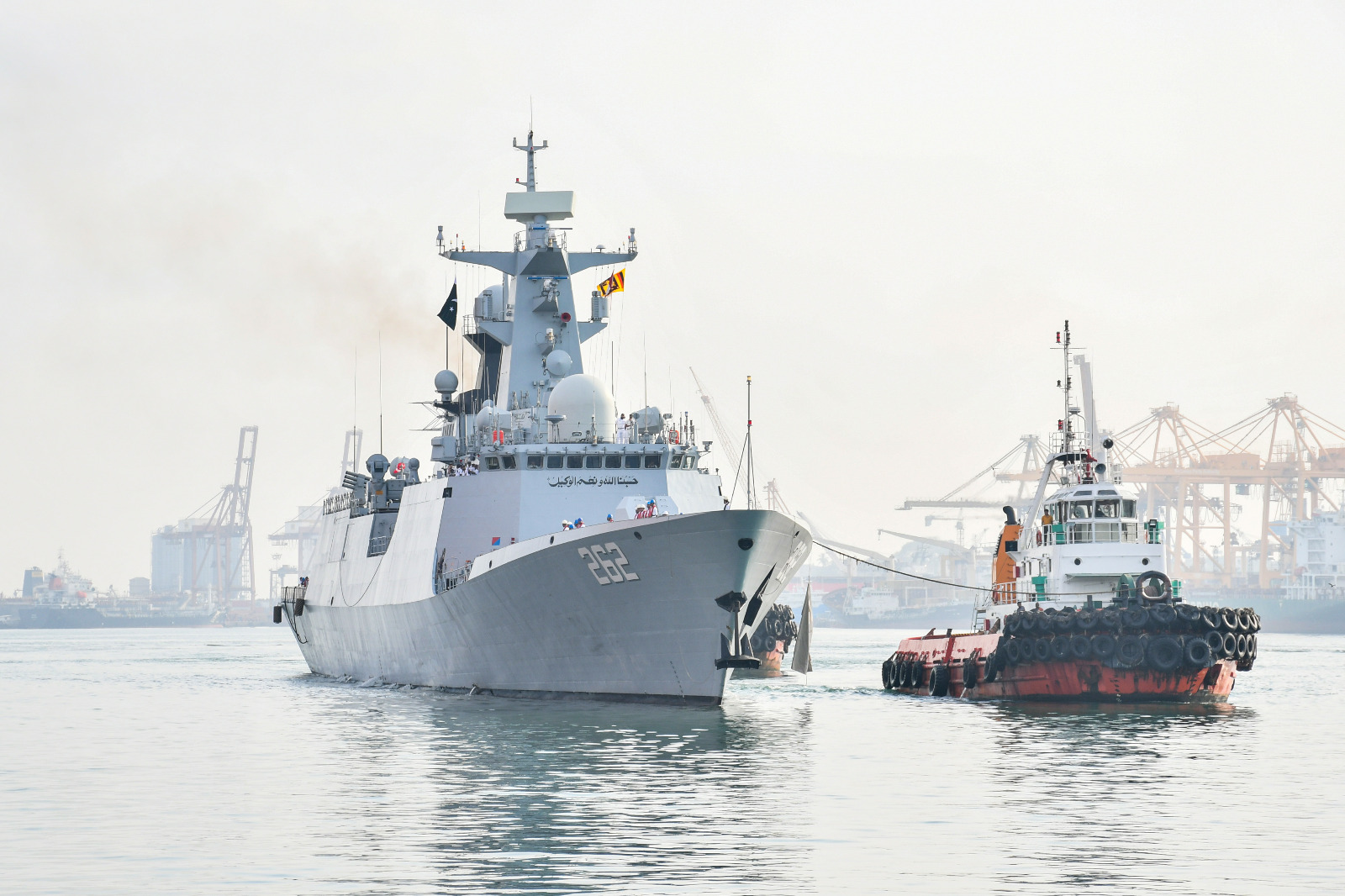
The Pakistan Navy Ship (PNS) TAIMUR and ASLAT arrived at the Port of Colombo on a goodwill visit on 12 Apr 26.
The visiting ships were welcomed by the Sri Lanka Navy in
compliance with naval traditions.
The duo of ships is commanded by Captain NIAMAT SAEED KHAN (PNS TAIMUR) and Captain NADIR MATEEN AFRIDI (PNS ASLAT).
Meanwhile, the ships are expected to conduct a Bilateral Naval Exercise LION STAR V with the Sri Lanka Navy in Colombo seas.

Salt and Patidar power RCB past Mumbai Indians

Prasidh, Buttler set up comfortable win for Gujarat Titans

Heat Index at Caution level’ in the Northern, North-central, North-western, Western and Southern provinces and in Trincomalee district.

Showers above 75 mm are likely at some places in the Western, Sabaragamuwa, Central, Southern and North-western provinces.

Sun directly overhead Pesalai, Mankulam and Nedunkerny about 12:11 noon

PNS TAIMUR & ASLAT arrive in Colombo

‘Dates have the highest sugar content to fight Coronavirus’

Sunday Island 27 December – Headlines

#SundayIsland 17th December – Headlines

Sunday Island – 28th March

Sunday Island Headlines – 21 March

Sunday Island – 21st February – Headlines
-

 News2 days ago
CEB orders temporary shutdown of large rooftop solar systems
-

 News7 days ago
Lankan-origin actress Subashini found dead in India
-

 News5 days ago
AG: Coal procurement full of irregularities
-

 Business4 days ago
Israeli attack on Lebanon triggers local stock market volatility
-

 Business5 days ago
Hayleys Mobility introduces Premium OMODA C9 PHEV
-

 News7 days ago
UN Regional Director launches SL’s first Country Gender Equality Profile during official visit
-

 News7 days ago
Dialog Launches ‘GanuDenu QR’, Making Cashless Transfers Free for All with eZ Cash and Dialog Finance
-

 Business4 days ago
HNB Assurance marks 25 years with strategic transformation to ‘HNB Life’