
Features
Understanding required system change

by Ranil Senanayake
We need a fresh paradigm towards a permanent truce with nature, in concurrence with her pace and in sync with her rhythm.” –– Ray Wijewardene,
Sri Lanka, is ‘the canary in the coalmine’ of fossil powered economic growth, that promises ‘development’. The pain of withdrawal from addiction is felt from the cooking fires of its homes, to the national energy grids. Can this pain provoke a realization that the only way to stop it from happening again, is to cease this addiction to fossil fuels and choose a new paradigm for growth and development.
It is not only the pain of withdrawal from fossil energy, it is also the awful reality of what we have done the environment that supports us chasing the myth of ‘development’ based the consumption of fossil fuels. I remember the taste of the water in the well from which I would drink go from sweet, to bitter. The bitter taste is a forerunner of the foul chemicals that will eventually make this well undrinkable. What is the value of a good, clean, drinking water well in my premises? To me priceless, but to the economic thinking that rules this nation, only worth what the market dictates. Being a good neighbour, I will gladly share the water from my well with my neighbours. However, because I will not charge them money for my water, the value that it represents to my neighbours, and me, is not computed in framing the national economy. Why?
This insensitivity to environmental and social contracts is not confined to Sri Lanka, it is an artifact of modern idea of ‘progress’ as defined and promoted by global politics as ‘Development’ today, it, unfortunately, compromises the basic needs of all of humanity. As pointed out by innumerable fellow travellers, on this journey of life, we are hurting ourselves; we are reducing our future options.
There is a paradigm shift needed but what is it? Can we look at this world in a different way, so that we can slow this rolling tsunami of hunger, disease and violence? We are constantly being made aware that there is a crisis in food, in water, in health and now in energy, the indicators of the coming tsunami.
In proposing a new paradigm, we must define the existing one first, so that the new can be evaluated. Today, humanity has defined consumerist-led growth, measured by indicators, such as the GDP, as ‘development’. Its operation has seen a rapid decline of the indicators of sustainable living, indicators such as water quality, oil quality, health quality and biodiversity. It looks to create transactions as the final goal. Often, these do not pay a real price and the cost of environmental services loss is externalized, so that it becomes a public liability. Further most of the transactions are made on non-living materials, value being relegated by rarity and demand.
In moving to a new paradigm the most obvious effect will be in the slowing down and, hopefully, reversing the current rapid decline of the indicators of sustainable living, indicators such as water quality, oil quality, health quality and biodiversity. The concept of consumerist growth will be measured by a host of other indicators and not merely transactions. These ‘indicators of sustainable living’ will provide the weighting factors for the computation of established economic indicators, such as the GDP. The real value of the ‘Global Commons’ will be formalized and value given to environmental services, especially those that provide positive externalities I the operation.
This reality is summarized effectively in a saying of the Shuar peoples of the Amazon, they say:
‘Oil represents the sprits of a long dead world, that we use to satisfy our greed for power and sacrifice and our children in return’.
This statement is correct in both metaphorical and real senses.
Oil (and other fossil fuels) does indeed represent a long dead world, be it Devonian coal that came from the mass of the great forests, of that time, or Jurassic oil that came from the productive oceans of that time. Our fossil fuels are indeed made from the bodies of the denizens of those times. They have condensed into energy high substances, from which we extract power and which in turn extracts the sustainability of humanity, as the life support system diminishes.
Carbon that cycles through living systems represents a fixed proportion of the planetary carbon. This carbon, called ‘biotic’ or living carbon, has a very different makeup to other sources of carbon. The biotic carbon cycling in the planetary biosphere is measured in time cycles of thousands of years. This carbon is activated by the energy of the sun fixed by living things. There is another pool of carbon, which is the ‘lithospheric’ or fossil carbon. This is carbon that once existed in the biosphere, but died and was buried underground where they reside for time periods measured in millions of years. This ‘dead’ carbon has no contact with the world of living carbon. Over geologic time, vast quantities of carbon, sequestered by living forms, became fossilized and removed from the biotic/atmospheric cycles to become distilled as the ‘spirits of a long dead world.’
Metaphorically, it reflects the human traditions that state ‘From light comes life, from darkness death’. They represent the age-old battle that divides men, those who choose the power of light and those who choose the power of dark. In human experience, both give power, both extend promises, both require sacrifice. The sacrifice required of when asking for power from the light, is the containment of greed, fasting, meditation, prayer, selflessness, in short the sacrifice of ‘self’. The sacrifice required by humans asking for power from the dark, is the worship of greed, selfish gain and the sacrifice of others. They will happily kill the future for selfish gain, for personal power and wealth.
Thus, the old paradigm of the creation of desire for consumption at the expense of the future and driven by fossil energy must change, if humanity is to progress anywhere.
Just as the power of fossil energy manifested the old paradigm it is the power of radiant energy that will manifest the new.
Radiant energy or light empowers us in two fundamental ways. The first is by maintaining the life support system of the planet the second is by providing electricity to power technological advances that are becoming social norms.
The supply of electricity from sources of energy other than fossil is exemplified by using water (hydro) trees (dendro), wind or radiation (solar). The technology to supply the marketplace is slowed by vested interests (fossil lobby); it is further slowed down by official lethargy.
The other aspect of radiant energy is the phenomenon of primary production, by which the entire living world is maintained. Primary production or the capture of light energy to make biomass, is possible only through the action of photosynthesis, by which Carbon Dioxide from the atmosphere is fused with water to provide the two essentials for life oxygen and biomass. It is the substance that provides the green colour of vegetation.
It is the action of this material, photosynthetic biomass, that makes life sustainable on this planet. The tragedy is, that under the current paradigm, no value is given to this critical substance, value is given only to its products of its action, such as timber or grain. As a consequence of this lack of recognition, the volume of photosynthetic biomass has begun to decrease dramatically planet-wide.
A fundamental consideration of photosynthetic biomass is that it retains value only as long as it is living. Unlike products such as timber, fruit, spices or grains which is valued after ‘harvest’ and is dead, it has no value in a dead state. The moment it is ‘harvested’ and ceases its activity, it loses its value.
So, what is photosynthetic biomass? It is the ‘green substance’ of all plants. On land, it is mostly the leaves of plants, in the sea it is the blooms of algae and phytoplankton. Photosynthetic biomass captures solar energy using atmospheric Carbon Dioxide and water to produce all the foodstuff for animal life of the planet. In addition it produces Oxygen to maintain an air that we can breathe. It also provokes water transformation or the cleansing of groundwater and the creation of rain, i.e. all actions essential for the sustainability of the life support system of the planet. Yet currently, it is only the product of photosynthetic biomass, as sequestered carbon, usually represented by wood/timber, fruits a grain etc. that has been recognized as having commercial value.
How can the recognition of the value of Primary Ecosystem Services contribute towards changing the paradigm?
A primary contribution would be to reverse the damage wrought to the planetary life support systems by making it profitable to restore and enhance the degraded environmental services. If economic and policy decisions create a climate conducive to placing a value on photosynthetic biomass, many critical activities to slow the current trend can be developed and implemented.
The greatest resource to implement these goals of restoration is the rural population. It is only the day-to-day attention to new plantings in the field and an increasing knowledge on the theory and practice of restoration that will produce the healed environments of tomorrow. Consideration of the rural populace, as key players in land restoration, is important because it is the rural person who will often be responsible for the acts that destroy or develop both biomass and biodiversity. Rural out-migration is often a consequence of an inability to make a decent living on the land. It has been the inability to place value on environmental services that constrains the development of new rural opportunities, beggaring the farming communities and their attendant biodiversity. But using photosynthetic biomass as a proxy for environmental services can contribute to reversing this trend.
As photosynthetic biomass can retain value only as long as it is living, the dependence of exporting a product to sustain economic activity ceases. He or she can be paid for the amount of photosynthetic biomass that they maintain alive on their land. Work on restoration suggests that the higher the complexity of vegetation the higher its photosynthetic biomass. Money can be now directed towards sustaining life rather than destroying it!
Such a paradigm change brings with it innumerable opportunities for research, business and market development. Such a move can indeed put us on a better track to sustainability. Such a move can move us from the dark to the light! It only requires the international system to recognize a value for photosynthetic biomass and let the market dictate its worth. We need to grasp the opportunity for change and move from a hydrocarbon driven economy to a carbohydrate driven one!



Tales of Mystery and Suspense 3
The murder, in a private dining room in the house, is of a financier with whom the government was negotiating a loan. When this seemed difficult the Minister of Home Affairs agreed to lead discussions, since he had known Mr Oissel the financier when they were young. Hence the private dinner, but when the Minister stepped out for a vote, Oissel was shot just as the Division Bell rang.
The Brahms and Simon detective novels, the first of which I wrote about last week, were amongst several books by the pair that Robert Scoble gave me when I was in Australia towards the end of last year. Amongst them was another thriller of a very different sort, though that too was written and set between the wars.
Called The Division Bell Mystery, it was set in the House of Commons, the first such book I believe, and was by Ellen Wilkinson, a Labour MP who became Minister of Education in Attlee’s government after the war, having served previously as Parliamentary Private Secretary to several ministers. Her hero Robert West is also a PPS, but a conservative, and his Minister, of Home Affairs, is an old style aristocrat, not much loved by the less orthodox Prime Minister, who nevertheless needs his support on many occasions.
The murder, in a private dining room in the house, is of a financier with whom the government was negotiating a loan. When this seemed difficult the Minister of Home Affairs agreed to lead discussions, since he had known Mr Oissel the financier when they were young. Hence the private dinner, but when the Minister stepped out for a vote, Oissel was shot just as the Division Bell rang.
West was just outside the door when the shot was heard, and when he opened it saw only the dead body with a revolver beside it. The assumption that this was suicide was however challenged by Oissel’s grand-daughter Annette, who was his heir, on the grounds that he would never have killed himself. But her view was given greater credence by the Inspector put in charge of the case who said there were no burn marks on the body which would have been the case had Oissel fired the pistol himself.
Matters are complicated by the fact that Oissel’s flat had been burgled while he was at dinner, and Jenks the policeman allocated to him, who had served the Home Secretary and seemed more acceptable to Oissel than someone from the Security Service, had been killed. Matters get even more complicated when Annette says her grand-father’s notebook in which he wrote his secrets in cipher was missing.
That was found in Jenks’ pocket, and then a photographer came to West to say he had been asked by Jenks to photograph this. More worryingly for West, he finds in the Home Secretary’s drawer a few pages from the notebook with what appears to be an interpretation of the cipher.

Ellen
Overwhelmed by all this he confides in a recently created peer who knows all about the business world, who insists that they leave the house party at which they had met over dinner and discuss the matter with the Prime Minister who promptly summons the Home Secretary.
But the Home Secretary had gone to Scotland to launch a ship over the weekend, so the meeting could take place only on the morning of the Monday, when difficult questions were expected on the adjournment motion. He admits at the meeting that he had got Jenks to take the notebook, and also that he knew the code since it had been created by him and Oissel when they were young.
He thought he should resign, and even contemplated suicide, but the Prime Minister told him that that would be even worse for the government, and that he should go home to bed. The Prime Minister said that he himself would handle the question, which he did with aplomb, insisting that confidentiality was needed until the inquest. What had happened would be made clear then, he declared, leaving West and Inspector Blackit and Lord Dalbeattie what seemed the impossible task of solving the murder.
Dalbeattie had suggested that West ask a female Labour MP who was very fond of him to get what information she could from the staff. That there was some involvement there had become clear when West, going back late one night to collect a briefcase he had left in a dining room, found someone lurking in the dark in the corridor outside the private rooms. Room J, where the murder had happened, was meant to be guarded throughout by a policeman, but he had left the room having felt dizzy, and it seemed that his coffee had been drugged. West’s sudden appearance however had prevented anyone else getting into the room.
Dalbeattie decides to recreate the scene of the murder and has a dinner party in Room J on the Tuesday night, inviting West and Annette and the society hostess at whose house he had met, and also Patrick Kinnaird, an MP who was engaged to Annette, as well as the Permanent Secretary to the Home Ministry.
After coffee Inspector Blackit comes in with Grace, the Labour MP who had got the confidence of the staff, and a journalist who had also been helpful, and just as they say they think they are on the track the division bell rings. Grace jumps up and tells the Inspector that that provides the solution and they get a ladder, and sure enough find the revolver in the space where the bell is. Directed at the place where Oissel had sat, it had been primed to go off with the ringing of the bell. The waiter who had helped to set things up made clear who the murderer had been.
The reason for the murder and the confused motives of all those involved made for a fascinatingly intricate mix. But also impressive in the book were the descriptions of the isolation possible in the crowded premises of the house, the forceful characterization of the members – Grace based on the writer, the society hostess based on Nancy Astor, the first female MP – and the laid back nature of senior politicians which West realized had to change in the brave new world of high finance.

 The current outbreak of anti-immigrant protests in Durban, South Africa is bound to have taken many a subscriber to value-based politics or political idealism quite by surprise. After all, this is evidence that despite the historic accomplishments of nation-builders of the stature of the late President Nelson Mandela it cannot be taken for granted that identity politics, including racism in its worst forms, is no more in South Africa.
At the time of this writing details are scarce on the substantive root causes of the protests but it could very well be that economic grievances, particularly on the part of the majority community in South Africa, are contributing considerably to the disaffection. Shrinking employment and material prospects are likely to figure majorly among the factors igniting the unrest.
Fortunately, the local authorities in Durban are losing no time in calling for peaceful co-existence among the relevant communities and are pointing to the vital importance of stepping-up national integration processes. Apparently, immigrants in sizable numbers from neighbouring countries are present in Durban. However, international TV footage of the protests quoted some local authorities as saying that the majority of the immigrants in some centres that housed them were not illegal migrants and had the documents that entitle them to be in Durban.
In the Durban protests the world has fresh proof of the socially divisive consequences of the gathering globe-wide economic disaffection, touched off particularly by the continuing crisis in West Asia. Going ahead, the world would need to brace for increasing identity-based unrest of the kind it is just witnessing in South Africa.
Considering that the material lot of ordinary people everywhere could only aggravate progressively, with the US and Iran showing no signs of negotiating an end to their confrontation any time soon, it will be left to the more democratic and progressive sections of the world community to initiate positive measures collectively to bring a measure of relief to the discontented.
The swiftness with which such relief will be provided would depend crucially on the importance those sections taking up these undertakings attach to value-based politics as opposed to Realpolitik of power politics.
Going by these yardsticks, Italy could be considered to be moving in the right direction. Recently Italy came to the fore in initiating the collective named, ‘Rome Coalition for Food Security and Access to Fertilizer’, which has as one of its aims the swift provision of fertilizer to economically weak African countries.
In a recent statement Italian Minister of Foreign Affairs and International Cooperation, Antonio Tajani, said that a principal aim of the project was to ensure that the farmers of Africa gained easy access to fertilizer, considering that food security is a growing concern among some of Africa’s economically vulnerable countries.
The statement went on to mention that some 30 countries hailing from the Mediterranean region, the Middle East, the Balkans as well as the FAO had been invited to join the coalition. The venture is far-seeing in that food security is main among the reasons for social discontent which in turn could degenerate into endemic political turmoil and bloodshed. Separatist violence and geographical fragmentation of countries wouldn’t be too far behind these developments, as Africa itself has often proved.
It is hoped that more G7 countries would take the cue from Italy and do what they could to ease the hardships of economically distressed countries, particularly of the global South. In these efforts they would need to break rank with the US, which is today brutally indifferent to the consequences of its policy of making ‘America First’, come what may.
Going by current developments, the Trump administration seems to be blithely oblivious to the wider, deleterious effects of its policy course in West Asia. Besides rendering Iran militarily and otherwise impotent nothing else seems to matter to Washington, as regards West Asia. This is policy short-sightedness of an extreme kind. After all, right now West Asia could be said to be sitting on the proverbial powder keg.
On the other hand, Iran is not giving the world the impression that it is doing anything constructive to get out of the policy straitjacket that it wove for itself decades ago. Rather than enter into a policy of ‘live and let live’ in relation to Israel in particular and initiate a process of reconciliation with the latter, it has chosen to operate within policy parameters that continue to damn Israel. This has put Israel always on the ‘defensive’ so to speak and prevented the opening up of space for meaningful dialogue.
That said, Israel is obliged to explore the possibilities of entering into a negotiatory process with the Arab-Islamic world that could lead to a de-escalation of tensions and bloodshed. It cannot continue to look at its neighbours through lenses that distort them as archetypal enemies who should be ‘wiped off completely from the face of the earth.’
In other words, the need is urgent for Realpolitik to give way to value-based politicks. Italy is beginning to prove that the latter approach could be pursued with some success. May be the EU and the UK could throw their weight behind these initiatives as well and establish that international politics could be refashioned on the basis of humane, civilized norms. The UN would need to be fully supportive of these moves and prove an organizational nucleus of the operations that follow.
In fact the time is ripe for people of conscience to collectively stand up on the side of peace and say ‘No’ to war and violence. Organizations such as the ICRC, the WHO and Medicines Sans Frontiers have already taken up this call. Referring to the widespread destruction of health facilities and their dehumanizing results these organizations have said, among other things, that ‘This is not a failure of the law. It is a failure of political will.’
True, ‘failure of political will’ among those powers that matter accounts for the runaway, uncontrollable nature of war and destruction in contemporary times, but more fundamentally it is a failure of the human conscience. It could very well be that the phenomenal levels to which violence and war have been unleashed today have had the effect of deadening consciences. This is a matter for urgent study and wide discussion.

 I would describe Indunil Kaushalya Dissanayaka as innovative and creative, and she operates under the name of Cuteefly.
Indunil always comes up with something novel to celebrate special occasions, and she does it with candles … and that’s her profession.
She was in the spotlight when she created a happening scene, with candles, for Christmas, Sinhala and Tamil New Year, and Valentine’s Day.
As lanterns light up Sri Lanka for Vesak, the Colombo-based candle maker is quietly turning wax and wick into little pieces of the festival.

Candles reflecting Vesak themes
Her candles reflect Vesak themes – light, peace, remembrance, giving, etc., to enable you to fill your Vesak celebration with devotion and beauty.
Among her Vesak creations is a lotus-shaped soy candle, scented with sandalwood, lavender, etc., meant to burn during this Vesak Poya Day.

Indunil Kaushalya Dissanayaka: Customers
praise her for her creativity
These handcrafted Vesak candles are perfect for offering at the temple, she says.
What makes her creations so novel is that they come in different shapes, scents, themes, and all are handmade.
What’s more, her customers have heaped praise on her for her creativity.
According to Indunil, her creations are perfect as a thoughtful gift … to bring beauty, unity, and light into every moment.
Says Indunil: “Our beautifully handcrafted Unity candles are designed with premium detail and love, making them perfect for celebrations, gifts, and meaningful occasions.”
Cuteefly, says Indunil, is available online.
Readers could contact Indunil on 0778506066 for more details.
He Facebook Page is: Cuteefly.

Handmade with love

Let us dispel the roots of greed, hatred, and delusion, and transform our lives into a nobel period that brings peace and serenity – PM

Prime Minister and United Nations Resident Coordinator discuss post-Ditwah recovery and humanitarian cooperation

Further embrace the values of Buddhism founded upon non-violence, compassion and boundless loving-kindness towards all living beings – President

Showers will occur at times in the Western, Sabaragamuwa and North-western provinces and in Galle, Matara, Kandy and Nuwara-Eliya districts

IMF urges Lanka not to meddle with exchange rate

Court orders arrest of Basil in Rs. 7.8m poll funds case

‘Dates have the highest sugar content to fight Coronavirus’

Sunday Island 27 December – Headlines

#SundayIsland 17th December – Headlines

Sunday Island – 28th March

Sunday Island Headlines – 21 March

Sunday Island – 21st February – Headlines
-

 News6 days ago
All-New GRAVITE launches at LKR 6.99 Mn
-

 Features6 days ago
The NPP’s pivot to the past
-

 News5 days ago
Police probe underway to ascertain links between criminals deported from UAE and local politicians
-
 News4 days ago
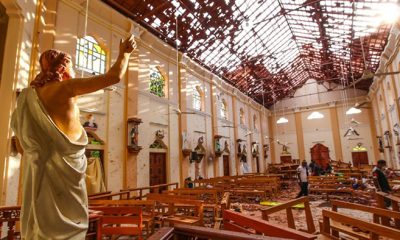
Easter Sunday carnage: Court told Maulana’s statement cannot be accepted without cross-examination
-

 Features6 days ago
End of Peacekeeping
-

 Opinion4 days ago
Undermining the democratic political framework
-

 News7 days ago
Ampara District special Coordination Committee meeting chaired by the President
-
 News4 days ago
UK passport holder hiding here wants to have deportation order rescinded to leave without blemish