
Features
Ukraine crisis and Sri Lanka, Security Implications


by Sarala Fernando
Before the present crisis engulfed Ukraine most Sri Lankans would have been hard pressed to find Ukraine on the map despite its huge territory and ancient civilization (603,628 km2 , making it the second largest country in Europe after Russia; the territory of modern Ukraine has been inhabited since 32,000 BC according to internet postings). It was the arrival of Ukrainian tourists as the first post-Covid visitors bringing welcome foreign currency that made the headlines in the Sri Lanka press in 2021, despite some scandal that they had also brought a new Covid strain to Sri Lanka. However today since the invasion of Ukraine, security implications override the economic benefits as thousands of Ukrainian and Russian tourists are stranded in Sri Lanka and unable to use even credit cards as international banks withdraw from dealings with Russia.
Yet, lest we forget, Sri Lanka’s relations with Ukraine go back to the time of the armed conflict when the Sri Lankan Airforce had depended heavily on its four Ukraine built AN32 B aircraft to maintain the lifeline with the Palaly complex as described by Dr Gamini Goonetilleke in his book In the Line of Duty on recollections of treating war casualties and armed forces personnel injured in battles in the north. Initially the four purchased aircraft had even been flown by Ukrainian pilots. As I recall one Ukrainian pilot lost his life in a crash. Just recently the remaining planes were refurbished in Ukraine factories and returned to Sri Lanka .
Most of the analysis in the Sri Lanka press and media has been on the economic impact of the Ukraine crisis, the rising oil prices, impact on our exports of tea and garments, impact on tourism, safe return of stranded Sri Lankans etc. Yet we should take cognizance that Russia’s objectives in the invasion of Ukraine are all security related, from dismembering its territory and altering its recognized borders, to its disarmament and neutrality and probably regime-change viz a puppet government to replace the present President elected by 70% of the popular vote. These demands are contrary to the fundamentals of international law and UN resolutions. Yet what has stirred the world to action to support Ukraine is the courage of ordinary people who are resisting the invasion by the aggressor military superpower. Ukraine’s dream of joining NATO is now probably dead as that security organization has firmly stated its goal is “containment”; it will not intervene and risk a larger European war. Did the West give President Zelensky false hopes of support? Several of the Sri Lankan commentaries underline the “hypocrisy” of the US, charging that the military super power had initiated much worse destructive foreign wars and NATO is also blamed for stretching too far east and ignoring Russian concerns.
Quite frequently these analysis refer to the notion of “Finlandization” and neutrality. Yet the thirst for freedom and the power to decide a state’s own strategic path runs deep. As a young foreign service officer sent to the Sri Lankan embassy in Washington D.C. in the late 1970’s, I remember being puzzled by the single line entries for Estonia, Latvia and Lithuania in the back of the American Diplomatic Directory. Much later, appointed as Sri Lanka’s Ambassador in Sweden covering also the Baltic States, I learned from those leaders how precarious had been their fight for independence from the Soviet Union and how grateful they were for steadfast American support during those long years of suppression. Ukraine’s resistance will reverberate in these states and others freed from the Soviet Union and now within the EU or NATO security umbrella.
Before Russia launched its invasion of Ukraine on Monday, February 21, some amateur analysts were speculating this was just a war of words between the US and Russia. However it seems on this occasion US intelligence has proved “unerringly accurate” on Russia’s plans to invade Ukraine. Moreover, those diplomatic watchers who had learned the lessons of history were worried all along as to Russia’s real intentions, given what had happened in segments of the former republics subsequent to their emergence as independent nations after the dissolution of the Soviet Union in 1991. Transnistria in Eastern Moldova, Abkhazia and South Ossetia in Northern Georgia and Artsakh in Southwestern Azerbaijan all have seen the rise of freedom movements among local Russian populations, resulting in these slivers of territory moving to depend on Russia for financial and arms support.
In Ukraine territory, Crimea was annexed by Russia without a shot being fired in 2014 and the adjoining People’s Republic of Donetsk and People’s Republic of Luhansk were recently proclaimed and recognized by Russia. These newly proclaimed Republics are much larger territories than the area controlled by separatists prior to Russia’s invasion . Now it seems now no one knows the size of the eventual territorial grab from present day Ukraine with Russia demanding in addition that Crimea be recognized as an integral part of Russia.
In sum, Russia is proclaiming its sphere of influence and what is happening in Ukraine is significant because for the first time, it is not just parts of territory but the whole of Ukraine which is under military threat by Russia. President Putin has claimed that Russia built Ukraine and therefore has rights of ownership. President Zelensky who was elected by 70% of popular vote by the Ukrainian people may be under threat of life yet continues to lead the unequal fight with courage in the face of a much superior military adversary. It is a lesson that we in Sri Lanka should learn as we grow more closely integrated in the present time of economic crisis with our Big Neighbour on supply of energy, use of Sri Lanka ports and even provision of essential foods and supplies. Will this result one day in a similar claim to what President Putin is now making, that Russia has historical claims, had “built” modern Ukraine and therefore had rights of ownership?
There is much speculation in the press as to why the rest of Western Europe had not immediately come to the assistance of Ukraine. The outward reason given is that Ukraine is not a member of either the EU or NATO. However the real reason may be that over the years, perhaps fooled by the thought that Russia could be persuaded to more liberal views, the era of globalization and economic integration has been proceeding apace such that Europe had become over- dependent on Russia for energy supplies and also for essential minerals. It is said that currently even more energy supplies than before the Russian invasion of Ukraine are being transported to Europe from Russia. However this state of affairs is about to change. Finally, in the face of the resistance by the Ukrainians, the West is acting, with economic sanctions against Russian leaders, Russian banks and significantly for the first time providing direct supplies of arms and missiles, even jets to Ukraine along with humanitarian aid. EU countries are increasing national defence expenditure in recognition that Russia is an aggressor nation and a re-set of European security architecture seems to be looming which may lead finally to that elusive European independent security force which has been pushed by France.
So the big question is whether Russia has miscalculated the costs of the invasion of Ukraine in the mistaken belief that Europe was sunk in apathy and NATO unable to act? The Russian propaganda spin based on unfounded charges of Nazism and genocide leveled against Ukraine’s Jewish President , seemed destined to bring along the Russian public. If however the provocation was aimed at Germany, it has not restrained that European powerhouse which has halted the certification of Nordstream 2 pipeline which would have brought Russian gas direct to Germany. Citing “the new reality” in Europe with the Russian invasion of Ukraine, Chancellor Olaf Scholz has also just announced that Germany is taking the first steps to rearming its military forces with major increases budgeted in national defence spending, overturning its pacifist policies after World War 11.
Germany’s depleted armed forces will receive a €100 billion increase in the defence budget and meet NATO’s spending target of 2two per cent of GDP while Germany will diversify its sources of energy supply. European countries, even the traditionally neutral Scandinavians like Sweden, are taking unprecedented steps in offering to send defensive military supplies, anti tank weapons and missiles to Ukraine. The supply of Stinger missiles to Ukraine brings back memories of the Afghanistan conflict and how Al Quaeda rebels were once trained to push back the superior Russian forces.
Some are asking why Western sanctions have been targeted at President Putin, Foreign Minister Lavrov and the oligarchs? It is tit for tat, in the same way the Russian leaders have targeted the Ukrainian President, trying to create conditions for regime-change by accusing him of being surrounded by “Nazis”. Finally the West appears to have realized that the real threat lies in the aggressive compulsions of the Russian leadership while the economic sanctions against the Russian banks will contribute to weakening their grip on power.
The larger question that the Ukraine crisis poses for Sri Lanka is whether any assessment has been made of the strategic calculations of our Big Neighbour and who are the backroom planners? For example, Sri Lanka has welcomed Indian politicians into its high circles and honored them at academic and other celebrations, yet how many here will acknowledge that at heart India’s leaders work together in support of what they perceive to be India’s national interests? For example, have we taken cognizance of the ramifications of the legal case one leading Indian politician is taking forward to make the whole of Adam’s Bridge a heritage site of India? If this is agreed in Indian courts, what will be the legal ramifications with regard to those islands on the Sri Lanka side which have come under Sri Lanka sovereignty since the bilateral maritime agreements signed in 1974 and 1976?
Is this astute politician counting on his Sri Lanka friends to leverage this quite blatant threat to Sri Lanka’s sovereignty and control of territory? How many in Sri Lanka have taken account of the chains of small islands around our mainland, an essential part of our territorial integrity and the need to protect these islands rather than to offer them for exploitation and sale to foreigners ? For years we have been unable even to reach understandings with India on the sustainable management of the Palk Straits. Surely, it is in the interests of both countries to ensure for example that bottom trawling does not kill off all the marine life in the Palk Straits and joint measures could be agreed between officials concerned with aquatic resources, on fleet size, volumes of catch, no-fishing during breeding seasons etc.
Between Russia and the former territories of the Soviet Union which are now independent states, there exists a similar situation to South Asia in the spill- over of ethnicities, leaving room for separatist movements to take shape with or without the direct intervention or surreptitious support of the Big Neighbour. Sri Lanka’s Jaffna has old historical roots, a proud independent heritage even before the creation of Tamil Nadu in modern day India. At one time prior to independence, Jaffna intellectuals claimed superiority over Madras although today that might be forgotten as Tamil Nadu emerges as an economic power house in India, attracting the largest portion of foreign investment into that country. A key question now in Sri Lanka is how the North’s relations with the rest of the country will develop in the post-conflict era and whether cooperation or conflict will prevail? Ukraine in the throes of the invasion crisis has appealed to the international courts and the UN and it has asked the EU take the extraordinary step of granting Ukraine emergency membership and protection. Whom will Sri Lanka turn to in the event of a crisis with the Big Neighbour?
However one thing we can be happy about and that is the urban renewal in Jaffna post- conflict, which, showcased along with the natural beauty of its white beaches , mangroves and palmyrah groves, makes it such a welcome place to live in and visit, in stark contrast to the environmental pollution and urban chaos in Chennai. But then, that is what people are lamenting today about Ukraine’s capital – they say that Kiev is a beautiful city – which is being bombed into submission. It seems these matters touching the people are of no consequence in the strategic calculations of the Big Powers. In Ukraine, the people are standing up for their values and freedom to chose their way of life despite the unbelievable cost of resistance in winter conditions, in human lives, displacement and destruction of critical infrastructure and buildings.
Sri Lanka’s official statement expresses deep concern about the recent “escalation of violence” in Ukraine , calling upon all parties concerned to exercise “maximum restraint” and work towards the “immediate cessation of hostilities” and to resolve the crisis through “diplomacy and sincere dialogue.” The Sri Lanka Foreign Secretary has been quoted as saying we want to be “neutral” – however this word has uneasy connotations now as Russia had sought guarantees from Ukraine of “neutrality” and has not hesitated to embark on military invasion for lack of such guarantee. For some of us who remember 1987, the “parippu drop” and subsequent signing of the Sri Lanka- India Accord which paved the way for the arrival of the IPKF, the present crisis in Ukraine recalls the vulnerability of small states situated near Big Powers and the difficulty of pursuing their dreams of independence.
Sri Lanka’s lukewarm diplomatic response today even its abstention in the UNGA resolution condemning Russia for its invasion of Ukraine, is understandable given the island’s current precarious economic situation. Yet how prudent is it to turn to Russia for loans today at a time when Western sanctions have been imposed on Russian banks and we may be targeted as a sanctions-breaker? Our shot-gun reactive diplomacy today is a far cry from the early days when Sri Lanka made a principled stand for Japan (in San Francisco), China (despite US congressional sanctions) and even Vietnam during its war with the US.
(Sarala Fernando, retired from the Foreign Ministry as Additional Secretary and her last Ambassadorial appointment was as Permanent Representative to the UN and International Organizations in Geneva . Her Ph.D was on India-Sri Lanka relations and she writes now on foreign policy, diplomacy and protection of heritage).

Illegal Foreign Exchange, Undiyal, Hawala and Money Laundering, A Four-Part Investigative Series
Forex Platforms, Cryptocurrency, AI and the New Financial Battlefield
THE INVISIBLE FINANCIAL EMPIRE – PART III
The Boyfriend Who Was Never Real
 Priya, a 34-year-old professional in Colombo, met “David” on LinkedIn. He claimed to work in fintech in Singapore. For six weeks they exchanged messages daily, about work, about life, about a recent trip he had taken to the Maldives. Eventually, the conversation turned, gently and naturally, to money.
“I’ve been trading on this platform, let me show you,” he said, sharing a screenshot of a sleek trading dashboard showing consistent, impressive returns.
Priya invested a small amount first, $500. Within days, her dashboard showed it had grown to $650. She withdrew $100 successfully, just to test it. It worked. Encouraged, she invested more. Then more. Over two months, she transferred a total of $42,000 into the platform.
When she tried to withdraw her full balance, the platform demanded a “regulatory release fee” of $8,000 before funds could be unlocked. She paid it. Then another fee appeared. Then the platform stopped responding altogether. “David” vanished. The trading dashboard, the customer support chat, the entire brokerage, all of it had never been real.
This is what investigators now call “pig butchering”, and, in 2026, the most disturbing development is not the scam itself, which has existed for years, but what now powers it: artificial intelligence has industrialised the entire operation.
From Manual Fraud to Machine-Generated Deception
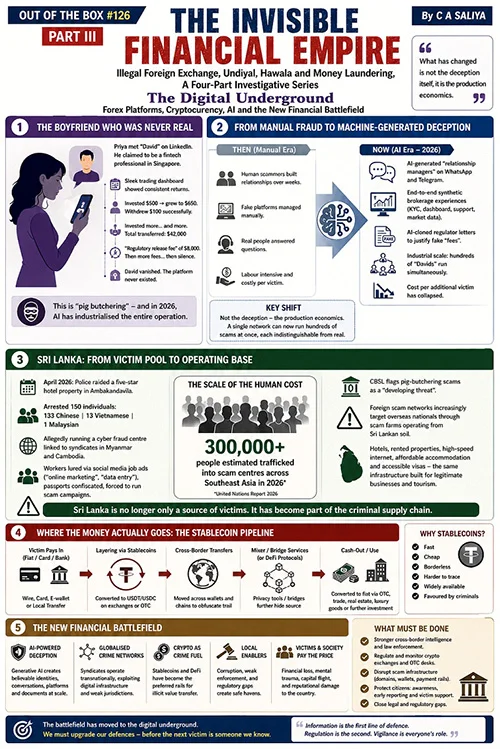 For most of the past decade, romance-and-investment scams, like the one that targeted Priya, required enormous manual labour. Scam operations, many of them staffed by trafficked workers held against their will in compounds across Myanmar, Cambodia, and Laos, needed real humans to build relationships with victims over weeks, manage fake trading platforms, and respond convincingly to questions.
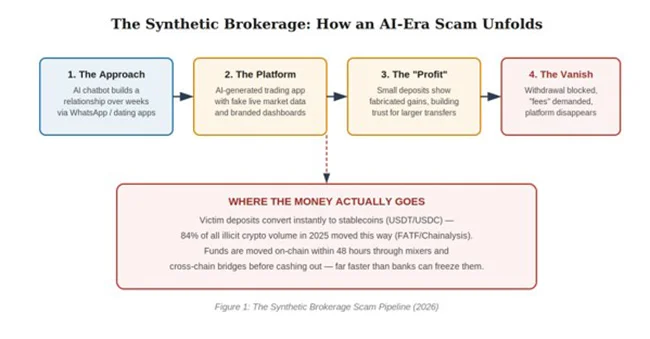
That labour-intensive model has now been substantially automated. According to financial-crime researchers tracking this shift through 2026, threat actors are standing up entire AI-generated “brokerage” experiences end-to-end, complete with KYC onboarding, branded customer-service chat, animated portfolio dashboards, and falsified live market data feeds, and operating them at industrial scale against multiple victims simultaneously. Generative-AI relationship managers now front the WhatsApp and Telegram conversations that once required real human scammers. AI-cloned regulator letters are generated on demand to justify the fake “release fees” that drain victims a final time before the platform disappears.
What has changed is not the deception itself, it is the production economics. The cost of running a credible synthetic brokerage against one additional victim has collapsed, meaning a single criminal network can now run hundreds of “Davids” simultaneously, each one indistinguishable from a genuine fintech professional until it is too late. (Figure 01)
Sri Lanka: From Victim Pool to Operating Base
Sri Lanka’s relationship to this global scam economy has shifted in an alarming direction over the past two years. The country is no longer only a source of victims, it has become an operating base for the criminal networks themselves.
In April, 2026, Sri Lankan police raided a five-star hotel property, in Ambakandavila, and arrested 150 individuals, including 133 Chinese nationals, 13 Vietnamese nationals, and one Malaysian national, allegedly running a cyber fraud centre with links to international criminal syndicates, based in Myanmar and Cambodia. Investigators say the operation followed a now-familiar regional pattern: recruiters advertise “online marketing” or “data entry” jobs on social media to lure foreign workers to Sri Lanka, confiscate their passports on arrival, and force them to operate scam campaigns under threat.
The Central Bank of Sri Lanka has formally flagged pig-butchering scams as a “developing threat,” warning that foreign scam networks are increasingly targeting overseas nationals through scam farms operating from Sri Lankan soil. A 2026 United Nations report estimated that at least 300,000 people have been trafficked into scam centres across Southeast Asia.
This is not an abstract international problem. It is unfolding in hotels and rented properties across the country, exploiting the same infrastructure, high-speed internet, affordable accommodation, accessible tourist visas, that Sri Lanka has built to attract legitimate digital businesses and tourists.
Where the Money Actually Goes: The Stablecoin Pipeline
Behind every successful pig-butchering scam sits a laundering pipeline that has been transformed almost as dramatically as the scams themselves, and the transformation has a single dominant feature: stablecoins.
According to the Financial Action Task Force’s March 2026, report, drawing on analysis from blockchain intelligence firms Chainalysis and TRM Labs, stablecoins accounted for 84% of the USD 154 billion in illicit virtual asset transaction volume recorded in 2025, the highest share ever observed, and a dramatic jump from just 15% only a few years earlier. TRM Labs separately found that illicit entities received USD 141 billion in stablecoins, in 2025 alone, the highest level observed in five years. (See Table 01)
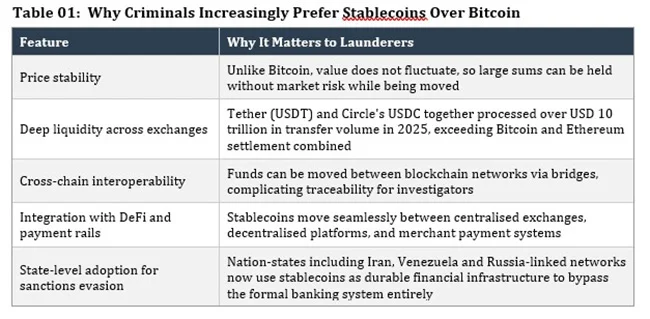
The scale of state-level abuse is striking. A Russian sanctions-evasion network built around the ruble-pegged stablecoin A7A5 processed more than USD 72 billion in total volume in 2025.
Fighting Fire with Fire: AI on the Defensive Side
The same artificial intelligence reshaping financial crime is also, out of necessity, reshaping the defence against it. Legacy anti-money laundering systems, built on static, rule-based thresholds, have proven badly outmatched by AI-generated fraud operating at machine speed. Research cited by compliance technology analysts suggests that between 90% and 95% of alerts generated by legacy AML systems are false positives, consuming enormous investigator time while genuinely suspicious activity slips through.
This is not a frictionless transition. AI models are notoriously difficult to explain to regulators and examiners in the way traditional rule-based systems are. The practical compromise emerging across the industry is a hybrid model: AI handles the initial scoring and prioritisation of risk, while documented rule-based logic still governs the final decision that must be defensible to a regulator.
The Regulatory Response: Catching Up to the Digital Frontier
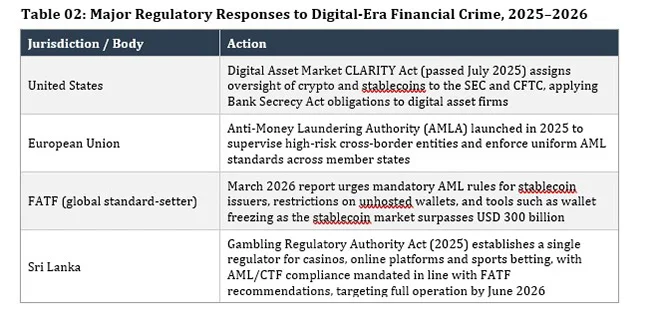
Regulators worldwide have begun moving to close the most dangerous gaps exposed by this digital transformation of financial crime. (See Table 02)
What Comes Next
We have now traced this investigation from the centuries-old mechanics of Hawala and Undiyal, through the three-stage architecture that turns criminal proceeds into apparently legitimate wealth, to the AI-generated frontier of digital financial crime reshaping all of it at machine speed.
In our concluding instalment, Part IV: “Sri Lanka at the Crossroads: Economic Consequences, Organised Crime and the Road Ahead”, we bring this series home. We examine precisely what all of this costs Sri Lanka in hard economic terms: lost remittances, exchange rate pressure, tax revenue forgone, and the 2026 FATF evaluation that will determine whether the country’s institutions can demonstrate, with evidence rather than legislation alone, that they are equal to this challenge. We close with a practical policy roadmap.
(The writer, a senior Chartered Accountant and professional banker, is Professor at SLIIT, Malabe.
Views expressed in this article are personal.)
Features
‘There are no private universities in Sri Lanka’ – some considerations for higher education reform

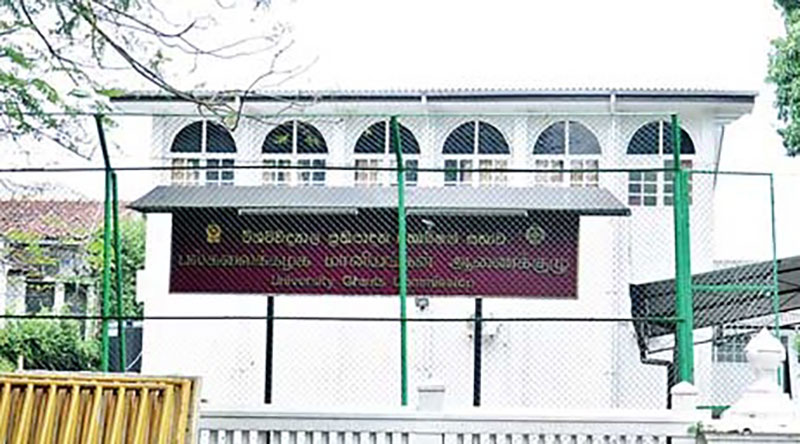
 Academics involved in education policy like to say that there is no such thing as a private university in Sri Lanka. The only ‘universities’ in the country are state universities; anything else offering degrees is a private higher education institution (HEI). This position is technically accurate. Yet, in the discourse and imagination of the public, private universities are very real – people teach in them, students register in them, families pay fees, and such degree holders enter job markets in Sri Lanka and outside.
For decades, activists concerned for public higher education have ignored or resisted looking at private HEIs, as if such scrutiny would taint them. Others have worked in both types of institutions, carrying practices from each to the other. The apex body governing state universities, the UGC, has, meanwhile, ignored the concept of conflict of interest and appointed individuals in private higher education in committees and leadership positions. It is unsurprising then that some of the ideologies informing private higher education appear in reform agendas in the state sector.
This is a good time then to consider the varying types of private HEIs around us, and to take a look at some of the issues within them in the hope that higher education reform agendas will include private, as well as state higher education.
What is a ‘private university’?
First, some clarifications. In the public imaginary, a ‘private university’ is typically an institution that provides a foreign or local degree for which the student makes a payment. But this broad classification encompasses a host of diverse institutions and types of degrees which I detail below.
The Non-State Higher Education Division (NSHE) of the Ministry of Education has recognised 295 degrees by 32 institutions. Most of these are private companies and include a handful of established, well-known private HEIs that are ‘university like’. The degrees are local degrees conferred by the institutions accredited by the NSHE Division. While private HEIs conferring local degrees must be accredited by the NSHE Division, there appears to be no legal consequence for not doing so. In addition, there are several permutations of the private degree that miss the net of this Division and the Standing Committee on Accreditation and Quality Assurance (SCAQA) that assists this Division.
For one, degrees conferred by foreign universities offered, via these same private HEIs, are not vetted by the NSHE Division. Secondly, there is a growing plethora of private HEIs which have either no physical presence locally or only a dubious presence. The University Grants Commission has notified the public, through their website, that foreign universities listed in the Commonwealth Universities Yearbook and the World Higher Education Database are recognised, but refrained from giving any other details – which degrees? Offered by what modes? These details are not known. Some of the foreign universities in the lists may be legitimate entities in their own land but the degrees conferred locally, in their name, may not adhere to curriculum or teaching specifications of the NSHE Division or the UGC.
Another troubling phenomenon is the ‘top up degree’, which appears to work on the same principle as that of a pre-paid mobile connection: if I have a Diploma or an HND of a sort, I am eligible to complete a course of study which provides me with a degree, usually from a foreign university. The idea that someone who does not initially qualify for a degree programme should be able to work their way towards one is a progressive notion. This is the concept that open and distance learning (ODL) was based on initially, but which is now sadly exploited. ODL models are expected to provide opportunity for learning for those who may be excluded from traditional learning institutions. In Sri Lanka, however, we have seen ODL become a marketplace offering easy to obtain, for-fee qualifications by institutions with little commitment to superior teaching and learning.
Finally, a perusal of the many types of private HEIs and their varied degrees bring to mind another question – how should the private degrees, provided by state institutions (that are not educational institutions), be regulated? Who should do so?
All of these create a host of problems for the public – for hopeful students and parents and trusting employers. For the higher education sector, recruitment of academic staff, too, has become difficult due to this plethora of ambiguous higher education qualifications, as I discussed in a previous Kuppi article (‘Recruiting academics to state universities’).
Some issues in private HEIs – a bellwether for change in state universities
In this second part of this article, I will discuss some aspects of work in private HEIs – albeit the more established institutions – given that such issues may appear in reform agendas in future.
Across state universities, all permanent staff of a specific category are paid according to the same criteria. The picture is not so clear when it comes to private HEIs since they are different entities legally, typically companies. Private HEIs have salary scales and financial incentives that are different to each other. The more established private HEIs reportedly have attractive renumeration packages, possibly a reason for academics of state universities migrating eagerly to such institutions during sabbatical years and on retirement. This may not of course be the case with other less established, or improperly registered HEIs of which we know little. Academic staff of these more accepted private HEIs seem to value the high financial remuneration they receive (in comparison to state universities) as something that makes their work rewarding.
Attractive remuneration is important to sustain the good life and is at times seen as the institution’s way of encouraging good work. Yet, this has implications for the future of the institution: to continue to deliver on promised financial packages, institutions must continue to have large profit margins. One strategy has been to enroll multiple cohorts of students per year, even up to three or four intakes per year. This can result in exploitative work conditions, since staff must cater to all these cohorts in that same year. If there is inadequate staff, employees are further burdened. On the other hand, if there is a sudden drop in enrolments (degrees can go out of fashion) unexpected layoffs occur. Similar to other sectors that employ short-term contract staff – including state universities – in private HEIs, too, individual teachers, who are on short term contracts that need regular renewal, can feel pressured to work under difficult or exploitative conditions.
At the same time, even in the more established private HEIs, work norms differ from those of state universities in that they include promotional work that keeps the institution’s name in the eye of the public. The Marketing (or similarly named) unit comes up in conversations as one of the most important departments. It appears to weigh in on decision-making related to the number of staff, the amount of re-sits per exams, and other pedagogically important matters. This is a worrying example of how financial rationales interfere with pedagogically or academically sound processes, resulting in problematic results in the classroom. On the plus side, junior colleagues, who had experience in both state and private HEIs, also felt that they faced less harassment in private HEIs – primarily due to the private HEIs ability to take swift action in reported cases of harassment. This is a real indictment on state institutions and their reluctance to address chronic issues of harassment in our universities.
Yet, while we hear much about problems in state universities, we hardly hear of problems that staff in private HEIs face. One rationale for a lack of public expressions by staff is that expressions of discontent might lead to trouble given the importance of reputation for private HEIs. The worry about reputational damage is a growing concern in state universities, too, as evidenced by social media policies and internal conversations on reputational damage, consequent to negative publicity. Institutional worries of reputational damage are harmful in the long run since these impact not only freedom of expression by student and staff, but also research that is possible in and about the education sector.
Some thoughts at the end…
A close look at the private higher education sector is important given its strong presence in the country. Impending reform needs to regulate this diverse array of higher education offerings in the private sector, as well as the state institutions that offer privately-funded options of higher education (a topic for a separate Kuppi on its own). It is time we carefully considered how to build a whole system of higher education out of this broken mess.
Kaushalya Perera is a senior lecturer at the University of Colombo.
Kuppi is a politics and pedagogy happening on the margins of the lecture hall that parodies, subverts, and simultaneously reaffirms social hierarchies.

Singer Nish Peiris is set to take the next big step in her music journey.
The talented vocalist, who has been seen and heard in the scene here for a short while, and was also featured with the now-defunct band, Inner Vision, has announced that she will be fully committing to her solo career, after completing her degree this year.
“I’m finishing my degree this year, and after that I’ll be fully committing to my solo music career,” Nish told The Island.
“I’ve already got a few tours lined up for next year, so I’m really excited for what’s ahead.”
Fans, no doubt, will remember Nish for her smooth voice and stage presence, and the good news is that she is now ready to chart her own path and bring new music to audiences at home and abroad.
With tours already planned for 2027, the year 2026 promises to be an exciting year for the young artiste as she steps into the spotlight on her own.
We wish Nish every success in this new chapter!

Mexico goalkeeper Guillermo Ochoa retires after 22-year career

New Chairperson and Members appointed to the Finance Commission

True leadership is not about titles or power, but about acting responsibly for the well-being of others – Prime Minister

A few showers will occur in the Western, Sabaragamuwa and North-western provinces and in Kandy, Nuwara-Eliya, Galle and Matara districts

Customs asked to resume probe or face legal action

Outgoing Chinese Ambassador Qi Zhenhong bids farewell to Mahanayake Theras

‘Dates have the highest sugar content to fight Coronavirus’

Sunday Island 27 December – Headlines

#SundayIsland 17th December – Headlines

Sunday Island – 28th March

Sunday Island Headlines – 21 March

Sunday Island – 21st February – Headlines
-
 Features3 days ago
Two memorable excerpts from a former SLAF commander’s memoir
-
 Business3 days ago
‘Giving up was never an option’: The fisherman who fought back after losing millions in SL
-
 Latest News4 days ago
Davis cup Asia/Oceania Group IV 2026 to be held in Colombo from 20th to 25th July
-
 Features3 days ago
Erdoğan’s New Republic
-
 Life style3 days ago
Taste of the Swiss Alps comes to Colombo
-
 News4 days ago
Evidence recorded in money laundering case against Yoshitha Rajapaksa
-
 News4 days ago
Dengue outbreak gallops ahead: Infections surpasses 73,455, leaving 50 dead
-

 News5 days ago
Money laundering case against Yoshitha, fixed for pre-trial conference