
Features
Trump pardons former Dominican President, Juan Hernandez


Hostilities against Venezuela escalated, President Maduro accused of trafficking illegal drugs
Who had been convicted by a New York Court for trafficking illegal drugs
In recent months, there have been escalating hostilities between US President Trump and Venezuela President Nicolas Maduro. The United States has been accusing Maduro of being the leader of the narco-terrorist organization designated as the “Cartel de los Soles”, responsible for trafficking drugs into the United States.
Neither Trump nor US Secretary of State, Marco Rubio, who made this claim in July, has provided a shred of evidence. Experts say that Cartel de los Soles is not a cartel, but a term used to describe alleged criminal networks within the armed forces of Venezuela, presumably led by Maduro, who are, again allegedly involved in the international drug trade. They pose no danger to the safety of the United States.
On the other hand, Maduro has accused the US drug offensive as an excuse for orchestrating regime change with the object of seizing Venezuelan oil.
Maduro is widely considered a dictator, leading an authoritarian government, rife with serious human rights violations, electoral fraud, and severe economic hardship, despite being an oil-rich country. But there are differences – Maduro is just 63 years old, has over a decade’s experience as a dictator, boasts a swarthy skin color without a tinge of orange and a luxuriant moustache.
The United States has been committing acts of war on the open seas, and conducted its 22nd strike on unidentified boats last Thursday. These strikes against suspected drug carrying vessels in the Caribbean have so far killed over 80 people, whom the Trump administration alleges are drug-trafficking terrorists smuggling drugs into the US, responsible for the deaths of thousands of Americans.
The strikes are random, and no evidence, not even an explanation, has been provided for its decision to attack these unidentified boats. Congress has not been informed of these bombings, and funds have not been allocated for the project.
The UN’s Human Rights chief has condemned these attacks on the Caribbean “violate international law and amount to extrajudicial killings”. In other words, they are war crimes.
As Republican Senator Rand Paul said, “We don’t know who’s in these boats. There could be people being trafficked, as opposed to alleged traffickers in international waters who have been killed in these strikes”.
Due process seems to be deleted in Trump’s new and improved constitution, and the penalty for drug trafficking, even if found guilty, is execution.
The most disgustingly cruel attack was carried out last Monday. It was noticed that there were two survivors, clinging to the boat. Regular rules of war require that survivors of such attacks are rescued. But regular rules do not seem to apply to the current US military. Admiral Bradley, on the instructions of the Secretary of War, Pete Hegseth, ordered a second bombing of the same boat (a “double tap” in cynical military parlance), killing the survivors. Hegseth’s actual words were “Kill them all”.
Everyone is pointing fingers at who was responsible for the second bombing, though the buck must stop with the President, who was aware, indeed approved of, these illegal bombings.
Secretary of State, Marco Rubio, stated that no one had the power to dictate to the United States how it should defend itself. But to “defend itself” by bombing boats in the open seas, nowhere near the US coast and presenting no danger to the United States, seems rather excessive. As illegally excessive as the USA invading Iraq in 2003 on the false assertion that Saddam Hussein possessed weapons of mass destruction, and was preparing to use them on his own people.
Trump is displaying aggression against Venezuela, bombing small boats in international seas, calling it an act of war with no evidence and amassing troops and battleships on the Venezuelan coastline. He is also threatening to commence a CIA operation with the objective of regime change. All these actions are eerily reminiscent of the reasons given for the illegal war against Iraq in 2003, with the Bush administration lying to Congress about Saddam possessing weapons of mass destruction. The original lie that Iraq was responsible for providing the terrorists of 9/11 had long been debunked.
The Bush administration stated that the United States will defeat Saddam’s army within weeks and the USA will be hailed as “liberators”. We all know the disaster caused by that war, with the loss of hundreds of thousands of Americans and Iraqis, men, women and children and the destruction of property.
The ultimate motive for that war was to get control of Iraq’s oil reserves.Venezuela has the largest proven oil reserves in the world. And an unpopular dictator. Is Trump, the “Peacemaker” planning another war to seize control of Venezuela’s oil reserves”?
The UN charter states: “All members of armed forces must comply with their internal operating procedures and military manuals and strictly abide by international law. Officers should refuse superior orders where these are manifest violation of the law and may result in a serious violation of human rights, including extrajudicial executions”.
Trump is nothing if not unpredictable. He is currently considering declaring war against Venezuela, having already bombed 22 vessels in the Caribbean, killing over 80 people. An ongoing operation, without an ounce of proof that Venezuela presents any danger, by way of trafficking illegal drugs or any other form of aggression, to threaten the safety of the United States.
Then last Monday, Trump formally gave a full and unconditional pardon to former Honduran President Juan Orlando Hernandez. Hernandez had been convicted and sentenced by a New York district court last year, to 45 years in prison and given $8 million fine by a US judge for – you got it right – illegal drug trafficking.
CNN has reported that Hernandez conspired with drug cartels during his tenure as president as they moved more than 400 tons of cocaine through Honduras to the United States. Man, that’s a whole lot of cocaine! Hernandez received millions of dollars in bribes from El Chapo and the cartels that he used for his rise in politics.
Pardon for corruption and trafficking in 400 tons of cocaine against the death penalty for suspicion of smuggling by boat perhaps a few hundred pounds of illegal drugs seem the current standard of the law of the current Trump administration.
White House Press Secretary, Karoline Leavitt stated that President Trump had been persuaded to pardon Hernandez because of the unfair treatment he had suffered under the Biden administration. Biden’s fault, again, almost a year after the end of his presidency.
Every member involved in these extra judicial bombings of unidentified boats in the Caribbean, from the airplane bomber to the Secretary of War is guilty of the crime of refusing to obey obviously illegal orders. These bombings of unidentified vessels in the open seas are clearly illegal, according to the section of the UN Charter cited above.
Probably prompted by these illegal bombings, and Trump’s unconstitutional use of the federal military as a “training ground” in Democratic cities, six congressional Democrats, all either former military or intelligence officials released a 90-second video, advising the US military and national security, that it is okay, in fact, it is mandatory, that illegal orders be refused. A rule not just applicable to the military community but to the general public.
The message, delivered by a social media video from Retired Admiral, Astronaut and Senator from Arizona, Mark Kelly and five other members of Congress who had all served in the military and intelligence, served as a reminder to military and intelligence personnel “that they are legally obligated to refuse unlawful orders that violate the constitution or US laws”.
“Our laws are clear. You can refuse illegal orders. In fact you must refuse illegal orders”.
This video was followed by Trump’s famous, unusually succinct tweet on Truth Social: “Seditious behavior, punishable by DEATH”. He has instructed his Attorney General, Pam Bondi, to initiate actions against all six lawmakers on charges of sedition. In addition, he has instructed retired Naval Admiral Senator Mark Kelly to be recalled to service at the navy to be court-martialed for his perfectly legal action, one that falls within the First Amendment of free speech.
Trump may have finally exceeded his authority that he may be losing the support of members of his base. And the Epstein Files are looming, due to be released to Congress by court order in two weeks.
by Vijaya Chandrasoma ✍️



By Ifham Nizam
Sri Lankan scientists have uncovered a remarkable long-distance migration route used by seabirds, linking the island’s shores with the Arctic—an achievement that is expected to reshape global understanding of bird movement and highlight Sri Lanka’s importance in the natural world.
The discovery, led by Professor Sampath S. Seneviratne of the University of Colombo, shows that Heuglin’s Gulls travel nearly 8,000 kilometres from Sri Lanka to breeding grounds in northern Russia, following a carefully chosen path that combines coastal travel with long inland journeys.
Prof. Seneviratne told The Island that the finding challenges the long-standing belief that seabirds depend mainly on ocean routes.
“For a long time, we assumed seabirds would stay close to the sea throughout their migration. What we are seeing here is very different. These birds are moving across land as well, using a route that connects Sri Lanka directly with the Arctic,” he said.
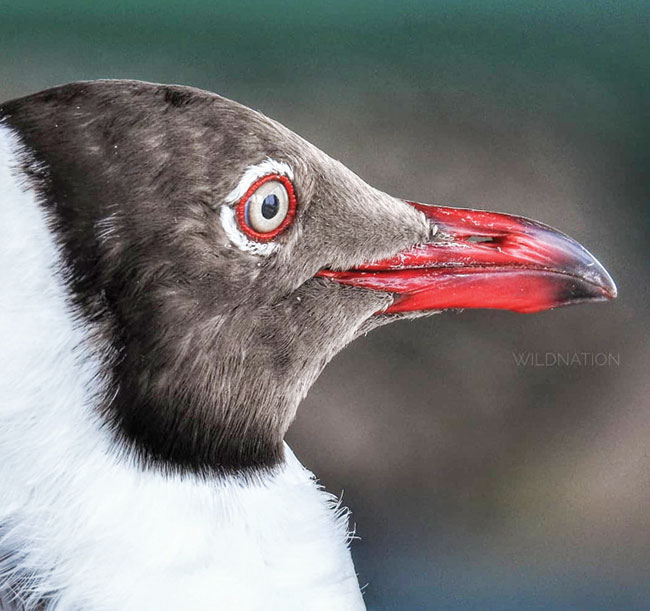
Brown headed gull- migrating from Himalayas to Mannar
The birds begin their journey from the northwestern coast of Sri Lanka, especially around Mannar—an area known for its rich birdlife and coastal habitats. From there, they cross over to India and move along the western coastline before turning inland.
Their journey then takes them through Pakistan and Afghanistan, across parts of Central Asia, and onwards to the Arctic region, where they breed during the northern summer.
What has drawn particular attention from scientists is the route chosen by the birds.
Instead of attempting to cross the world’s highest mountain ranges, or taking a much longer path over the open ocean, the gulls appear to follow a middle course that allows them to avoid harsh conditions while still maintaining a steady journey.
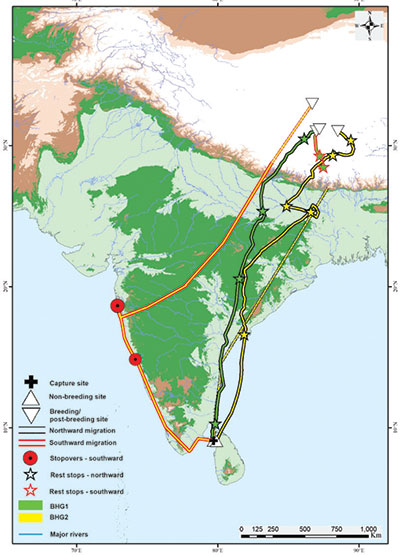
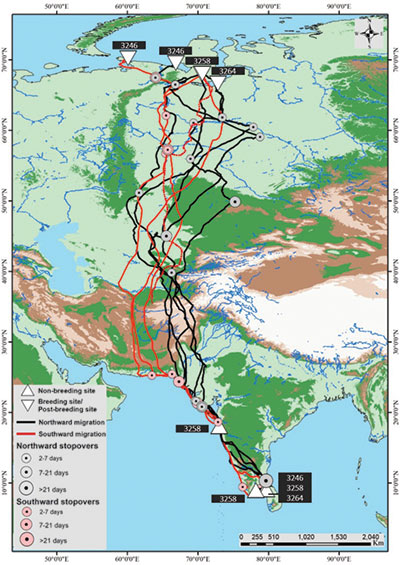
Map 1 &2 birds moving through the continent to reach the Artctic
“They are not simply taking the shortest distance,” Prof. Seneviratne explained. “They are choosing a route that gives them the best chance of survival. Along this path, they are able to find food, rest, and avoid extreme environments.”
The birds travel long distances each day, covering hundreds of kilometres, but they do not do it all in one stretch. Their journey depends heavily on stopovers—places where they pause to rest and rebuild energy.
“These stopovers are critical,” Prof. Seneviratne said. “If the birds cannot find suitable places to feed and recover, they will not be able to complete the journey.”
Co-researcher Dr. Gayomini Panagoda said the discovery sheds light on a route that had remained largely hidden until now.
“We always knew these birds were leaving Sri Lanka during certain times of the year, but we did not fully understand where they were going or how they got there,” she said. “Now we have a much clearer picture of their journey.”

Awareness among schoolchildren
She added that the findings show how closely connected different parts of the world are through nature.
“A bird that spends part of its life in Sri Lanka ends up in the Arctic. That tells us how linked these ecosystems really are,” she said.
The findings also underline the importance of Sri Lanka’s coastal areas, which serve as vital feeding and resting grounds for migratory birds before they begin their long journey north.
Veteran ornithologist , Professor Emeritus Sarath Kotagama said these habitats are of international importance and must be protected.
“These coastal regions, especially places like Mannar, provide the food and shelter these birds need before migration. If those areas are damaged, it will affect bird populations far beyond Sri Lanka,” he said.
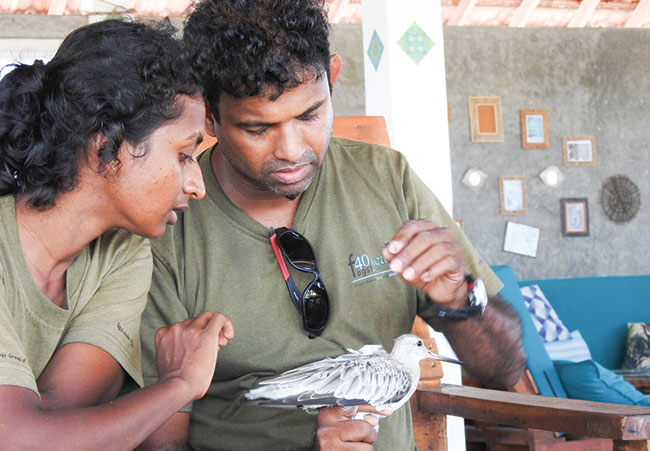
Professor Seneviratne with Dr. Gayomini Panagoda
Kotagama warned that increasing pressure on coastal ecosystems—from development, pollution, and climate change—could pose serious risks.
“We are already seeing changes in many of these birds. If we are not careful, we could lose habitats that are essential not just for local wildlife, but for species that travel across continents,” he said.
The discovery also draws attention to the wider network of migration routes that connect countries across Asia and beyond. Birds do not recognise national borders, and their survival depends on conditions in many different places along their journey.
Prof. Seneviratne stressed that protecting these birds will require cooperation between countries.
“These birds travel across several regions, and each of those regions plays a role in their survival. Conservation cannot be done by one country alone,” he said.
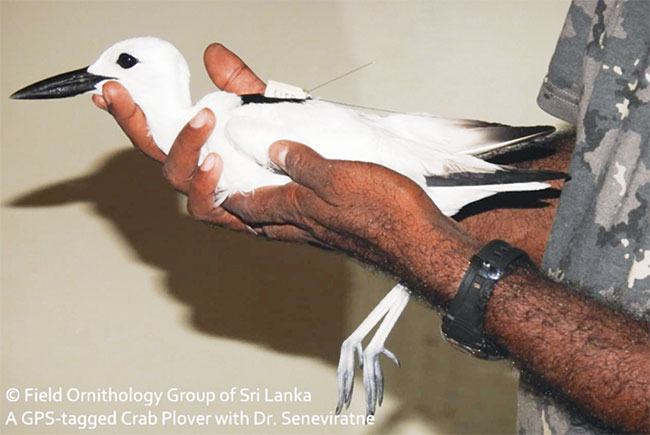
A GPS tagged Crab Plover
He added that more work is needed to understand how other species use similar routes and how changes in climate and land use may affect migration patterns in the future.
“There is still much we do not know. This is just one piece of a much larger picture,” he said.
Environmentalists say the findings should encourage stronger action to protect wetlands and coastal ecosystems in Sri Lanka, many of which are under increasing threat.
“These areas are not just important for birds,” Dr. Panagoda said. “They support fisheries, protect coastlines, and are part of our natural heritage. Protecting them benefits both people and wildlife.”
She noted that conserving these habitats will also help ensure that future generations can continue to witness the arrival and departure of migratory birds.
For Sri Lanka, the discovery is both a moment of pride and a reminder of responsibility.
It highlights the role the island plays in supporting wildlife that travels across vast distances and connects different parts of the world.
It also shows that even a small country can have a big impact when it comes to global biodiversity.
As Prof. Seneviratne put it, “What happens in Sri Lanka does not stay in Sri Lanka. These birds carry that connection across continents.”
The discovery is expected to encourage further research into bird migration in the region, as scientists continue to explore how different species move across landscapes and adapt to changing conditions.
It also reinforces the need to protect the natural environments that make such journeys possible.
In the end, the story of these birds is not just about distance. It is about survival, connection, and the delicate balance of nature.
From the shores of Sri Lanka to the frozen Arctic, their journey is a powerful reminder that the natural world is far more connected than we often realise—and that protecting one part of it helps protect the whole.

 For the morally-conscious, the tendency among some sections in Sri Lanka to promote the production of drones for national defence purposes could be deeply worrying. Besides, this proposition flies in the face of common sense and disregards the relentlessly increasing harsh economic realities coming in the wake of the current wars that could push many a southern country into beggary. In fact even the West is facing an economic recession.
To begin with the latter issues, it is a proved reality that the majority of Southern countries are descending further into poverty at present. The FAO has the ‘bleeding statistics’ . For instance, food insecurity in Asia is of such disquieting proportions that the region accounts for ‘ approximately half of the world’s 370.7 million undernourished people’.
It is against such a bleak economic backdrop that countries of the South are being called on to pump money into the production or importing of drones. Pointed reference needs to be made here to the South because drones are peddled as cutting-edge defence systems that are comparatively economical to acquire and relatively easy to operate. It is even voiced that with time drones could enable even smaller countries of the South to acquire ‘strategic parity’ with the major powers of the North and middle level powers.
Meanwhile, no thought is spared for the poor of the South who would sink steadily into poverty and powerlessness. Because more defence spending by southern countries only entrenches the ruling classes of those countries, and in some cases their military high commands, further in the systems of governance and repression.
This has essentially been the experience of the majority of post-colonial states. As aptly phrased by economic and political analyst Susan George in the seventies, it has always been a case of ‘The Other Half Dying’.
Accordingly, it cannot be perceived as to how more defence spending by the South on drones could help alleviate the latter’s principal problem of deepening poverty. As for the perceived escalating insecurities of the South, these problems are of such complexity that drones could never be seen as offering a quick fix for them. They need patient, multi-pronged managing, mainly at the negotiating table with the powers that matter. These are long- gestation projects that need to be compulsorily undertaken in view of the fact that the alternative could be indefinite conflict and war.
Since Sri Lanka too is mentioned as one of those countries that needs to look at the drone proposition with some seriousness, it is relevant to underscore that Sri Lanka is second in a list of countries that are described as facing acute material hardships at present in the wake of the economic instability bred by the Hormuz crisis. The source of such information is no less than the respected Kiel Institute for the World Economy. The first 10 such gravely affected countries are: Zambia, Sri Lanka, Taiwan, Pakistan, Equatorial Guinea, Kenya, Bangladesh, Vietnam, the Philippines and Thailand.
It is thought-provoking that among the above countries are not only those that have been traditionally seen as experiencing severe underdevelopment but also up-and-coming middle income countries that have been hitherto described as being on a fast track to development. The interesting mix proves that no country at present could consider itself immune to current economic shocks originating mainly in the Middle East that could plunge it dramatically into acute poverty virtually overnight.
We are left to conclude that ‘Bread’ or the economic well being of people could in no way be sacrificed for ‘Drones’ in democratic countries whose governments are obliged to be accountable to the people. Considering the phenomenal hardships that could be waiting to happen worldwide, the world could very well do without more ‘Guns’ or ‘Drones’.
However, if southern governments in particular opt for ‘Drones’ or an accumulation of ‘Guns’, the chances are that there could be overwhelming tides of social discontent in their countries, bred by economic want, that could then ignite indefinite war and repression. That is, a ‘No-Win’ situation for all concerned.
Ukraine has been spiritedly and admirably taking the fight back to the invading Russian forces over the past few years but its skillful use of sophisticated drones of its own making has in no way decreased the human costs the war has been incurring for itself. Ukraine has no choice but to continue with all the weaponry at its command to beat back the Russian invader but sooner rather than later it would need to take into account the immense suffering the war has been inflicting on its people and focus on the fact that the Russians are not backing down but using equally lethal weaponry against it.
The above are some of the dilemmas of the present wars that call for urgent resolution. Warring countries are obliged to address on a priority basis the misery and destruction their actions incur for their publics and consider deploying diplomacy, preferably under the aegis of the UN, to work out peaceful solutions to their enmities and differences. Considering the futility of their war Russia and Ukraine are obliged to think on these lines.
No less a power than the US should be considering deeply right now the advisability of continuing with its military interventions in the South in particular to achieve its self interests. The rising loss of American lives and the economic costs of war in the Middle East will be weighing heavily with the Trump administration and it shouldn’t come as a surprise if negotiations are given a serious try, going ahead. Ground realities in the region moreover indicate that the US ‘has bitten off more than it could chew’ and that Iran is remaining hostile and unyielding despite being bloodied.
For both sides to the war what should be inescapable is the harsh reality of continuing human suffering on a chilling scale. Sophisticated and increasingly destructive weaponry such as drones and missiles are being used but they have not brought either side any closer to victory. Instead human misery is being perpetrated mindlessly with a steady deadening of consciences and a flagrant abandoning of reason.
Accordingly, what perceived legitimate aims could drone warfare, for instance, help achieve? It is quite some time since sections of the world community came to realize the futility of violence and war. There is no choice but for humans to recognize and revere the principle of the sacredness of life. A return to fundamentals is imperative.

 Singer Rajiv Sebastian has the unique ability to woo an audience and he did just that on his recent trip to London, performing at the Funky ’70s Bash Dinner Dance.
This particular event of music, nostalgia, and celebration, was organised by the Ananda Balika Vidyalaya Old Girls’ Association – UK, and held at the DoubleTree by Hilton London Elstree, in Borehamwood, on 28th February.
They say the success of the evening was made possible through the dedication and hard work of President Devika Arrawwalage and the committed committee members of the Ananda Balika Vidyalaya OGA – UK.
Rajiv Sebastian was in top form, delivering an engaging performance that took the audience on a nostalgic musical journey through the iconic sounds of the’70s.

Doing the first set in full suit, with a fan joining in the action
He did three sets, appearing in three different outfits – suit, the normal shirt and trouser, and the sarong – and the crowd loved it.
Adding to the energy of the event, I’m told, was the music provided by the band Hasthi, made up of Sri Lankan musicians based in the UK.
At the end of a truly enjoyable and memorable event, the organisers had this to say about Rajiv Sebastian’s performance:
“On behalf of the entire team, I want to extend our heartfelt thanks to you for travelling all the way from Sri Lanka to perform at our first ever ABV dinner dance in the UK.
-

- Superb talent for captivating an audience
-

- Rajiv Sebastian
“Your performance was truly the highlight of the night. You have a superb talent for captivating an audience; from the moment you took the stage, your vibrant energy and incredible vocal range completely transformed the atmosphere.
“It was wonderful to see how effortlessly you engaged the crowd, keeping the dance floor packed and everyone in high spirits throughout the evening. You have graced the stage as a guest artiste on three separate occasions, delivering exceptional performances that set you apart from your peers.
“We feel incredibly privileged to have had an artiste of your calibre and charisma join us. You didn’t just provide music; you created an unforgettable experience that people are still talking about.
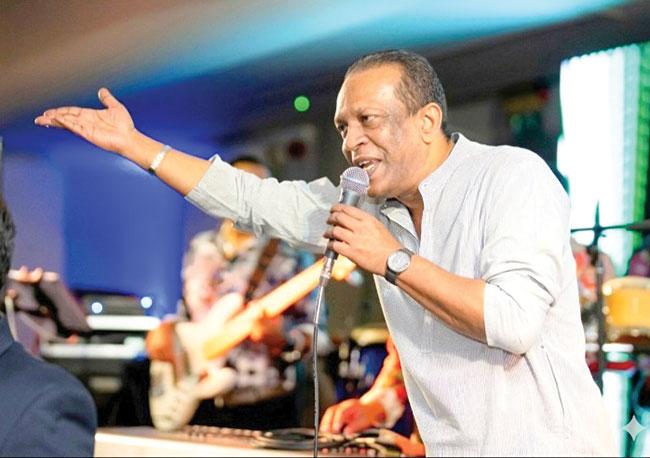
Surprises for his fans in Sri Lanka, as well
“Thank you for sharing your immense gift with us. Hope to see you back on a UK stage very soon!”
Yes, and it’s happening soon; Rajiv says he is off to London again, in mid-April, and will be performing at four different venues.
He also mentioned that he has some surprises for his fans in Sri Lanka, when he and his band, The Clan, present their 35th Anniversary concert … in June, this year.

Brook, Bethell receive warnings from Cricket Regulator after Wellington incident

Former Minister Mahinda Wijesekara passes away aged 83

Navy seize 323kg of heroin from fishing vessel in southwestern seas

Magnitude 7.4 quake hits off Indonesia’s Ternate, tsunami warning lifted

NASA successfully launches historic Artemis II moon mission

Sameer Rizvi arrives in the IPL to guide Delhi Capitals home in low-scoring chase

‘Dates have the highest sugar content to fight Coronavirus’

Sunday Island 27 December – Headlines

#SundayIsland 17th December – Headlines

Sunday Island – 28th March

Sunday Island Headlines – 21 March

Sunday Island – 21st February – Headlines
-

 Features6 days ago
A World Order in Crisis: War, Power, and Resistance
-

 News7 days ago
Energy Minister indicted on corruption charges ahead of no-faith motion against him
-

 Sports7 days ago
SLC to hold EGM in April
-
 Opinion7 days ago
When elephants fight, it is the grass that suffers
-

 Features7 days ago
Lest we forget
-

 News3 days ago
Tariff shock from 01 April as power costs climb across the board
-

 Business7 days ago
Pan Asia Bank empowers export sector as Strategic Partner of NCE Export Awards
-

 News6 days ago
Minister Jayakody indicted in Colombo High Court over alleged corruption