
Features
Trump pardons former Dominican President, Juan Hernandez


Hostilities against Venezuela escalated, President Maduro accused of trafficking illegal drugs
Who had been convicted by a New York Court for trafficking illegal drugs
In recent months, there have been escalating hostilities between US President Trump and Venezuela President Nicolas Maduro. The United States has been accusing Maduro of being the leader of the narco-terrorist organization designated as the “Cartel de los Soles”, responsible for trafficking drugs into the United States.
Neither Trump nor US Secretary of State, Marco Rubio, who made this claim in July, has provided a shred of evidence. Experts say that Cartel de los Soles is not a cartel, but a term used to describe alleged criminal networks within the armed forces of Venezuela, presumably led by Maduro, who are, again allegedly involved in the international drug trade. They pose no danger to the safety of the United States.
On the other hand, Maduro has accused the US drug offensive as an excuse for orchestrating regime change with the object of seizing Venezuelan oil.
Maduro is widely considered a dictator, leading an authoritarian government, rife with serious human rights violations, electoral fraud, and severe economic hardship, despite being an oil-rich country. But there are differences – Maduro is just 63 years old, has over a decade’s experience as a dictator, boasts a swarthy skin color without a tinge of orange and a luxuriant moustache.
The United States has been committing acts of war on the open seas, and conducted its 22nd strike on unidentified boats last Thursday. These strikes against suspected drug carrying vessels in the Caribbean have so far killed over 80 people, whom the Trump administration alleges are drug-trafficking terrorists smuggling drugs into the US, responsible for the deaths of thousands of Americans.
The strikes are random, and no evidence, not even an explanation, has been provided for its decision to attack these unidentified boats. Congress has not been informed of these bombings, and funds have not been allocated for the project.
The UN’s Human Rights chief has condemned these attacks on the Caribbean “violate international law and amount to extrajudicial killings”. In other words, they are war crimes.
As Republican Senator Rand Paul said, “We don’t know who’s in these boats. There could be people being trafficked, as opposed to alleged traffickers in international waters who have been killed in these strikes”.
Due process seems to be deleted in Trump’s new and improved constitution, and the penalty for drug trafficking, even if found guilty, is execution.
The most disgustingly cruel attack was carried out last Monday. It was noticed that there were two survivors, clinging to the boat. Regular rules of war require that survivors of such attacks are rescued. But regular rules do not seem to apply to the current US military. Admiral Bradley, on the instructions of the Secretary of War, Pete Hegseth, ordered a second bombing of the same boat (a “double tap” in cynical military parlance), killing the survivors. Hegseth’s actual words were “Kill them all”.
Everyone is pointing fingers at who was responsible for the second bombing, though the buck must stop with the President, who was aware, indeed approved of, these illegal bombings.
Secretary of State, Marco Rubio, stated that no one had the power to dictate to the United States how it should defend itself. But to “defend itself” by bombing boats in the open seas, nowhere near the US coast and presenting no danger to the United States, seems rather excessive. As illegally excessive as the USA invading Iraq in 2003 on the false assertion that Saddam Hussein possessed weapons of mass destruction, and was preparing to use them on his own people.
Trump is displaying aggression against Venezuela, bombing small boats in international seas, calling it an act of war with no evidence and amassing troops and battleships on the Venezuelan coastline. He is also threatening to commence a CIA operation with the objective of regime change. All these actions are eerily reminiscent of the reasons given for the illegal war against Iraq in 2003, with the Bush administration lying to Congress about Saddam possessing weapons of mass destruction. The original lie that Iraq was responsible for providing the terrorists of 9/11 had long been debunked.
The Bush administration stated that the United States will defeat Saddam’s army within weeks and the USA will be hailed as “liberators”. We all know the disaster caused by that war, with the loss of hundreds of thousands of Americans and Iraqis, men, women and children and the destruction of property.
The ultimate motive for that war was to get control of Iraq’s oil reserves.Venezuela has the largest proven oil reserves in the world. And an unpopular dictator. Is Trump, the “Peacemaker” planning another war to seize control of Venezuela’s oil reserves”?
The UN charter states: “All members of armed forces must comply with their internal operating procedures and military manuals and strictly abide by international law. Officers should refuse superior orders where these are manifest violation of the law and may result in a serious violation of human rights, including extrajudicial executions”.
Trump is nothing if not unpredictable. He is currently considering declaring war against Venezuela, having already bombed 22 vessels in the Caribbean, killing over 80 people. An ongoing operation, without an ounce of proof that Venezuela presents any danger, by way of trafficking illegal drugs or any other form of aggression, to threaten the safety of the United States.
Then last Monday, Trump formally gave a full and unconditional pardon to former Honduran President Juan Orlando Hernandez. Hernandez had been convicted and sentenced by a New York district court last year, to 45 years in prison and given $8 million fine by a US judge for – you got it right – illegal drug trafficking.
CNN has reported that Hernandez conspired with drug cartels during his tenure as president as they moved more than 400 tons of cocaine through Honduras to the United States. Man, that’s a whole lot of cocaine! Hernandez received millions of dollars in bribes from El Chapo and the cartels that he used for his rise in politics.
Pardon for corruption and trafficking in 400 tons of cocaine against the death penalty for suspicion of smuggling by boat perhaps a few hundred pounds of illegal drugs seem the current standard of the law of the current Trump administration.
White House Press Secretary, Karoline Leavitt stated that President Trump had been persuaded to pardon Hernandez because of the unfair treatment he had suffered under the Biden administration. Biden’s fault, again, almost a year after the end of his presidency.
Every member involved in these extra judicial bombings of unidentified boats in the Caribbean, from the airplane bomber to the Secretary of War is guilty of the crime of refusing to obey obviously illegal orders. These bombings of unidentified vessels in the open seas are clearly illegal, according to the section of the UN Charter cited above.
Probably prompted by these illegal bombings, and Trump’s unconstitutional use of the federal military as a “training ground” in Democratic cities, six congressional Democrats, all either former military or intelligence officials released a 90-second video, advising the US military and national security, that it is okay, in fact, it is mandatory, that illegal orders be refused. A rule not just applicable to the military community but to the general public.
The message, delivered by a social media video from Retired Admiral, Astronaut and Senator from Arizona, Mark Kelly and five other members of Congress who had all served in the military and intelligence, served as a reminder to military and intelligence personnel “that they are legally obligated to refuse unlawful orders that violate the constitution or US laws”.
“Our laws are clear. You can refuse illegal orders. In fact you must refuse illegal orders”.
This video was followed by Trump’s famous, unusually succinct tweet on Truth Social: “Seditious behavior, punishable by DEATH”. He has instructed his Attorney General, Pam Bondi, to initiate actions against all six lawmakers on charges of sedition. In addition, he has instructed retired Naval Admiral Senator Mark Kelly to be recalled to service at the navy to be court-martialed for his perfectly legal action, one that falls within the First Amendment of free speech.
Trump may have finally exceeded his authority that he may be losing the support of members of his base. And the Epstein Files are looming, due to be released to Congress by court order in two weeks.
by Vijaya Chandrasoma ✍️


Speak the truth, before the crisis does
 The Sri Lankan rupee is not merely depreciating. It is sending a warning. Once again, the country is being reminded that recovery is not the same as stability, and that an IMF programme is not a substitute for disciplined national economic management.
Beneath the casual conversations of scholars lies a serious argument: Sri Lanka is not yet out of danger. The country may have escaped the worst of the 2022 collapse, but it has not escaped the habits that produced it: delayed decisions, weak communication, excessive import appetite, fuel-intensive lifestyles, and a political reluctance to tell citizens the hard truth.
The vicious cycle
The latest pressure on the rupee should, therefore, not be dismissed as a temporary market fluctuation. It reflects a familiar and dangerous sequence. When the rupee begins to fall, exporters hold on to dollars in expectation of a better rate. Importers rush to buy dollars before costs rise further. Banks become reluctant to release foreign exchange. The interbank market tightens. Anxiety feeds behaviour, and behaviour feeds anxiety. That is how a currency problem becomes a confidence problem.
Sri Lanka has seen this movie before, precisely during 2020-2022. The names, personalities, and policy language may have changed, but the underlying pattern is recognisable. First, the exchange rate comes under pressure. Then the authorities speak calmly. Then temporary measures are discussed. Then import restrictions are considered. Then citizens are told certain goods are “non-essential.” Finally, when pressure becomes unbearable, the truth emerges: the country had less room than officials implied.
The danger today is not that Sri Lanka is exactly back in 2022. It is not. The fiscal position is stronger. The IMF programme is in place. The Central Bank has more credibility than during the worst period of denial. But that is precisely why complacency is dangerous. A country that has just survived a crisis should be more alert, not less and announce “there is no problem”.
The IMF tranche expected shortly may calm the market. It may bring dollars into the system. It may help the Central Bank reassure banks, exporters, importers, and investors. But IMF money is not a national economic strategy. It is breathing space. If that breathing space is used merely to postpone difficult choices, then the country will have learnt very little from its own trauma.
The most dangerous illusion is that import controls can solve the problem. They cannot. They can delay pressure, redirect it, and make the government look active for a few weeks. But they do not eliminate underlying demand. If people cannot import vehicles, the credit and purchasing power do not vanish. They move elsewhere: housing, construction, consumer goods, machinery, travel, or other import-linked spending.
Vehicle imports illustrate the dilemma. They consume foreign exchange and increase future fuel demand. But they also generate large tax revenue and support leasing, insurance, repairs, spare parts, logistics, and employment. A crude ban may reduce one form of dollar demand while damaging revenue and pushing economic activity into other channels. The correct answer is not panic prohibition. It is intelligent demand management.
Fuel is the real battlefield
Petroleum is one of the country’s largest import burdens, yet Sri Lankans still behave as if fuel consumption is a private matter with no national consequence. It is not. Every unnecessary trip, every idle engine, every fuel-inefficient commute, and every avoidable private-car journey becomes part of the country’s dollar problem.
If fuel prices are artificially softened, people continue as before. If the rupee falls further, the eventual pain comes through every channel at once: fuel, electricity, food, water, transport, and imported inputs. The country then discovers that avoiding one price increase only produced a larger national price increase later.
Poor households must be protected
That is why targeted support is essential. Public transport must be supported. But subsidies should not be thrown blindly across the economy. They should be directed through systems that can be monitored: Aswesuma for vulnerable households, route-based support for buses, and transparent cash or coupon mechanisms linked to actual public service.
Sri Lanka should be making public transport the patriotic option, not the poor man’s punishment. If citizens are being asked to reduce fuel consumption, they must be given a credible alternative. That means better buses, cleaner buses, more AC services, higher frequency, safer routes, and regulations that reflect reality rather than outdated assumptions.
Transport system management is vital
Discussions about metro-style bus services is important for precisely this reason. If commuters are willing to stand in an air-conditioned bus because it is cleaner, quieter, smoother, and more comfortable than the ordinary alternative, policy should expand that service. Do not suffocate better service with rules written for a different era. Regulate for safety, yes. But do not block improvement in the name of procedure.
Rail is even more important. A serious country does not solve urban commuting only with buses and private vehicles. The railway should be the backbone of mass commuting into Colombo. Trains move more people with less fuel per passenger. They avoid road congestion. They reduce import pressure indirectly by reducing fuel demand. But this requires frequency, rolling stock, signalling upgrades, centralised control, digital systems, and operational seriousness. Sri Lanka cannot talk about saving dollars while tolerating a transport system that pushes citizens into private vehicles.
Hello, please speak the truth
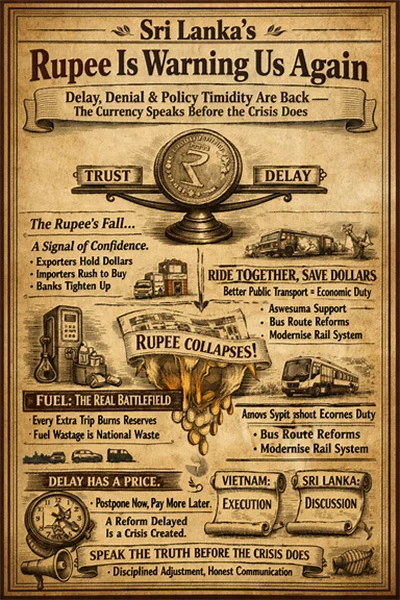 The government’s communication failure is equally serious. Leaders in India and Singapore have been willing to tell citizens that conditions are difficult and that behaviour must adjust. Use public transport. Reduce unnecessary consumption. Work from home where possible. Conserve fuel. Be careful with imports. These are not signs of weakness. They are signs of mature leadership.
In Sri Lanka, the message remains too soft. Officials appear afraid to say plainly that the country is not yet secure. The public is allowed to behave as if recovery means normalcy. Fuel is consumed, imports resume, roads fill, luxury vehicles appear, and private lifestyles continue with little sense of national constraint.
This is irresponsible. Citizens cannot be expected to act prudently if the state refuses to speak honestly. Economic management is not only about interest rates, reserves, and IMF reviews. It is also about shaping expectations. If leaders do not explain the seriousness of the situation early, the market will explain it later through far more painful consequences, such as runaway inflation and shortages of essential goods.
There is also a deeper governance problem. The issue today may not be crude corruption of the old kind. The more immediate danger may be hesitation. The government appears too slow in making necessary decisions. It overthinks. It delays. It waits. It consults. It hesitates. Meanwhile, markets move.
Delay is very expensive
In economics, delay is not neutral. Delay has a price. A decision postponed in May may become a crisis measure in August. A reform avoided today may become a forced adjustment tomorrow. The market does not wait for Cabinet comfort, bureaucratic neatness, or political messaging.
This is where Sri Lanka must learn from Vietnam, which did not become an investment magnet through speeches about development. It made decisions. It signed trade agreements. It improved investor access to land. It aligned policy with competitive advantage. It pushed digitalisation. It treated investment facilitation as practical statecraft, not ceremonial rhetoric.
Sri Lanka remains trapped in procedural delay. Land acquisition takes too long. Export-zone facilitation is too slow. Intellectual property reforms remain incomplete. The Madrid Protocol issue is not a minor technicality. For exporters and investors, brand protection, product security, and legal alignment with global systems matter. A country that cannot protect intellectual property cannot expect higher-value investment to arrive simply because officials request it.
The lesson is blunt: Investors do not reward potential. They reward execution. Sri Lanka has potential. It has always had potential. That is precisely the problem. Potential has become an excuse for underperformance. Vietnam converted potential into policy. Sri Lanka converted potential into discussion.
Disciplined adjustment means telling citizens the truth before the crisis does
If the country responds with another cycle of reassurance, delay, temporary restriction, and vague optimism, then the recovery will remain fragile. If, however, the government uses this moment to speak honestly, manage fuel demand, strengthen public transport, target subsidies, speed up reforms, and treat policy execution as urgent, the rupee’s warning may still be useful.
The choice is not between panic and denial. The choice is between disciplined adjustment and forced adjustment. Disciplined adjustment means telling citizens the truth before the crisis does. It means asking those who can work from home to do so. It means encouraging public transport while improving its quality. It means protecting the poor without subsidising waste. It means recognising that every unnecessary dollar spent today weakens the country’s room for manoeuvre tomorrow.
Forced adjustment is what happens when leaders avoid these choices. Then the exchange rate makes the decision. Prices make the decision. Queues make the decision. Import shortages make the decision. Public anger makes the decision, similar to Aragalaya in 2022. Sri Lanka has already paid once for denial. It should not pay again for hesitation.
The rupee is not only a price. It is a signal of trust. When it weakens, it tells us that markets are uncertain, citizens are unconvinced, and policy has not moved fast enough. The correct response is not to blame exporters, importers, consumers, or global conditions alone. The correct response is to govern. The country does not need another explanation after the damage is done. It needs timely action before the damage spreads.
That is the real message of this moment: the rupee is warning us again. This time, Sri Lanka must listen early.
(The writer, a senior Chartered
Accountant and professional banker,
is a professor at SLIIT, Malabe. Views expressed in this article are personal.)
The IMF staff and Sri Lankan authorities have reached a staff-level agreement to conclude the combined Fifth and Sixth Reviews of Sri Lanka’s reform programme under the Extended Fund Facility (EFF). If approved by the IMF Executive Board, Sri Lanka will gain access to about US$700 million in financing. While the IMF has acknowledged progress in reserves, growth, and revenue performance, it has also warned that Sri Lanka remains exposed to external shocks, including the Middle East conflict and the aftermath of Cyclone Ditwah.
This mixed picture of progress and vulnerability gives added significance to the recent warning by economist Dr. Ganeshan Wignaraja. Speaking on 4 May 2026 at a discussion held at the Regional Centre for Strategic Studies (RCSS) in Colombo, titled “A Global Economy in the Shadow of the Middle East War: Implications for Sri Lanka’s Debt Recovery,” he cautioned that Sri Lanka may once again have to consider the possibility of seeking further IMF assistance if current vulnerabilities are not addressed with urgency.
Dr. Wignaraja pointed out that although Sri Lanka’s current IMF programme is scheduled to conclude in 2027, the country will once again face major external debt repayment obligations beginning in 2028. At the same time, global economic instability, Middle Eastern conflicts, rising fuel prices, and climate-related disruptions could place Sri Lanka’s fragile recovery under renewed pressure.
This is not merely an ordinary economic observation. It is a serious warning about the deep structural weaknesses that have shaped Sri Lanka’s economy for decades. In fact, turning to the IMF is not new for Sri Lanka. Since 1965, the country has entered into 17 IMF programmes, placing Sri Lanka among the nations that have relied most frequently on IMF assistance.
This recurring dependence is not simply the result of temporary financial shortages. It reflects deeper structural problems: weak productive capacity, insufficient export growth, poor fiscal discipline, and an economic model excessively dependent on borrowing. When a country repeatedly requires IMF support, it raises fundamental questions about the sustainability and resilience of its economic system.
According to Table 1.16, “Outstanding External Debt Position,” in the Central Bank of Sri Lanka’s Annual Economic Review 2025, Sri Lanka’s total external debt position at the end of 2025 was reported at USD 54.8 billion at market value and USD 56.2 billion at face value. Of this amount, the government’s external debt stood at approximately USD 36.7 billion at face value. In 2022, Sri Lanka suspended external debt repayments for the first time in its history, after which debt restructuring began under the IMF-supported programme. Although this provided short-term stability, many of the country’s core economic vulnerabilities remain unresolved.For example, Sri Lanka’s export earnings remain relatively low compared to GDP. Countries such as Vietnam, Bangladesh, and Thailand have transformed themselves into export-driven manufacturing economies, while Sri Lanka continues to depend heavily on tourism, worker remittances, and external borrowing for foreign exchange earnings.
Although tourism revenues and remittances improved somewhat during 2024 and 2025, these are not sufficiently stable foundations for long-term economic sustainability. External shocks such as Middle Eastern conflicts, fluctuations in global fuel prices, international market downturns, and climate-related disasters could disrupt these income sources at any time.
Dr. Wignaraja also emphasised that climate change itself may become a major factor affecting Sri Lanka’s future debt sustainability. Floods, droughts, and declining agricultural productivity increase food import costs and place further pressure on foreign exchange reserves, thereby worsening the country’s economic vulnerabilities.
At the same time, IMF programmes carry significant social costs. Since 2023, tax increases, electricity tariff revisions, reductions in government spending, and state-sector reforms have imposed severe pressures on ordinary citizens. The middle class has weakened considerably, poverty levels have risen, and many small and medium-sized enterprises have struggled to survive rising operational costs. Youth unemployment and migration aspirations have also intensified during this period.
Nevertheless, it must also be acknowledged that recovering from the 2022 crisis without IMF support would have been extremely difficult. The IMF not only provides financial assistance but also offers a framework of credibility that enables countries to secure support from institutions such as the World Bank, the Asian Development Bank, and other international lenders. In Sri Lanka’s case, the IMF programme helped restore a degree of investor confidence and international credibility.
However, the deeper problem lies elsewhere. Sri Lanka has repeatedly used IMF programmes as temporary crisis-management tools rather than as opportunities for genuine economic transformation. The 2024 review of the current IMF-supported Extended Fund Facility again highlighted several specific reform commitments that Sri Lanka was expected to continue. These included strengthening revenue mobilisation and tax administration, advancing public financial management and debt management reforms, maintaining cost-reflective fuel and electricity pricing to reduce fiscal risks from state-owned enterprises, improving governance and restructuring of state-owned enterprises and state-owned banks, and implementing stronger anti-corruption and governance reforms. The IMF also emphasized the need to protect vulnerable groups through better-targeted social safety nets while continuing fiscal consolidation.
More specifically, the 2024 programme review required stronger anti-corruption measures in revenue-collecting agencies such as Inland Revenue, Customs, and Excise; greater transparency in public procurement and tax exemptions; publication and implementation of governance reform action plans; stronger oversight of public assets; and reforms to improve the governance of state-owned banks. These were not merely technical conditions. They were meant to address the institutional weaknesses that have repeatedly pushed Sri Lanka back into external financing crises.
Yet Sri Lanka has historically struggled to fully implement such reforms. Tax administration, state-owned enterprise restructuring, public financial management, anti-corruption measures, and cost-reflective pricing have often been delayed, diluted, or weakened due to political resistance, weak institutions, and short-term policy decisions. As a result, IMF programmes have brought temporary stability, but not always lasting structural change. After almost every IMF programme, the country gradually returned to old habits: excessive government spending, politically driven populism, inefficient state-owned enterprises, and debt-financed development.
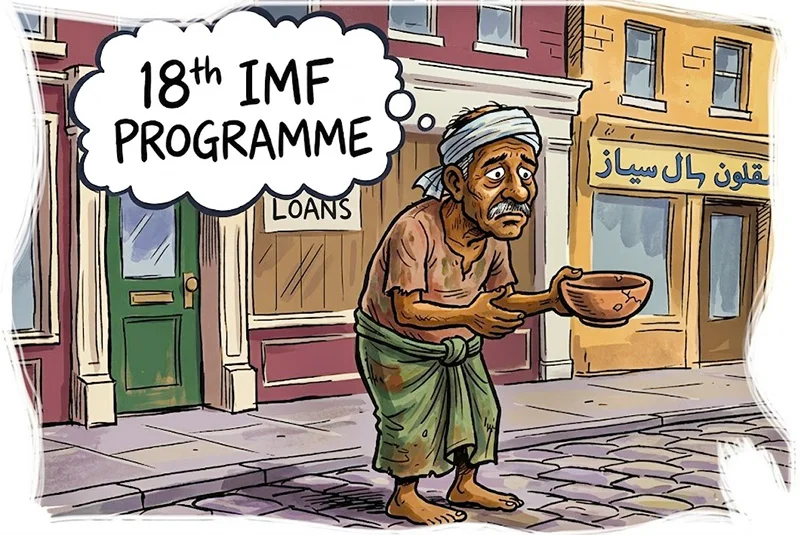
Therefore, the real issue is not simply whether Sri Lanka will enter an 18th IMF programme. The more important question is whether the country is capable of building an economy that no longer requires repeated IMF intervention.
Achieving this requires more than slogans or short-term political promises. It demands a clear and disciplined national economic strategy. Government expenditure must be prioritized carefully. Loss-making state-owned enterprises should be freed from political interference and placed under professional management. The tax system must broaden the revenue base fairly while encouraging investment and reducing tax evasion.
At the same time, Sri Lanka must transform itself into an export-oriented productive economy. Agriculture, manufacturing, tourism, information technology, port services, education services, and healthcare services should all be strategically developed as foreign exchange earning sectors. Investors do not seek tax concessions alone; they require policy consistency, legal stability, efficient approval processes, and an environment free from corruption.
True reform does not mean continuously burdening citizens with higher taxes and reduced living standards. Genuine reform means creating a more efficient state, reducing waste and corruption, increasing productivity, and expanding income-generating opportunities for ordinary people. Whether under an IMF programme or outside one, Sri Lanka urgently needs this kind of national economic discipline.
Ultimately, the IMF is not a symbol of economic success. It is an emergency support mechanism used during periods of crisis. The national objective should not be to secure yet another IMF programme, but to build an economy strong enough to function without repeated external rescue packages.
Otherwise, today’s question — “Will Sri Lanka need an 18th IMF programme?” — may eventually become “When will the 19th programme begin?”
That is not the future Sri Lanka should aspire to. The country does not need an economy that survives by repeatedly seeking external assistance. It needs a mature national economy that produces, exports, innovates, earns global confidence, and builds its future through its own strength and productivity.
by Professor Ranjith Bandara, PhD (Qld.,)
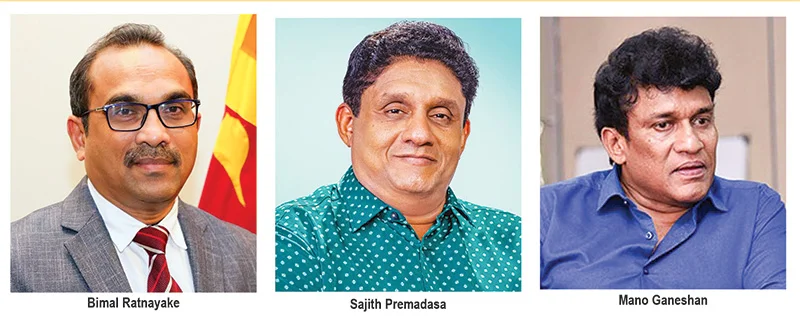
At a symposium on reconciliation organised by the National Peace Council last week, more than 250 religious clergy, civic activists and political representatives from different communities gathered to discuss the country’s future. Speaking at the event, Minister Bimal Rathnayake explained the government’s approach to national reconciliation. He said the government viewed the country’s recovery in terms of a three stage process. The first stage was stabilisation, the second was development and the third was transformation. Reconciliation, he implied, would come in that final stage. The participation of Opposition Leader Sajith Premadasa at the same symposium, and the constructive nature of his comments, strengthens that hope.
When the present NPP government took office in 2024, the country was emerging from one of the gravest crises in its post Independence history. The economic collapse of 2022 had led to shortages of fuel, food, medicines and electricity. Inflation soared, foreign reserves disappeared and long queues became part of daily life. The political upheaval that followed culminated in the resignation of former President Gotabaya Rajapaksa after mass public protests under the banner of the Aragalaya movement. The country was then governed by a leadership that spoke the language of reform and reconciliation but was widely perceived as lacking a direct popular mandate.
Sri Lanka’s past experience suggests that stabilisation and transformation cannot be treated as entirely separate stages. Postponing reconciliation until some future moment risks repeating the failures of the past. If transformation is endlessly delayed until a supposedly perfect moment arrives, there will always be new crises and new reasons for postponement. Minister Rathnayake’s contention that the government’s immediate priority has necessarily been stabilisation flows from the government’s awareness of the precarious situation the country is. Over the past two years, the government has succeeded to a significant extent in restoring economic and political stability. Inflation has reduced, shortages have ended and public institutions have regained a degree of functionality.
Guaranteed Changes
On the other hand, the country’s development continues to face challenges due to adverse global conditions, including disruptions caused by conflict in the Middle East and extreme weather events that have affected tourism, trade and the cost of living. The danger is that reconciliation may be indefinitely postponed in the name of stabilisation. This danger can be reduced if the government works proactively with the opposition and civil society to commence practical measures of transformation now rather than later. The participation of Opposition Leader Sajith Premadasa at the symposium, and the constructive nature of his comments, has strengthened the sense that bipartisan engagement on reconciliation may now be possible.
The urgency of transformation came through strongly in the presentations made by representatives of the Sri Lanka Tamil and Malaiyaha Tamil communities. ITAK parliamentarian S.Shritharan spoke of the frustration caused by unresolved post war issues in the north and east. He referred to disputes regarding land occupied during the war years, including controversies linked to Buddhist temples and state sponsored settlement activity in areas claimed by local communities. He also pointed to the continuing large scale presence of the security forces in the north and east nearly two decades after the end of the war. These grievances have remained central to Tamil political discourse since the end of the armed conflict in 2009. Families displaced by war continue to seek the return of ancestral lands. Civil society organisations in the north have repeatedly called for greater civilian control over local administration and a reduction in military involvement in civilian life.
Academic research and practical work on the ground have shown that reconciliation cannot be separated from questions of dignity, equality and justice. Former minister Mano Ganesan, leader of the Democratic People’s Front, focused on the longstanding problems faced by the Malaiyaha Tamil community. He spoke passionately about continuing housing shortages, landlessness and economic marginalisation, issues that have persisted since Independence. He also highlighted the devastating impact of recent extreme weather events on estate communities that remain socially and economically vulnerable. The condition of the Malaiyaha Tamil community remains one of the enduring social justice issues in Sri Lanka.
After Independence in 1948, a large proportion of them were denied citizenship and voting rights through legislation that rendered them stateless. Though citizenship rights were eventually restored, the social and economic consequences of exclusion continue to be felt generations later.
Many families still lack secure housing and land ownership despite their immense contribution to the country’s plantation economy. Minister Rathnayake’s responses to both these concerns were politically significant. He argued that recent political developments, including the declining influence of narrow ethnic politics across communities, indicated a major shift in public attitudes. According to him, the political ground has changed in ways that make it increasingly difficult for politicians who rely primarily on ethnic division and communal insecurity to retain public support.
Inter-Connected
There is evidence to support the assessment about the changing political grounding which sees future prospects in the resolution of long standing problems. . The economic collapse of 2022 affected all communities alike and generated a new politics centred on governance, anti corruption, accountability and economic justice. The Aragalaya protests brought together Sinhalese, Tamils and Muslims in a common demand for political change. Although ethnic grievances have not disappeared, the crisis created space for a broader understanding that the country’s future depends on cooperation rather than division. Opposition Leader Premadasa’s comments at the symposium reflected this changing political climate. He emphasised that national reconciliation could not be separated from economic justice and the need to address disparities between regions and social classes.v He also mentioned the need for civil society organisations to take this message to the community. This wider understanding of reconciliation is important because ethnic inequality and economic inequality have often reinforced each other in Sri Lanka’s history.
Academic studies have identified the denial of citizenship rights after Independence as a historic injustice that set back the Malaiyaha community for decades. The challenge now is to ensure that transformation becomes part of the stabilisation and development process itself. Practical first steps are both possible and necessary. The release of civilian lands still under state control, greater devolution of administrative authority, reduction of military involvement in civilian affairs, language equality in public administration and accelerated housing and land ownership programmes in the plantation sector are all measures that can begin immediately without waiting for a final stage of transformation.
The government’s recent commitment that provincial council elections will finally be held this year is therefore significant. These elections have been repeatedly postponed by successive governments. Holding them would not solve the ethnic conflict by itself. But it would signal a willingness to restore democratic institutions and share power in a meaningful way.
Sri Lanka has repeatedly postponed difficult reforms in the hope that a more convenient political moment would eventually arrive. But opportunities are invariably created and fought for instead of being provided as a gift by a benevolent government.
The present moment, shaped by the economic crisis and public demand for accountable government, offers a rare opportunity to move simultaneously towards stability, development and reconciliation. Provincial council elections can be the first meaningful step. But they must not be the last.
by Jehan Perera

Explosive top orders in focus as Rajasthan Royals face bogey team Sunrisers Hyderabad

New High-Definition (HD) Television Studio at the University of Vocational Technology handed over to students with the participation of the Prime Minister

Multiple people killed and others missing after chemical explosion at US paper mill

Dozens killed in Lebanon as Israel intensifies strikes

Showers will occur at times in the Western, Sabaragamuwa and North-western provinces and in Galle, Matara, Kandy and Nuwara-Eliya districts

Banking sector claims its integrity intact despite ‘isolated incidents of fraud’

‘Dates have the highest sugar content to fight Coronavirus’

Sunday Island 27 December – Headlines

#SundayIsland 17th December – Headlines

Sunday Island – 28th March

Sunday Island Headlines – 21 March

Sunday Island – 21st February – Headlines
-

 Business5 days ago
Historic launch of CCWE Fashion Week & International Summit 2026
-
 Opinion6 days ago
Murder of Ehelepola family, Bogambara Wewa and Sightings of Wangediya
-
 News6 days ago
Steps underway to safeguard Sri Lanka’s maritime heritage
-
 News2 days ago
Police probe underway to ascertain links between criminals deported from UAE and local politicians
-
 Features3 days ago
The NPP’s pivot to the past
-

 News3 days ago
All-New GRAVITE launches at LKR 6.99 Mn
-

 Editorial6 days ago
A play without its protagonist
-

 Opinion5 days ago
The need to reform Buddhist ecclesiastical order