
Features
Tribute to Jennifer Latiff


“The beauty of a woman is not in the clothes she wears, the figure that she carries, or the way she combs her hair. The beauty of a woman is seen in her eyes, because that is the doorway to her heart, the place where love resides. True beauty in a woman is reflected in her soul. It’s the caring that she lovingly gives; the passion that she shows and the beauty of a woman only grows with passing years.”
Audrey Hepburn wrote this paragraph which is so very true of Jennifer Amaraskera Latiff who died two days ago of a cancer that kept her away from her friends, even before the later lockdowns were enforced.
She is mourned by so many: her sister Marie, son Yohan and daughter Suan; Yohan’s children and in-laws; and of course Kandy High School Old Girls of all ages.
Jenny, as we shortened her name to, was much younger than I, a schoolmate, but we were great friends. Her father being the parish priest of the historic St Paul’s Church very near the Dalada Maligawa, she attended Girls’ High School, Kandy, from Baby Class to AL. I chatted just now with one of her classmates – Kamini Jayasekera. Her expression of Jenny being a lovely person had the ‘lovely’ drawn out, accompanied by a quiet sob. Mayanthi Kulatunge Jayakody informing KHS OGA (Colombo Branch) members of Jenny’s death wrote: “Above all, she was a wonderful and lovable lady who touched the heart of anybody who she came across. She will be dearly missed at all our future events.” Obviously when the President Sylvia Wijekoon rang me, her voice indicated shed tears.
Yes, Jennifer was a truly wonderful woman, so genteel and soft spoken, so concerned about others. About eight of us Old Girls of KHS of all ages from 90s down to 40s would meet for lunch and birthdays in one home or another. We loved gossiping and often even maligning –politicians mostly. Not Jenny to utter a word of gossip or blame. She did not reprimand us. No, she would listen and smile, but it was totally alien to her to run people down.
Our small group went on trips together, one being a very memorable stay in Nuwara Eliya. One room in the row of rooms we occupied at the Golf Club was occupied by a political VIP who often kept his door open. Many were the irrepressible giggles and tall tales. No comment from Lady Jenny. On our outstation forays, while we wore rubber slippers and had our hair awry, Jenny always wore shoes, a neat skirt and modest blouse with her short hair very much in place. She was an excellent tripper, readily agreeing to plans made and consenting to any likely changes. She was fun too, making us laugh at her asides, never malicious, but spicy.
Life of service
Jennifer served Ceylon Tobacco Company for long in a secretarial position and was approved and liked by all. She then moved to being secretary to Mr Merril Fernando at Dilmah around 15 years ago. At the tail end of her stay, a friend said, she started on Mr Fernando’s biography. However she had to abandon it as she fell ill.
Most noteworthy and remarkable was her dedication and service to the Colombo Branch of the KHS OGA. She must have served in it for well over 25 years, being a committee member when Hema Jayasinghe followed by her sister Chitra Abeyaratne were Presidents. We worked together – Jenny and I and friends in our small group – in the OGA Colombo Branch. Jenny served two terms as Secretary, two as President and was from 2018 to 2020 Patron of the Association. She was a patron who attended every committee meeting, not called for but time sacrificed to better serve.
It has been mentioned that Jennifer was ever ready to help others. I quote one instance. An Old Girl, much older than Jenny, needed a lift to events. Jennifer would always pick her up and drop her back home, even when she was holding the post of Secretary or President and in spite of wanting to be one of the first at the venue. When this person became somewhat disabled, Jennifer did more for her. She would bring her and her helper and lead the former solicitously to her seat. Jenny’s car and she as driver were always at hand for those who needed lifts.
Jennifer will be sorely missed by so many. Our group lunches and KHS OGA events will not be the same without Jenny’s presence. But that is life and partings have to be accepted. Thinking of her, the phrase ‘She walks in beauty’ kept going through my mind. Hence I quote many lines from George Gordon Byron’s poem with that phrase as title.
“She walks in beauty, like the night
Of cloudless climes and starry skies;
And all that’s best of dark and bright
Meet in her aspect and her eyes;
And on that cheek and o’er that brow,
So soft, so calm, yet eloquent,
The smiles that win, the tints that glow,
But tell of days in goodness spent,
A mind at peace with all below,
A heart whose love is innocent.”
May Jennifer receive all she would desire, and deserve, after her death, which death we sorely mourn
Nanda Pethiyagoda



R. W. Ievers, who wrote this poem, was the Government Agent of the North Central Province during 1884, 1886, and 1890. He is the author of the Manual of the North Central Province (1899) and a half dozen published reports on the life and practices in the Province. Before his death, he shared it with his good friend H.C.P. Bell, the Archaeological Commissioner of Ceylon at the time. In 1917, Bell had it published in the Times of Ceylon – Christmas Number. Since then, it remained unknown for 109 years, until Ievers’s great-grandson, Turtle Bunbury, historian and author of Living in Sri Lanka (2006) with James Fennell, tipped me off about its source – H.C.P. Bell: Archaeologist of Ceylon and the Maldives (1993), written by Bell’s granddaughters Bethia N. Bell and Heather M. Bell.
THE ANTHEM
Anuradhapura! City grand and vast,
Lanka’s famous Capital, in ages of the past:
In the Mahawansa the story has been told
Of thy palaces, and temples, and pinnacles of gold.
Hail! then hail! to the worth of a bygone day,
Hail! all hail! to the relics of kingly sway
Hail to thee, Fair City, glorious in decay,
Hail! thrice hail! Forever and for aye!
Si monumentum quaeris
– cast your gaze around
Ruined fanes and dagobas everywhere abound
Alas! for glory faded, for erstwhile beauty sped
For hierarchs and heroes, long numbered with the dead
Hail! then hail!…
Great Ruwanaveli Seya, once fairest of the fair,
The splendour of thy palmy days has melted into air;
And like Imperial Caesar now ‘dead and turned into clay’,
Thy sacred bricks ‘may stop a hole to keep the wind away.’
Note by Tillakaratne:
Since 1873, Bhikku Naranvita Sumanasara has been doing conservation work on this stupa. In 1876, Governor William Gregory, after visiting the work site, wrote that its conservation was not just a religious work but a great National Monument.
See ‘Bayagiri’ massive – ‘Fearless Mount’ forsooth – Centre once of schism rank, from ‘Great Vihara’ truth.
Patched up by prison labour, anew it flaunts on high
A ‘hideous excrescence’ athwart a tranquil sky.
Note by H. C. P. Bell
: T. N. Christie, Planting Member at the time protested in the Legislative Council against the abortive “restoration” by prison labour of the Abhayagiri Dagaba, dubbing its truncated pinnacle, half restored, a “hideous excrescence”.
Jetawanarama, Great Sena’s priestly boon
Comely shape and giddy height will crumble all too soon;
Where forest trees and chequered shade a peaceful picture lend,
From cruel axe and ruthless spade, may gracious Heaven defend.
Note by H. C. P. Bell:
Two decades after these poems were written, the surrounding area of the Jetawanarama was still covered in forest, and the Atamasthana Committee conditionally allowed a monk to clear a limited number of trees. But not a tree remained unfelled, contrary to what the monk was authorized to do.
Thuparama graceful, in outline clear and bold,
Begirt with column chaste and slim, a gem in the ring of gold
To thee pertains high honour a pious people gave – The tomb of Sanghamitta, and Prince Mahinda’s grave.
Note by
H. C. P. Bell: The ruins are pointed out, wrongly, as the tradional tombs of Arahat Mahinda and Sanghamitta Theranee.
With bricks and mortar bolstered up, behold the Sacred Bo;
To some – misguided mortals – ‘tis but a ‘bo-gas’ show.
Where humble Mirisveti a monarch’s fad recalls,
Lo! Royal Siam’s silver now builds its futile walls.
Note by H. C. P. Bell:
According to Mahawansa, Mirisavetiya was so named after King Dutugemunu’s compunction at forgetting chillies (miris) in his alms giving to monks on one occasion. The restoration work on the Mirisavetiya began under the Ceylon Government, with funds provided by the King of Siam. When the money flow began to cease, work also ceased, and bats began to frequent the holed structure.
-

- Ruwanveli Seya in the background. Murage in the front c. 1900 From Sacred City of Anuradhapura (1908)
-

- Bhayagriya (Abhayagiriya) c. 1900 From: Sacred City of Anuradhapura (1908)
-

- Jetawanaramaya c. 1900. From Sacred City of Anuradhapura (1908)
What need to tell of sculptures, of ‘pokunas’ galore,
Of balustrades and Yogi stones and half a hundred more,
Of Brazen Palace spacious, with gilt-roofed storeys dight –
A modern race more ‘brazen’ would desecrate each site.
For midst these sacred ruins of shrines and cloistered hall,
A reckless generation disports with little balls,
Whilst ‘Parliamentary language’ and imprecations deep
Disturb the peaceful solitude where saintly Rahats sleep.
Note by H. C. P. Bell:
After European residents, old city Anuradhapura in the late 19th century, the area still being cleared between Ruwanveli Seya and Thuparama, was used a ‘golf links’. Ievers did not like the area used as a playground:
Iconoclasts and vandals have had their little day;
No more shall ancient pillars to culverts find their way.
No more a watchful Government such sacrilege condones –
One may not meddle with the gods, nor tamper with the stones.
Anuradhapura! Thy glory shall revive;
Yhu [sic] sons shall swarm within thee like bees about a hive.
The effort of the present for past neglect atones;
New breath of life resuscitates this vale of driest bones.
Composed by R. W. Ievers
(1850-1905)
Introduced by Lokubanda Tillakaratne

For thousands of Sri Lankans living with limb loss and physical disabilities, access to quality rehabilitation services remains a significant challenge. Yet, for more than three decades, our organisation has quietly transformed lives through innovation, compassion and community-based care. The Meththa Rehabilitation Foundation Guarantee Limited (MRFGL), supported by the Meththa Foundation-UK and in partnership with the Manitha Neyam Trust, the LEBARA Foundation and the Oblates of Mary Immaculate in Jaffna, emerged as one of Sri Lanka’s most effective voluntary rehabilitation service providers, restoring mobility, independence and dignity to some of the country’s most vulnerable citizens.
The Foundation’s roots stretch back to 1994, when a group of expatriate Sri Lankan professionals in the United Kingdom recognised the severe shortage of rehabilitation services available to disabled persons in Sri Lanka. Drawing upon their expertise in rehabilitation medicine and allied healthcare professions, they established the Meththa Foundation-UK with a simple but powerful vision: to provide affordable, high-quality prosthetic and rehabilitation services to those who needed them most.
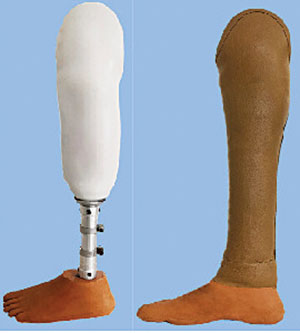
Below knee artificial limb Designed and made at Mahawa
What began as an effort to recycle and repurpose high-quality prosthetic components donated by the UK’s National Health Service has evolved into a comprehensive rehabilitation network serving communities across the island.
Clinical services commenced in Sri Lanka in 1995 through a mobile outreach programme that initially supported injured soldiers and later expanded to civilians affected by conflict and disability. The majority of them were victims of land mines. In 2010, the Sri Lankan arm of the organisation was formally registered as the Meththa Rehabilitation Foundation Guarantee Limited, strengthening its ability to deliver sustainable services nationwide.
Today, the Foundation operates four modern rehabilitation centres located in Mahawa, Mankulam, Balapitiya and Kilinochchi. These centres provide prosthetic and orthotic services, posture and mobility support, limb repairs, and rehabilitation assistance to patients from diverse social and economic backgrounds.
Recognising that many disabled individuals live in remote areas with limited access to healthcare, Meththa Foundation also established a mobile outreach service in 2011. Through a successful “Hub and Spoke” model, rehabilitation teams travel regularly to underserved communities, ensuring that patients are not denied care simply because of distance or financial hardship.
The scale of the Foundation’s work is impressive. During 2025 alone, the organisation recorded approximately 2,000 patient contacts, including the provision of 350 new artificial limbs, 850 limb repairs and around 800 other rehabilitation devices. For many beneficiaries, these interventions represent far more than medical treatment; they offer a pathway back to employment, education and social participation.
Innovation has become a hallmark of the Foundation’s approach. Through an active research and development programme, MRFGL has developed affordable prosthetic technologies specifically suited to Sri Lankan conditions. Among its achievements is the development of a modular below-knee artificial limb system manufactured largely from locally sourced materials. The Foundation has also designed low-cost prosthetic knee components that significantly reduce the financial burden on patients while maintaining quality and functionality. These developments are funded by generous International Grants facilitated by affluent members of the Meththa Foundation-UK. Service users are encouraged to donate whatever they can but for those who cannot, which is a majority the services are entirely free.
These innovations not only make rehabilitation more affordable but also strengthen local manufacturing capabilities and reduce dependence on imported components.
Equally important is the Foundation’s commitment for building local expertise. Recognising the shortage of trained rehabilitation professionals in Sri Lanka, Meththa Foundation
established an apprentice-based vocational training programme that recruits and trains young people as prosthetists, orthotists and rehabilitation technicians. Several locally trained staff members are now employed across the Foundation’s centres, helping to create a sustainable workforce for the future.
The organisation’s work has attracted growing recognition within the healthcare sector. Discussions have already taken place with health authorities regarding the potential use of Meththa-designed prosthetic components within Government hospitals. Such collaboration could significantly expand access to affordable rehabilitation services throughout the country.
Beyond its clinical achievements, the Foundation’s impact is measured in restored confidence and renewed independence. Surveys conducted among beneficiaries indicate that many educated amputees successfully return to productive lives after receiving rehabilitation support. However, the findings also highlight an ongoing challenge among poorer and less educated amputees, many of whom struggle to access follow-up care due to transportation difficulties and financial constraints.
To address this issue, the organisation hopes to -expand its mobile services and community outreach programmes. Additional funding would allow rehabilitation teams to reach isolated communities more frequently, ensuring that vulnerable patients continue to receive the support they need.
Operating on an annual expenditure of approximately Rs. 30 million in Sri Lanka, supplemented by overseas fundraising and donations, the Foundation remains heavily reliant on the partnership of charitable trusts such as the Manitha Neyam Trust and LEBARA Foundation and generosity of individual well-wishers. Every contribution directly supports the provision of artificial limbs, mobility devices, training programmes and outreach services for those who might otherwise be left behind.
As Sri Lanka continues to strengthen its healthcare and social welfare systems, organisations such as the Meththa Foundation demonstrate how innovation, volunteerism and dedication can create lasting social
By helping individuals regain mobility and independence, the Foundation is not merely providing artificial limbs—it is rebuilding lives and restoring hope.
For many “beneficiaries, every step they take is a testament to the life-changing work of the Meththa foundation
www.meththafoundation-sl-uk.org
Chairman’s WhatsApp contact number +94 77 788 6119
Prof S P Lamabadusurira, Chairman and Dr B Panagamuwa, ✍️
First Trustee

EPISODE 7
A shorter piece today, after the lengthy tale set in Tudor England. This one too is set in the past, but just a hundred years back, like A Queer Case. But this one is set in a distant land, in British India, in the period just after the First World War when the movement for home rule was gathering strength.
The book was given to me by Robert Scoble, who presented a whole set of Brahms and Simon novels including their three detective stories. But this one was just on loan for the duration of my cruise. At dinner he told me about a detective series set in Calcutta, which sounded so interesting that I asked to borrow the first in the series.
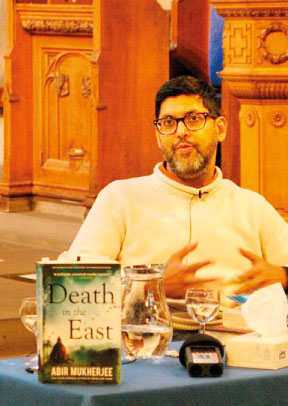
Mukherjee
So, the following morning, when he turned up to collect something he had dropped in the restaurant, he gave me A Rising Man by Abir Mukherjee, a Bengali born and brought up in Scotland. His hero is a British Police Officer in Calcutta just after the First World War, Captain Sam Wyndham. The Watson to his Holmes is an Indian Police Sergeant called Surendranath Bannerjee, who had been called Surrender Not by Inspector Digby, who had been his boss before Wyndham appeared, in a higher rank. Wyndham realized that Digby, who had long service but had not been promoted as might have been expected, was not too happy about this.
The novel begins with the discovery of the body of a high-ranking Civil Servant, in a shady part of the city, very near a brothel. Alexander MacAuley is a principal aide to the Lieutenant Governor of Calcutta, next only to the Viceroy in importance. There is a note stuffed in his mouth suggesting that the murder was the work of Indian radicals, and Wyndham soon discovers, through Digby, that there had been a meeting of radicals that very night.
But Bannerjee points out that the note seems like a plant, and Wyndham realizes that he needs to investigate further. Though the leader of the radicals is arrested, and the army, entrusted with the case by the Lieutenant Governor, is determined to find him guilty, Wyndham delves deeper and realizes that McAuley had seemed a tormented man in the months before his death, and he needs to check on what he was doing in the brothel, as well as the involvement of a businessman to whom he had been close.
The terrorist tells Wyndham that he had decided to shift to Gandhi’s non-violent approach and, though the army will have no truck with this, Wyndham believes him and, after some nifty detective work – which includes interviewing one of the prostitutes in the brothel who is soon afterwards found dead – he establishes that MacAuley had acted as a procurer, but then felt qualms about what he had been doing, which is why he had been silenced.
Bannerjee kills the murderer who had lured Wyndham into a trap, and there is enough evidence for the Lieutenant Governor to commute the sentence of death on the reformed terrorist, and instead exile him to the Andamans. And Wyndham’s boss, the Commissioner of Police, is able to affirm the independence of his department, and limit interference from the forces and the Lieutenant Governor, given that he is able to show their involvement in the cover up.
Though politics is not the subject of the story, there is much about what was going on in India at the time, and one gets a strong sense of how thin was the façade of British superiority. It was based on claims to a moral high ground which Mukherjee makes clear was mythical, though as the great analyst of the failure of the British in India, Paul Scott, indicated, there were many individuals who believed in that perspective. The crisis they had to face was where to stand when it became clear that their peers were cynical about the values they were supposed to uphold, and thus brutal in their dealings with Indians.
I also found fascinating the description of the many faces of Calcutta, which I am less familiar with than the other big cities of India. Mukherjee looks at Calcutta in its heyday, just a few years after it had ceased to be the capital of British India. The move was under Curzon, who understood the dangers of Bengali domination of nationalism. Though the province had been divided, to reduce its influence, that decision was changed, but instead the capital was moved away and gradually Bengali domination of the nationalist movement diminished.
Mukherjee captures the sense of a city and an administration dwindling in influence, but also notes the remnants of its past domination. And the contrast between the grand haunts of the British, and sordid areas they also penetrated, is powerfully presented.
As with Shardlake and his henchman, Wyndham and his Indian mate are characters I hope to read more about.

ANURADHAPURA ANTHEM c.1893

Sorry plight of 1.6 mn children and young adults with disabilities in the country

Amshi de Silva runs through Unicorns to give Super Kings second win

Meththa Rehabilitation Foundation: Restoring Mobility, Dignity and Hope Across Sri Lanka

Sri Lanka–Thailand Free Trade Agreement at last sees the light of day

Pathfinder Foundation hosts luncheon meeting for visiting US Assistant Secretary of State

‘Dates have the highest sugar content to fight Coronavirus’

Sunday Island 27 December – Headlines

#SundayIsland 17th December – Headlines

Sunday Island – 28th March

Sunday Island Headlines – 21 March

Sunday Island – 21st February – Headlines
-

 News7 days ago
Creditor receives USD 2.5 mn as Lankan public bears loss from theft of Treasury funds
-

 News6 days ago
Creditor not yet paid
-
 News6 days ago
Consumers bearing 22% tax burden despite 18% VAT claim: Dr. Harsha de Silva
-

 Features5 days ago
Nanda Pethiyagoda Wanasundara as three generations of family saw her
-

 Features4 days ago
Sri Lanka developing independent hydrographic capabilities
-

 Editorial5 days ago
Fuel crisis: Beyond price debate
-

 Latest News4 days ago
Sooryavanshi thumps fastest List A fifty as India A win tri-series
-
 Opinion3 days ago
Ranasinghe Premadasa: The man who would not take ‘No’ for an answer