
Midweek Review
Transmission modes of COVID-19


By Prof.Kirthi Tennakone,
National Institute of Fundamental Studies
(ktenna@yahoo.co.uk)
In the late 1850s Louis Pasteur discovered organisms seen only through a microscope cause putrefaction of dead biological materials and also infectious diseases. On the basis of these findings, the medical profession at the time concluded; when people get exposed to decaying organic matter, microbes therein gain access to human body, making them sick. Their excrements carrying the pathogen also transfer the disease to others. Later on it became clear a specific types of microbes latently established in the community or in animal reservoirs are responsible for each infectious disease. Sometimes they flare-up, transmitting from one host to another, resulting in an epidemic. When the community acquires herd immunity, the disease wane and move to another location, or reappear at the same place later. Rarely a microorganism, naturally associated with an animal, jumps to a human and after genetic alterations develops into a contagious illness. Most of the existing infectious diseases are believed to have originated by the above evolutionary process. The genetic material of the coronavirus (SARS-CoV-2) resemble those of viruses present in some species of bats, but definitive evidence is not available to determine how it passed to humans.
Depending on the nature of the infectious agent and symptoms caused by its invasion to the human body, diseases spread via one or several of different modes. Notably; direct or indirect exposure to body fluids, food or water contaminated with excretions of the sick, pathogen released to air or mediation of another living organism (vector).
Pathogens evolve to optimize the mode of transmission to proliferate and survive, but not to exterminate the host. Propensity of evolution via genetic changes is higher in the case of viruses, notably those based on RNA. More the virus replicate by infecting a larger population, chances of popping up variants increase proportionately.
Respiratory transmission of
infectious diseases
One of the most effectual modes of disseminating an infection is releasing the pathogen into the air in coughing, sneezing, talking or exhalation. Here, germs enter into the bodies of other people during inhalation, deposition on lips, nostrils, eyes or skin. Those deposited on surrounding objects sometimes contaminate hands and may subsequently enter the mouth. Apart from COVID-19, quite a number of most contagious viral and bacterial diseases spread by the airborne route. These include viral diseases; common cold, influenza, measles, mumps, chicken pox, viral meningitis and bacterial diseases; tuberculosis, diphtheria, whooping cough and anthrax. Lungs and the respiratory tract are more susceptible to intrusion by germs compared to the gastrointestinal tract, because the acidity of the latter resist foreign organisms.
Airborne diseases are hardest to control, because of the high probability of transmission through an all-pervading invisible medium and prohibitive difficulty of sterilizing large volumes of air.
The direct respiratory transmission of a pathogen proceeds via two aerodynamical mechanisms; droplet transmission and aerosol transmission, the latter is also referred to as airborne transmission.
Droplet Transmission
When an infected person cough, sneeze, speak or exhale deeply, ejected fluid droplets disperse into air. These droplets constituted largely of water, enclose mucus and the pathogen. With the initial velocity imparted, droplets propel forward and begin to fall owing to gravity, following a curved trajectory.
At school, we learn that all falling objects; irrespective of mass and size, moves with continuously increasing speed at a constant acceleration of approximately 10 meters per second. This is in absence of air resistance, negligible compared to gravitational force for heavy objects. Situation differs in the case of small particles, where air resistance is comparatively important. As shown by Irish physicist George Stokes, falling spherical particles encounter a breaking force proportional to the velocity. Consequently they accelerate for very short time and thereafter fall down with a uniform speed proportional to the square of the radius. Thus larger droplets, those greater than 5-10 micrometers (1micrometer = 1/1000 of a millimeter) fall rapidly and reach the ground after propelling a short distance of about 1-2 meters. Only those persons within this range get exposed to larger droplets. Smaller droplets fall further or remain airborne and floats around.
Particles floating in air without settling down to the ground are known as aerosols.
Water in respiratory droplets evaporate, converting sizable ones to smaller entities; more likely to be transported as aerosols. Sometimes water evaporates completely producing nuclei carrying the pathogen. Nuclei being lighter remain afloat longer. Evaporation depends on relative humidity and ambient temperature.
The genius scientist and engineer William F. Wells working in Baltimore hospital, United States, in 1934 was the first to analyze theoretically the respiratory transmission of infections, distinguishing droplet and aerosol modes.
Aerosol Transmission
Smaller droplets (less than 5-10 micrometers and sometimes even larger), those reduced to similar sizes by evaporation of the water content and droplet nuclei resulting from drying-up of droplets remain suspended in air without falling to the ground. They can be carried long distances exceeding 10 meters by air currents or accumulate in poorly ventilated spaces. Evaporation to dryness could inactivate pathogen and many viruses and bacteria seem to have evolved strategies to circumvent this problem – possibly the residue mucus help to preserve them live.
To prove the aerosol hypothesis, William Wells vented air from a tuberculosis ward in Baltimore hospital to a compartment where Guinea pigs were nourished. He observed about 3 percent of the animals contracted tuberculosis. Examination of the lesions in lungs revealed they have originated by deposition very few bacilli each time; further supporting the aerosol hypothesis. Aerosols being minute, each carry very few microbes. In another experiment Wells irradiated air from the tuberculosis ward with ultraviolet light before venting to the Guinea pig cage. Here none of the pigs developed the disease, confirming germs originated from the ward.
Today we describe tuberculosis as an archetypal example of a respiratory disease communicated by aerosols. Measles and chickenpox also spread predominantly via aerosol route.
Despite the seminal work of W.G. Wells, medical texts continued to emphasize most respiratory infections including common cold and influenza transmits via droplet mechanism. For this reason the COVID-19 virus was assumed to transmit primarily via droplets and preventive measures were recommended accordingly.
Although scientists continued to insist COVID-19 virus could communicate via aerosols; World Health Organization (WHO) and Center for Disease Control and Prevention (CDC), United States and several other leading health care authorities did not acknowledge airborne transmission. About a month ago, all these organizations revised their websites making statements to the effect that COVID-19 could also be transmitted by aerosols.
At shorter distances (2-3 meters), both droplets and aerosols pass on coronavirus. Whereas at longer distances (especially unventilated situations) aerosols play a predominant role.
There exist reasons to suspect aerosol communicated illness is more virulent. In droplet mechanism, the virus lands on the nasal region of the respiratory passage gradually proliferating downwards in the respiratory tract. Whereas aerosols can reach the lungs directly, causing acute respiratory complications instantly. Possibly when virus is first introduced into the upper respiratory tract by droplets, the local infection there induce some immunity before it reaches the lungs – suggesting aerosol communicated infection is more virulent.
COVID Transmission modes and control measures
Decisions regarding what measures to be adopted in controlling an infectious disease necessitates gaining an understanding of the nature of the causative agent and how it is transmitted. For diseases known to have existed for long periods of time, requisite information is readily available permitting immediate intervention. When COVID-19 surfaced it was a new disease not known to have existed previously. Modern science was quick to ascertain the genotype (complete genetic information of an organism) and phenotype of the virus (actually observed characteristics of an organism) and pathology of the disease – information essential design vaccines and curative medicines.
Finding how the virus spreads poses more challenges, especially when there are more than one possible modes of transmission. Here it is important to determine the relative weightage of each mode. In absence of detailed information regarding modes of transmission, droplet mechanism was assumed; because common viral respiratory diseases are considered to pass via this avenue. Accordingly, preventive measures recommended were; social distancing, limiting mobility, wearing masks and sanitization of the hand as well as surfaces likely to be contaminated by the deposit of droplets.
Even in situations where aerosol transmission turns out be more likely, it is imperative, the measures recommended for the droplet mode are strictly followed. However, additional safeguards needs to be imposed when aerosols poses a threat. Aerosols travel longer distance from the source and could diffuse throughout a closed space or carried further by air currents. Masks one wears has to be the type that filters aerosols and tight fitting to avoid aspiration of air from the gaps during inhalation. The risk of aerosol transmitted infection is vastly higher in poorly ventilated indoor environments.
In outdoors situations aerosol transmission is minimal provided social distancing (about 2-3 meters) is strictly maintained while wearing masks, as aerosols diffuse fast. However open markets cannot be considered as outdoor owing to poor circulation. Here additional precautions are necessary to avoid overcrowding.
Superspreading of COVID-19
In many instances a good number of people gathered in markets, shops, malls and auditoriums or enclosed workplaces have contracted COVID-19, presumed to be infected by one identified carrier. All individuals who contracted the infection were most unlikely to have encountered the carrier at 1-2 meter distance. Obvious conclusion would be, the virus had been in air and many have breathed it. Experiments indicate virus could survive in aerosols several hours. Poor ventilation, improper air-conditioning and air recycling accumulate aerosols. An infected individual identified to have created a big cluster is sometimes referred to as a superspreader. However, it does not necessarily imply the subject shreds more of the virus. Often the cause of extensive spread had been the nature of an event or the environment where people gathered and participated. In a large congregate, one carrier moving around could contaminate breathing air with germs harbored aerosols to lethal proportions, if the ventilation is inadequate. Imagine the extent of transmission in such situations, when there are several carriers!
A peculiarity of the COVID-19 pandemic: over-dispersion of the basic reproduction number
The present pandemic is peculiar in terms of a concept in mathematical epidemiology referred to as over-dispersion of the basic reproduction number. Basic reproduction number (R0) refers to the average of number of new cases generated by one carrier of the pathogen. For COVID 19 value of R0 is generally a number around 2. It is an average, if we take R0 as 2; it does not mean every infected person reproduce 2 others. The value of R0 could fluctuate randomly or follow an identifiable non-random pattern to yield an average of 2. Statistics of corona virus cases points to the latter.
A larger percentage of infected persons may not pass the disease to anyone, but if each in a smaller percentage of carriers, under special circumstances; infect numbers very much greater than 2, you still would obtain an average of 2. This is exactly the pattern observed in COVID-19 – about 75 percent of the infected persons do not pass disease to others! The flu of 1918 which caused a major calamity also had a basic reproduction number of about 2. Here, contrastingly; 40 percent did not cause secondary infections. Mathematicians measure this difference in terms of another parameter known as the over-dispersion factor denoted by K. The value of K for COVID-19 and the 1918 flu are 0.1 and 1 respectively. A small value of K implies a large percentage of infected persons rarely pass the disease to others, while a small percentage aggressively and sporadically fuel the epidemic.
In Sri Lanka and elsewhere the COVID-19 epidemic progressed mainly as clusters appearing spatially and temporally. The low over-dispersion factor of the present pandemic testifies cluster effect.
If causes are understood and actions taken to alleviate them, low over-dispersion can be advantageously exploited to mitigate the pandemic. A small value for K, means; rare situations congregating people, trigger the pandemic. If they are identified and eliminated, pandemic will dwindle and disappear allowing time for vaccinations secure long term safety and suppress breeding of variants.
The over-dispersion of basic reproduction number of the present pandemic imply that in respiratory transmission of the coronavirus ; it does not significantly distribute via random association of infected and susceptible individuals, but largely by a small set of noticeable social situations and therefore in principle, suppressible by community efforts to follow preventive measures. The pandemic may be suppressed by curtailing events and situations leading to breeding of clusters without restricting routine and other activities essential to drive the economy.
Many epidemiologists believe one of the main causes of low value of K is a direct consequence aerosol transmission under circumstances favorable to their accumulation – especially events and situation that congregate people.
Low dispersion of the basic reproduction number is also advantageous to the virus to resist the pressure of herd immunity. Even if a large fraction of a population is vaccinated, a local situation favorable for super-spreading could create a cluster.
Flu pandemic of 1918 fizzled out completely in 2.5 to 3 years, presumably because of the much higher value of K and rapid acquisition of herd immunity by exposure to the pathogen. Apart from distinctions in the viruses and their pathologies; a noteworthy difference of 1918 pandemic and COVID-19 are: smaller population densities, less human mobility and rarity of super spreading situations and events in the former.
Since the emergence of the COVID-19 epidemic in China, world learned so much about the disease. Yet, there are unknowns; especially finer details of how it propagates and how to cure it. The complex phenomenon of COVID-19 spreading cannot be understood entirely in terms of two numbers R0 and K – although these quantities have provided valuable insights.
We know for certain corona virus can be suppressed by control measures and vaccination. It is the duty of every citizen, community and nation to strictly abide by rules of prevention until vaccines are rolled out and appropriately thereafter.


Humour and the Creation of Community:
“As melancholy is sadness that has taken on lightness,
so humour is comedy that has lost its bodily weight”. Italo Calvino on ‘Lightness’ (Six Memos for the New Millennium (Harvard UP, 1988).
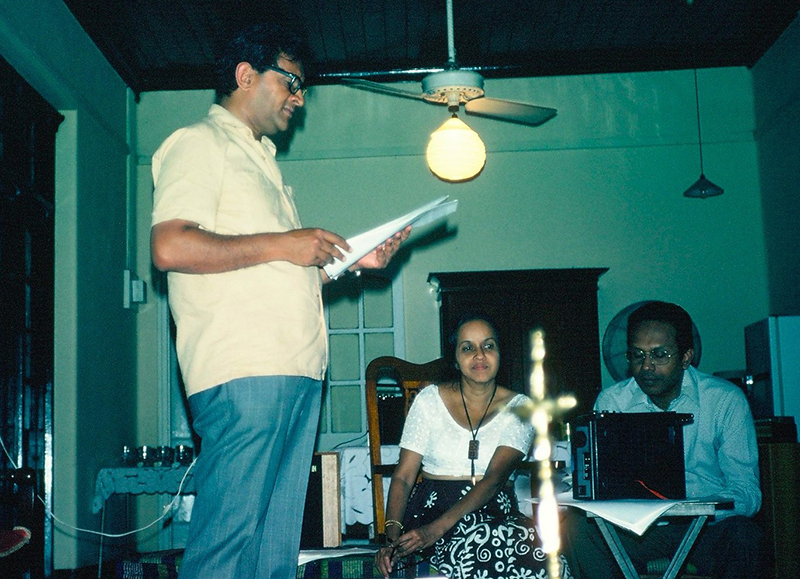
With the death of Ernest Thalayasingham MacIntyre or Mac, as he was affectionately known to us, an entire theatrical milieu and the folk who created and nourished Modern Lankan Theatre appear to have almost passed away. I have drawn from Shelagh Goonewardene’s excellent and moving book, This Total Art: Perceptions of Sri Lankan Theatre (Lantana Publishing; Victoria, Australia, 1994), to write this. Also, the rare B&W photographs in it capture the intensity of distant theatrical moments of a long-ago and far-away Ceylon’s multi-ethnic theatrical experiments. But I don’t know if there is a scholarly history, drawing on oral history, critical reviews, of this seminal era (50s and 60s) written by Lankan or other theatre scholars in any of our languages. It is worth remembering that Shelagh was a Burgher who edited her Lankan journalistic reviews and criticism to form part of this book, with new essays on the contribution of Mac to Lankan theatre, written while living here in Australia. It is a labour of love for the country of her birth.
Here I wish to try and remember, now in my old age, what Mac, with his friends and colleagues from the University of Ceylon Drama Society did to create the theatre group called Stage & Set as an ‘infrastructure of the sensible’, so to speak, for theatrical activity in English, centred around the Lionel Wendt Theatre in Colombo 7 in the 60s. And remarkably, how this group connected with the robust Sinhala drama at the Lumbini Theatre in Colombo 5.
Shelagh shows us how Bertolt Brecht’s plays facilitated the opening up of a two-way street between the Sinhala and English language theatre during the mid-sixties, and in this story, Mac played a decisive role. I will take this story up below.
I was an undergraduate student in the mid-sixties who avidly followed theatre in Sinhala and English and the critical writings and radio programmes on it by eminent critics such as Regi Siriwardena and A. J. Gunawardana. I was also an inaugural student at the Aquinas University’s Theatre Workshop directed by Mac in late 1968, I think it was. So, he was my teacher for a brief period when he taught us aspects of staging (composition of space, including design of lighting) and theatre history, and styles of acting. Later in Australia, through my husband Brian Rutnam I became friends with Mac’s family including his young son Amrit and daughter Raina and followed the productions of his own plays here in Sydney, and lately his highly fecund last years when he wrote (while in a nursing home with his wife and comrade in theatre, Nalini Mather, the vice-principal of Ladies’ College) his memoir, A Bend in the River, on their University days. In my review in The Island titled ‘Light Sorrow -Peradeniya Imagination’ I attempted to show how Mac created something like an archaeology of the genesis of the pivotal plays Maname and Sinhabahu by Ediriweera Sarachchandra in 1956 at the University with his students. Mac pithily expressed the terms within which such a national cultural renaissance was enabled in Sinhala; it was made possible, he said, precisely because it was not ‘Sinhala Only’! The ‘it’ here refers to the deep theatrical research Sarachchandra undertook in his travels as well as in writing his book on Lankan folk drama, all of which was made possible because of his excellent knowledge of English.
The 1956 ‘Sinhala Only’ Act of parliament which abolished the status of Tamil as one of the National languages of Ceylon and also English as the language of governance, violated the fundamental rights of the Tamil people of Lanka and is judged as a violent act which has ricocheted across the bloodied history of Lanka ever since.
Mac was born in Colombo to a Tamil father and a Burgher mother and educated at St Patrick’s College in Jaffna after his father died young. While he wrote all his plays in English, he did speak Tamil and Sinhala with a similar level of fluency and took his Brecht productions to Jaffna. I remember seeing his production of Mother Courage and Her Children in 1969 at the Engineering Faculty Theatre at Peradeniya University with the West Indian actress Marjorie Lamont in the lead role.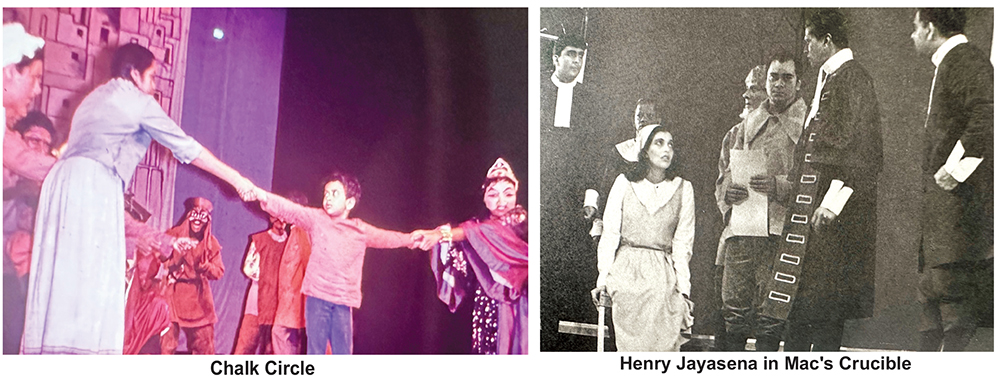
Stage & Set and Brecht in Lanka
The very first production of a Brecht play in Lanka was by Professor E.F. C. Ludowyk (Professor of English at Peradeniya University from 1933 to 1956) who developed the Drama Society that pre-existed his time at the University College by expanding the play-reading group into a group of actors. This fascinating history is available through the letter sent in 1970 to Shelagh by Professor Ludowyk late in his retirement in England. In this letter he says that he produced Brecht’s The Good Woman of Szechwan with the Dram Soc in 1949. Shelagh who was directed by Professor Ludowyk also informs us elsewhere that he had sent from England a copy of Brecht’s Caucasian Chalk Circle to Irangani (Meedeniya/Serasinghe) in 1966 and that she in turn had handed it over to Mac, who then produced it in a celebrated production with her in the role of Grusha, which is what opened up the two way-street between the English language theatre of the Wendt and the Lumbini Theatre in Sinhala. Henry Jayasena in turn translated the play into Sinhala, making it one of the most beloved Sinhala plays. Mac performed in Henry’s production as the naughty priest who has the memorable line which he was fond of reciting for us in Sinhala; ‘Dearly beloved wedding and funeral guests, how varied is the fate of man…’. The idiomatic verve of Henry’s translation was such that people now consider the Caucasian Chalk Circle a Sinhala play and is also a text for high school children, I hear. Even a venal president recently quoted a famous line of the selfless Grusha in parliament assuming urbanely that folk knew the reference.
Others will discuss in some detail the classical and modern repertoire of Western plays that Mac directed for Stage & Set and the 27 plays he wrote himself, some of which are published, so that here I just want to suggest the sense of excitement a Stage & Set production would create through the media. I recall how characters in Mac’s production of Othello wore costumes made of Barbara Sansoni’s handloom material crafted specially for it and also the two sets of lead players, Irangani and Winston Serasinghe and Shelagh and Chitrasena. While Serasinghe’s dramatic voice was beautifully textured, Chitrasena with his dancer’s elan brought a kinetic dynamism not seen in a dramatic role, draped in the vibrant cloaks made of the famous heavy handloom cotton, with daring vertical black stripes – there was electricity in the air. Karan Breckenridge as the Story Teller in the Chalk Circle and also as Hamlet, Alastair Rosemale-Cocq as Iago were especially remarkable actors within the ensemble casts of Stage & Set. When Irangani and Winston Serasinghe, (an older and more experienced generation of actors than the nucleus of Stage & Set), joined the group they brought a gravitas and a sense of deep tradition into the group as Irangani was a trained actor with a wonderful deep modulated voice rare on our stage. The photographs of the production are enchanting, luminous moments of Lankan theatre. I had a brief glimpse of the much loved Arts Centre Club (watering hole), where all these people galvanised by theatre, – architects, directors, photographers, artists, actors, musicians, journalists, academics, even the odd senator – all met and mingled and drank and talked regularly, played the piano on a whim, well into the night; a place where many ideas would have been hatched.
A Beckett-ian Couple: Mac & Nalini
In their last few years due to restricted physical mobility (not unlike personae in Samuel Beckett’s last plays), cared for very well at a nursing home, Mac and Nalini were comfortably settled in two large armchairs daily, with their life-long travelling-companion- books piled up around them on two shelves ready to help. With their computers at hand, with Nalini as research assistant with excellent Latin, their mobile, fertile minds roamed the world.
It is this mise-en-scene of their last years that made me see Mac metamorphose into something of a late Beckett dramatis persona, but with a cheeky humour and a voracious appetite for creating scenarios, dramatic ones, bringing unlikely historical figures into conversation with each other (Galileo and Aryabhatta for example). The conversations, rather more ludic and schizoid and yet tinged with reason, sweet reason. Mac’s scenarios were imbued with Absurdist humour and word play so dear to Lankan theatre of a certain era. Lankans loved Waiting for Godot and its Sinhala version, Godot Enakan. Mac loved to laugh till the end and made us laugh as well, and though he was touched by sorrow he made it light with humour.
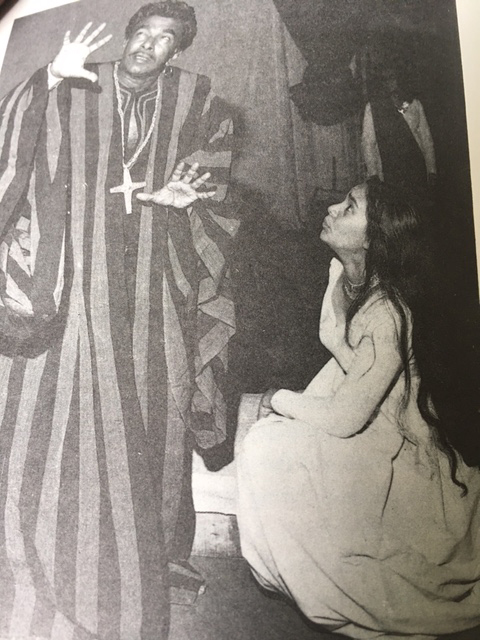
Chitrasena & Shelagh as Othelo & Desdemona
And I feel that his Memoir was also a love letter to his beloved Nalini and a tribute to her orderly, powerful analytical mind honed through her Classics Honours Degree at Peradeniya University of the 50s. Mac’s mind however, his theatrical imagination, was wild, ‘unruly’ in the sense of not following the rules of the ‘Well-Made play’, and in his own plays he roamed where angels fear to tread. Now in 2026 with the Sinhala translation by Professor Chitra Jayathilaka of his 1990 play Rasanayagam’s Last Riot, audiences will have the chance to experience these remarkable qualities in Sinhala as well.
Impossible Conversations
In the nursing home, he was loved by the staff as he made them laugh and spoke to one of the charge nurses, a Lankan, in Sinhala. Seated there in his room he wrote a series of short well-crafted one-act plays bristling with ideas and strange encounters between figures from world history who were not contemporaries; (Bertolt Brecht and Pope John Paul II, and Galileo Galilei and a humble Lankan Catholic nun at the Vatican), and also of minor figures like poor Yorik, the court jester whom he resurrects to encounter the melancholic prince of Denmark, Hamlet.
Community of Laughter: The Kolam Maduwa of Sydney
A long life-time engaged in theatre as a vital necessity, rather than a professional job, has gifted Mac with a way of perceiving history, especially Lankan history, its blood-soaked post-Independence history and the history of theatre and life itself as a theatre of encounters; ‘all the world’s a stage…’. But all the players were never ‘mere players’ for him, and this was most evident in the way Mac galvanised the Lankan diasporic community of all ethnicities in Sydney into dramatic activity through his group aptly named the Kolam Maduwa, riffing on the multiple meanings of the word Kolam, both a lusty and bawdy dramatic folk form of Lanka and also a lively vernacular term of abuse with multiple shades of meaning, unruly behaviour, in Sinhala.
The intergenerational and international transmission of Brecht’s theatrical experiments and the nurturing of what Eugenio Barba enigmatically calls ‘the secret art of the performer’, given Mac’s own spin, is part of his legacy. Mac gave a chance for anyone who wanted to act, to act in his plays, especially in his Kolam Maduwa performances. He roped in his entire family including his two grand-children, Ayesha and Michael. What mattered to him was not how well someone acted but rather to give a person a chance to shine, even for an instance and the collective excitement, laughter and even anguish one might feel watching in a group, a play such as Antigone or Rasanayagam’s Last Riot.
A colleague of mine gave a course in Theatre Studies at The University of California at Berkeley on ‘A History of Bad Acting’ and I learnt that that was his most popular course! Go figure!
Mac never joined the legendary Dram Soc except in a silent walk-on role in Ludowyk’s final production before he left Ceylon for good. In this he is like Gananath Obeyesekere the Lankan Anthropologist who did foundational and brilliant work on folk rituals of Lanka as Dionysian acts of possession. While Gananath did do English with Ludowyk, he didn’t join the Dram Soc and instead went travelling the country recording folk songs and watching ritual dramas. Mac, I believe, did not study English Lit and instead studied Economics but at the end of A Bend in the River when he and his mates leave the hall of residence what he leaves behind is his Economics text book but instead, carries with him a copy of the Complete Works of Shakespeare.
I imagine that there was a ‘silent transmission of the secret’ as Mac stood silently on that stage in Shaw’s Androcles and the Lion; the compassionate lion. Mac understood why Ludowyk chose that play to be performed in 1956 as his final farewell to the country he loved dearly. Mac knew (among others), this gentle and excellent Lankan scholar’s book The Foot Print of the Buddha written in England in 1958.
Both Gananath and Mac have an innate sense of theatre and with Mac it’s all self-taught, intuitive. He was an auto-didact of immense mental energy. In his last years Mac has conjured up fantastic theatrical scenarios for his own delight, untrammelled by any spatio-temporal constraints. And so it happens that he gives Shakespeare, as he leaves London, one last look at his beloved Globe theatre burnt down to ashes, where ‘all that is solid melts into air’.
However, I wish to conclude on a lighter note touched by the intriguing epigram by Calvino which frames this piece. It is curious that as a director Mac was drawn to Shakespearean tragedy (Hamlet, Othello), rather than comedy. And it becomes even curiouser because as a playwright-director his own preferred genre was comedy and even grotesque-comedy and his only play in the tragic genre is perhaps Irangani. Though the word ‘Riot’ in Rasanayagam’s Last Riot refers to the series of Sinhala pogroms against Tamils, it does have a vernacular meaning, say in theatre, when one says favourably of a performance, ‘it was a riot!’, lively, and there are such scenes even in that play. So then let me end with Calvino quoting from Shakespeare’s deliciously profound comedy As You Like It, framed by his subtle observations.
‘Melancholy and humour, inextricably intermingled, characterize the accents of the Prince of Denmark, accents we have learned to recognise in nearly all Shakespeare’s plays on the lips of so many avatars of Hamlet. One of these, Jacques in As You Like It (IV.1.15-18), defines melancholy in these terms:
“But it is a melancholy of mine own, compounded of many simples, extracted from many objects, and indeed the sundry contemplation of my travels, in which my often rumination wraps me in a most humorous sadness.”’
Calvino’s commentary on Jacques’ self-perception is peerless:
‘It is therefore not a dense, opaque melancholy, but a veil of minute particles of humours and sensations, a fine dust of atoms, like everything else that goes to make up the ultimate substance of the multiplicity of things.’
Ernest Thalayasingham MacIntyre certainly was attuned to and fascinated to the end by the ‘fine dust of atoms, by the veil of minute particles of humours and sensations,’ but one must also add to this, laughter.
by Laleen Jayamanne ✍️
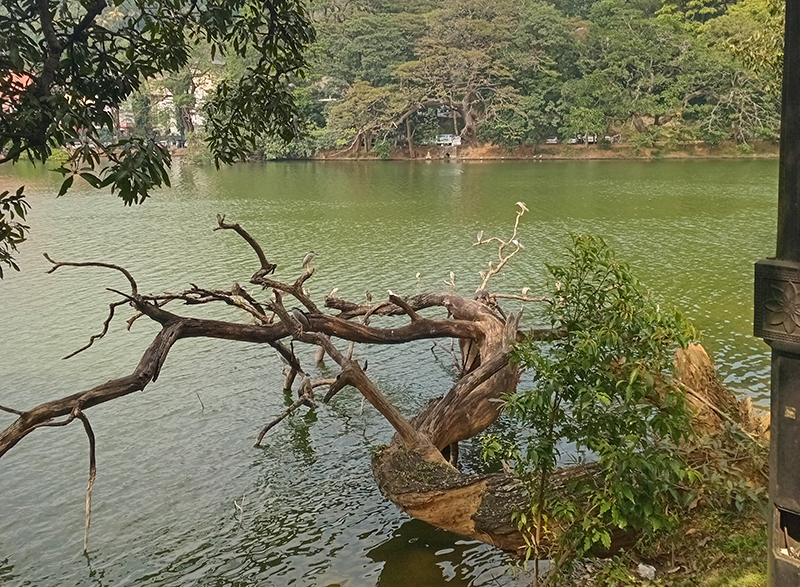
With a quiet, watchful eye,
The winged natives of the sedate lake,
Have regained their lives of joyful rest,
Following a storm’s battering ram thrust,
Singing that life must go on, come what may,
And gently nudging that picking up the pieces,
Must be carried out with the undying zest,
Of the immortal master-builder architect.
By Lynn Ockersz ✍️
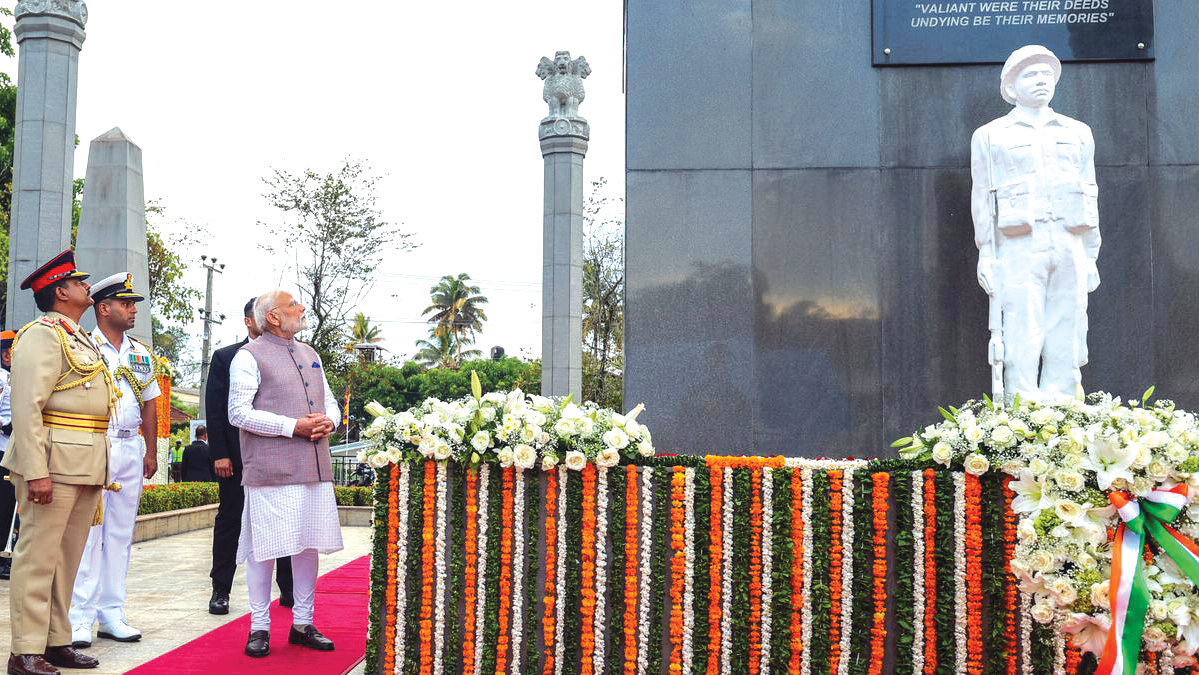
A day after the UN freshly repeated the allegation this week that sexual violence had been “part of a deliberate, widespread, and systemic pattern of violations” by the Sri Lankan military and “may amount to war crimes and crimes against humanity,” India praised its military (IPKF) for the operations conducted in Sri Lanka during the 1987-1990 period.
Soon after, as if in an echo, Human Rights Watch (HRW) in a statement, dated January 15, 2026, issued from Geneva, quoted Meenakshi Ganguly, Deputy Asia Director at the organisation, as having said: “While the appalling rape and murder of Tamil women by Sri Lankan soldiers at the war’s end has long been known, the UN report shows that systematic sexual abuse was ignored, concealed, and even justified by Sri Lankan government’s unwillingness to punish those responsible.”
Ganguly, who had been with the Western-funded HRW since 2004 went on to say: “Sri Lanka’s international partners need to step up their efforts to promote accountability for war crimes in Sri Lanka.”
To point its finger at Sri Lanka, or for that matter any other weak country, HRW is not that squeaky clean to begin with. In 2012, Human Rights Watch (HRW) accepted a $470,000 donation from Saudi billionaire Mohamed Bin Issa Al Jaber with a condition that the funds are not be used for its work on LGBT rights in the Middle East and North Africa. The donation was kept largely internal until it was revealed by an internal leak published in 2020 by The Intercept. Its Executive Director Kenneth Roth got exposed for taking the kickback. It refunded the money to Al Jaber only after the sordid act was exposed.
The UN, too, is no angel either, as it continues to play deaf, dumb and blind at an intrepid pace to the continuing unprecedented genocide against Palestinians and other atrocities being committed in West Asia and other parts of the world by Western powers.
The HRW statement was headlined ‘Sri Lanka: ‘UN Finds Systemic Sexual Violence During Civil War’, with a strap line ‘Impunity Prevails for Abuses Against Women, Men; Survivors Suffer for Years’
HRW reponds
The HRW didn’t make any reference to the atrocities perpetrated during the Indian Army deployment here.
The Island sought Ganguly’s response to the following queries:
* Would you please provide the number of allegations relating to the period from July 1987 to March 1990 when the Indian Army had been responsible for the Northern and Eastern Provinces of Sri Lanka and the Sri Lanka military confined to their camps, in terms of the Indo-Lanka accord.
* Have you urged the government of India to take tangible measures against the Indian Army personnel for violations perpetrated in Sri Lanka?
* Would you be able to provide the number of complaints received from foreign citizens of Sri Lankan origin?
Meenakshi responded: Thanks so much for reaching out. Hope you have been well? We can’t speak about UN methodology. Please could you reach out to OHCHR. I am happy to respond regarding HRW policies, of course. We hope that Sri Lankan authorities will take the UN findings on conflict-related sexual violence very seriously, regardless of perpetrator, provide appropriate support to survivors, and ensure accountability.
Mantri on IPKF
The Indian statement, issued on January 14, 2026, on the role played by its Army in Sri Lanka, is of significant importance at a time a section of the international community is stepping up pressure on the war-winning country on the ‘human rights’ front.
Addressing about 2,500 veterans at Manekshaw Centre, New Delhi, Indian Defence Minister Raksha Mantri referred to the Indian Army deployment here whereas no specific reference was made to any other conflicts/wars where the Indian military fought. India lost about 1,300 officers and men here. At the peak of Indian deployment here, the mission comprised as many as 100,000 military personnel.
According to the national portal of India, Raksha Mantri remembered the brave ex-servicemen who were part of Operation Pawan launched in Sri Lanka for peacekeeping purposes as part of the Indian Peacekeeping Force (IPKF) almost 40 years ago. Mantri’s statement verbatim: “During the operation, the Indian forces displayed extraordinary courage. Many soldiers laid down their lives. Their valour, sacrifices and struggles did not receive the respect they deserved. Today, under the leadership of PM Modi, our government is not only openly acknowledging the contributions of the peacekeeping soldiers who participated in Operation Pawan, but is also in the process of recognising their contributions at every level. When PM Modi visited Sri Lanka in 2015, he paid his respects to the Indian soldiers at the IPKF Memorial. Now, we are also recognising the contributions of the IPKF soldiers at the National War Memorial in New Delhi and giving them the respect they deserv.e” (https://www.pib.gov.in/PressReleseDetailm.aspx?PRID=2214529®=3&lang=2)
One-time President of the Bharatiya Janata Party (BJP), and ex-Home Minister Mantri received the Defence Portfolio in 2019. There hadn’t been a similar statement from any Modi appointed Defence Minister since he became the Prime Minister in 2014.
Perhaps, we should remind Mantri that Operation Pawan hadn’t been launched for peacekeeping purposes and the Indian Army deployment here cannot be discussed without examining the treacherous Indian destabilisation project launched in the early ’80s.
Nothing can be further from the truth than the attempt to describe Operation Pawan as a peacekeeping mission. India destabilised and terrorised Sri Lanka to its heart’s content that the then President JRJ had no option but to accept the so-called Indo-Lanka accord and the deployment of the Indian Army here to supervise the disarming of terrorist groups sponsored by India. Once the planned disarming of terrorist groups went awry in August, 1987 and the LTTE engineered a mass suicide of a group of terrorists who had been held at Palaly airbase, thereby Indian peacekeeping mission was transformed to a military campaign.
Mantri, in his statement, referred to the Indian Army memorial at Battaramulla put up by Sri Lanka years ago. The Indian Defence Minister seems to be unaware of the first monument installed here at Palaly in memory of 33 Indian commandos of the 10 Indian Para Commando unit, including Lieutenant Colonel Arun Kumar Chhabra who died in a miscalculated raid on the Jaffna University at the commencement of Operation Pawan.
BJP politics
Against the backdrop of Mantri’s declaration that India recognised the IPKF at the National War Memorial in New Delhi, it would be pertinent to ask when that decision was taken. The BJP must have decided to accommodate the IPKF at the National War Memorial in New Delhi recently. Otherwise Mantri’s announcement would have been made earlier. Obviously, Modi, the longest serving non-Congress Prime Minister of India, didn’t feel the need to take up the issue vigorously during his first two terms. Modi won three consecutive terms in 2014, 2019 and 2024. Congress great Jawaharlal Nehru is the only other to win three consecutive parliamentary elections in 1951, 1957 and 1962.
The issue at hand is why India failed to recognise the IPKF at the National War Memorial for so long. The first National War Memorial had been built and inaugurated in January 1972 following the Indo-Pakistan war of 1971, but under Modi’s direction India set up a new memorial, spread over 40 acres of land near India Gate Circle. Modi completed the National War Memorial project during his first term.
No one would find fault with India for honouring those who paid the supreme sacrifice in Sri Lanka, but the fact that the deployment of the IPKF took place here under the overall destabilisation project cannot be forgotten. India cannot, under any circumstances, absolve itself of the responsibility for the death and destruction caused as a result of the decision taken by Indira Gandhi, in her capacity as the Prime Minister, to intervene in Sri Lanka. Her son Rajiv Gandhi, in his capacity as the Prime Minister, dispatched the IPKF here after Indian,trained terrorists terrorised the country. India exercised terrorism as an integral part of their overall strategy to compel Sri Lanka to accept the deployment of Indian forces here under the threat of forcible occupation of the Northern and Eastern provinces.
India could have avoided the ill-fated IPKF mission if Premier Rajiv Gandhi allowed the Sri Lankan military to finish off the Liberation Tigers of Tamil Eelam (LTTE) in 1987. Unfortunately, India carried out a forced air-drop over the Jaffna peninsula in June, 1987 to compel Sri Lanka to halt ‘Operation Liberation,’ at that time the largest ever ground offensive undertaken against the LTTE. Under Indian threat, Sri Lanka amended its Constitution by enacting the 13th Amendment that temporarily merged the Eastern Province with the Northern Province. That had been the long-standing demand of those who propagated separatist sentiments, both in and outside Parliament here. Don’t forget that the merger of the two provinces had been a longstanding demand and that the Indian Army was here to install an administration loyal to India in the amalgamated administrative unit.
The Indian intervention here gave the Janatha Vimukthi Peramuna (JVP) with an approving wink from Washington as India was then firmly in the Soviet orbit, an opportunity for an all-out insurgency burning anything and everything Indian in the South, including ‘Bombay onions’ as a challenge to the installation of the Eelam People’s Revolutionary Liberation front (EPRLF)-led administration in the North-East province in November 1988. How the Indian Army installed ex-terrorist Varatharaja Perumal’s administration and the formation of the so-called Tamil National Army (TNA) during the period leading to its withdrawal made the Indian military part of the despicable Sri Lanka destabilisation project.
The composition of the first NE provincial council underscored the nature of the despicable Indian operation here. The EPRLF secured 41 seats, the Sri Lanka Muslim Congress (SLMC) 17 seats, Eelam National Democratic Liberation Front (ENDLF) 12 and the United National Party (UNP) 1 in the 71-member council.
The Indian intelligence ran the show here. The ENDLF had been an appendage of the Indian intelligence and served their interests. The ENDLF that had been formed in Chennai (then Madras) by bringing in those who deserted EPRLF, PLOTE (People’s Liberation Organisation of Tamil Eelam) and Three Stars, a PLOTE splinter group led by Paranthan Rajan was accused of committing atrocities. Even Douglas Devananda, whose recent arrest over his failure to explain the disappearance of a weapon provided to him by the Sri Lanka Army, captured media attention, too, served the ENDLF for a short period. The ENDLF also contested the parliamentary polls conducted under Indian Army supervision in February 1989.
The ENDLF, too, pulled out of Sri Lanka along with the IPKF in 1990, knowing their fate at the hands of the Tigers, then honeymooning with Premadasa.
Dixit on Indira move
The late J.N. Dixit who was accused of behaving like a Viceroy when he served as India’s High Commissioner here (1985 to 1989) in his memoirs ‘Makers of India’s Foreign Policy: Raja Ram Mohun Roy to Yashwant Sinha’ was honest enough to explain the launch of Sri Lanka terrorism here.
In the chapter that also dealt with Sri Lanka, Dixit disclosed the hitherto not discussed truth. According to Dixit, the decision to militarily intervene had been taken by the late Indira Gandhi who spearheaded Indian foreign policy for a period of 15 years – from 1966 to 1977 and again from 1980 to 1984 (Indira was assassinated by her Sikh bodyguards in that year). That disastrous decision that caused so much death and destruction here and the assassination of her son Rajiv Gandhi had been taken during her second tenure (1980 to 1984) as the Prime Minister.
The BJB now seeking to exploit Indira Gandhi’s ill-fated decision probably taken at the onset of her second tenure as the Premier, came into being in 1980. Having described Gandhi’s decision to intervene in Sri Lanka as the most important development in India’s regional equations, one-time Foreign Secretary (December 1991 to January 1994) and National Security Advisor (May 2004 to January 2005) declared that Indian action was unavoidable.
Dixit didn’t mince his words when he mentioned the two major reasons for Indian intervention here namely (1) Sri Lanka’s oppressive and discriminating policies against Tamils and (2) developing security relationship with the US, Pakistan and Israel. Dixit, of course, didn’t acknowledge that there was absolutely no need for Sri Lanka to transform its largely ceremonial military to a lethal fighting force if not for the Indian destabilisation project. The LTTE wouldn’t have been able to enhance its fighting capabilities to wipe out a routine army patrol at Thinnaveli, Jaffna in July 1983, killing 13 men, including an officer, without Indian training. That was the beginning of the war that lasted for three decades.
Anti-India project
Dixit also made reference to the alleged Chinese role in the overall China-Pakistan project meant to fuel suspicions about India in Nepal and Bangladesh and the utilisation of the developing situation in Sri Lanka by the US and Pakistan to create, what Dixit called, a politico-strategic pressure point in Sri Lanka.
Unfortunately, Dixit didn’t bother to take into consideration Sri Lanka never sought to expand its armed forces or acquire new armaments until India gave Tamil terrorists the wherewithal to challenge and overwhelm the police and the armed forces. India remained as the home base of all terrorist groups, while those wounded in Sri Lanka were provided treatment in Tamil Nadu hospitals.
At the concluding section of the chapter, titled ‘AN INDOCENTRIC PRACTITIONER OF REALPOLITIK,’ Dixit found fault with Indira Gandhi for the Sri Lanka destabilisation project. Let me repeat what Dixit stated therein. The two foreign policy decisions on which she could be faulted are: her ambiguous response to the Russian intrusion into Afghanistan and her giving active support to Sri Lanka Tamil militants. Whatever the criticisms about these decisions, it cannot be denied that she took them on the basis of her assessments about India’s national interests. Her logic was that she could not openly alienate the former Soviet Union when India was so dependent on that country for defense supplies and technologies. Similarly, she could not afford the emergence of Tamil separatism in India by refusing to support the aspirations of Sri Lankan Tamils. These aspirations were legitimate in the context of nearly fifty years of Sinhalese discrimination against Sri Lankan Tamils.
The writer may have missed Dixit’s invaluable assessment if not for the Indian External Affairs Ministry presenting copies of ‘Makers of India’s Foreign Policy: Raja Ram Mohun Roy to Yashwant Sinha’ to a group of journalists visiting New Delhi in 2006. New Delhi arranged that visit at the onset of Eelam War IV in mid-2006. Probably, Delhi never considered the possibility of the Sri Lankan military bringing the war to an end within two years and 10 months. Regardless of being considered invincible, the LTTE, lost its bases in the Eastern province during the 2006-2007 period and its northern bases during the 2007-2009 period. Those who still cannot stomach Sri Lanka’s triumph over separatist Tamil terrorism, propagate unsubstantiated allegations pertaining to the State backing excesses against the Tamil community.
There had been numerous excesses and violations on the part of the police and the military. There is no point in denying such excesses happened during the police and military action against the JVP terrorists and separatist Tamil terrorists. However, sexual violence hadn’t been State policy at any point of the military campaigns or post-war period. The latest UN report titled ‘ACCOUNTABILITY FOR CONFLICT RELATED VIOLENCE IN SRI LANKA’ is the latest in a long series of post-war publications that targeted the war-winning military. Unfortunately, the treacherous Sirisena-Wickremesinghe Yahapalana government endorsed the Geneva accountability resolution against Sri Lanka in October 2015. Their despicable action caused irreversible damage and the ongoing anti-Sri Lanka project should be examined taking into consideration the post-war Geneva resolution.
By Shamindra Ferdinando ✍️

Alleged drug kingpin and ex-Olympian Ryan Wedding arrested after years on the run

Showers above 50 mm are likely at some places in the Northern, North-central, and North-western provinces and in Trincomalee district

Karu argues against scrapping MPs’ pension as many less fortunate members entered Parliament after ’56

Johnston, two sons and two others further remanded over alleged misuse of vehicle

CIABOC indicts MP Chamara Sampath in HC on bribery allegation

High-level discussion held to enhance Sri Lanka Agricultural Productivity with Chinese assistance

‘Dates have the highest sugar content to fight Coronavirus’

Sunday Island 27 December – Headlines

#SundayIsland 17th December – Headlines

Sunday Island – 28th March

Sunday Island Headlines – 21 March

Sunday Island – 21st February – Headlines
-

 Editorial6 days ago
Illusory rule of law
-
 Features6 days ago
Daydreams on a winter’s day
-
 Features6 days ago
Surprise move of both the Minister and myself from Agriculture to Education
-

 Features5 days ago
Extended mind thesis:A Buddhist perspective
-
 Features6 days ago
The Story of Furniture in Sri Lanka
-
 Opinion4 days ago
American rulers’ hatred for Venezuela and its leaders
-
 Features6 days ago
Writing a Sunday Column for the Island in the Sun
-
 Business2 days ago
CORALL Conservation Trust Fund – a historic first for SL