
Features
The Charmed Life of a Genius Priest

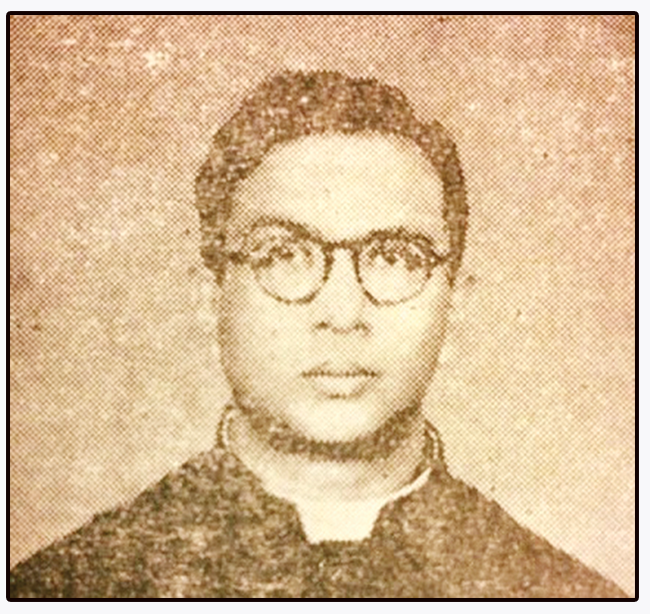
Ignatius of Colombo
By Avishka Mario Senewiratne
avishkamario@gmail.com
Talent, passion and humility are virtues hard to emulate and seldom found are those who are blessed with all three. Fr. Ignatius Perera of revered memory, was one such individual born on this palm-fringed island. Some remember him as the Radio Priest. Some recall his prowess in training choirs as well as his concerts. But those who were truly touched by his generosity were those without hope when they dropped out of school not knowing what to do next. He clothed and fed them as well as educated them, giving them the life they deserved. When he suddenly passed away in January 1981, The Catholic Messenger said the following:
“The fascinating personality of Fr. Ignatius should be the subject of serious study by those concerned with the training of pastors…Born into a family of musicians, and schooled in the classics, Fr. Ignatius became an engineer by option, because he had a knack for it, and saw the need for it.”
Whether the life of Fr. Ignatius was studied is doubtful, but his memory has not faded from the minds of those who were inspired by his life and work. Born on October 30, 1915, in the coastal township of Periyamulla, in Negombo, dubbed ‘Little Rome’, Alphonsus Narcissus Ignatius Perera was born to a family of musicians. His father was Louis Perera and his mother, Egistina Catherine Fernando. His elder brother, Francis would be a priest as well as a Choral Director. While receiving his early education at St. Mary’s College, Negombo, young Ignatius received the calling to be a priest. His brother’s influence may also have had something to do with his decision.
The superiors of young Ignatius, such as the seminary Rector, Fr. Edmund Pieris OMI, communicated his brilliant academic record as well as his prowess in music to Fr. Maurice Le Goc OMI, the Rector of St. Joseph’s College at that time. Fr. Le Goc was highly impressed and immediately recruited him to St. Joseph’s. Young Ignatius was known to invent all sorts of creative things in his early days. The scientist priest (now forgotten), Fr. Gregory Goonawardena, played a big role in Ignatius’ early days. Upon completing his school education, he received the opportunity to study in Rome for his priesthood. The subsequent years in Europe would be a roller-coaster ride for the young man as war intervened in his formation as a priest. However, the delay entering the priesthood was one of the best things that would happen for Fr. Ignatius.
The colourful days in Rome
The young seminarian was an outstanding student and well-read in the classics. He mastered several Western languages and spoke fluent Italian. Apart from his theological and philosophical studies, Ignatius read for an Honour’s Degree in Classics. Soon after, he got to experiment with two other skills he had not developed in Ceylon. It is unusual that a person could balance sacred music and radio.
Yet, this was the niche Ignatius Pera filled along with his passion for classics. It was through sheer hard work and self-study that he mastered electronics. He truly had a knack for it and doing repairs along with other work brought him great satisfaction in the then Fascist-ruled Italy. However, there were periods where he spent too much time on radios and less on classics flunking some of his exams! The young seminarian’s skills became well-known in the days to come.
On one occasion just 10 minutes before a transmission was to begin, the Vatican Radio broke down. During this time Giulio Marconi, son of Guglielmo Marconi, who was in charge of Vatican Radio rang young Ignatius to come and help. Within no time, the transmission was active and the radio worked as if new. It is also said that Ignatius was called multiple times by a priest called Fr. Giovanni Montini for repair work. This priest would later be Pope Paul VI.
Another interesting anecdote on Fr. Ignatius was when he was in charge of the BTH Super 35mm Arc projector in the auditorium of Propaganda College. He found an ingenious way of modifying the projector motor feed. Thanks to Ignatius, those at Propaganda had the good fortune of watching 35mm feature films, a facility which many others did not enjoy then. He was assisted in the projection room by a German priest and the future Rector of SJC and SPC, Fr. Mervyn Weerakkody.
While Ignatius was running the projector one day, he had to urgently run to the washroom. That day there were no assistants. Unexpectedly, a fire broke out in the projection cubicle, damaging both the films and the projector. However, Ignatius’ magical hands were able to rewind the burnt transformer and repair the projector.
One day the Vatican grounds were full of aero-buffs who had come to fly their model planes. Ignatius found a way of hacking the frequencies of these model aircraft and directed the planes as he wished taking control of the flying machines from their hapless controllers on the ground. There certainly was pandemonium in the Vatican on that eventful day!
After his formation ended, he amassed a lot of free time. This he utilized usefully by learning Sacred Music at the Academy of St. Cecelia. Again, through basic teaching and self-study, he also mastered this field. Ignatius surprised all by sitting for the Bachelor of Music Degree at the University of London. Here he succeeded with ease. In Rome, he received one of the rare privileges of conducting the Choir of the Sistine Chapel. With the fall of Benito Mussolini in 1943, Italy was liberated. However, World War II continued for two more years.
During these war-torn years, young Ignatius taught Classics to various groups. In the meantime, he ventured to do a Diploma from Faraday House (An electrical engineering College in the UK), to secure a recognized qualification in electronics. After a long period of gestation, Ignatius and his fellow seminarians were ordained in Rome on March 19, 1944. He was 27-years of age. A year later, Fr. Ignatius was called back to Ceylon and the Archbishop of Colombo, Msgr. Masson gave him his first appointment to serve his alma mater.
During this period, St. Joseph’s College had been taken over by the Royal Navy, and the staff and students were located in various parts of the Western Province. Fr. Ignatius was sent to the Borella branch of SJC. Here he had a guide in the person of Fr. Peter Pillai, the Rector. The two of them got along with another contemporary, Fr. Justin Perera. The College in Borella adjoining the Archbishop’s House was a temporary structure and was quite uncomfortable for the boys who had once been in Darley Road. Fr. Ignatius had a reputation that preceded him, for what he had achieved in Rome was beyond the ordinary. Thus, his future students expected a certain stature and strict personality in their teacher. What they saw was this simple priest, not taller than 5’4, riding a ladies bicycle to Borella, raising many eyebrows. One of his first students, Peter Perera now residing in UK, recalls his early memory of Fr. Ignatius as follows:
“He was an unassuming, simple down-to-earth character, affable, youthful, completely approachable almost like one of the students. There was none of the aloofness and authoritarian manner of the teachers we were accustomed to.”
Fr. Ignatius first started taking the Latin class, for this was his initial forte. His teaching was compelling and those who disliked the subject were attracted to it solely because of him. During the 45-minute period, only 15 minutes were spent on Latin declensions. The rest of the period was a discussion any other subject the students questioned him about and his extraordinary experiences in war-torn Europe. Despite this, his students were all successful in their exams for he knew the art of imparting knowledge and making students learn in their own way. Soon he was entrusted with the role of choir master of the almost defunct St. Cecilia’s Choir of SJC. Here is how the 1949 Blue and White magazine wrote about the coming of Fr. Ignatius to the choir:
“And then 1946 – our new birth, our new home with our new choirmaster. How am I to tell you of those first practices, those practices at which all sorts of strange fish turned up: fish that our little priest had to turn into singing fish? Many of those fish kept wondering what this man was doing to them. Was he trying to ruin them? Making them sing in parts – it may seem exaggerated but I’m sure there were boys – I among them – who did not catch on to the idea of singing while somebody near them seemed to prefer to sing his own composition. Having patiently got each group – Sopranos, Altos, Tenors and Basses – to learn their parts, he found the whole lot lustily singing Soprano! Poor little priest! But in the midst of apparent failure, the messiah had to triumph. In about three months we found ourselves, to our own surprise, actually singing in parts! And that in four parts too!”
Fr. Ignatius’ skill and experience in Rome came into good hands to revive the Josephian Choir. His methodical training and meaningful set of practices warranted success. Soon, the standards had risen to such a level that the students were able to sing over the National Service of Radio Ceylon. The feedback from the general public was overwhelming. The revived Josephian Choir would now go on to take part in the music competition hosted by the Western Music Section of the Department of Education, and ultimately win it.
The judge at this event was D’Hales of Trinity College of Music in London. He hailed the choir for their splendid performance and said they sang just as well as choirs in England. ‘Handel’s Requiem’ conducted by Fr. Ignatius and performed by the Josephians is considered the greatest of the musical performances the College hosted at that time. The Josephian Orchestra was established in the year 1947, consisting of 16 members (seven violinists, a bass player and a pianist). It was conducted by Fr. Ignatius Perera.
With World War II’s end, most British forces stationed in Ceylon left for their own country. Their vehicles, weapons, radios and other war equipment were put up for sale as the forces had little use for them any more. Fr. Ignatius bought a rifle, an army jeep, and some radios. Whenever he had time, he would drive his jeep to distant jungles. He took great pleasure in hunting birds and wild boar. On one of his jungle trips, he rescued a mongoose in Pottuvil and adopted it as his pet. The mongoose named ‘Tikka’ would be with Fr. Ignatius as he worked in his radio lab and at times he took Latin in the classroom. The mongoose and the priest became a feature of the College at that time.
At the request of his students, Fr. Ignatius started the Radio Lab of St. Joseph’s College in 1947. The students were very curious about radios, their working and repairs. Soon the membership would reach about 30 or so. Fr. Ignatius taught them the theory of radio and soon made arrangements to let them repair radio sets and make amplifiers. Fr. Peter Pillai trusted this initiative. Soon the Radio Lab made their own amplifier and fixed it to the sound system of the Bonjean Hall. With unprecedented donations and sponsorship, Fr. Ignatius’ lab was well-equipped with state-of-the-art technology. No school or lab elsewhere was able to match its standard.
Fr. Ignatius Perera installed a private Intercom telephone system with 24 connections, linking various offices and buildings in St. Joseph’s College. The standards maintained at the Radio Club were extremely high, and the services it rendered outside school were stupendous. The Radio Club installed amplifiers that were manufactured at the College Lab in some of the popular churches on the island, such as St. Mary’s Church, Bambalapitiya, All Saints’ Church, Borella, Our Lady of Mount Carmel Cathedral, Chilaw and St. Mary’s Church, Negombo. A large amplifier system of 180 Watt output was built for the church and camp of St. Anne’s Shrine, Talawila. A giant 27,000 Watts transformer for a three-phase electricity supply was also built under the guidance of Fr. Ignatius.
For all his work in the lab, Fr. Ignatius had his very own golaya in the person of Aloysius, a young man who was starving on the streets with little hope for the future. Fr. Ignatius employed him and they developed a lifelong friendship. Ignatius and Aloysius were workaholics who slept less and mostly on the table of the lab. The ‘equipment hospital’ was a mess, strewn with damaged radios, clocks, refrigerators, toys, and gramophones. However, whatever was brought to the lab, was restored by Fr. Ignatius. This is how Noel Crusz, a good friend of Ignatius illustrated the latter:
“Ignatius smoked ‘Peacock’ cigarettes butt to butt. His fingers were brown with nicotine. He had his tot of double-distilled Mendis special. He was generous to a fault, especially to those seeking advice on equipment, electronics, music or the classics.”
Fr. Ignatius as stated above was a brilliant teacher in whatever he taught. However, with all these talents what made him special and loved by all was his zeal for the Almighty and care for the needy. His devotion to the downtrodden made him a veritable angel to those who had once lost hope in life. Fr. Ignatius was a simple man who had a unique sense of humour. He was childlike and lovable. Such traits are not common in modern society. Chaplain Raja Pereira, a student of Fr. Ignatius relates an important story on the latter:
“One day, during class Father wrote on the board this equation: V = I x R and asked ‘What is this, son?”. I was still fresh with our B1 class’s Physics teacher Eric Mendis’ electricity lectures and so I soon put up my hand and said ‘Ohm’s Law, Father’. Fr. Ignatius responded ‘No sonna boy, this was God’s Law which Ohm happened to discover’. It was from here that we learnt that one should put what God said at all times ahead of what man says.”
In the early 1950s, Fr. Ignatius started the famous Catholic Choral Society consisting of young men and women from various parts of Colombo. Ruth Van Gramberg, my good friend living in Melbourne, wrote to me recently relating her experience in those memorable days of the Choral Society. She mentioned that the maestro regularly trained them and received many opportunities to perform at Radio Ceylon. She recalled how Fr. Perera would be invited to perform in public functions with the choir. Once the choir had performed for Premier Sir John Kotelawala at his Kandawala home.
On many occasions Fr. Ignatius paired with the like-minded media-friendly Fr. Noel Crusz. They partnered in several plays where Fr. Crusz wrote the screenplay and Fr. Ignatius directed the music. Those performances were attended by hundreds and sometimes in thousands. In 1956, the sound editing for the feature film Little Bike Lost, directed by Fr. Noel Crusz was done by Fr. Ignatius and his students in the radio lab.
One of the greatest supporters of Fr. Perera was Mrs. Edith (J.L.M.) Fernando of Pegasus Reef Hotel fame. She, through her son Lalin had come to know him quite well and lobbied those in the Church to aid his good work. Edith Fernando had convinced Fr. Peter Pillai to recommend Fr. Ignatius for a USIS Scholarship in the USA. This move paid off and Fr. Ignatius was able to travel to USA and Europe for his studies in 1960. One area he extensively studied was the new development in electromagnetism. Upon his return, Fr. Ignatius had plans to start a new radio lab.
Archbishop Thomas Cooray supported this ideal wholeheartedly and made plans to form the lab in Kotahena, near the Cathedral. In 1962, after donations had been received from many of his friends, students, and especially the Philips Electric Company, the Radio Lab was ready. It was blessed and opened by the Archbishop. This multi-story building was to make men and not records. Fr. Perera was very keen on recruiting school dropouts who did not have any hope in academics. Vocational studies such as electronics became a useful option.
Despite his high level of intelligence and ability to do multiple things, Fr. Ignatius Perera, was a simple, down-to-earth presbyter. His devotion to the poor and downtrodden was well known. It was customary for him to help anyone for nothing in return. On one occasion, when Fr. Justin Perera was admitted to a public ward at the General Hospital, he noticed that a child in critical condition was being put on an iron lung (a mechanical ventilator) which failed and those in the hospital were unable to fix it. While the child’s life was ebbing away, Fr. Justin called Fr. Ignatius for help. It was 10 in the night and Ignatius was as usual up and working in the lab. When answering the phone Ignatius said, “Justin, I have never seen an Iron Lung in all my life”. Fr. Justin countered saying, “That does not matter one bit. You just come along”.
Within a few minutes, Fr. Ignatius was on the scene and in a few moments fixed the failed Iron Lung with just a little strip of bamboo! Such was his interest in those in distress and his divine ability to repair appliances considered unfix-able. Fr. Justin in his writings discusses while he was editor of the Ceylon Catholic Messenger, one of the printing machines of the Colombo Catholic Press had failed when an important publication was being printed. Again, Fr. Ignatius did the impossible, though printing machines were not part of his expertise. On another occasion, when a large foreign ship was docked in the Colombo Port, its radios failed. The government of Ceylon trusted none but this genius priest, who once again did the needful with relative ease. Stories of Fr. Ignatius can go on and on. This is what makes him legendary.
Towards the end of his life, Fr. Ignatius’ sight failed and he became a recluse. However, only a year before his death, he received a Doctorate from MIT (Massachusetts Institute of Technology) with no Bachelor’s or Master’s Degree. Such was his recognition.
Fr. Ignatius Perera passed away from a heart attack in his room in the Kotahena Lab premises on January 1981 aged 66. Many from various parts of the island came to pay their final respects to this much-loved and talented priest. President J.R. Jayewardene granted special permission to inter his remains on the premises of the Lab. Today a statue has been erected in his memory and yeoman contribution to the country. Whence cometh another?


Sri Lanka wakes each morning to wings.
From the liquid whistle of a magpie robin in a garden hedge to the distant circling silhouette of an eagle above a forest canopy, birds define the rhythm of the island’s days.
Their colours ignite the imagination; their calls stir memory; their presence offers reassurance that nature still breathes alongside humanity. For conservation biologist Rajika Gamage, these winged lives are more than fleeting beauty—they are a lifelong calling.
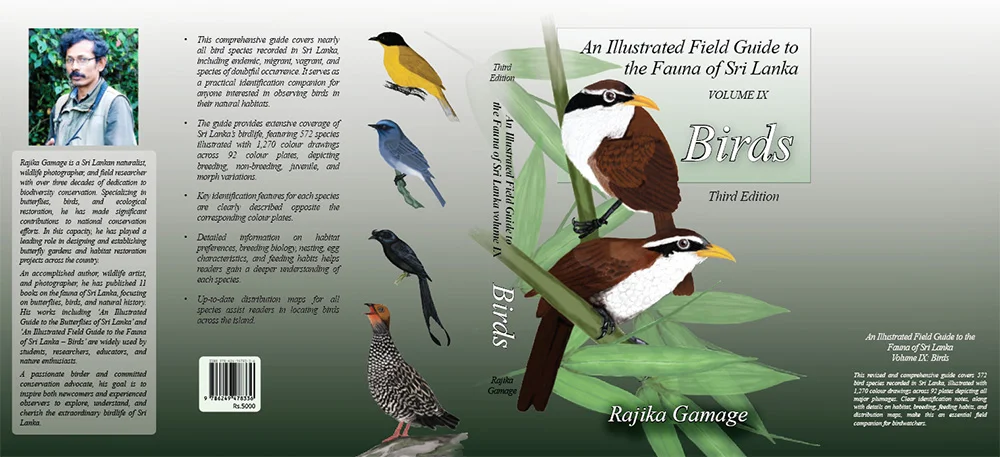
Now, after years of patient observation, artistic collaboration, and scientific dedication, Gamage’s latest book, An Illustrated Field Guide to the Fauna of Sri Lanka – Birds, is set to reach readers when it hits the market on March 6.
The new edition promises to become one of the most comprehensive and visually rich bird guides ever produced for Sri Lanka.
Speaking to The Island, Gamage reflected on the inspiration behind his work and the enduring fascination birds hold for people across the country.
“Birds are an incredibly diverse group,” he said. “Their bright colours, distinct songs and calls, and showy displays contribute to their uniqueness, which is appreciated by all bird-loving individuals.”
Birds, he explained, occupy a special place in the natural world because they are among the most visible forms of wildlife. Unlike elusive mammals or secretive reptiles, birds share human spaces openly.
“Birds are widely distributed in all parts of the globe in large enough populations, making them the most common wildlife around human habitations,” Gamage said. “This offers a unique opportunity for observing and monitoring their diverse plumage and behaviours for conservation and recreational purposes.”
This accessibility has made birdwatching one of the most popular forms of wildlife observation in Sri Lanka, attracting everyone from seasoned scientists to curious schoolchildren.
A remarkable island of avian diversity
Despite its small size, Sri Lanka possesses extraordinary bird diversity.
According to Gamage, the country’s geographic position, varied climate, and diverse habitats—from coastal wetlands and rainforests to montane cloud forests and dry-zone scrublands—have created ideal conditions for birdlife.
“Sri Lanka is home to a rich diversity of birdlife, with a total of 522 bird species recorded in the country,” he said. “These species are spread across 23 orders, 89 families, and 267 genera.”
Of these, 478 species have been fully confirmed. Among them, 209 are breeding residents, meaning they live and reproduce on the island throughout the year.
Even more remarkable is Sri Lanka’s high level of endemism.
“Thirty-five of these breeding resident species are endemic to Sri Lanka,” Gamage noted. “They are confined entirely to the island, making them globally significant.”
These endemic species—from forest-dwelling flycatchers to vividly coloured barbets—represent evolutionary lineages shaped by Sri Lanka’s long geological isolation and ecological uniqueness.
In addition to resident birds, Sri Lanka also serves as a seasonal refuge for migratory species traveling thousands of kilometres.
“There are regular migrants that arrive annually, as well as irregular migrants that visit less predictably,” Gamage explained. “Vagrants, birds that appear outside their typical migratory routes, have also been spotted occasionally.”
Such unexpected visitors often generate excitement among birdwatchers and scientists alike, providing valuable insights into migration patterns and environmental change.
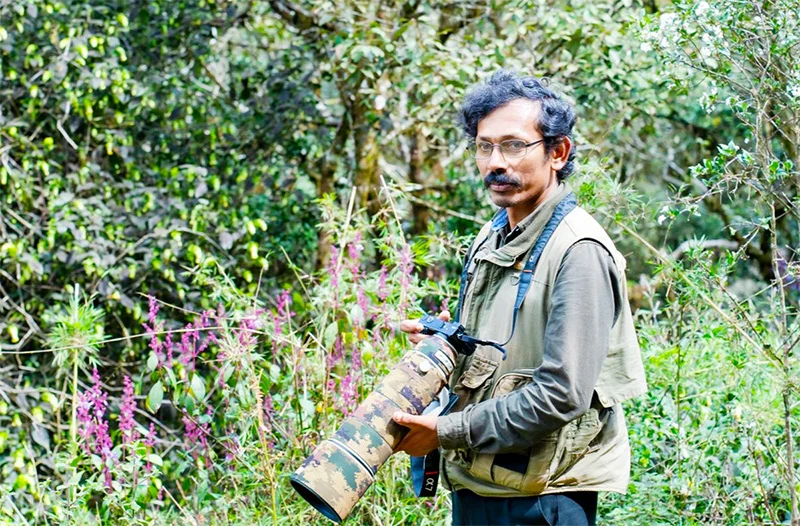
Rajika Gamage
A guide born from passion and necessity
The new field guide represents the culmination of years of research and builds upon Gamage’s earlier publication, which was released in 2017.
“The stimulus for this bird guide was due to the success of my first book,” he said. “This new edition aims to facilitate identification and provide an idea of what to look for in observed habitats or regions.”
The book is designed not merely as a scientific reference but as an accessible companion for anyone interested in birds. Its structure reflects this dual purpose.
“The first section is dedicated to the introduction, geography, and life history of Sri Lankan birds,” Gamage explained. “The second section is the main body of the guide, which illustrates 532 species of birds.”
Each illustration has been carefully crafted in colour to capture the distinctive plumage of each species.
“All illustrations are designed to show each bird’s significant and distinct plumage,” he said. “Where possible, the breeding, non-breeding, and juvenile plumages are provided.”
This attention to detail is especially important because many birds change appearance as they mature.
“Some groups, especially gulls, display many plumages between juveniles and adults,” Gamage noted. “Many take several years to develop full adult plumage and pass through semi-adult stages.”
By illustrating these stages, the guide helps birdwatchers avoid misidentification and deepen their understanding of avian development.
New discoveries and evolving science
One of the most exciting aspects of the new edition is its inclusion of newly recorded species and updated scientific classifications.
“Changes in the bird list of Sri Lanka, especially newly added endemic birds such as the Sri Lankan Shama, Sri Lanka Lesser Flameback, and Greater Flameback, are now included,” Gamage said.
Scientific names and classifications are not static; they evolve as researchers learn more about genetic relationships and species boundaries. The guide reflects these changes, ensuring it remains scientifically current.
The book also incorporates conservation status information based on the latest National Red Data Report and global assessments.
“The conservation status of Sri Lankan birds, as listed in the 2022 National Red Data Report and the global Red Data Report, are included,” Gamage said.
This information is vital for conservation planning and public awareness, highlighting which species face the greatest risk of extinction.
The guide also documents rare and accidental visitors, including species such as the Blue-and-white Flycatcher, Rufous-tailed Rock-thrush, and European Honey-buzzard.
“These represent accidental visitors and newly recorded vagrants,” Gamage said. “Altogether, the first edition offers some 25 additional species, all illustrated.”
Art and science in harmony
Unlike many field guides that rely heavily on photographs, Gamage’s book emphasises detailed illustrations. This choice reflects the unique advantages of scientific art.
Illustrations can emphasise diagnostic features, eliminate distracting backgrounds, and present birds in standardised poses, making identification easier.
“The principal birds on each page are painted to a standard scale,” Gamage explained. “Flight and behavioural sketches are shown at smaller scales.”
The guide also includes descriptions of habitats, distribution, nesting behaviour, and alternative names in English, Sinhala, and Tamil.
“The majority of birds have more than one English, Sinhala, and Tamil name,” he said. “All of these are included.”
This multilingual approach reflects Sri Lanka’s cultural diversity and ensures the guide is accessible to a wider audience.
A tool for conservation and connection
Beyond its scientific value, Gamage believes the book serves a deeper purpose: strengthening the bond between people and nature.
By helping readers identify birds and understand their lives, the guide fosters appreciation and responsibility.
“This field guide aims to facilitate identification and provide a general introduction to birds,” he said.
In an era of rapid environmental change, such knowledge is essential. Habitat loss, climate change, and human activity continue to threaten bird populations worldwide, including in Sri Lanka.
Yet birds also offer hope.
Their presence in gardens, wetlands, and forests reminds people of nature’s resilience—and their own role in protecting it.
Gamage hopes the guide will inspire both seasoned ornithologists and beginners alike.
“All these changes will make An Illustrated Field Guide to the Fauna of Sri Lanka – Birds one of the most comprehensive and accurate guides available within Sri Lanka,” he said.
A lifelong devotion takes flight
For Rajika Gamage, birds are not merely subjects of study—they are companions in a lifelong journey of discovery.
Each call heard at dawn, each silhouette glimpsed against the sky, each feathered visitor from distant lands reinforces the wonder that first drew him to ornithology.
With the release of his new book on March 6, that wonder will now be shared more widely than ever before.
In its pages, readers will find not only identification keys and scientific facts, but also something more enduring—the story of an island, told through wings, colour, and song.
By Ifham Nizam

Buddhism, one of the world’s oldest religions, offers profound insights into the nature of existence and the ways we can alleviate our suffering. As one of the world’s most profound spiritual traditions, it offers a transformative solution: the art of letting go. Unlike simply losing interest in things or giving up, letting go in Buddhism is about liberation, releasing ourselves from the chain of attachment that prevents us from experiencing true peace and happiness. Letting go is a profound philosophical concept in Buddhism, deeply intertwined with an understanding of suffering, attachment, and the nature of reality. This philosophy encourages us to release our grip on desires, attachments, and on what we hold dear- whether relationships, material goods, or even their identities, ultimately leading to greater peace and enlightenment. Our tendency to cling tightly to the various aspects of life leads to a significant source of stress. We tend to grasp at things, perceiving them as solid and permanent, yet much of what we hold onto is transient and subject to change. This mistaken belief in permanence can trap us in cycles of worry, fear, and anxiety.
The challenge of letting go is especially evident during difficult periods in life. We may find ourselves ruminating over lost opportunities, failed relationships, and unmet expectations. Such thoughts can keep us ensnared in emotions like hurt, guilt, and shame, hindering our ability to move forward. By holding onto the past, we often prevent ourselves from embracing the present and future.
At the heart of Buddhist practice lies the concept of letting go, often encapsulated in the term “non-attachment.” Letting go is a crucial concept in both Buddhism and Christianity, emphasising the release of attachments that bind us and contribute to our suffering. At its core, letting go is about finding freedom from desires and acknowledging that both relationships and material possessions are fleeting and transient.
In Buddhism, letting go, or non-attachment, is fundamental for achieving inner peace. The First Noble Truth acknowledges that life is filled with suffering, often rooted in our cravings and attachment to things. The Second Noble Truth teaches that by letting go of this craving, we can transcend the cycles of life and attain enlightenment.
Spiritually, Buddhism emphasises the impermanence of all things (annica). We tend to cling to people, experiences, and even our identities, but everything is fleeting. Recogniing this helps us appreciate the present moment and fosters compassion. Instead of allowing attachments to cloud our relationships, letting go encourages us to engage with others without judgment or expectation, fostering deeper connections.
Philosophically, Buddhism challenges the notion of a permanent self (anatta) that is often the focus of human attachment. It teaches that our identity is not a fixed entity but a collection of experiences and perceptions in constant flux. Understanding this can help us see the futility of clinging to desires and identities, paving the way for a liberated state of being built on wisdom cultivated through meditation and mindfulness.
From a psychological standpoint, letting go can significantly improve our emotional health and well-being. Attachment often breeds fear, anxiety, and stress, while non-attachment promotes resilience and adaptability. When we embrace the idea of impermanence, we become more capable of handling life’s challenges without being overwhelmed. Mindfulness—being present and accepting our emotions without judgment—allows us to process difficult feelings constructively, making it easier to let go of what we cannot control.
Letting go is also an essential concept in Christianity, which emphasises surrender and trust in God. Biblical teachings encourage believers to let go of worries and anxieties, placing their faith in divine providence. For instance, verses like Matthew 6:34 remind individuals not to be anxious about tomorrow, but to focus on the present. By surrendering our burdens to God, we find peace and freedom from the weight of excessive attachment.
Moreover, both traditions highlight the importance of community. In Buddhism, the sangha, or community of practitioners, supports individuals on their journeys toward non-attachment. Similarly, the Christian community encourages believers to lean on one another for support, fostering a sense of belonging and shared faith that helps mitigate the loneliness that comes with attachment.
Ultimately, the concept of letting go serves as a powerful antidote to suffering in both Buddhism and Christianity. By embracing impermanence, cultivating wisdom, and practising mindfulness or faith, individuals can experience profound liberation. In our chaotic world, the principles of letting go offer a clear path toward inner peace, fulfilment, and deeper connections with ourselves, others, and the divine.
Buddhism explores the profound concept of letting go, providing valuable insights into the human experience and pathways to alleviating suffering. Rooted in one of the world’s oldest spiritual traditions, Buddhism presents letting go as a transformative practice, distinct from mere disengagement or giving up. Instead, it encompasses liberation from the chains of attachment that hinder us from experiencing genuine peace and happiness. Christianity too explore this profound concept in its teachings
At the core of Buddhist philosophy lies the idea of non-attachment, which encourages individuals to free themselves from desires and possessions, ultimately leading to tranquility and enlightenment. Letting go is intertwined with an understanding of suffering, attachment, and the transient nature of existence. This philosophy instructs us to relinquish our grip on what we hold dear—whether relationships, material goods, or even our identities—recognising that these are impermanent.
Buddhism’s First Noble Truth acknowledges that life inherently involves suffering, often stemming from our cravings and attachments. The Second Noble Truth reveals that overcoming this craving is key to transcending the cycles of life and achieving enlightenment. Emphasising the impermanence of all things, Buddhism invites us to appreciate the present moment and fosters compassion by helping us detach from fixed identities and experiences. This awareness enriches our relationships, allowing us to connect with others free from judgment or expectation.
Philosophically, Buddhism challenges the notion of a static self (anatta), asserting that our identity is not a fixed concept but rather a fluid collection of experiences. Recognising this notion helps highlight the futility of clinging to desires and identities, opening the door to a liberated existence founded on wisdom cultivated through meditation and mindfulness practices.
From a psychological perspective, the act of letting go can significantly enhance emotional health and well-being. Attachment often fuels fear, anxiety, and stress, while embracing non-attachment cultivates resilience and adaptability. By accepting impermanence, we equip ourselves to face life’s challenges with greater ease. Practicing mindfulness—being present and accepting emotions without judgment—further facilitates the process of releasing what is beyond our control.
In Christianity, the theme of letting go is also prominent, emphasizing surrender and trust in God. Scripture encourages believers to release their worries and anxieties by placing their faith in divine providence. For example, Matthew 6:34 advises individuals to focus on the present rather than fret over the future. By surrendering our burdens to God, we can experience relief from the weight of excessive attachment.
Both traditions underscore the significance of community in supporting the journey of letting go. In Buddhism, the sangha, or community of practitioners, encourages the pursuit of non-attachment. Likewise, Christian fellowship fosters belonging and shared faith, helping believers lean on one another for strength and mitigating the loneliness that can arise from attachment.
Ultimately, the concept of letting go serves as a powerful antidote to suffering in both Buddhism and Christianity. Embracing impermanence, nurturing wisdom, and practising mindfulness or trust can lead individuals toward profound liberation. In an increasingly chaotic world, the principles of letting go illuminate a pathway to inner peace, fulfilment, and deeper connections with ourselves, others, and the divine. By understanding and embodying this philosophy, we can navigate life’s complexities with grace and openness.////Buddhism delves into the profound concept of letting go, offering valuable insights into the human experience and pathways to alleviating suffering. As one of the world’s oldest spiritual traditions, Buddhism presents letting go as a transformative practice that goes beyond mere disengagement or resignation. It represents liberation from the chains of attachment that prevent us from experiencing true peace and happiness. Similarly, Christianity explores this profound concept in its teachings.
At the heart of Buddhist philosophy is the idea of non-attachment, which encourages individuals to free themselves from desires and possessions, ultimately leading to tranquility and enlightenment. Letting go is closely related to an understanding of suffering, attachment, and the impermanent nature of existence. This philosophy guides us to loosen our hold on what we cherish—be it relationships, material possessions, or even our own identities—recognizing that everything is transient. Through this understanding, we can cultivate a deeper sense of peace and fulfillment in our lives.
 BY Dr. Justice Chandradasa Nanayakkara
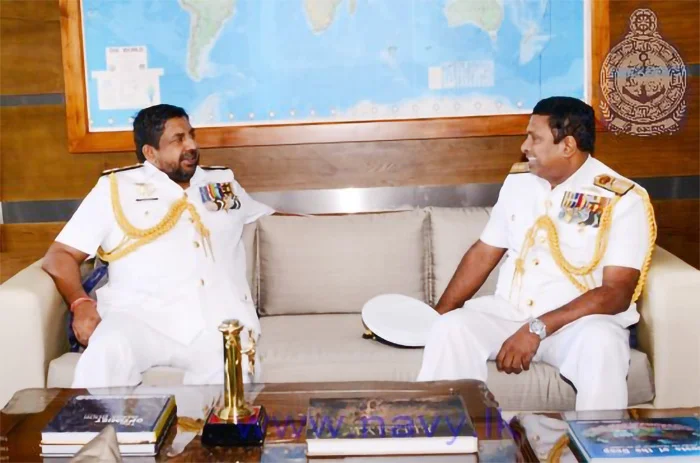
Rear Admiral Udaya Bandara, VSV, USP (retired)
This incident happened in 2006 when I was the Director Naval Operations, Special Forces and Maritime Surveillance under then Commander of the Navy Vice Admiral Wasantha Karannagoda. Udaya (fondly known as Bandi) was a trusted Naval Assistant (NA) to the Commander.
We were going through a very hard time fighting the LTTE Sea Tigers’ explosive-laden suicide boats that our Fast Attack Craft (s) and elite SBS’ Arrow Boats encountered in our littoral sea battles.
Brilliant Marine Engineer Commander (then) Chaminda Dissanayake, who was known for his “out of the box” thinking and superior technical skills on research and development, met me at my office at Naval Headquarters and showed me a blueprint of an explosive- laden remotely controlled small boat.
Udaya’s Naval Assistant’s office was next to mine, the Director Naval Operations office. Both places are very close to the Navy Commander’s office. I walked into Bandi’s office with Commander Dissa and showed this blueprint a brilliant idea. Being a Marine Engineer “par excellence”, Bandi immediately understood the great design. I urged him to brief the Commander of the Navy with Commander Dissa.
My burden was over! Bandi took over the project and within a few weeks we tested our first prototype “Explosive-laden Remotely Controlled arrow boat “at sea off Coral Cove in the Naval Base Trincomalee. It was a complete success.
This remotely controlled boats went out to sea with our SBS arrow boats fleet and had devastating effects against LTTE suicide boats and their small boats fleet. Thanks, Bandi, for your contribution. The present-day Admiral of the Fleet used to tell us during those days “you cannot buy a Navy – you have to build one”!
We built our own small boats squadrons at our boat yards in Welisara and Trincomalee to bring LTTE Sea Tigers. The Special Boats Squadron (SBS) and rapid action boats squadron (RABS) being so useful with remotely controlled explosive-laden arrow boats to win sea battles convincingly.
Bandi used to say, “Navy is a technical service and we should give ALL SRI LANKA NAVY OFFICERS FIRST A TECHNICAL DEGREE AT OUR ACADEMY (BTec degree).” That idea did not receive much attention here, but the Indian Navy—Bandi graduated as a Marine Engineer- at Indian Navy Engineering College SLNS Shivaji in Lonavala, Pune, India— understood this idea well over two decades ago. Indian Navy Commissioned their new Naval Academy at Ezhimala (in Kerala State) which is the largest Naval Academy in Asia (Campus covers area of 2,452 acres) starts its Naval officers training with a BTech degree, regardless of what branch of the navy one joined.
Bandi’s technical expertise was not limited to SLN. He was the pioneer of “Mini – Hydro Power projects” in Sri Lanka. When I was a young officer, he urged me to invest some money in one of these projects and advised me “Sir! as long as water flows through turbines, you will get money from the CEB, which is always short of electricity”. I regret that I did not heed Bandi’s advice.
When he worked under me when I was Commander Southern Naval Area, as my senior Technical Officer, I observed pencil marks on walls of his chalet and I inquired from him what they were. He said it was the result of his “pencil shooting training”, a drill Practical Pistol Firers do to improve their skills. He used to practice “draw and fire” drills and pencil shooting drills late into nights to be a good Practical Pistol firer in Sri Lanka Navy team. He didn’t stop at that. He represented Sri Lanka National Practical Pistol Firing team and won International Championships.
As the Officer in charge of Technical Training in the Navy, he worked as Training Commander to train Royal Oman Navy Engineering Artificers in Sri Lanka, especially on Fast Attack Craft Main Engine Overhauls. The Royal Oman Navy Commander was so impressed with the knowledge acquired by Artificers that he donated money for the construction of a four-storey accommodation building for Sri Lanka Navy Naval and Maritime Academy, Trincomalee now known as “Oman Building”. The credit for this project should go to Bandi.
Bandi’s wife was a senior Judge of Kegalle High Court, and she retired a few years ago. Their only child, a son studied at the British School, Colombo and followed in his mother’s footsteps became a lawyer. Bandi was so much attached to his family and very proud of his son’s accomplishments.
When Bandi was due to retire in 2016 as a Rear Admiral and Director General Training, after distinguished service of 34 years, and reaching retirement age of 55 years, I requested him to serve for some more years after mobilising him into our Naval Reserve Force. He had other plans. He wanted to take his mini-Hydro Power projects to East African countries.
His demise after a very brief illness at age of 64 years was a shock to his family and friends. His funeral was held on Feb. 27 with Full Military Honors befitting a Rear Admiral at his home town Aranayake.
Dear Bandi, the beautiful Sri Lanka Navy, Naval and Maritime Academy in Trincomalee, which was built with your efforts will serve for Sri Lanka Navy Officer Trainees and sailors for a very long time and remember you forever.
May dear Bandi attain the supreme bliss of Nirvana!
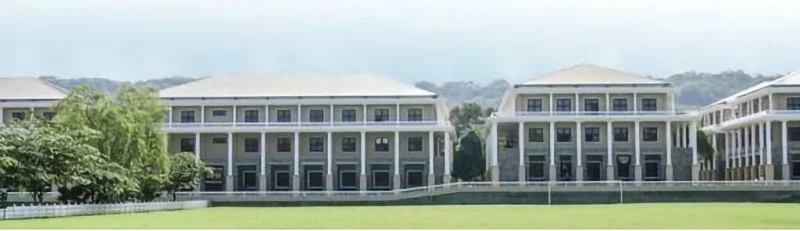
Naval and Maritime Academy, Trincomalee
By Admiral Ravindra C Wijegunaratne
WV, RWP and Bar, RSP, VSV, USP, NI (M) (Pakistan), ndc, psn, Bsc
(Hons) (War Studies) (Karachi) MPhil (Madras)
Former Navy Commander and Former Chief of Defence Staff
Former Chairman, Trincomalee Petroleum Terminals Ltd,
Former Managing Director Ceylon Petroleum Corporation,
Former High Commissioner to Pakistan

Oil prices rise after ships attacked near Strait of Hormuz

War photographer Paul Conroy dies as tributes paid

Allies of US in the Gulf bear brunt of Iran attacks

Dry weather will prevail in most parts of the island

Israel resumes attacks as Iran vows to avenge supreme leader’s death

CPC has enough fuel stocks

‘Dates have the highest sugar content to fight Coronavirus’

Sunday Island 27 December – Headlines

#SundayIsland 17th December – Headlines

Sunday Island – 28th March

Sunday Island Headlines – 21 March

Sunday Island – 21st February – Headlines
-
 News7 days ago
Prime Minister Attends the 40th Anniversary of the Sri Lanka Nippon Educational and Cultural Centre
-

 Opinion3 days ago
Jamming and re-setting the world: What is the role of Donald Trump?
-

 Sports7 days ago
Dottin out obstructing the field as Sri Lanka clinch series
-
 Features3 days ago
An innocent bystander or a passive onlooker?
-

 Features5 days ago
Building on Sand: The Indian market trap
-
 Opinion5 days ago
Future must be won
-
 Features4 days ago
Ratmalana Airport: The Truth, The Whole Truth, And Nothing But The Truth
-
 Business4 days ago
IRCSL transforms Sri Lanka’s insurance industry with first-ever Centralized Insurance Data Repository