
Latest News
Allies of US in the Gulf bear brunt of Iran attacks

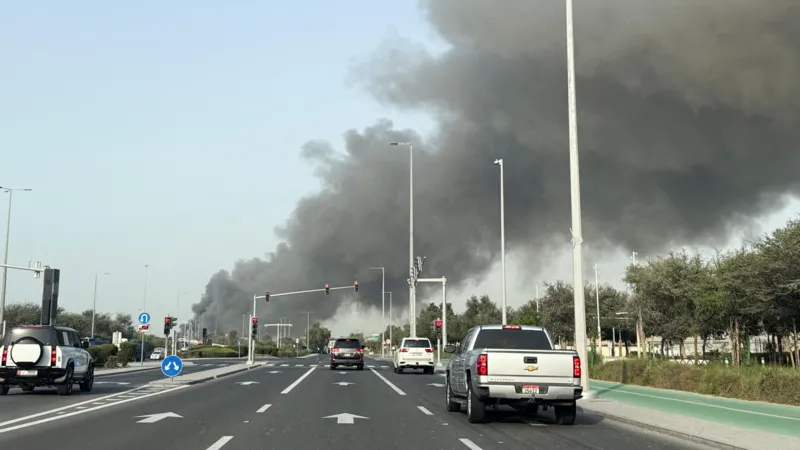
In the clear blue skies above Abu Dhabi, white contrails streak high above the sand-coloured villas and well-watered gardens.
These are no incoming Dreamliners or Airbuses bringing in the next manifest of tourists and guest workers. They are incoming ballistic missiles, launched by the Emirates’ giant neighbour just across the Gulf: Iran.
As of Sunday afternoon, the United Arab Emirates (UAE) defence ministry said it had so far “dealt with” 165 incoming ballistic missiles, two cruise missiles and 541 Iranian drones.
In Bahrain, a friend alerted me on Sunday morning that the airport was under attack after having a sleepless night.
“Woken by huge bangs and wailing siren,” he texted. “I think maybe around 20 booms and bangs. At least two hits”.
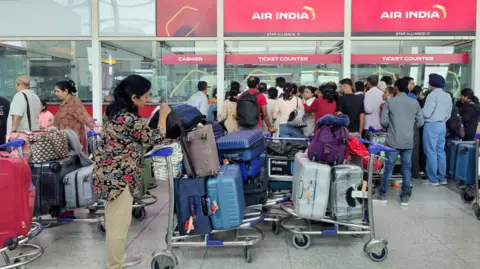
These are not familiar scenes in this region, but since this conflict began on Saturday morning, Iran appears to have expanded its target set from just hitting military targets, like the US Navy’s 5th Fleet headquarters in Bahrain, to airports and other civilian sites.
Now luxury hotels and shopping malls, high-rise apartment blocks, state-of-the-art airport departure terminals are getting sporadically hit as gaps appear in the Arab states’ air defences in the Gulf.
These places were never built with the prospect in mind that they would one day come under attack from drones and ballistic missiles.
Iran’s Foreign Minister, Abbas Aragchi, has denied targeting his country’s neighbours, telling Al Jazeera: “We are not attacking our neighbours in the Persian Gulf countries, we are targeting the presence of the US in these countries. Neighbours should direct their grievances to the decision-makers of this war”.
Some of the damage to civilian infrastructure in the Gulf states is accidental – resulting from debris falling from intercepted missiles.
But not all.
The number of attacks on airports in Bahrain and the UAE point to more than coincidence.
Iran always made it clear in advance that, if it was attacked, it would retaliate at any country it considered to be complicit in that attack.
The Gulf states went to some lengths to show Iran they were not part, in their eyes, of this US-Israeli attack.
Yet essentially they have been punished for being long-term military partners of Washington’s.
Before the Islamic Revolution, in the days of the shah, Iran was known as “the policeman of the Gulf”.
Since the revolution, it has always tried to convince its neighbours that it should resume that role, “taking charge of security” in what it calls Khaleej-e-Fars, the Persian Gulf (Arabs call it the Arabian Gulf).
Iranian leaders have tried, unsuccessfully, to persuade the Arab states in the Gulf to expel the US Navy and adopt them as their guardians instead.
But for rulers of the Gulf states – conservative, dynastic monarchies for whom the revolutionary zeal of the Islamic Republic is anathema – a line has been crossed here.
It is hard to see how they can ever have anything approaching normal relations again with the current Iranian leadership, that is, if it survives this war.
Saudi Arabia and Oman, two countries that have long hosted US and Western military forces, have both escaped a lot more lightly than the other four Gulf Arab states.
Oman, which remains on good terms with the Islamic Republic and was mediating the nuclear talks between the US and Iran, suffered a drone strike on its commercial port of Duqm, down on the Arabian Sea coast.
The Saudi capital Riyadh appears to have been targeted on Saturday, prompting an angry statement from its government.
“The Kingdom of Saudi Arabia expresses its rejection and condemnation in the strongest terms of the blatant and cowardly Iranian attacks that targeted the Riyadh Region and the Eastern Province, which were successfully intercepted. These attacks cannot be justified under any pretext,” the statement said.
This is not the first time Iran has attacked its Arab neighbours in the Gulf, either directly or indirectly, but never quite on this scale.
In 2019, an Iranian-backed militia in Iraq launched a volley of drones at Saudi Aramco’s petrochemical facilities at Abqaiq and Khurais, temporarily knocking out half of its daily export capacity.
Last June, Iran fired ballistic missiles at the al-Udaid airbase in Qatar but this was seen as a performative response to America’s Operation Midnight Hammer air raid that destroyed Iran’s nuclear sites at Isfahan, Natanz and Fordo, and Tehran quietly gave advance warning.
Bahrain, which has a large, sometimes restive Shia population, has long accused Iran of funding, training and arming insurgents in its country.
All of this, though, pales compared to the situation the Arab states of the Gulf are now experiencing.
For President Trump, for Israel, for many governments in the Middle East, and of course for many Iranians themselves the best result now would be a swift end to the regime of the Islamic Republic followed by a smooth transition to democracy and a world where Iran can enjoy normal relations with the rest of the world.
That, though, is far from certain.
A race is currently under way by the US and Israel to try to destroy Iran’s ability to keep launching these missiles and drones before they can fire them.
For Iran’s Revolutionary Guards Corps, the IRGC, the dilemma is whether to surge an attack on a major target like a US warship in the hopes of overcoming its defences, or hold back much of its concealed arsenal in the hopes of outlasting President Trump’s patience.
Iran also knows that while it has a finite number of missiles and drones, so, too, are its adversaries constrained by their number of remaining air defences.
If or when those run out before Iran runs out of missiles, drones or launchers then life for those on the ground in the Gulf could be about to get even more alarming.
The balance of power is heavily in favour of the US and Israel. These are two of the world’s most powerful and technologically advanced militaries in the world.
There are two US carrier strike groups in the region with over 200 warplanes while Iran, under sweeping sanctions for years, has no air force to speak of.
Both Israel and the US enjoy complete air superiority.
But Tehran still has some things on its side.
The regime, although weakened and unpopular with much of its population, only has to survive to proclaim itself the long-term winner in this conflict.
The Islamic Republic, with its cult of martyrdom, can take a lot more pain than the US can and the longer this conflict goes on the keener President Trump will be to find an off-ramp.
Will the US and Iran return to talks?
If the Iranian regime collapses, that will not be necessary.
But if the regime survives, and it may well, then Washington’s triple demands of Tehran will come back into focus, namely: a curb on Iran’s suspect nuclear programme, including a return to inspections; an end to Iran’s ballistic missile programme; and an end to Iran’s support for proxy militias around the region, such as the Hezbullah, Hamas, and the Houthis.
Oman says real progress was being made in talks in Geneva last month on the nuclear file.
But Iran ruled out discussing the other two issues – leading Donald Trump to say he was “not happy with the way the talks are going”.
It is possible that back channel contacts could well produce a ceasefire, followed by a return to talks.
But if the two sides’ bargaining positions have not moved then military action could well resume.
So this conflict has yet to run its course.
[BBC]

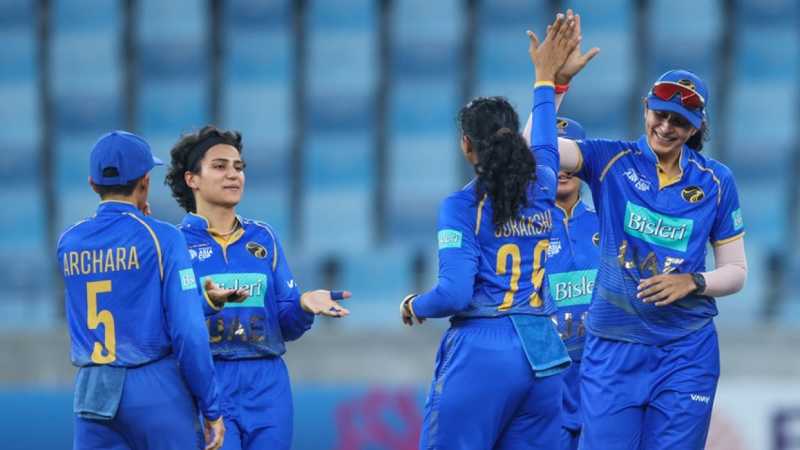
A complete performance from UAE’s bowling unit kept their semi-final hopes alive at the 2026 Women’s T20 Asia Cup, skittling Indonesia for 73 and then completing the chase with six wickets to spare. They now have to beat Bangladesh on September 8 and also hope other results go their way.
UAE were on top right from the first ball courtesy offspinner Suraksha Kotte, who starred with 3 for 16. Kotte struck with the first two balls of the innings, dismissing Indonesia opener Maria Corazon and No. 3 Ni Luh Dewi for first-ball ducks. UAE captain Esha Oza (2 for 11) then dismissed the other opener Rahmawati Pangestuti in the fourth over.
Indonesia captainN8 Puu Ayu Nanda Sakarini top-scored with a lone hand of 39 off 52 balls, with four fours and a six, accounting for 53.4% of Indonesia’s runs. But with little support, they could not find a way back in and were bowled out for 73.
Slow left-arm spinner Heena Hotchandani (2 for 6) and seamer Samaira Dharnidharka (1 for 12) also got among the wickets. Legspinner Vaishnave Mahesh struck twice in the 20th over to clean up the tail.
UAE openers Theertha Satish and Oza put on 17 for the first wicket. After losing Theertha in the fifth over, Oza hit two boundaries in each of the sixth and eighth overs. No. 3 Rinitha Rajith then hit three fours off Sofia Velic in the ninth over.
A brief wobble followed for UAE as they slid from 62 for 1 to 68 for 4. Oza fell for a 29-ball 30 at the start of the 11th over to Ni Ariani and Velic grabbed two wickets in the 12th. However, with only six runs needed, UAE wrapped up the chase at the start of the 14th over, the tournament hosts securing two points with 41 balls to spare. This was also Indonesia’s final match of the campaign, bowing out with losses in all three games.
Scores:
UAE Women 75 for 4 8n 13.1 overs (Esha Oza 30, Rinitha Rajith 22; Ni Riani 1-10, Sang Maypriani 1-17, Sofia Velic 2-25) beat IndonesiaWomen 73 in 19.4 overs (N8 Putu Ayu Nanda Sakarini 39, Desi Wulandari 12; Suraksha Kotte 3-16, Heena Hotchandani 2-06, Esha Oza 2-11, Samira Dharnidarkha 1-12 ) by six wickets
(Cricinfo)
Latest News
Sun directly overhead Moratuwa, Kesbewa, Handapangoda, Idalgashinna, Yudhaganawa, Kotiyagala and Panama about 12.08 noon today (05)

The sun is going to be directly over the latitudes of Sri Lanka from 28th of August to 07th of September due to its apparent southward relative motion.
The nearest places of Sri Lanka over which the sun is
overhead today (05) are Moratuwa, Kesbewa, Handapangoda, Idalgashinna, Yudhaganawa, Kotiyagala and Panama about 12.08 noon
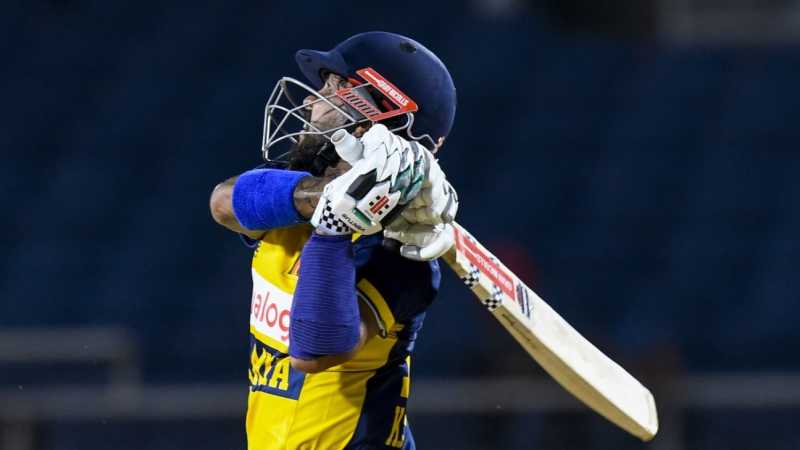
Kusal Mendis and Binura Fernando have been ruled out of Sri Lanka’s upcoming T20I series against England, with the SLC saying that the two were “still undergoing rehabilitation” after injuries picked up at the 2026 Lanka Premier League.
The update came just over a day after the two were named in the 16-member squad, with Kusal retained as captain of both the T20I and the ODI sides.Charith Asalanka, who had returned to the vice-captain’s position for the series, will now lead the side in the T20Is. Though Kusal hasn’t been ruled out of the ODIs just yet, were he to miss out, Asalanka, as the designated vice-captain, might step in there too.
Kusal has been out of action since July 19 with a right hamstring injury, while Binura hasn’t played since August 5, SLC putting his absence down to a back injury.
Pavan Rathnayake, the 24-year-old top-order batter, has replaced Kusal in the T20I touring party, while Dilshan Madushanka, the fast bowler who was in the squad for the Tests against India recently but didn’t get to play, has come in for Binura.
(Cricinfo)

Malaysia declares emergency in Sarawak as haze from Indonesia worsens

UAE keep semi-final hopes alive after convincing win over Indonesia

Sun directly overhead Moratuwa, Kesbewa, Handapangoda, Idalgashinna, Yudhaganawa, Kotiyagala and Panama about 12.08 noon today (05)

Showers above 75 mm are likely at some places in the Uva, Central and Eastern provinces and in Polonnaruwa and Mullaittivu districts after 2.00 p.m

Namal remanded until Sept. 18 over Airbus deal investigation

Dengue cases surpass 96,000 this year

‘Dates have the highest sugar content to fight Coronavirus’

Sunday Island 27 December – Headlines

#SundayIsland 17th December – Headlines

Sunday Island – 28th March

Sunday Island Headlines – 21 March

Sunday Island – 21st February – Headlines
-

 Features7 days ago
“Wrap Me Up in My Blazer”— A Gentlemanly Bradby Reminiscence
-

 Features6 days ago
When Sri Lankan stories find their own voice
-

 Features7 days ago
JVP/NPP government as seen from outside by Lionel Bopage now domiciled in Australia
-

 News6 days ago
BASL takes exception to Justice Ganepola being denied a place in SC
-

 Features7 days ago
Prof. Savitri Goonesekere: What has she done?
-

 News3 days ago
Denied of promotion to SC despite vacancies, justice Gurusinghe retires
-

 Latest News3 days ago
Grade 5 scholarship exam results released
-

 News3 days ago
22A: SC urged to suspend hearing, appoint full bench