
Business
Tackling the urgent challenge of parallel imports for accelerated economic and industrial recovery


By Thushara Rathnaweera, Head of Mobile Experience at Samsung Electronics (Sri Lanka)
In the intricate web of today’s global economy, a burning issue demands our immediate attention, which is the challenge of parallel imports, often referred to as ‘grey goods.’ As the Head of Mobile Experience at Samsung Sri Lanka, I consider it my duty to delve into the intricate ramifications of parallel imports and propose strategic measures imperative for fortifying our nation’s economic resilience. The implications of parallel imports extend beyond mere surface observations, compelling us to explore their deeper repercussions. But first – what exactly is considered ‘Parallel Imports’?
Parallel imports, known as ‘grey goods,’ involve branded products entering markets without brand owners’ authorization and these genuine items lack consent for specific market distribution. Often sourced from countries with lower prices or different packaging, products are re-imported into other markets. This arises due to price disparities, regional market variations, and import taxes. Parallel imports offer reduced prices, attracting cost-conscious consumers.
The gravity of these parallel imports lies in their direct threat to Sri Lanka’s economic stability. These unauthorized imports divert substantial revenue away from legitimate channels and contribute to significant tax losses. For instance, Samsung incurred around LKR 330 million losses from 2020 to 2023 due to such imports, in stark contrast to the legitimate tax contribution of LKR 3,802,408,685. Authorized competitors contributed LKR 5,081,089,154 in taxes, highlighting the disparity between legitimate channels and parallel imports. Notably, parallel imports also led to job losses—2500 direct and 500 indirect—which impacts families and the industry.
Moreover, while parallel imports might offer seemingly alluring products at lower prices, this apparent affordability conceals a more sinister cost. The proliferation of these unauthorized products erodes consumer trust in authentic brands, discouraging investments in research and development. As consumers are enticed by these seemingly budget-friendly alternatives, the potential implications for authorized businesses loom large.
Furthermore, the challenge of parallel imports is not limited to economics alone; it has the power to induce a shift in consumer behavior. This shift can lead consumers away from legitimate distribution channels, inadvertently fostering a preference for cheaper alternatives. Such behavioral shifts disrupt market equilibrium and pose significant challenges to established businesses. These shifts have the potential to send ripples through the economy, leading to far-reaching consequences.
Addressing the multifaceted challenges posed by parallel imports requires a united effort spanning all sectors of our society. Strategically navigating the challenge of parallel imports necessitates collaborative efforts from all corners. To counteract the influence of parallel imports, we must establish and enforce robust Intellectual Property Rights (IPR) frameworks. These frameworks should comprehensively protect brand owners and their trademarks. This entails implementing stringent legal measures and penalties to deter involvement in parallel imports and trademark infringement.
Additionally, the power of knowledge is pivotal in combating parallel imports. Public awareness campaigns can illuminate the importance of supporting authorized distribution channels while shedding light on the potential repercussions of purchasing unauthorized goods. Furthermore, fostering productive dialogues with governmental bodies can amplify the understanding of the far-reaching consequences of parallel imports. By articulating the negative impact on our economy and society, these conversations can pave the way for stringent regulations and robust enforcement mechanisms.
We strongly advise customers, not just Samsung’s but of all brands’, to exercise caution when dealing with unauthorized sellers offering below-standard warranties, such as 6 to 3 months or shop warranties. Samsung Sri Lanka for example emphasizes authenticity and quality by exclusively partnering with authorized dealers. This strategic collaboration ensures strict adherence to Samsung’s rigorous standards, delivering peace of mind to our customers. When you purchase from our authorized dealers, you enjoy the exclusive benefits of a one-year comprehensive warranty. This warranty underscores our commitment to product excellence and serves as a testament to our confidence in the durability and performance of our devices.
Opting for Samsung’s official channels guarantees that you receive the full benefits and protection that come with a genuine Samsung device. Furthermore, at Samsung Sri Lanka, we exclusively offer TRCSL-approved products. TRCSL (Telecommunications Regulatory Commission of Sri Lanka) certification signifies adherence to local regulations and standards, ensuring quality and compliance. We encourage all our customers to verify the TRCSL certification status of their devices before making a purchase, which can be conveniently done by sending an SMS to 1909 with the message “IMEI (Space) IMEI Number.” On a broader level, these are some steps we take to ensure maximum safety and satisfaction for our customers.
Championing Sri Lanka’s economic prosperity amidst the challenge of parallel imports is a shared responsibility. The urgency of addressing this issue surpasses economic concerns; it embodies our commitment to innovation, consumer confidence, and sustainable growth. As a leader in Samsung Sri Lanka, I am steadfast in guiding our nation towards an economy characterized by resilience and strength. By harnessing strategic collaboration and unwavering determination, we can navigate the intricate landscape of parallel imports and forge an economic environment that enriches the lives of all Sri Lankans.











Business
Redefining Industry Standards: Home Lands Group Emerges as Sri Lanka’s Premier Force in Lifestyle and Developer Leadership

At a time when Sri Lanka’s property landscape is experiencing rapid transformation, one organisation continues to define the direction of the market through scale, innovation, and an unwavering commitment to quality. At the 2025 PropertyGuru Asia Property Awards (Sri Lanka), the Home Lands Group of Companies maintained its place at the peak of the industry, acquiring two of the most influential awards of the year: Best Developer for the Group and Best Lifestyle Developer for Home Lands Skyline (Private) Limited.
These distinctions signify more than just project-level success. They reflect the organisation’s leadership in shaping how Sri Lankans aspire to live, work, and invest.
The Home Lands Group has built a broad presence throughout Sri Lanka’s most active corridors, from the rapidly evolving suburbs of Colombo to the developing lifestyle hubs of Negombo, Malabe, and Kahathuduwa, guided by extensive market research. The Group has transformed its in-depth knowledge of the property market into a portfolio of assets embodying superior residential living experiences, supported by strategically located branches that deliver an integrated suite of real estate services for buyers nationwide.
Home Lands Skyline, the Group’s flagship development arm and the 2025 Best Lifestyle Developer, is responsible for this on-ground reach. The company was commended for shaping communities through visionary residential environments and for its ability to combine cutting-edge sustainability with expansive lifestyle amenities. With 19 completed projects, including the largest integrated golf community in Sri Lanka and nine sustainable developments, Home Lands Skyline keeps raising the bar for efficiency, design, and placemaking.
Both ambition and operational strength are evident in its recent accomplishments. The company completed a number of landmark projects such as Elixia 3C’s Apartments, Santorini Resort Apartments & Residencies, and the 1,200-unit Canterbury Golf Resort Apartments & Residencies, which has more than 50 resort amenities that meet international standards and the nation’s first day-and-night golf course. In addition, the Group’s remarkable 58% market share earned it the title of Sri Lanka’s Most Preferred Residential Real Estate Brand in the RIU Brand Health Survey.
This growth is supported by a sustainability-first philosophy. The company incorporates environmental responsibility into every stage of development, from modular construction, renewable energy integration, and ethical sourcing throughout its supply chain to passive design principles that improve natural light and ventilation. This dedication is demonstrated by its Platinum Award at the CIOB Green Awards 2024.
The Home Lands Group is at the forefront of creating new lifestyle expectations as demand for well-planned, resort-style communities rises. In addition to confirming past achievements, the Group’s 2025 victories at the PropertyGuru Asia Property Awards (Sri Lanka) indicate a trajectory of ongoing leadership, positioning it as a transformative force in the future of Sri Lankan real estate.

The opening weeks of 2026 are offering a glimmer of cautious hope for the business community weary from years of economic turbulence and steep financing costs. The Central Bank’s latest weekly economic indicators signal more than just macroeconomic stability. They point to early signs of a long-awaited trend; a measurable dip in borrowing costs.
“If sustained, this shift could transform steady growth into a robust, investment-led expansion,” a senior economist told The Island Financial Review.
The benchmark Average Weighted Prime Lending Rate (AWPR) declined by 21 basis points to 8.98% for the week ending 16 January, according to the Central Bank.
“For entrepreneurs and CEOs, this is not just another statistic. It could mean the difference between postponing an expansion and hiring new staff. Across boardrooms, the hope is that this marks the start of a sustained downward trend that holds through 2026,” he said.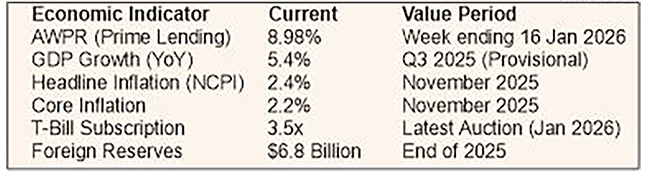
When asked about the instances where Treasury Bills are not fully subscribed by the investors, he replied,” Treasury Bill yields remained broadly stable, with only minimal movement across 91-day, 182-day, and 364-day tenors. Strong demand was clear, with the latest T-Bill auction oversubscribed by about 3.5 times. This sovereign-level stability creates room for the gradual easing of commercial lending rates, allowing the Central Bank to nurture a more growth-supportive monetary policy.”
Replying to a question on how he views the inflation numbers in this context, he said, “The year-on-year increase in the National Consumer Price Index stood at a manageable 2.4% in November, with core inflation at 2.2%. Such an environment should allow interest rates to fall without sparking a price spiral. For businesses, it means the real cost of borrowing adjusted for inflation, and it is becoming more favourable for them. While consumers still face weekly price shifts in vegetables and fish, the broader disinflation trend gives policymakers leeway to keep credit affordable.”
Referring to the growth trajectory, he mentioned, “With GDP growth provisionally at 5.4% in the third quarter of 2025 and Purchasing Managers’ Indices signalling expansion in both manufacturing and services, the economy is in a growth phase. However, to accelerate this momentum businesses need capital at lower cost to modernise machinery, boost export capacity, and spur innovation. Affordable credit is, therefore, not merely helpful, it is essential to shift growth into a higher gear.”
In conclusion , he said,” The coming months will be watched closely, because for Sri Lankan businesses, a sustained decline in borrowing costs isn’t just an indicator; it’s the foundation for growth. There’s hope that this easing in the cost of money will prevail through most of the year.”
By Sanath Nanayakkare ✍️

Mercantile Investments & Finance PLC has expanded its national footprint to 90 branches with a new opening in Tangalle, reinforcing its commitment to community accessibility. The trusted non-bank financial institution, with over 60 years of service, now supports diverse communities across Sri Lanka with leasing, deposits, gold loans, and tailored lending.
This physical expansion aligns with significant financial growth. The company recently surpassed an LKR 100 billion asset base, with its lending portfolio doubling to Rs. 75 billion and deposits growing to Rs. 51 billion, reflecting strong customer trust. It maintains a low NPL ratio of 4.65%.
Chief Operating Officer Laksanda Gunawardena stated the branch network is vital for building trust, complemented by ongoing digital investments. Managing Director Gerard Ondaatjie linked the growth to six decades of safeguarding depositor interests.
With strategic plans extending to 2027, Mercantile Investments aims to convert its scale into sustained competitive advantage, supporting both customers and Sri Lanka’s economic progress.

PM departs Sri Lanka to participate in the 56th World Economic Forum Annual Meeting in Davos-Klosters, Switzerland.

Several killed in Kabul blast, Afghan Interior Ministry says

Senegal beat hosts Morocco to win AFCON 2025 after farcical walk-off

At least six killed in Pakistan as fire rips through Karachi shopping mall

Chile declares ‘state of catastrophe’ as deadly wildfires menace cities

At least 21 killed in Spain after crash involving high-speed trains

‘Dates have the highest sugar content to fight Coronavirus’

Sunday Island 27 December – Headlines

#SundayIsland 17th December – Headlines

Sunday Island – 28th March

Sunday Island Headlines – 21 March

Sunday Island – 21st February – Headlines
-

 Editorial2 days ago
Illusory rule of law
-
 News3 days ago
UNDP’s assessment confirms widespread economic fallout from Cyclone Ditwah
-

 Business5 days ago
Koaloo.Fi and Stredge forge strategic partnership to offer businesses sustainable supply chain solutions
-

 Editorial3 days ago
Crime and cops
-

 Features2 days ago
Daydreams on a winter’s day
-

 Editorial4 days ago
The Chakka Clash
-

 Features2 days ago
Surprise move of both the Minister and myself from Agriculture to Education
-

 Features2 days ago
The Story of Furniture in Sri Lanka