
Opinion
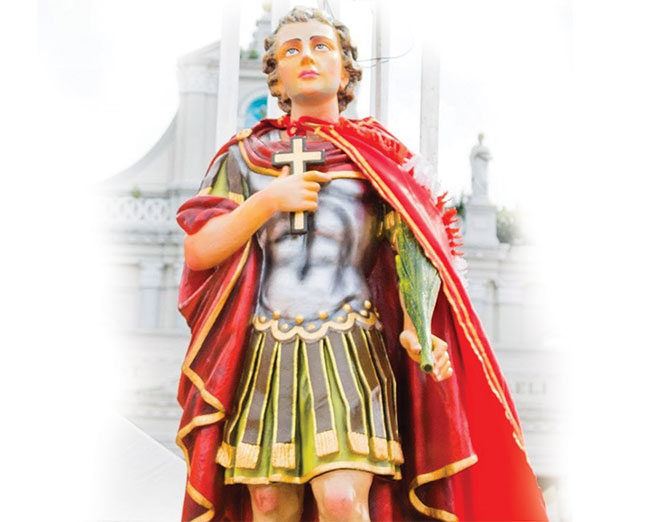
St. Sebastian Martyr and Soldier

By Godfrey Cooray
Senior Attorney-at-Law
Former Ambassador of Sri Lanka to Norway
President National Catholic Writers’ Association
According to legend, St. Sebastian was born at Narbonne in Gaul. He became a soldier in Rome and encouraged Marcellian and Marcus who were sentence to death to remain firm in their faith. St. Sebastian made several converts; among them were master of the rolls Nicostratus, who was in charge of prisoners and his wife Zoe, a deaf mute whom he cured.
Sebastian was named captain in the Roman army by Emperor Diocletian, by Emperor Maximian when Diocletian went to the east. Neither knew that Sebastian was a Christian. When it was discovered that Sebastian was indeed a Christian, he was ordered to be executed. He was shot with arrows and left to die but when the widow of St. Castulas went to recover his body, she found out that he was still alive and nursed him back to health. Soon after his recovery, St. Sebastian intercepted the Emperor; denounced him for his cruelty to Christians and was beaten to death on the Emperor’s order.
St. Sebastian was venerated in Milan as early as the time of St. Ambrose. St. Sebastian is the patron of archers, athletes, soldiers, the Saint of the youths and is appealed to protection against the plagues. St. Ambrose reveals that the parents that young Sebastian were living in Milan as a noble family. St. Ambrose further says that Sebastian along with his three friends, Pankasi, Pulvius and Thorvinus, completed his education successfully with the blessing of his mother, Luciana. Rev. Fr. Dishnef guided him through his spiritual life. From his childhood Sebastian wanted to join the Roman army and with the help of King Karnus, young Sebastian became a soldier and within a short span of time he was appointed as the Commander of the army of King Karnus. Emperor Diocletian declared Christians the enemy of the Roman Empire and instructed judges to punish Christians who have embraced the Catholic Church. Young Sebastian as one of the servants of Christ converted thousands of other believers into Christians. When Emperor Diocletian revealed that Sebastian had become a catholic, the angry Emperor ordered for Sebastian to be shot with arrows to death. After being shot by arrows, one of Sebastian supporters Irane treated him and cured him. When Sebastian was cured he came to the Emperor Diocletian and professed his faith for the second time disclosing that he is a servant of Christ. Astounded by the fact that Sebastian is a Christian, Emperor Diocletian ordered the Roman army to kill Sebastian with clubs.
In the liturgical calendar of the church, the feast of the St. Sebastian is celebrated on the 20 January. This day is indeed a mini Christmas to the people of Kandana irrespective of their religion. The feast commences with the hoisting of the flag staff on the 11th of January at 4 p.m. at the Kandana junction, along the Colombo Negombo road. There is a long history attached to the flag staff. The first flag staff which was an arecanut tree, 25 feet tall, was hoisted by the Aththidiya family of Kandana and today their descendants continue hoisting of the flag staff as a tradition. This year’s flag staff, too, was hoisted by the Raymond Aththidiya family. Several processions originating from different directions carrying flags meet at this flag staff junction. The pouring of milk on the flag staff has been a tradition in existence for a long time. The Nagasalan band was introduced by a well-known Jaffna businessman that had engaged in business in Kandana in the 1950s. The famous Kandaiyan Pille’s Nagasalan group takes the lead even today in the procession. Kiribath Dane in the Kandana town had been a tradition from the time immemorial.
According to the available history from the Catholic archives and volume III of the Catholic Church in Sri Lanka, the British period of vicariates of Colombo, written by Rev. Ft. Vito Perniola SJ in 1806, states that the British government granted the freedom of conscious and religion to the Catholics in Ceylon and abolished all the anti-Catholic legislation enacted by the Dutch. The proclamation was declared and issued on the 3rd of August 1796 by Colonel James Stuart, the officer commanding the British forces of Ceylon stated “freedom granted to Catholics” (Sri Lanka national archives 20/5).
Before the Europeans, the missioners were all Goans from South India. In the year 1834, on the 3rd of December, XVI Gregory the Pope, issued a document Ex Muwere pastoralis ministeric, after which Ceylon Catholic Church was made under the south Indian Cochin diocese. Very Rev. Fr. Vincent Rosario, the apostolic vicar general was appointed along with 18 Goan priests (The Oratorion Mission in Sri Lanka being a history of the Catholic Chruch 1796-1874 by Arthur C Dep Chapter 11 pg 12) Rev Fr. Joachim Alberto arrived in Sri Lanka as missionary on the 6th of March 1830 when he was 31 years old and he was appointed to look after catholics in Aluthkuru Korale consisting Kandana, Mabole, Nagodaa and Ragama. There have been one church built in 1810 in Wewala about 3 miles away from Kandana. Wewala Chruch was situated bordering Muthurajawela which rose to fame for its granary. History reveals that the entire area was under paddy cultivation of which most of them were either farmers or toddy tappers. History further reveals that there have been an old canal built by King Weera Parakrama Bahu. Later it was built to flow through the Kelani River and Muthurajawela up to Negombo which was named as the Dutch Canal (RL Brohier historian). During the British time this canal was named as Hamilton Canal and was used to transport toddy, spices, paddy and tree planks of which the latter were stored in Kandana. Therefore, Kandana name derives from Kandan Aana.
Rev. Fr. Joachim Alberto purchased a small piece of land called Haamuduruwange watte at Nadurupititya in Kandana and put up a small cadjan chapel and placed a picture of St. Sebastian for the benefit of his small congregation. In 1837 with the help of the devotees, he dug a small well of which water was used for the drinking and bathing and today this well is still operative. He bought several acres of land including the present cemetery premises. Moreover, he had put up the church at Kalaeliya in honour of his patron St. Joachim where his body has been laid to rest according to his wish of the Last will attested by Weerasinghe Arachchige Brasianu Thilakaratne. Notary public dated 19th of July 1855. Present Church was built on the property bought on the 13th of August 1875 on deed no. 146 attested by Graciano Fernando. Notary public of the land Gorakagahawatta Aluthkuru Korale Ragam Pattu in Kandana within the extend ¼ acre from and out of the 16 acres. According to the old plan number 374 made by P.A. H. Philipia, Licensed surveyor on the 31st of January 195, 9 acres and 25 perches belonged to St. Sebastian church. However, today only 3 acres, 3 roods and 16.5 perches are left according to plan number 397surveyed by the same surveyor while the rest had been sold to the villagers. According to the survey conducted by Orithorian priest on the 12th of February 1844 there were only 18 school going catholic students in AluthKuru Korale and only one Antonio was the teaching for all classes. In 1844 there was no school at Kandana (APF SCG India Volume 9829).
According to Sri Lanka National Archives (The Ceylon Almanac page 185) in the year 1852 there were 982 Catholics – male 265, female 290, children 365 with a total of 922. According to the census reports in 2014 prepared by Rev. Ft. Sumeda Dissanayake TOR, the director Franciscan Preaching group, Kadirana Negombo a survey revealed that there are 13,498 Catholics in Kandana.
According to the appointment of the Missionaries in the year 1866-1867 by Bishop Hillarien Sillani, Rev. Fr. Clement Pagnani OSB was sent to look after the missions in Negoda, Ragama, Batagama, Thudella, Kandana, Kala Eliya and Mabole. On the 18th of April 1866, the building of the new church commenced with a written agreement by and between Rev. Fr. Clement Pagnani and the then leaders of Kandana Catholic Village Committee. This committee consisted of Kanugalawattage Savial Perera Samarasinghe Welwidane, Amarathunga Arachchige Issak Perera Appuhamy, Jayasuriya Arachchige Don Isthewan Appuhamy, Jayasuriya Appuhamylage Elaris Perera Muhuppu, Padukkage Andiris Perera Opisara, Kanugalawattage Peduru Perera Annavi and Mallawa Arachchige Don Peduru Appujamy. The said agreement stated that they will give written undertaking that their labour and money will be utilised to build the new church of St. Sebastian and if they failed to do so they were ready to bear any punishment which will be imposed by the Catholic Church.
Rev. Fr. Bede Bercatta’s book “A History of the Vicariate of Colombo page 359” says that Rev. Fr. Stanislaus Tabarani had problems of finding rock stones to lay the foundation. He was greatly worried over this and placed his due trust in divine providence. He prayed for days to St. Sebastian for his intercession. One morning after mass, he was informed by some people that they had seen a small patch of granite at a place in Rilaulla, close to the church premises although such stones were never seen there earlier and requested him to inspect the place. The parish priest visited the location and was greatly delighted as his prayers has been answered. This small granite rock amount provided enough granite blocks for the full foundation of the present church. This place still known as “Rilaulla galwala”. The work on the building proceeded under successive parish priests but Rev. Fr. Stouter was responsible for much of it. The façade of the church was built so high that crashed on the 2nd of April 1893.
The present façade was then built and completed in the year 1905. The statue of St. Sebastian which is behind the altar had been carved off a “Madan tree”. It was done by Paravara man named Costa Mama, who was staying with a resident named Miguel Baas at Ridualle, Kandana. This statue was made at the request of Pavistina Perera Amaratunge, mother of former Member of Parliament gate muadliyer D. Panthi Jayasuirya. The church was completed during the time of Rev. Fr. Keegar and was blessed by then Archbishop of Colombo Dr. Anthony Courdert OMI on the 20th of January 1912. In 1926, Rev. Fr. Romauld Fernando was appointed as the parish priest to Kandana Church. He was an educationalist and a social worker. Without any hesitation he can be called as the father of education to Kandana. He was the pioneer to build three schools to Kandana: Kandana St. Sebastian Boys School, Kandana St. Sebastian English Girls School and, the Mazenod College Kandana. Later he was appointed as the principal of the St. Sebastian Boys English School. He bought a property at Kandana close to Ganemulla road and started De Mazenod College. Later, it was given officially to Christian Brothers of Sri Lanka, by then Archbishop of Colombo, Peter Mark. In 1931, there were three hundred students (history of De Lasalle brothers by Rev. Fr. Bro Michael Robert). Today, there are over three thousand five hundred students and is one of the leading catholic schools in Sri Lanka. In 1924, one Karolis Jayasuriya Widanage donated two acres to build De Mazenod College for its extension.
Frist priest from Kandana to be ordained was Rev. Fr. William Perera in 1904. With the help of Rev. Fr. Marcelline Jayakody, he composed the famous hymn “the Vikshopa Geethaya”, the hymn of our Lady of Sorrow.
The Life story of St. Sebastian was portrayed through a stage play called ” Wasappauwa” and the world famous German passion play Obar Amargave wchi was a sensation was initiated by Rev. Fr. Nicholas Perera. Legend reveals that in the year 1845 South Indian catholic on his way to meet his relatives in Colombo had brought down a wooden statue of St. Sebastian, one and half feet tail to be sold in Sri Lanka. When he reached Kalpitiya he had unexpectedly contracted malaria. He had made a vow at St. Anne’s Church,Thalawila, expecting a full recovery. En route to Colombo he had come to know about the church in Kandana and dedicated to St. Sebastian. In the absence of the then parish priest Rev. Fr. Joachim Alberto, the Muhuppu of the Church with the help of the others had agreed to buy the statue for 75 pathagas (one pahtaga was 75 cent). Even though the seller had left the money in the hands of the Muhuppu to be collected but he never returned.
On the 19 January 2006, Archbishop Oswald Gomis declared St. Sebastian Church as “St. Sebastian Shrine” by way of special notification and handed over the declaration to Rev. Fr. Susith Perera, the parish priest of Kandana.
On the 12 January 2014, Catholics in Sri Lanka celebrated the reception of a reliquary containing a fragment of the arm of St. Sebastian. The reliquary was gifted from the administrator of the Basilica of St. Anthony of Padua and was brought to Sri Lanka by Monsignor Neville Perera. His Eminence Cardinal Malcolm Ranjit, Archbishop of Colombo, accompanied by priests and a large gathering, received the relic at the Katunayake International Airport, and brought to Kandana led by a procession, and was enthroned at the St. Sebastian Shrine.
Rev. Fr. Lalith Expeditus the present administrator of the shrine has finalized all arrangements to conduct the feast of St. Sebastian on a grand scale.
The latest book written by Senior Lawyer Godfrey Cooray named “Santha Sebastian Puranaya Saha Kandana”. (The history of St. Sebastian and Kandana) was launched at De La Salle Auditorium De Mazenod College, Kandana.
The Archbishop of Colombo His Eminence Cardinal Malcolm Ranjith and former Chief Justice Priyasath Dep were the guests at the event.
The book discusses about the buried history of Muthurajawela and Aluth Kuru Korale civilization, the history of Kandana and St. Sebastian. The author discusses the historical and archaeological values and culture.
156th Annual Feast of St. Sebastian’s National Shrine Kandana will be held on 20th of January 2024. On the 19th of January, Friday at 7pm Solemn Vespers will be presided by His Eminence Cardinal Malcolm Ranjith, he Archbishop of Colombo. Festive High Mass will be presided by His Lordship Most Rev. Dr. J. D. Anthony, the Auxiliary Bishop of Colombo on the 20th of January at 8am.


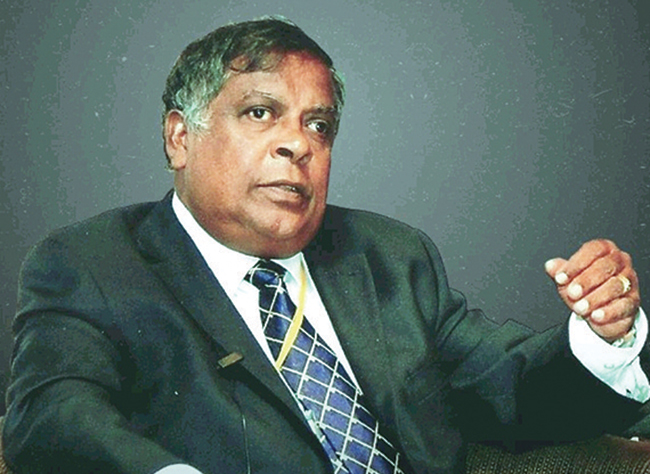
Mr. Tuli Cooray, former Deputy Director General of the Board of Investment of Sri Lanka (BOI) and former Secretary General of the Joint Apparel Association Forum (JAAF), passed away three months ago, leaving a distinguished legacy of public service and dedication to national economic development.
An alumnus of the University of Colombo, Mr. Cooray graduated with a Special Degree in Economics. He began his career as a Planning Officer at the Ministry of Plan Implementation and later served as an Assistant Director in the Ministry of Finance (Planning Division).
He subsequently joined the Greater Colombo Economic Commission (GCEC), where he rose from Manager to Senior Manager and later Director. During this period, he also served at the Treasury as an Assistant Director. With the transformation of the GCEC into the BOI, he was appointed Executive Director of the Investment Department and later elevated to the position of Deputy Director General.
In recognition of his vast experience and expertise, he was appointed Director General of the Budget Implementation and Policy Coordination Division at the Ministry of Finance and Planning. Following his retirement from government service, he continued to contribute to the national economy through his work with JAAF.
Mr. Cooray was widely respected as a seasoned professional with exceptional expertise in attracting foreign direct investment (FDI) and facilitating investor relations. His commitment, leadership, and humane qualities earned him the admiration and affection of colleagues across institutions.
He was also one of the pioneers of the BOI Past Officers’ Association, and his passing is deeply felt by its members. His demise has created a void that is difficult to fill, particularly within the BOI, where his contributions remain invaluable.
Mr. Cooray will be remembered not only for his professional excellence but also for his integrity, humility, and the lasting impact he made on those who had the privilege of working with him.
The BOI Past Officers’ Association
jagathcds@gmail.com
“As a small and open country, Singapore will always be vulnerable to what happens around us. As Lee Kuan Yew used to say: “when elephants fight, the grass suffers, but when elephants make love, the grass also suffers“. Therefore, we must be aware of what is happening around us, and prepare ourselves for changes and surprises.” – Prime Minister Lee Hsien Loong, during the debate on the President’s Address in Singapore Parliament on 16 May, 2018, commenting on the uncertain external environment during the first Trump Administration.
“When elephants fight, it is the grass that suffers”
is a well-known African proverb commonly used in geopolitics to describe smaller nations caught in the crossfire of conflicts between major powers. At the 1981 Commonwealth conference, when Tanzanian President Julius Nyerere quoted this Swahili proverb, the Prime Minister Lee Kuan Yew famously retorted, “When elephants make love, the grass suffers, too”. In other words, not only when big powers (such as the US, Russia, EU, China or India) clash, the surrounding “grass” (smaller nations) get “trampled” or suffer collateral damage but even when big powers collaborate or enter into friendly agreements, small nations can still be disadvantaged through unintended consequences of those deals. Since then, Singaporean leaders have often quoted this proverb to highlight the broader reality for smaller states, during great power rivalry and from their alliances. They did this to underline the need to prepare Singapore for challenges stemming from the uncertain external environment and to maintain high resilience against global crises.
Like Singapore, as a small and open country, Sri Lanka too is always vulnerable to what happens around us. Hence, we must be alert to what is happening around us, and be ready not only to face challenges but to explore opportunities.
When Elephants Fight
To begin with, President Trump’s “Operation Epic Fury”.
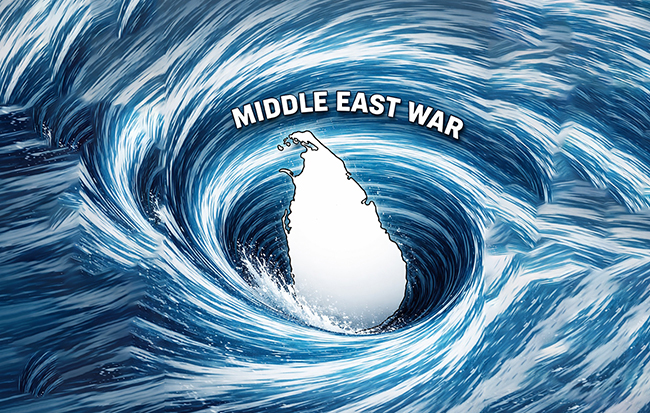
Did we prepare adequately for changes and surprises that could arise from the deteriorating situation in the Gulf region? For example, the impact the conflict has on the safety and welfare of Sri Lankans living in West Asia or on our petroleum and LNG imports. The situation in the Gulf remains fluid with potential for further escalation, with the possibility of a long-term conflict.
The region, which is the GCC, Iraq, Iran, Israel, Jordan, Syria and Azerbaijan (I believe exports to Azerbaijan are through Iran), accounts for slightly over $1 billion of our exports. The region is one of the most important markets for tea (US$546 million out of US$1,408 million in 2024. According to some estimates, this could even be higher). As we export mostly low-grown teas to these countries, the impact of the conflict on low-grown tea producers, who are mainly smallholders, would be extremely strong. Then there are other sectors like fruits and vegetables where the impact would be immediate, unless of course exporters manage to divert these perishable products to other markets. If the conflict continues for a few more weeks or months, managing these challenges will be a difficult task for the nation, not simply for the government. It is also necessary to remember the Russia – Ukraine war, now on to its fifth year, and its impact on Sri Lanka’s economy.
Mother of all bad timing
What is more unfortunate is that the Gulf conflict is occurring on top of an already intensifying global trade war. One observer called it the “mother of all bad timing”. The combination is deadly.
Early last year, when President Trump announced his intention to weaponise tariffs and use them as bargaining tools for his geopolitical goals, most observers anticipated that he would mainly use tariffs to limit imports from the countries with which the United States had large trade deficits: China, Mexico, Vietnam, the European Union, Japan and Canada. The main elephants, who export to the United States. But when reciprocal tariffs were declared on 2nd April, some of the highest reciprocal tariffs were on Saint Pierre and Miquelon (50%), a French territory off Canada with a population of 6000 people, and Lesotho (50%), one of the poorest countries in Southern Africa. Sri Lanka was hit with a 44% reciprocal tariff. In dollar terms, Sri Lanka’s goods trade deficit with the United States was very small (US$ 2.9 billion in 2025) when compared to those of China (US$ 295 billion in 2024) or Vietnam (US$ 123 billion in 2024).
Though the adverse impact of US additional ad valorem duty has substantially reduced due to the recent US Supreme Court decision on reciprocal tariffs, the turbulence in the US market would continue for the foreseeable future. The United States of America is the largest market for Sri Lanka and accounts for nearly 25% of our exports. Yet, Sri Lanka’s exports to the United States had remained almost stagnant (around the US $ 3 billion range) during the last ten years, due to the dilution of the competitive advantage of some of our main export products in that market. The continued instability in our largest market, where Sri Lanka is not very competitive, doesn’t bode well for Sri Lanka’s economy.
When Elephants Make Love
In rapidly shifting geopolitical environments, countries use proactive anticipatory diplomacy to minimise the adverse implications from possible disruptions and conflicts. Recently concluded Free Trade Agreement (FTA) negotiations between India and the EU (January 2026) and India and the UK (May 2025) are very good examples for such proactive diplomacy. These negotiations were formally launched in June 2007 and were on the back burner for many years. These were expedited as strategic responses to growing U.S. protectionism. Implementation of these agreements would commence during this year.
When negotiations for a free trade agreement between India and the European Union (which included the United Kingdom) were formally launched, anticipating far-reaching consequences of such an agreement on other developing countries, the Commonwealth Secretariat requested the University of Sussex to undertake a study on a possible implication of such an agreement on other low-income developing countries. The authors of that study had considered the impact of an EU–India Free Trade Agreement on the trade of excluded countries and had underlined, “The SAARC countries are, by a long way, the most vulnerable to negative impacts from the FTA. Their exports are more similar to India’s…. Bangladesh is most exposed in the EU market, followed by Pakistan and Sri Lanka.”
So, now these agreements are finalised; what will be the implications of these FTAs between India and the UK and the EU on Sri Lanka? According to available information, the FTA will be a game-changer for the Indian apparel exporters, as it would provide a nearly ten per cent tariff advantage to them. That would level the playing field for India, vis-à-vis their regional competitors. As a result, apparel exports from India to the UK and the EU are projected to increase significantly by 2030. As the sizes of the EU’s and the UK’s apparel markets are not going to expand proportionately, these growths need to come from the market shares of other main exporters like Sri Lanka.
So, “also, when elephants make love, the grass suffers.”
Impact on Sri Lanka
As a small, export dependent country with limited product and market diversification, Sri Lanka will always be vulnerable to what happens in our main markets. Therefore, we must be aware of what is happening in those markets, and prepare ourselves to face the challenges proactively. Today, amid intense geopolitical conflicts, tensions and tariff shifts, countries adopt high agility and strategic planning. If we look at what our neighbours have been doing in London, Brussels and Tokyo, we can learn some lessons on how to navigate through these turbulences.
(The writer is a retired public servant and can be reached at senadhiragomi@gmail.com)
by Gomi Senadhira
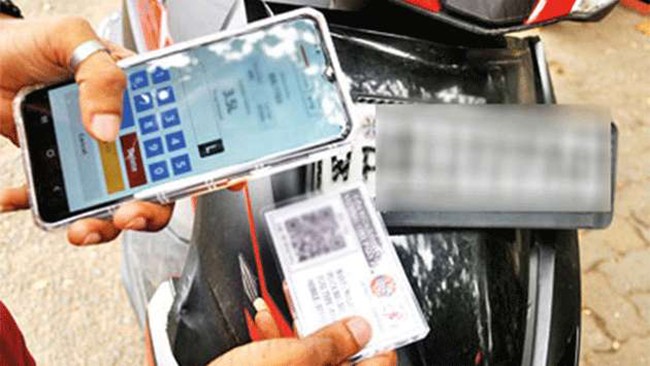
The introduction of the QR code–based fuel quota system can be seen as a timely and necessary measure, implemented as part of broader austerity efforts to manage limited fuel resources. In the face of ongoing global fuel instability and economic challenges, such a system is aimed at ensuring equitable distribution and preventing excessive consumption. While it is undeniable that this policy may disrupt the daily routines of certain segments of the population, it is important for citizens to recognize the larger national interest at stake and cooperate with these temporary measures until stability returns to the global fuel market.
At the same time, this initiative presents an important opportunity for the Government to address long-standing gaps in regulatory enforcement. In particular, the implementation of the QR code system could have been strategically linked to the issuance of valid revenue licenses for vehicles. Restricting QR code access only to vehicles that are properly registered and have paid their revenue dues would have helped strengthen compliance and improve state revenue collection.
Available data from the relevant authorities indicate that a significant number of vehicles—especially three-wheelers and motorcycles—continue to operate without valid revenue licences. This represents a substantial loss of income to the State and highlights a weakness in enforcement mechanisms. By integrating the fuel quota system with revenue license verification, the government could have effectively encouraged vehicle owners to regularise their documentation while simultaneously improving fiscal discipline.
In summary, while the QR code fuel system is a commendable step toward managing scarce resources, aligning it with existing regulatory requirements would have amplified its benefits. Such an approach would not only support fuel conservation but also enhance government revenue and promote greater accountability among vehicle owners.
Sariputhra
Colombo 05

Electricity tariffs to be increased from 1st April

A QR code system to be introduced for agricultural lands and other sectors requiring fuel

Rickelton, Rohit, Shardul break Mumbai’s first-game jinx

Oil tops $116 a barrel as Iran accuses US of preparing invasion

Iranian attack damages Kuwait power and desalination plant, kills worker

Warm weather conditions prevailing over the island are expected to continue

‘Dates have the highest sugar content to fight Coronavirus’

Sunday Island 27 December – Headlines

#SundayIsland 17th December – Headlines

Sunday Island – 28th March

Sunday Island Headlines – 21 March

Sunday Island – 21st February – Headlines
-

 News6 days ago
Senior citizens above 70 years to receive March allowances on Thursday (26)
-

 Features3 days ago
A World Order in Crisis: War, Power, and Resistance
-

 News4 days ago
Energy Minister indicted on corruption charges ahead of no-faith motion against him
-

 News5 days ago
US dodges question on AKD’s claim SL denied permission for military aircraft to land
-

 Business5 days ago
Dialog Unveils Dialog Play Mini with Netflix and Apple TV
-

 News6 days ago
CEB Engineers warn public to be prepared for power cuts after New Year
-

 Sports4 days ago
SLC to hold EGM in April
-
 Business7 days ago
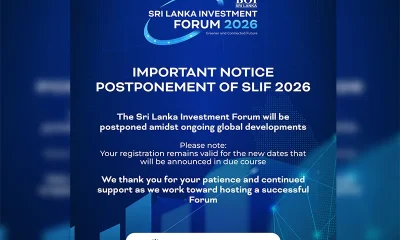
Postponement of Sri Lanka Investment Forum 2026