
News
Speaker to give MPs laptops

By Saman Indrajith
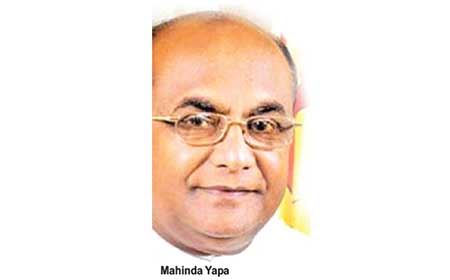
Parliament would explore the possibility of giving its members laptops, Speaker Mahinda Yapa Abeywardena said yesterday.
The Speaker said so when MPs complained that they could not take away the laptops that had been provided as they were fixed to their desks.
SJB Matara District MP Buddhika Pathirana raising a point of order said that various documents including annual reports and performance reports of ministries and statutory bodies were provided to MPs in Compact Discs. “These CDs are a waste of money. Years ago, these reports came in book format and kept on our tables.
Thereafter, a positive move was taken to replace books with CDs. As we know many MPs do not use them. They do not take those CDs with them. It could be seen that some of the CDs are now lying along the corridors here. That is not only a financial loss but an environmental hazard. Each MP has been given a laptop. These reports could be saved in those laptops. As per the past few days, CDs for more than 100 reports have been given to each MP. I propose that we should move on to a more modern system that would not cause environmental damage and save money.”
Environment Minister Mahinda Amaraweera: That proposal is a valuable suggestion. What the opposition MP said is true. Very few members make use of them. These are a problem for the environment. The MPs can access them through their laptops.
Speaker Mahinda Yapa Abeywardena: These reports are already in the laptops.
Minister Amaraweera: Therefore there is no need to distribute them in CDs.
SJB Colombo District MP S. M. Marikkar: We have to email these reports to another address and then take printouts. The problem is these laptops are fixed to the tables. We cannot take them away. If an MP is given a laptop the MPs should be able to take it away and use them. We cannot use this fixed laptop. Please make it possible for the MPs to use their laptops.
The Speaker: We’ll look into the matter and find a way to provide MPs with laptops.

… lead on Rs 13.2 bn NDB fraud
A sprawling fraud, involving the transfer of millions of dollars overseas under the guise of payments for non-existent imports, has been uncovered by law enforcement and customs authorities, Public Security Minister Ananda Wijepala told Parliament yesterday.
The Minister said investigations by the Central Crimes Investigation Bureau (CCIB), the Financial Crimes Investigation Division (FCID) and Sri Lanka Customs had revealed that large-scale foreign exchange transfers were being routed abroad through telegraphic transfer (TT) systems for goods that were never imported, contributing to significant dollar outflows from the country.
Wijepala said investigators were now working to identify political figures, state officials and banking sector employees, allegedly linked to the racket, adding that preliminary findings indicated the involvement of individuals across multiple institutional levels.
He told the House that provisions under the Prevention of Money Laundering Act, No. 5 of 2006 had earlier classified foreign exchange offences as predicate offences for money laundering,
but amendments under the Foreign Exchange Act, No. 12 of 2017 had removed such provisions, creating loopholes that were subsequently exploited for illicit capital flight. The government, he said, had now moved to amend the relevant legal framework.
The Minister outlined a series of parallel investigations that, he said, pointed to interconnected money laundering and narcotics-linked financial networks operating through shell companies and bank accounts.
In one major breakthrough, the Kelaniya Crime Division police conducting a random search in Peliyagoda discovered Rs. 30 million hidden in a three-wheeler. Two suspects were arrested and, following further interrogations, six more persons were taken into custody. Acting on initial suspicions of narcotics proceeds, the Inspector General of Police referred the case to the CCIB.
Subsequent investigations revealed that the cash had been intended for deposit into accounts linked to Next Gen (Pvt.) Ltd. The company was found to have transferred approximately Rs. 12,890 million abroad in 953 transactions to 256 companies across 26 countries, purportedly for imports that never materialised. The total outflow was estimated at USD 42.7 million.
Investigators further found that the company was controlled by a single director and shareholder and had no verifiable business activity. Authorities also established that funds linked to a recent Rs. 13 billion fraud, at NDB, had been routed into the same accounts.
Police have since frozen two accounts held at the People’s Bank’s Kolonnawa branch and Sampath Bank’s Wellampitiya branch.
In a separate incident, Negombo police arrested four suspects, on 15 February, 2026, in possession of heroin. Interrogations reportedly revealed that proceeds from narcotics sales were being channelled into a bank account, opened at a Divulapitiya branch of a Commercial Bank, allegedly linked to a Sri Lankan national, operating from Dubai.
According to investigators, the network involved deposits from drug dealers into the Divulapitiya account, with funds subsequently transferred to a Commercial Bank, Pettah branch account, belonging to AY Investments. The account reportedly held Rs. 2.2 billion after being opened on 09 September, 2024.
Authorities said withdrawals were made via cheques every two to three days and re-deposited into another AY Investments account at Union Bank’s Pettah branch. The company maintained four accounts at the branch, collectively holding around Rs. 13 billion.
Between 03 October, 2025, and 04 March, 2026, investigators said approximately USD 43 million had been transferred abroad from these accounts under the pretext of importing hardware, bathroom fittings and gold jewellery, none of which were brought into the country. A further Rs. 53.6 million balance has since been frozen as suspected proceeds of crime.
Investigators have also uncovered a wider pattern in which company directors allegedly establish import-export entities, operate them for short periods of around six months, and then dissolve or replace them with new entities. Customs officials have reportedly identified 105 local companies operating through 227 accounts in 13 banks, with funds transferred abroad in 26,108 instances between 01 January, 2023, and 30 September, 2025, for non-imported goods.
The racket is believed to involve 55 company directors and secretaries who allegedly function as facilitators in setting up and rotating such entities.
Officials noted that under existing procedures, banks are required to inform Sri Lanka Customs and the Central Bank within 180 days of TT transactions related to imports. Where goods are not received, Customs is expected to notify the Import and Export Controller and the Central Bank. However, investigators said these reporting mechanisms had not been properly followed, enabling systemic abuse.
Following the exposure of the racket, President Anura Kumara Dissanayake has summoned heads of relevant institutions for two high-level meetings, directing immediate action and comprehensive investigations.
Minister Wijepala said further inquiries were ongoing and assured that strict legal action would be taken against all perpetrators regardless of rank or position in the coming days.
By Saman Indrajith
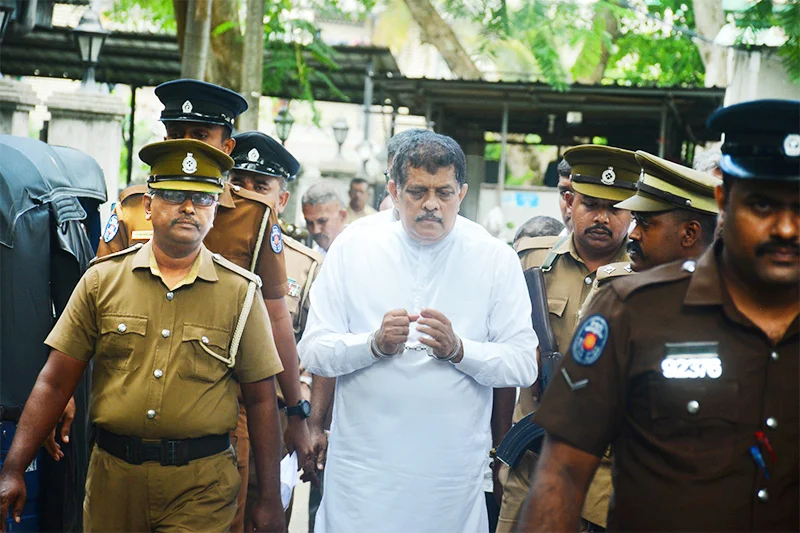
Colombo High Court Judge Mohamed Mihal yesterday (09) found former Deputy Minister Sarana Gunawardena (UPFA) guilty on four counts of corruption charges and was sentenced to four years of rigorous imprisonment for each count. Accordingly, the court ordered a total sentence of 16 years of rigorous imprisonment.
In addition, the court imposed a fine of Rs. 1.8 mn on the ex-MP in respect of the four cases.
The indictments were filed by the Commission to Investigate Allegations of Bribery or Corruption (CIABOC) under Section 70 of the Bribery Act of 1954, alleging the offence of corruption.
The prosecution alleged that, while serving as Chairman of the Development Lotteries Board in 2006, Gunawardena caused a loss to the State by procuring vehicles for the institution on a rental basis. Based on these allegations, CIABOC filed the four cases against him in 2022.
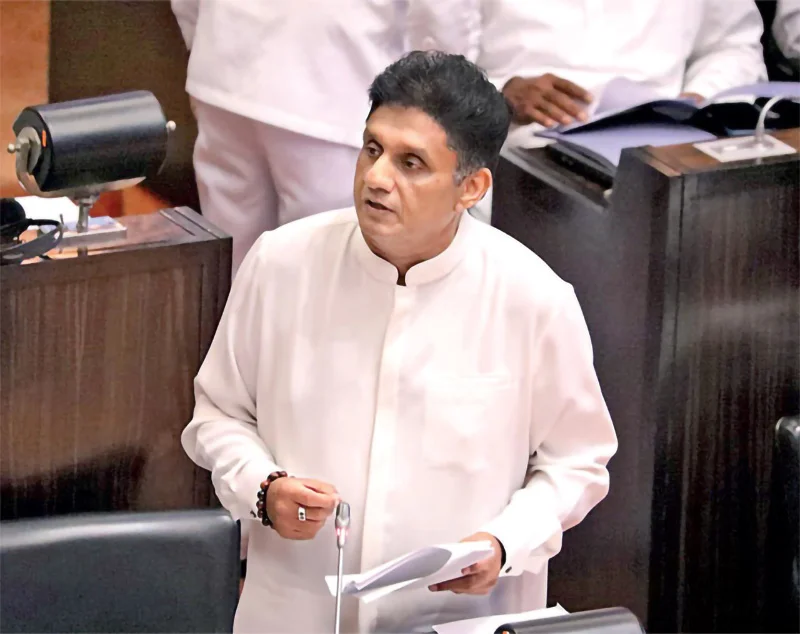
Opposition and SJB Leader Sajith Premadasa yesterday (09) called on the Government to immediately table in Parliament the Treasury report on the alleged USD 2.5 million financial loss.
Addressing the House, Premadasa said contradictory positions taken by the Central Bank and the Treasury had triggered what he described as a serious crisis in economic policy coherence, undermining the consistency required for effective fiscal and monetary management.
He warned that such divergences in official positions were weakening confidence at a time when both fiscal and monetary frameworks required clarity, coordination and predictability.
The Opposition Leader also urged the government to present a comprehensive policy framework on fiscal and monetary management, including the instruments in use, their respective targets, and the institutions tasked with implementation.
Premadasa further called for disclosure of the extent to which agreements with multilateral lenders and development partners, including the International Monetary Fund (IMF), World Bank and Asian Development Bank, have influenced domestic policy decisions, particularly in relation to primary balance and revenue targets.
Drawing attention to the cost-of-living burden, he questioned the Government’s claim that Rs. 17,000 was sufficient for an individual to meet monthly living expenses, asking whether such an amount could realistically cover both food and non-food requirements.
He also sought details of measures taken to alleviate economic pressure on the middle class, professionals, small and medium enterprises, farmers, fishermen and low-income groups, who, he said, continue to be affected by high taxation, expenditure constraints and elevated interest rates.
Premadasa stressed the need to strengthen parliamentary oversight and enhance public accountability in the formulation and implementation of fiscal and monetary policy.
by Saman Indrajith

Showers will occur at times in the Western, Sabaragamuwa and North-western provinces and in Galle, Matara, Kandy and Nuwara-Eliya districts

Local firms move millions of dollars overseas for phantom imports: Govt.

Corruption case: Sarana sentenced to 16 years RI

Sajith questions contradictory stands taken by Treasury and CB on USD 2.5 mn theft

Sallay’s wife appeals to Prez to cancel detention order

Corruption: A concept to be understood properly

‘Dates have the highest sugar content to fight Coronavirus’

Sunday Island 27 December – Headlines

#SundayIsland 17th December – Headlines

Sunday Island – 28th March

Sunday Island Headlines – 21 March

Sunday Island – 21st February – Headlines
-
 Latest News6 days ago
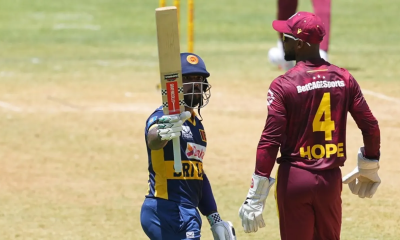
Kusal Mendis, Pathum Nissanka, bowlers put Sri Lanka 1-0 up
-
 News6 days ago
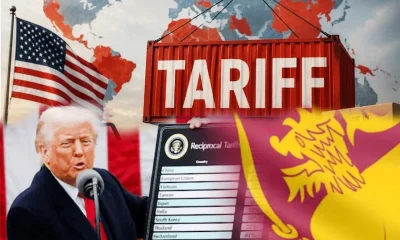
New US tariffs proposed on 60 countries, including Sri Lanka
-

 Features5 days ago
Power crept into the Sangha and is now tearing it apart
-

 Features5 days ago
Kondachchi wind farm and battery storage project to boost energy security, says Power Ministry Secretary
-

 Features5 days ago
Saudi Arabia sets new benchmark in Hajj management as 1.7 million pilgrims complete sacred journey
-

 News3 days ago
Women’s T20 World Cup 2026 warm-up: Chamari Athapaththu’s 94 helps Sri Lanka beat Pakistan
-

 News4 days ago
Asst. Manager, security officer arrested over Rs 30 mn snatch at Horana PB branch
-

 Editorial2 days ago
Probe Sallay’s complaint