
News
‘SLT board fired me from chairman’s post in mighty hurry’: Rohan Fernando


One of two dissenting govt. board members appointed new Chairman
by Sanath Nanayakkare
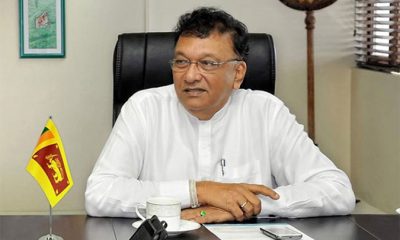
Rohan Fernando was removed from the post of Chairman of Sri Lanka Telecom yesterday. A few hours after his removal, Fernando called a press conference and said: “I called a meeting of the SLT Director Board at 9 am to discuss usual business. And then I was surprised at the proposal of a motion at the very outset, which was not on the agenda. A situation had arisen where the Malaysian investors of SLT or rather the investors of Global Telecommunications Holdings (GTH) wanted to replace me.
“What surprised me was that a few months ago when there were newspaper reports that SLT chairman would be replaced, those directors wrote a letter denying such a situation and went on to say that it was a decision to be taken by the government being the major shareholder of SLT, and the board of directors had said that they wouldn’t get involved in such a move. That is why I said I was surprised.”
“Clause 105 of the SLT statute says that Directors may appoint and remove the chairman of the board at their respective meetings and may determine the period for which he or she is to hold office. There are ambiguities in the clause though. When the vote came up, two directors who represent the government voted to support my expulsion, which was approved by the Board on a majority consensus.
Reyaz Mihular, a newly appointed director by the government was one of them who voted to expel me and he was appointed as new SLT chairman at the same meeting. SLT has ten directors. Six of them represent the government shares of SLT (about 51%) and other four represent the shares of GTH (about 49%) which has a Malaysian origin. So, when two directors from the government representation voted with the other party, the move was clearly passed. The appointments and the composition of the Board are made through the secretary of the Finance Ministry.
But the Ministry of Finance hadn’t initiated such a replacement move. That’s another reason that makes me surprised at this development. I see it as a boardroom manipulation because this could have been amicably settled through discussion. I thought I should clarify this matter in the interest of SLT and the people of the country. Still I am not sure whether the procedure to expel me was correct or not. I will seek legal advice regarding the matter. I have a letter from the appointing agent which is the Treasury Secretary, therefore, I will get it clarified from the Treasury also.”
“As chairman of SLT, I brought in four main principles to root out corruption, improve efficiency, minimise waste and encourage participatory administration. With these principles. We made a successful and progressive journey. Of course, the Board and the shareholders have a right to fire a chairperson if an organization is performing poorly. But SLT is performing well financially, so it arouses my curiosity how such a thing could have happened without manipulation.”
Fernando said that he had refused to take a salary from SLT and didn’t use a fleet of vehicles or take any house rents. I only accepted a director fee for attending the Board meetings. That is the only perk I had taken. This expulsion is not a loss for me but it came as a shock to me,” he said.
When The Island asked him whether the current Board would have wanted to take SLT in a new direction under a new leader, he replied “If that was the intention, it should have been spelled out at the meeting.”
SLT officially informed the Colombo Stock Exchange yesterday that in terms of the articles of association of the Company, Reyaz Mihular, Independent non-executive director had been appointed as the Non-Executive Chairman of the SLT Board with effect from 20 July, 2023, and Rohan Fernando would continue to be an independent non-executive director of the Board.
Rohan Fernnado was appointed by former president Gotabaya Rajapaksa in January 2020.








Latest News
Sun directly overhead Kokkuvil, Nallur, Kodikamam and Nagar Kovil at about 12.11 noon today (28)


The sun is going to be directly over the latitudes of Sri Lanka during 28th of August to 07th of September due to its apparent southward relative motion.
The nearest places of Sri Lanka over which the sun is overhead today (28) are Kokkuvil, Nallur, Kodikamam and Nagar Kovil about 12.11 noon.

Police to arrest and question four former ministers, others over links to Basik
By Norman Palihawadane
Police are investigating alleged links between suspected major drug trafficker Shiran Basik and a number of prominent politicians, with eight of them due to be arrested and questioned as investigators widen their probe into his financial dealings and network of associates, police headquarters, according to a senior police officer.
Among those set to face questioning include a sitting MP, four former ministers, and at least one of them is a female. Police are also investigating allegations that Basik provided large sums of money to politicians during election campaigns and extended other financial and material benefits to political figures.
Investigators are also looking into claims that two politicians were provided with facilities to construct houses and hotels, while efforts are under way to establish the extent of political support and assistance allegedly provided to Basik.
The Colombo Central Crime Investigation Bureau (CCIB) is expected to question the politicians based on information reportedly disclosed by Basik during interrogation. Two electoral organisers are also expected to be taken into custody as part of the ongoing investigation, according to police sources.
Meanwhile, statements are being recorded from managers and employees of several businesses allegedly linked to Basik, while investigators continue to examine information and records recovered from his mobile phone.
Basik, 48, was brought back to Sri Lanka on August 14 after being arrested in Dubai and deported. He was taken into custody by officers of the Criminal Investigation Department’s Airport Unit at Bandaranaike International Airport and subsequently handed over to the CCIB for further investigation.
Police initially obtained a 72-hour detention order to question Basik before securing approval to detain him for 90 days.
Basik, a resident of Dehiwala, is facing investigations over alleged large-scale drug trafficking as well as firearms, and unlawful assembly of weapons-related offences. Police are also examining whether he had any involvement in recent prison-related incidents and have said information has emerged linking him to the 2012 Welikada Prison riot.
The investigation has also expanded to Basik’s alleged assets and business interests in Sri Lanka and overseas.
Police have said information uncovered during questioning indicates that Basik had claimed ownership of five hotels along Colombo’s Marine Drive. Investigators have also identified two houses and two mobile phone shops in Boralesgamuwa allegedly linked to him.
A court has ordered a comprehensive examination of bank accounts linked to Basik, with the Financial Intelligence Unit of the Central Bank of Sri Lanka to conduct a review of his financial accounts. A separate investigation into his wealth and properties is being conducted by the Illegal Assets Investigation Division.
Investigators are also examining claims that Basik owns properties, including hotels and vehicles, in several European countries, as well as a high-value vehicle in Dubai. These claims remain subject to further investigation.
Basik had left Sri Lanka for Dubai in 2018, where police said he lived a lavish lifestyle while operating businesses. He was arrested by UAE authorities before being deported to Sri Lanka.
During initial questioning, Basik told investigators that Dubai police had stopped and searched him at a shopping mall and examined his mobile phone. He claimed that footage relating to Iranian missile and drone attacks was found on the device and that he was subsequently questioned over alleged links to Iran.
Police are continuing to examine the circumstances surrounding his arrest and deportation, as well as the information contained in his mobile phone and other evidence gathered during the investigation.
The ongoing probe is being conducted under the supervision of Senior DIG Ranmal Kodituwakku and SSP Kamal Ariyawansa.The allegations against Basik and the politicians named in connection with the investigation have not been established in court, and the investigations remain ongoing.

The Bar Association of Sri Lanka (BASL) has opposed the proposed “Twenty-Second Amendment to the Constitution”, saying it raises serious concerns over judicial independence and the rights and interests of the public.
In a statement signed by BASL President Rajeev Amarasuriya and Secretary Nalin De Silva, the association said it had challenged the constitutionality of the proposed amendment before the Supreme Court.
The BASL noted that the Chief Justice would be the first Supreme Court judge to benefit from the proposed amendment if it becomes law. It also referred to widespread speculation that the amendment was being expedited to facilitate an extension of the incumbent Chief Justice’s tenure, which is due to end on December 1, 2026.
Full text of the statement:
“The Bar Association of Sri Lanka (BASL) has taken a principled position opposing the Bill titled the “Twenty-Second Amendment to the Constitution” on the basis that it raises serious concerns regarding the independence of the Judiciary and the rights and interests of the people. Accordingly, the BASL has challenged the constitutionality of the proposed amendment before the Supreme Court.
“It is observed that it will be the Honourable Chief Justice who will be the first Judge of the Supreme Court who will benefit from the 22nd Amendment, if this Bill is enacted into Law.
There is widespread belief that this amendment is being rushed to facilitate the extension of the tenure of the Honourable Chief Justice which would otherwise complete on 1st December 2026. In this backdrop, in the recent past, we have witnessed allegations being made in Parliamentary Proceedings as well as on Social Media concerning the Judiciary including the incumbent Chief Justice.
“During this period, the BASL has also been subjected to unfounded attacks on social media and other platforms.
“The Judiciary, like every other institution exercising public power, must remain subject to legitimate scrutiny and accountability. Judgments, judicial conduct and the administration of justice may properly be subjected to fair, informed and responsible criticism. Where credible concerns or allegations arise regarding any member of the Judiciary, including the Chief Justice, they should be examined objectively and addressed through the appropriate constitutional and parliamentary processes which are in place, with due regard to fairness and due process.
“At the same time, everyone must exercise responsibility when making allegations concerning individual judges, lawyers and others. Personal attacks based upon unsubstantiated allegations can undermine public confidence in the administration of justice and affect the independence and integrity of the judicial process and the system of justice
“Judicial independence is not intended to shield any individual from legitimate scrutiny or accountability. It is a safeguard for the people, ensuring that disputes are determined impartially and that individual rights, the Rule of Law and the constitutional order are protected.
“The BASL therefore calls upon all organs of the State, all parties concerned and the media to respect the role of the Judiciary and the system of administration of justice, while ensuring that any genuine concerns are addressed fairly, responsibly and through the procedures established by the Constitution and the law.”

Sun directly overhead Kokkuvil, Nallur, Kodikamam and Nagar Kovil at about 12.11 noon today (28)

Showers above 75 mm are likely at some places in the Western and Sabaragamuwa provinces and in Kandy, Nuwara-Eliya, Galle and Matara districts

Eight politicians in drug kingpin probe

CJ first SC judge to benefit from 22A, if enacted: BASL

Over 84,000 people adversely affected by prevailing El Niño dry weather

Rooftop solar systems over 300kW to be temporarily switched off

‘Dates have the highest sugar content to fight Coronavirus’

Sunday Island 27 December – Headlines

#SundayIsland 17th December – Headlines

Sunday Island – 28th March

Sunday Island Headlines – 21 March

Sunday Island – 21st February – Headlines
-

 Business6 days ago
SriLankan Airlines makes ShakthiSAT Mission possible for talented Sri Lankan student
-

 Latest News7 days ago
Imran Khan moved to private hospital amid deteriorating health
-
 Features5 days ago
My secondary schooling after Royal Primary
-
 Features5 days ago
From the First to the 22nd: A short history of Amendment Politics and Reform Frustrations
-

 Latest News6 days ago
Tharanga edges out Chopra in 88m javelin battle
-

 News3 days ago
Missing doctor’s body found in Mahiyanganaya
-
 Features5 days ago
How Shelton Kodikara became first Professor of International Relations
-
 Features5 days ago
How St. John’s College Shaped Panadura for 150 Years