
News
SLRFS contributed towards strengthening bilateral relations between Sri Lanka and Russia


The Sri Lanka–Russia Friendship Society has a history that goes back to 1942 when it was established under the name Ceylon Friends of Soviet Union. During this period, the friendship society published a magazine named ‘Lankan–Soviet Magazine’.
The society was officially registered in 1959 as the Lanka-Soviet Friendship League, which has now evolved into what it is today, the Sri Lanka-Russia Friendship Society (SLRFS) after it was renamed in 1977. The SLRFS currently operates in Colombo with branches in Kandy, Galle and Nuwara Eliya.
With the assistance of Rossotrudnichestvo and the Association of Sri Lankan Graduates from Socialist Countries (ASLGSC), SLRFS publishes a Sinhala language quarterly magazine named ‘Rusiyawa’, which provides timely information on Russia to local readers.
Standing tall for many decades, the SLRFS has been a key contributor towards strengthening bilateral relations between Sri Lanka and Russia.
The All-Union Society for Cultural Relations (AUSCR) was created in April 1925. It was a difficult period for a newly emerged state that did not have international recognition and contacts with other countries. There was a need to tell the world about a completely new political system, to provide objective information that could dispel the myths that have arisen around the young Soviet power and provide support to foreign scientific and cultural intelligentsia.
The AUSCR aimed at “the establishment and development of scientific and cultural ties between institutions, NGOs and cultural figures of the USSR and abroad.”
Olga Kameneva, sister of Leo Trotsky and wife of the first head of the Soviet state Leo Kamenev, had become the chair of the organization. Prior to that, she led the Commission to Foreign Aid (CFA), which was created just over a year after the formation of the Soviet Union and became the prototype of the AUSCR.
Departments of science and technology, literature, studentship and language were represented in the new organization. Prominent figures such as poet Vladimir Mayakovsky, composers Sergei Prokofiev and Dmitri Shostakovich, writer Mikhail Sholokhov, and director Sergei Einstein contributed towards the work of AUSCR in the field of development of foreign relations.
On the part of foreign countries, physicists Albert Einstein and Marie Curie, writers Romain Rolland, Theodore Dreiser and Herbert Wells advocated the establishment of friendly relations with the Soviet authorities.
At the invitation of AUSCR, various delegations of foreign companies, as well as notable figures of science and culture like the French physicist Paul Langvin and writer Romain Rolland, Indian composer and public figure Rabindranath Tagore, Danish writer Martin Andersen Nexco, and many others visited the USSR.
AUSCR sent delegations and representatives of Soviet science and culture to foreign countries to participate in congresses and conferences; theatre troupes, music and dance ensembles; organized exchanges of literature and museum exhibits, etc. It was the AUSCR that first initiated the trips of Soviet citizens abroad.
Even during the war, AUSCR continued to work actively with the friendship societies in different countries. These organizations participated in the resistance movement, which was established in German-occupied territories. All-Union Society sought to unite prominent figures of the world of culture in the fight against Nazism.
Together with foreign friendship societies AUSCR raised awareness by distributing materials which voiced the deeds of the Soviet people in the struggle against the invaders and atrocities of the Nazis in the occupied territories.
With the assistance of Rossotrudnichestvo and the Association of Sri Lankan Graduates from Socialist Countries (ASLGSC), SLRFS publishes a Sinhala language quarterly magazine named “Rusiyawa” which provides timely information about Russia to local readers. The Sri Lanka-Russia Friendship Society has been a key contributor that has strengthened the bilateral relationship between Sri Lanka and Russia, standing tall for many decades.
The beginning of the cold war, emergence of the new political objectives demanded a new format of the AUSCR. In 1958, it was transformed into the Union of Soviet Friendship Societies (USFS). Soviet social and political activist Nina Popova became the first chairman of the newly formed body.
Thus, the society of friendship with Bulgaria was headed by an academician, aircraft designer, Andrei Tupolev, Association for Friendship with Italy by famous Soviet film director Sergei Gerasimov, one with Cuba – by Cosmonaut Yuri Gagarin, with Vietnam – cosmonaut German Titov. Cosmonaut Yuri Gagarin visited Ceylon on the invitation of then Prime Minister, Sirimavo Bandaranaike on December 7, 1961. Around 5,000 people gathered to welcome to first man to go to space.
During the visit, he planted a sapling at the Peradeniya Botanical Garden which still stands even after 50 years plus. Further, the current president of the Russia Sri Lanka Friendship Society is the famous cosmonaut of the country, Vladimir Lyakov, who was a Commander on Soyuz 32, Soyuz T-9, and Soyuz TM-6, and spent 333 days, 7 hours, 47 minutes in space.
Friendship societies united 25,000 enterprises, collective and state farms, educational, scientific and cultural institutions. Over 50 million people participated in the activities of the USFS. Each year, republican society alone held about 25,000 events dedicated to foreign countries.
With the collapse of the USSR in the early 1990s, USFS among other organizations underwent a transformation. It was turned into a Russian Association for International Organization (RAIC) in April 1992. Also, a Russian Agency for International Cooperation and Development (RAICD) was created to strengthen informational, cultural and scientific relations among Russia and other states through the system of representative offices and centres of science and culture based in foreign states. Later, following the government decree of April 8, 1994, functions of the RAICD were transferred to the Russian Centre for International Scientific and Cultural Cooperation under the Government of the Russian Federation (RusInterCentre).
For the first time in the history of the system AUSCR – USFS – RAICD – RusInterCentre the organization entered the structure of state agencies. The Heroine of the Soviet Union cosmonaut Valentina Tereshkova headed the newly created body.
Expansion of a structure that emerged after the collapse of the Soviet Union such as the CIS necessitated fresh approaches to building a new format of international relations, not only with foreign countries, but also with Russia’s closest neighbours. There was a need to create a special federal body, which would have full authority in the development of Russian cultural ties with foreign countries in general, CIS countries in particular.
The current head of Rossotrudnichestvo, Yevgeny Primakov was appointed Head of Rossotrudnichestvo by Decree of the President of the Russian Federation Vladimir Putin under Act No. 416 of June 25, 2020.
Modern Russia has huge potential for expansion of humanitarian contacts as well as for promotion of its culture and rich historical heritage abroad. Today, as many years ago, the need of formulating an objective vision of our country, debunking the myths about it and further expanding the circle of friends on both diplomatic level and among ordinary citizens, remain highly significant.
Anastasia Khokhlova,
Director, Russian Centre Colombo.


The Cabinet of Ministers approved the resolution forwarded by the Minister of Health and Mass Media to relocate the Deniyaya Base Hospital after constructing a new hospital with a capacity of 300 beds at an estimated cost of Rupees 6,000 million.
The Southern Provincial Department of Health has acquired a plot of land in Handford estate which is approximately 03 kilometres away from the town for this purpose.
News
Cabinet nod to legally empower methodology for implementing the ‘Praja Shakthi’ poverty alleviation national movement

The Cabinet of Ministers granted approval for the resolution furnished by the Minister of Rural Development, Social Security and Community Empowerment to instruct the Legal Draftsman to draft a bill to legally empower the implementation of ‘Praja Shakthi’ (Strength of the Community) poverty alleviation national movement
…preliminary work started on new Constitution
JVP General Secretary Tilvin Silva yesterday (17) maintained that the NPP government was not under Indian pressure to hold the long delayed Provincial Council elections.
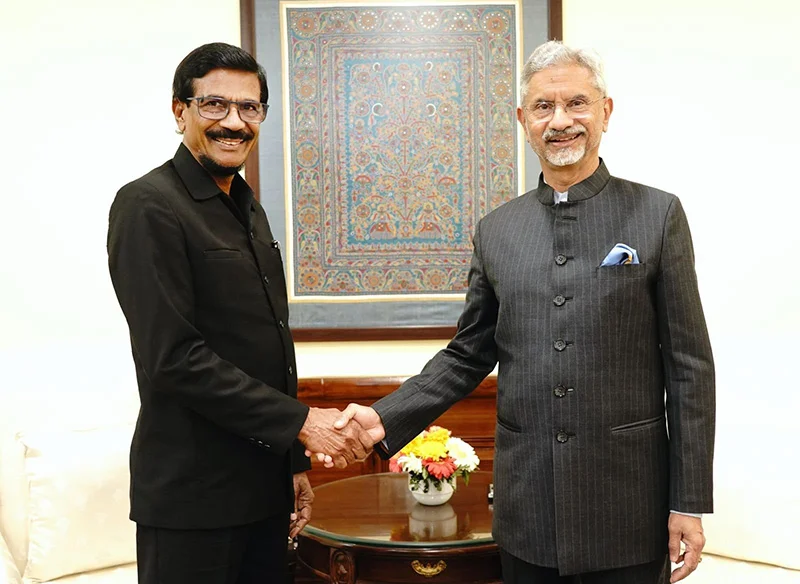
The top JVP official said so appearing on Sirasa Pathikada, anchored by Asoka Dias. Tilvin Silva said that neither the devolution nor terrorism issues had been discussed during his meeting with External Affairs Minister Dr. S. Jaishankar and Deputy National Security Advisor Pavan Kapoor, in New Delhi. This was Tilvin Silva’s first visit to India.
Declaring that politics hadn’t been on the agenda, the JVPer said that the Indian focus was entirely on economic development and technology.
The JVP General Secretary visited India under the Indian Council for Cultural Relations’ (ICCR) Distinguished Visitors Programme from 5-12 February 2026. General Secretary Silva was accompanied by Kitnan Selvaraj, MP, Ilankumaran Karunanathan, MP, JVP Central Committee Member Janaka Adhikari, JVP’s Media Unit Head Hemathilaka Gamage and Member of JVP’s International Relations Department Kalpana Madhubhashini. The delegation visited New Delhi, Ahmedabad and Thiruvananthapuram.
Responding to another query, Tilvin Silva said that Dr. S. Jaishankar had reiterated that India would always remain a true and trusted partner for Sri Lanka, in accordance with its ‘Neighbourhood First Policy’ and Vision ‘MAHASAGAR.’
Referring to the second JVP insurrection in the late 1980s, the JVPer claimed that they had not been against India but responded to the actions of the then Indian government.
Sri Lanka enacted the 13th Amendment to the Constitution in the wake of the Indo-Lanka peace accord of July 1987 to pave the way for Provincial Councils.
Tilvin Silva said that since they came to power, Indo-Sri Lanka relations had changed. “India has realised we could work together,” he said.
The JVP official said that preliminary work was underway, regarding the formulation of a new Constitution. The abolition of executive presidency and creation of an Office of President sans executive powers, too, would be addressed, he said, adding that the strengthening of the legislature was the other issue at hand.
Pointing out that the NPP had 2/3 majority in Parliament and could introduce a new Constitution on their own, Tilvin Silva said that they intended to obtain views of all and study the past processes in a bid to secure consensus. The JVP, as the party that campaigned against the introduction of executive presidency, way back in 1978, would lead the current effort to do away with the existing Constitution, he said.
Tilvin promised that they would implement what was in their manifesto.
The interviewer also raised the issue of abolishing the pensions for ex-Presidents. Tilvin Silva said that the Supreme Court, too, had approved the move to abolish pensions to ex-MPs. Therefore there was no issue with that, however, the ex-Presidents pensions couldn’t be done away with as they were made through the Constitution. That would be addressed when the government introduced a new Constitution in consultation with other stakeholders.
By Shamindra Ferdinando

India look to go into Super Eight stage with all-win record

Cabinet approves construction of new 300 bed Base Hospital in Deniyaya

Heavy showers about 100 mm are likely at some places in the Eastern, Uva and North-central provinces and in Matale and Nuwara-Eliya districts

Cabinet nod to legally empower methodology for implementing the ‘Praja Shakthi’ poverty alleviation national movement

NPP not under Indian pressure to hold PC polls – JVP

Battery storage drive to power Sri Lanka’s renewable leap

‘Dates have the highest sugar content to fight Coronavirus’

Sunday Island 27 December – Headlines

#SundayIsland 17th December – Headlines

Sunday Island – 28th March

Sunday Island Headlines – 21 March

Sunday Island – 21st February – Headlines
-

 Life style3 days ago
Marriot new GM Suranga
-

 Business2 days ago
Ministry of Brands to launch Sri Lanka’s first off-price retail destination
-

 Features3 days ago
Monks’ march, in America and Sri Lanka
-
 Opinion6 days ago
Will computers ever be intelligent?
-

 Features3 days ago
The Rise of Takaichi
-

 Features3 days ago
Wetlands of Sri Lanka:
-
 News3 days ago
Thailand to recruit 10,000 Lankans under new labour pact
-
 News3 days ago
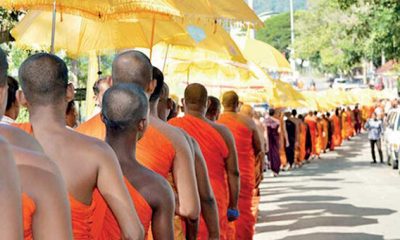
Massive Sangha confab to address alleged injustices against monks