
Business
SLIM and SLT Mobitel collaborate to empower agripreneurs and enhance national agri output

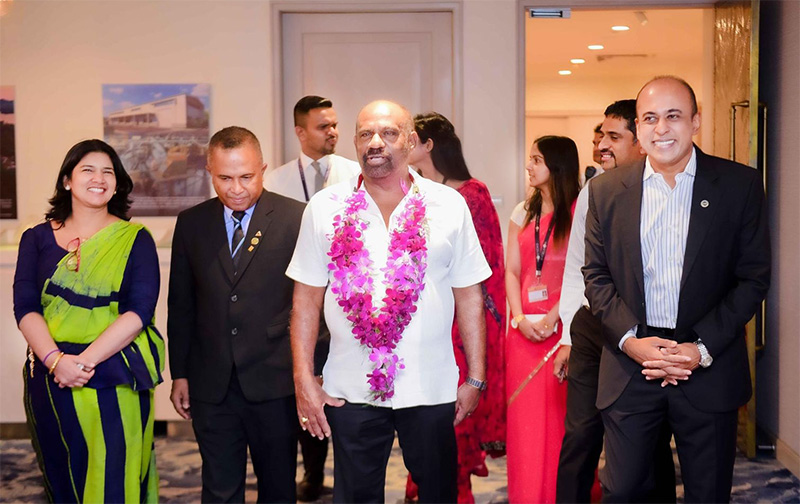
The Sri Lanka Institute of Marketing (SLIM) and SLT-Mobitel are proud to announce the successful commencement of the second phase of the “Agri Saviya” program, a pioneering initiative aimed at revolutionising the agricultural sector in Sri Lanka. The event at the Kandy City Centre (KCC) marked a significant step forward in leveraging technology to improve the quality and quantity of national agricultural output.
Delivering the welcome speech, Dr. Muditha Hewawanitunga, Project Chairman and Executive Committee member of the Sri Lanka Institute of Marketing (SLIM), commended the participants for choosing a career path as agripreneurs. “Your decision to embark on this journey is commendable, as agripreneurship is vital for the future of our nation’s agriculture,” said Dr. Hewawanitunga. He highlighted the importance of this collaboration with SLT-Mobitel, noting that it provides a robust platform to elevate the national agricultural output through the integration of advanced technology.
Charaka Perera, General Manager Marketing of Mobitel, elaborated on the initiative’s goal to bring various value additions to the business community. “Through this national initiative, we aim to enhance the business community with different value additions. Marketing, in particular, plays a crucial role in adding significant value to the customer,” said Perera. He also emphasised the role of digitalisation and various technological enablers in advancing the agricultural sector. “Digitalization and technological advancements are key to empowering the agricultural community and enhancing national output,” he added. Charaka Perera is also the Founder Chairman & Creator of ‘Agri Saviya’ National Initiative as well as a Board Member of Agripreneurs Forum
Sharing his views about this initiative, SLIM President Gayan Perera stated, “Our mission is to transform Sri Lanka’s agriculture by empowering agripreneurs with cutting-edge technology and innovative marketing strategies. Together, we can cultivate a thriving agricultural sector contributing to national prosperity.”
“By fostering collaboration and harnessing the power of technology, we can create a sustainable agricultural ecosystem that drives national growth and resilience,” emphasised Dr. Dilhan Sampath Jayatilleke, SLIM Vice President – Events and Sustainability Projects.
Ms. Indika Herath, Assistant General Manager (AGM) – Central Operations at SLIM added, “We initiated this program to specifically empower entrepreneurs in the agricultural sector. By providing them with the necessary knowledge and support, we aim to foster innovation and sustainability, which are crucial for the growth and resilience of our national agriculture.”
The Chief Guest, Thusitha Wijesena, (Kandy City Center) KCC Chairman, praised the efforts of SLIM and Mobitel in undertaking a national responsibility to elevate the profile of the agricultural community. “The dedication shown by SLIM and Mobitel in supporting our agripreneurs is truly commendable. This initiative not only enhances the agricultural sector but also strengthens the backbone of our economy,” stated Wijesena.


When we buy shark dry fish (Mora Karawala), do we really know what species we are consuming? What if endangered sharks are hiding in our meal? Most consumers are unaware.
In Sri Lanka, dried fish is more than food; it is a flavour, a tradition and a way of life. Affordable, long-lasting, and rich in taste, it has become a staple across the island, mainly in rural communities, the dry zone, and hill country. While most fish are eaten fresh, about 14% of the catch is preserved through age-old methods, such as salting, sun drying, smoking and fermentation. Whether served as a main dish (Karawala) or as a flavourful condiment (Umbalakada), dried fish has secured a special place on Sri Lankan plates.
Today, nearly two-thirds of the demand for dry fish is met locally, with dried sharks being the most common and popular in markets. And many people believe that milk sharks are particularly nutritious for lactating mothers.
Typically, part of the excess fish supply in peak seasons, fish arrive late from multiday fishing boats, fish from the bottom of nets, fish that are susceptible to quick spoilage or have low market appeal, are used to produce dry fish rather than letting this resource go to waste. In many coastal villages, drying fish is carried out at the fishing “waadi” (fishing villages/houses) level, often led by women as a means of earning supplementary income.
-

- Salting (not an elasmobranch
-
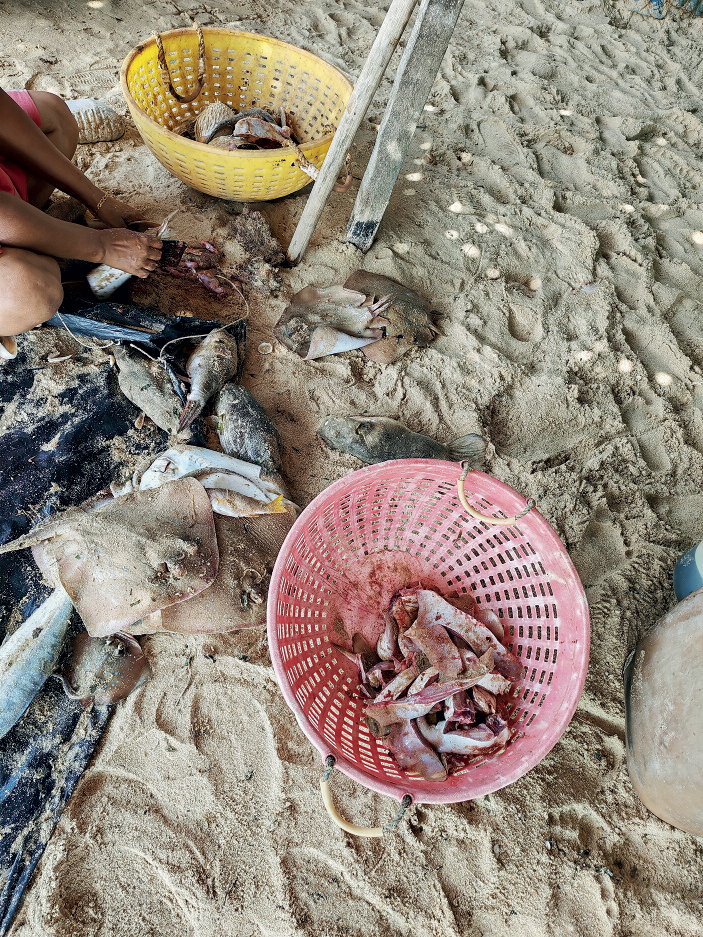
- Cutting rays into pieces prior to salting
But this comes with a cost. Sharks and Rays are slow-growing, late maturing and producing only a few young cannot keep up with rising demand. Sharks and Rays are captured by large-scale artisanal fisheries and often retained as bycatch. Mainly exploited for their meat and other derivatives, including gill plates, fins, and skins. Overfishing has pushed their populations into serious decline.
In Sri Lanka, over 60–70% of shark and ray species are threatened with extinction according to the IUCN Red List, with many others listed as Data Deficient — meaning their true status may be even worse. Only a handful of species might be considered less at risk, but even those assessments are uncertain.

Sun drying of ray meat

Once dried, it becomes nearly impossible to identify which species are being sold. Drying removes distinguishing features, making it impossible to verify the species or ensure sustainability. Labelling is virtually non-existent, and consumers have no reliable way to tell which species they are purchasing.
This means endangered sharks are likely ending up on plates across the country — without anyone realising it. Given the high proportion of threatened species and the lack of transparency, the safest and most responsible choice is to avoid all shark-based dried fish entirely.
By choosing alternative dried fish products made from more sustainable species, we can protect Sri Lanka’s marine biodiversity and ensure that our cultural traditions remain part of a future where sharks still swim in our oceans.
About the Author:
Apsara Rupasinghe, a zoologist with a BSc (Hons) Degree in Zoology, is pursuing MPhil research on shark and ray genetics at BRT-FiPo, with a background in conservation genetics and population genetics. Her work involves combining genetics and conservation to improve species identification and protect endangered elasmobranch species. Apsara pays special attention to the dry fish industry in Sri Lanka as part of her research.
by Apsara Rupasinghe
(Researcher, Fisheries and Policy Programme, Blue Resources Trust)

SPAR Sri Lanka marked a significant milestone with the opening of its 12th outlet—its first in the historic city of Kandy and only the second outside the Western Province. Established in 2018 as a joint venture between SPAR South Africa Group and Ceylon Biscuits Limited, SPAR Sri Lanka combines global expertise with strong local roots.
Speaking at the launch, CEO of SPAR Sri Lanka highlighted the cultural and commercial significance of Kandy, noting that the brand’s aim is “not just to open a store, but to serve the community in a meaningful and relevant way.”
The Kandy outlet offers over 6,200 products, with nearly 3,900 locally sourced, supporting farmers, producers, and SMEs, while the remaining range includes imported SPAR international brands. Innovative features such as a dedicated pet care section, TOPs liquor store, pharmacy, and banking facilities create a one-stop lifestyle destination.
SPAR Sri Lanka is also fostering youth employment and professional development, providing structured training programs to equip staff with globally recognised retail skills. The store has created over 50 jobs in the region and supports local suppliers in meeting international standards, opening doors for broader market access.
With its SPAR2U online platform and SPAR Rewards app, customers can enjoy convenience and value, while the company’s ecosystem approach supports retailers, suppliers, and communities alike. The brand’s next expansion is scheduled in Kurunegala, underscoring SPAR Sri Lanka’s vision of reshaping retail while uplifting local economies.
Text and Pic By S.K Samaranayake
Business
Sri Lanka Insurance Life Honoured at Great Managers Awards, Becoming First SOE to Achieve this Recognition


Sri Lanka Insurance Life (SLIC Life) was recognised at the prestigious ‘Great Managers Awards 2025’, held on 26th March 2026 at Cinnamon Grand, Colombo, marking a significant milestone as the first State-Owned Enterprise (SOE) to receive this recognition.
Organised by CLA Coaching in collaboration with the Colombo Leadership Academy, the awards recognise organisations and individuals who demonstrate excellence in leadership and managerial effectiveness, benchmarked against global best practices through a rigorous evaluation process.
Sri Lanka Insurance Life was recognised under the category of ‘Companies with Great Managers’, reflecting its commitment to nurturing leadership talent and building a culture that supports sustainable performance and people development.
Several SLIC Life team members were also honoured across multiple categories, highlighting the depth of leadership within the organisation. Duminda Pieris, Assistant General Manager/Zonal Head, was recognised for Driving Results and Execution Excellence, while Chaminda Athauda, Deputy General Manager – Life, received recognition for Aligning Organisational Vision. Jagath Welgama, Deputy General Manager – National Sales, and Manjula Darmaprema Branch Manager – Pilimathalawa were acknowledged for Building Team Effectiveness and Collaboration. Amali Gomez, Manager – Corporate & Marketing Communications, was recognised for Integrality and Holistic Approach. Ruchira Edirisinghe, Brand Manager, and Uththara Kapugamage, Manager – Employee Engagement, were both recognised as Great Millennial Managers.
Commenting on the achievement, Nalin Subasinghe Chief Executive Officer of Sri Lanka Insurance Life stated: “We are truly humbled and honoured to be recognised at the Great Managers Awards 2025, especially as the first State-Owned Enterprise to receive this accolade. This achievement is a testament to the strength, dedication, and professionalism of our team, who continue to demonstrate exceptional leadership across all levels of the organisation. We take great pride in this collective success.” He further added, “We also commend this initiative for its role in encouraging organisations to nurture and develop future leaders. Platforms such as these are vital in shaping strong leadership cultures that drive sustainable business success and industry-wide progress.”
This recognition underscores Sri Lanka Insurance Life’s ongoing commitment to developing its people, strengthening leadership capabilities, and fostering a high-performance culture that contributes to long-term organisational success.

Sameer Rizvi aces another tricky chase as Delhi Capitals floor Mumbai Indians

Sun directly overhead Dodanduwa, Rathgama, Yakkalamulla, Akuressa, Mulgirigala, Ranna, Kalamatiya and Ussangoda at about 12:13 noon today (05th April)

Showers expected in the Western, Sabaragamuwa, Central, Southern, Uva, Eastern and Northcentral provinces after 2.00 p.m.

Heat Index at Caution Level in the Western, Sabaragamuwa, Southern, Eastern, North-western, Northern and North-central provinces and in Monaragala district

Global ‘Walk for Peace’ to be held in Lanka

World Bank launches new 5-year partnership framework with Lanka

‘Dates have the highest sugar content to fight Coronavirus’

Sunday Island 27 December – Headlines

#SundayIsland 17th December – Headlines

Sunday Island – 28th March

Sunday Island Headlines – 21 March

Sunday Island – 21st February – Headlines
-

 News3 days ago
2025 GCE AL: 62% qualify for Uni entrance; results of 111 suspended
-

 News5 days ago
Tariff shock from 01 April as power costs climb across the board
-
 News6 days ago
Inquiry into female employee’s complaint: Retired HC Judge’s recommendations ignored
-
 Features6 days ago
New arithmetic of conflict: How the drone revolution is inverting economics of war
-

 Editorial3 days ago
Search for Easter Sunday terror mastermind
-
 Business4 days ago
Hour of reckoning comes for SL’s power sector
-

 Sports6 days ago
Sri Lanka’s 1996 World Cup heroes to play exhibition match in Kuala Lumpur
-

 Features5 days ago
Seychelles … here we come