
News
Serious shortage of medicine due to foreign currency crisis


Pharmaceutical Industry contradicts Health Ministry
In spite of repeated government denials, severe restrictions have hampered the entire range of imports, including medicine. A few days after Health Ministry denied unavailability of medicines in the market, Sri Lanka Chamber of the Pharmaceutical Industry said that there was a shortage due to the deteriorating foreign currency crisis.
In a statement issued on Thursday (13), the outfit while declaring that it imported approximately 80 percent of medicine into the country said that the public raised two issues. They are; ‘will there be a scarcity of medicines in the near future in the country and if so, should they be stocking up their regular medications? and will the price of medicines go up in conjunction with all the other products in the market?’
The grouping warned the industry faced collapse as it couldn’t go on due to the continuing depreciation of Sri Lanka Rupee against the USD. It reminded the government that it was the only importer subjected to price control.
The following is the text of the statement issued by the apex body: “At least some sections of the public must be aware that there are shortages of some medicines even at present. This is due to many reasons but the foremost of these is the foreign currency crisis in the country which makes it difficult for banks to facilitate the payments through Letters of credit (LC’s). At present, banks, both state and private sector, allows the Pharma Importers to open LC’s only when they have sufficient dollars to safely guarantee payment for the imports. Although medicines are given certain priority, there are other items such as essential food items, Petroleum products, fertilizer etc., that have to be given priority as well by the Government. The result is that importing of medicines is now done on the availability of foreign currency and not on the needs of the country or its patients. In this situation, it is inevitable that there will be shortages of more and more medicines as the foreign exchange crisis deepens.
“As for stocking medicines in excess of usual treatment regime by patients, it is not advisable to do so for long periods since these products have to be stored under strict conditions specified by the manufacturers. It is doubtful whether such conditions can be maintained in an average household. In addition, bulk or panic buying by the affluent may deprive the less able segment of the population access to medicines they require for a healthy life.
“We as an industry will do our utmost to keep the supplies of medicines available uninterrupted, since we fully realize the implications of failing to do so. In this regard, we earnestly hope that the authorities concerned will give us priority in establishing LC’s on time.
“At the moment, medicines are the only commodity in the market that is under price control in Sri Lanka. This is making it nearly impossible for the companies to keep selling the medicines at the same price when the US Dollar continues to appreciate over time. On top of this, the global supply chain disruptions, increase in raw material costs and freight make it impossible to supply quality medicine as anyone would understand.
“It will be also catastrophic in the event if the dollar is allowed to float, which will mean that all medicines will have to be sold at a loss and as such, the entire industry will collapse in the face of such a threat where the importation would obviously stop as the cost of importation will be higher than the approved prices.
“There is no solution to this dilemma than removing the price control of medicines and implement a fair and equitable pricing mechanism which will link the price of medicines to the dollar, inflation and direct costs such as raw material, fuel and freight charges, which will make the importing and marketing of medicines viable. As difficult as it may sound, the authorities will have to choose between having medicines at a cost and not having medicines at all.
“We as an ethically responsible industry, have already sought the intervention of the courts in order to bring about a transparent pricing mechanism for Pharmaceuticals & Medical Devices that is fair to all. Such a mechanism may be the only salvation for the industry and the patients of the country and it is in the best interest of all concerned if the process is expedited by the authorities concerned by the government.
We would like to give a solemn undertaking to the public that we will do our utmost to see that the drug pricing is fair and equitable. The members of the SLCPI have an exceptional record of maintaining an uninterrupted supply of efficacious, safe & quality medicines at globally competitive prices over many decades while supporting the continuous medical education of the country.”


The Cabinet of Ministers approved the resolution forwarded by the Minister of Health and Mass Media to relocate the Deniyaya Base Hospital after constructing a new hospital with a capacity of 300 beds at an estimated cost of Rupees 6,000 million.
The Southern Provincial Department of Health has acquired a plot of land in Handford estate which is approximately 03 kilometres away from the town for this purpose.
News
Cabinet nod to legally empower methodology for implementing the ‘Praja Shakthi’ poverty alleviation national movement

The Cabinet of Ministers granted approval for the resolution furnished by the Minister of Rural Development, Social Security and Community Empowerment to instruct the Legal Draftsman to draft a bill to legally empower the implementation of ‘Praja Shakthi’ (Strength of the Community) poverty alleviation national movement
…preliminary work started on new Constitution
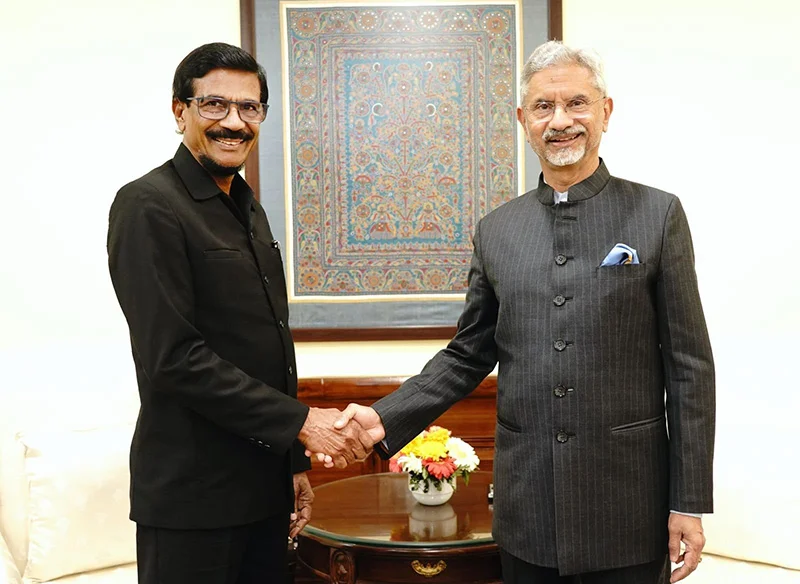
JVP General Secretary Tilvin Silva yesterday (17) maintained that the NPP government was not under Indian pressure to hold the long delayed Provincial Council elections.
The top JVP official said so appearing on Sirasa Pathikada, anchored by Asoka Dias. Tilvin Silva said that neither the devolution nor terrorism issues had been discussed during his meeting with External Affairs Minister Dr. S. Jaishankar and Deputy National Security Advisor Pavan Kapoor, in New Delhi. This was Tilvin Silva’s first visit to India.
Declaring that politics hadn’t been on the agenda, the JVPer said that the Indian focus was entirely on economic development and technology.
The JVP General Secretary visited India under the Indian Council for Cultural Relations’ (ICCR) Distinguished Visitors Programme from 5-12 February 2026. General Secretary Silva was accompanied by Kitnan Selvaraj, MP, Ilankumaran Karunanathan, MP, JVP Central Committee Member Janaka Adhikari, JVP’s Media Unit Head Hemathilaka Gamage and Member of JVP’s International Relations Department Kalpana Madhubhashini. The delegation visited New Delhi, Ahmedabad and Thiruvananthapuram.
Responding to another query, Tilvin Silva said that Dr. S. Jaishankar had reiterated that India would always remain a true and trusted partner for Sri Lanka, in accordance with its ‘Neighbourhood First Policy’ and Vision ‘MAHASAGAR.’
Referring to the second JVP insurrection in the late 1980s, the JVPer claimed that they had not been against India but responded to the actions of the then Indian government.
Sri Lanka enacted the 13th Amendment to the Constitution in the wake of the Indo-Lanka peace accord of July 1987 to pave the way for Provincial Councils.
Tilvin Silva said that since they came to power, Indo-Sri Lanka relations had changed. “India has realised we could work together,” he said.
The JVP official said that preliminary work was underway, regarding the formulation of a new Constitution. The abolition of executive presidency and creation of an Office of President sans executive powers, too, would be addressed, he said, adding that the strengthening of the legislature was the other issue at hand.
Pointing out that the NPP had 2/3 majority in Parliament and could introduce a new Constitution on their own, Tilvin Silva said that they intended to obtain views of all and study the past processes in a bid to secure consensus. The JVP, as the party that campaigned against the introduction of executive presidency, way back in 1978, would lead the current effort to do away with the existing Constitution, he said.
Tilvin promised that they would implement what was in their manifesto.
The interviewer also raised the issue of abolishing the pensions for ex-Presidents. Tilvin Silva said that the Supreme Court, too, had approved the move to abolish pensions to ex-MPs. Therefore there was no issue with that, however, the ex-Presidents pensions couldn’t be done away with as they were made through the Constitution. That would be addressed when the government introduced a new Constitution in consultation with other stakeholders.
By Shamindra Ferdinando

India look to go into Super Eight stage with all-win record

Cabinet approves construction of new 300 bed Base Hospital in Deniyaya

Heavy showers about 100 mm are likely at some places in the Eastern, Uva and North-central provinces and in Matale and Nuwara-Eliya districts

Cabinet nod to legally empower methodology for implementing the ‘Praja Shakthi’ poverty alleviation national movement

NPP not under Indian pressure to hold PC polls – JVP

Battery storage drive to power Sri Lanka’s renewable leap

‘Dates have the highest sugar content to fight Coronavirus’

Sunday Island 27 December – Headlines

#SundayIsland 17th December – Headlines

Sunday Island – 28th March

Sunday Island Headlines – 21 March

Sunday Island – 21st February – Headlines
-
 Life style3 days ago
Marriot new GM Suranga
-

 Business2 days ago
Ministry of Brands to launch Sri Lanka’s first off-price retail destination
-

 Features3 days ago
Monks’ march, in America and Sri Lanka
-
 Opinion6 days ago
Will computers ever be intelligent?
-
 Features3 days ago
The Rise of Takaichi
-

 Features3 days ago
Wetlands of Sri Lanka:
-
 News3 days ago
Thailand to recruit 10,000 Lankans under new labour pact
-
 News3 days ago
Massive Sangha confab to address alleged injustices against monks