
Latest News
Second wave of Lebanon device explosions kills 20 and wounds 450


At least 20 people have been killed and more than 450 wounded by a second wave of explosions from wireless communication devices in Lebanon, the country’s health ministry says.
Walkie-talkies used by the armed group Hezbollah blew up in the southern suburbs of the capital Beirut, the Bekaa Valley, and southern Lebanon – areas seen as its strongholds.
Some of the blasts took place during funerals for some of the 12 people who the ministry said were killed when Hezbollah members’ pagers exploded on Tuesday. Hezbollah blamed Israel for that attack. Israel has not commented.
The attacks came as Israel’s Defence Minister Yoav Gallant announced a “new phase in the war” and as an Israeli army division was redeployed to the north.
UN Secretary General António Guterres warned of the “serious risk of a dramatic escalation” and called on all parties to “exercise maximum restraint”.
“Obviously the logic of making all these devices explode is to do it as a pre-emptive strike before a major military operation,” he told reporters.
There were already rising fears of an all-out conflict after 11 months of cross-border fighting sparked by the war between Israel and Hamas in Gaza.
Hours after Wednesday’s explosions, Israel’s Prime Minister Benjamin Netanyahu vowed to return the tens of thousands of displaced people from the north of the country “securely to their homes”.
Defence Minister Yoav Gallant meanwhile said Israel was “opening a new phase in the war” and that the “centre of gravity is shifting to the north through the diversion of resources and forces”.
An army division recently engaged in Gaza has been redeployed to the north, the Israeli military confirmed.
Hezbollah says it is acting in support of Hamas – which is also backed by Iran and proscribed as a terrorist organisation by Israel and many Western countries – and will only stop its cross-border attacks once the fighting in Gaza ends.
An indication of what the group might be planning to do next could come on Thursday, when its powerful leader, Hassan Nasrallah, is due to give a speech.
Hezbollah’s media office on Wednesday announced the death of 13 of its fighters, including a 16-year-old boy, since the second wave of explosions.
It also said the group targeted Israeli forces near the border and in the Israeli-occupied Golan Heights during the day, firing rockets at Israeli artillery positions.
The Israeli military said about 30 projectiles crossed from Lebanon on Wednesday, sparking a fire but causing no injuries.
It said Israeli aircraft struck Hezbollah fighters in southern Lebanon.
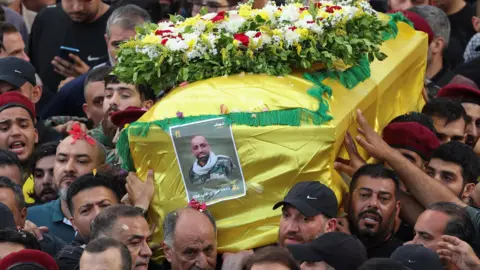
Wednesday’s deadly explosions represent another humiliation for Hezbollah and a possible indication that its entire communication network might have been infiltrated by Israel.
Many Lebanese are still shocked – and angered – by what happened on Tuesday, when thousands of pagers exploded at the same time, after people received a message they believed had come from the group.
Twelve people – including an eight-year-old girl and an 11-year-old boy – were killed and 2,800 others were wounded by the blasts, according to the Lebanese health minister.
A BBC team was at a funeral for four of those killed in the southern Beirut suburb of Dahiya on Wednesday when they heard a loud explosion around 17:00 local time (14:00 GMT).
There was chaos and confusion among the mourners, and then reports started to come in of explosions happening in other parts of the country as well.
One unconfirmed social media video showed a man falling to the ground following a small blast during what appeared to be a Hezbollah procession attended by large crowds.
The Lebanese Red Cross said more than 30 ambulances had responded to explosions in the capital’s southern suburbs, as well as in southern Lebanon and the Bekaa Valley.
The health ministry said the deadly explosions “targeted walkie-talkies”. A source close to Hezbollah also told AFP news agency that walkie-talkies used by its members had blown up.
Lebanon’s state-run National News Agency (NNA) said one man was killed when a walkie-talkie exploded inside a shop selling cellular devices in Chaat, in the northern Bekaa Valley.
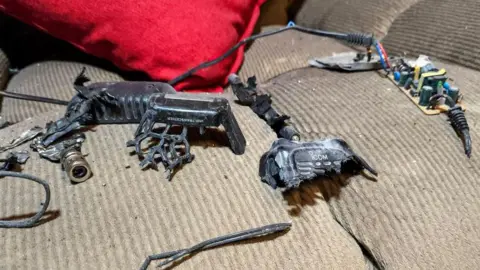
It identified the device as an ICOM-V82 handheld VHF radio, which is a now-discontinued model made by the Japan-based electronics manufacturer ICOM.
NNA said another ICOM-V82 exploded at a house on the outskirts of the nearby town of Baalbek. Video footage showed fire damage to a table and wall, as well as damaged parts of what appeared to be a walkie-talkie bearing the label “ICOM”.
Photos on social media from two other locations appeared to show the same model.
Reuters news agency cited a Lebanese security source as saying the walkie-talkies were purchased by Hezbollah five months ago – around the same time as the pagers were bought.
The Axios news website cited two sources as saying that Israeli intelligence services had booby-trapped thousands of walkie-talkies before delivering them to Hezbollah as part of the group’s war-time emergency communications system.
The BBC asked ICOM’s UK arm to comment on the reports, but it referred all media requests to the company’s press office in Japan. The BBC has reached out to ICOM Japan.
US and Lebanese sources told the New York Times and Reuters that Israel had planted small amounts of explosives inside the pagers which blew up on Tuesday.
An ophthalmologist at one hospital in Beirut told the BBC that at least 60% of the people he had seen had lost at least one eye, with most also losing a hand.
“Probably this is the worst day of my life as a physician. I believe the number of casualties and the type of damage that has been done is humongous,” Dr Elias Warrak said.
“Unfortunately, we were not able to save a lot of eyes, and unfortunately the damage is not limited to the eyes – some of them have damage in the brain in addition to any facial damage.”
(BBC)

Latest News
Sun directly overhead Dodanduwa, Rathgama, Yakkalamulla, Akuressa, Mulgirigala, Ranna, Kalamatiya and Ussangoda at about 12:13 noon today (05th April)

On the apparent northward relative motion of the sun, it is going to be directly over the latitudes of Sri Lanka during 05th to 15th of April in this year.
The nearest areas of Sri Lanka over which the sun is overhead today (05th) are Dodanduwa, Rathgama, Yakkalamulla, Akuressa, Mulgirigala, Ranna, Kalamatiya and Ussangoda at about 12:13 noon
Latest News
Heat Index at Caution Level in the Western, Sabaragamuwa, Southern, Eastern, North-western, Northern and North-central provinces and in Monaragala district

Warm Weather Advisory
Issued by the Natural Hazards Early Warning Centre
Issued at 3.30 p.m. on 04 April 2026, valid for 05 April 2026
The Heat index, the temperature felt on human body is likely to increase up to ‘Caution level’ at some places in the Western, Sabaragamuwa, Southern, Eastern, North-western, Northern and North-central provinces and in Monaragala district.
The Heat Index Forecast is calculated by using relative humidity and maximum temperature and this is the condition that is felt on your body. This is not the forecast of maximum temperature. It is generated by the Department of Meteorology for the next day period and prepared by using global numerical weather prediction model data.

Effect of the heat index on human body is mentioned in the above table and it is prepared on the advice of the Ministry of Health and Indigenous Medical Services.
ACTION REQUIRED
Job sites: Stay hydrated and takes breaks in the shade as often as possible.
Indoors: Check up on the elderly and the sick.
Vehicles: Never leave children unattended.
Outdoors: Limit strenuous outdoor activities, find shade and stay hydrated.
Dress: Wear lightweight and white or light-colored clothing.
Note:
In addition, please refer to advisories issued by the Disaster Preparedness & Response Division, Ministry of Health in this regard as well. For further clarifications please contact 011-7446491.

Iran has executed two men convicted of being members of the banned People’s Mojahedin Organization of Iran (PMOI/MEK) opposition group, in the latest action targeting dissidents, even as the United States – Israeli war on Iran drags on.
The two were executed on Saturday morning after the country’s Supreme Court upheld earlier sentences that convicted them of PMOI/MEK membership, and “armed rebellion through involvement in multiple terrorist acts”.
“Abolhassan Montazer and Vahid Baniamerian were hanged after trial and their sentences were upheld by the Supreme Court,” the Iranian judiciary website, Mizan Online, said on Saturday.
PMOI/MEK had initially supported the 1979 Islamic revolution that unseated the Iranian monarchy. However, in the 1980s, it fell out with the new leadership in Tehran and was designated a “terrorist” organisation. PMOI/MEK has since operated in exile.
Four other convicted members of the group were executed on March 30 and 31. According to information on the PMOI/MEK website, the men were: Mohammad Taghavi, Akbar Daneshvarkar, Babak Alipour and Pouya Ghobadi.
All six men were arrested and convicted by a Revolutionary Court in late 2024, according to PMOI/MEK.
The group condemned the executions in an April 2 statement, calling Tehran’s actions a “futile” attempt to suppress opposition.
“These brutal executions will not silence the opposition; instead, they will only intensify the resolve of Iran’s rebellious youth to overthrow the regime,” PMOI/MEK said.
Rights groups, too, have criticised the spate of hangings. Activists have long accused Iran of being the second most prolific executioner after China.
In a statement following the first set of hangings on March 31, Amnesty International accused Iranian authorities of torturing the men while they were held in prison and then abruptly transferring them to an unknown location shortly before their executions.
Amnesty further raised fears of more planned executions, including of protesters arrested during mass anti-government demonstrations in January, during which thousands were killed.
“It is unconscionable that even as the population is reeling from conflict and mass bereavement amid the ongoing aerial bombardment by Israel and the USA, the authorities of the Islamic Republic of Iran continue to weaponize the death penalty to eradicate dissenting voices and further terrify people,” said Diana Eltahawy, Amnesty International’s deputy regional director for the Middle East and North Africa.
Since the US and Israel’s war on Iran began on February 28, Tehran has executed several people, including Kouroush Keyvani, a dual Iranian-Swedish national convicted on charges of spying for Israel in a case that has drawn outrage from Stockholm and the European Union.
One man convicted of acting on behalf of Israel and the US during the protests was also executed on Thursday.
Earlier, on March 19, four people – Saleh Mohammadi, Mehdi Ghasemi, and Saeed Davoudi – arrested in connection with the uprising, were killed.
Amnesty warns that another five young protesters previously sentenced to death could soon be executed after they were moved from the Ghezel Hesar prison to an unidentified location this week.
[Aljazeera]

Sun directly overhead Dodanduwa, Rathgama, Yakkalamulla, Akuressa, Mulgirigala, Ranna, Kalamatiya and Ussangoda at about 12:13 noon today (05th April)

Showers expected in the Western, Sabaragamuwa, Central, Southern, Uva, Eastern and Northcentral provinces after 2.00 p.m.

Heat Index at Caution Level in the Western, Sabaragamuwa, Southern, Eastern, North-western, Northern and North-central provinces and in Monaragala district

Global ‘Walk for Peace’ to be held in Lanka

World Bank launches new 5-year partnership framework with Lanka

NASA’s Epic Flight, Trump’s Epic Fumble and Asian Dilemmas

‘Dates have the highest sugar content to fight Coronavirus’

Sunday Island 27 December – Headlines

#SundayIsland 17th December – Headlines

Sunday Island – 28th March

Sunday Island Headlines – 21 March

Sunday Island – 21st February – Headlines
-

 News3 days ago
2025 GCE AL: 62% qualify for Uni entrance; results of 111 suspended
-
 News5 days ago
Tariff shock from 01 April as power costs climb across the board
-
 News6 days ago
Inquiry into female employee’s complaint: Retired HC Judge’s recommendations ignored
-
 Features6 days ago
New arithmetic of conflict: How the drone revolution is inverting economics of war
-

 Editorial3 days ago
Search for Easter Sunday terror mastermind
-

 Business4 days ago
Hour of reckoning comes for SL’s power sector
-

 Sports6 days ago
Sri Lanka’s 1996 World Cup heroes to play exhibition match in Kuala Lumpur
-
 Features5 days ago
Seychelles … here we come