
Business
Sanjiv Hulugalle appointed CEO and General Manager of Cinnamon Life at City of Dreams Sri Lanka

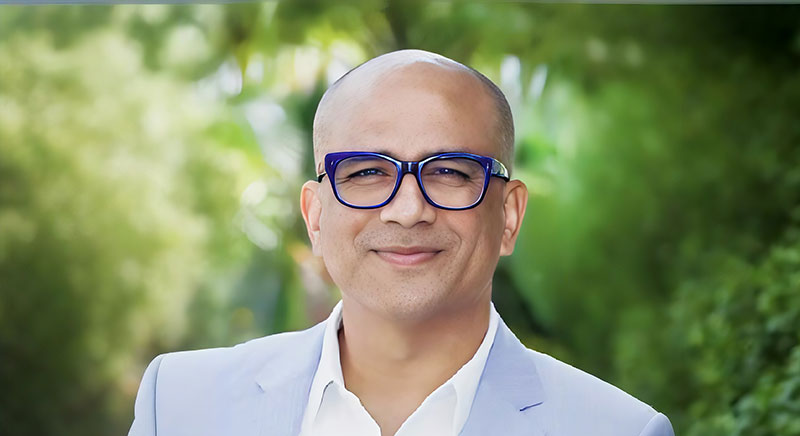
A Global Hospitality Visionary Returns Home to Lead Sri Lanka’s Most Ambitious Integrated Resort
Cinnamon Life announces the appointment of Sanjiv Hulugalle as the Chief Executive Officer and General Manager of Cinnamon Life at City of Dreams Sri Lanka, marking a pivotal moment in the evolution of Sri Lanka’s hospitality landscape.
With a career that spans over three decades and 12 countries across five continents, Hulugalle brings to Cinnamon Life an unparalleled legacy in luxury hospitality, real estate development, and transformative leadership. From the Maldives to Canada, China to the UAE, he has been at the helm of some of the world’s most prestigious hospitality and real estate ventures.
Previously the Group President of Hospitality & Real Estate at KOHLER Co., Hulugalle drove innovation and strategic growth across a diverse portfolio. At Auberge Resorts Collection, he led the ambitious repositioning of a $210 million development. His 24-year tenure with Four Seasons saw him lead top-tier teams and deliver award-winning results across the globe.
But this latest chapter is deeply personal.
Having been semi-retired, Hulugalle’s return to Sri Lanka was sparked not by circumstance, but by calling and purpose. “This is not just a role,” says Hulugalle. “It’s a way of giving back to the country that raised me—with its gracious hospitality, boundless warmth, and vibrant soul.”
“Sri Lankan hospitality is naturally gracious and kind,” he reflects. “It’s in our DNA. My mother would’ve wanted me to return and give back.”
Redefining Colombo as a City of Dreams
With Hulugalle at the helm, Cinnamon Life is set to emerge not just as a landmark development in Colombo—but as a destination, that captures the imagination of the world. Under his leadership, City of Dreams will embody the essence of modern Sri Lanka: rooted in culture, rich in character, and radiating with opportunity.
In addition to his work in hospitality, Hulugalle is also an active investor in AI-led technologies, residential real estate, and wellness-driven consumer brands, always seeking to blend strategic foresight with heartfelt service.


AFP –The International Monetary Fund’s (IMF) board approved two reviews of Sri Lanka’s loan programme, making USD695 million in additional loans immediately available to the island nation.
It is the latest tranche in the country’s four-year USD3 billion bailout, with the Fund warning of further risks due to the economic impact of the Middle East conflict.
Surging oil prices due to the conflict have heavily impacted many import-dependent Asian countries.
“Sri Lanka’s strong implementation under the EFF arrangement has continued despite challenging circumstances,” said the IMF’s Deputy Managing Director and Acting Chair Kenji Okamura.
“Gains from the economic reform programme helped preserve economic resilience and provided room to respond to cyclone Ditwah and the Middle East conflict. The latter, however, has significantly worsened Sri Lanka’s economic outlook and tilted risks to the downside.”
The IMF projects 2026 growth to slow to three per cent, with higher oil prices increasing inflation and weighing on the current account balance.
The board’s approval was contingent on Sri Lanka adjusting certain energy market subsidies issued in the wake of the conflict.
The statement said the Sri Lankan authorities had met the Fund’s requirements on fuel and electricity prices meeting cost-recovery criteria.
Criteria on ensuring no new external debts and on not imposing or intensifying import restrictions “were not observed”, however.
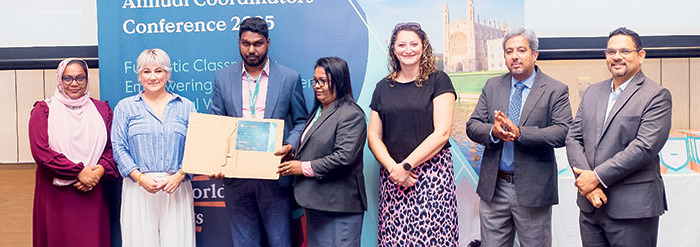
The Cambridge College of English Language Training recently held a certificate and medal awarding ceremony to recognize the academic achievements of students who successfully completed Cambridge English examinations.
The ceremony was held at the Hindu Cultural Hall in Kandy with the Vice Chancellor of the University of Peradeniya, Prof. W.M.T. Madhujith, attending as the Chief Guest, while Kandy Mayor Chandrasiri Wijenayake participated as the Guest of Honour.
Founded on March 1, 2024, by English tutor, author and Cambridge TKT lecturer T. Ravichandran, the institution has emerged as a leading centre for Cambridge English examination preparation in Kandy.
Beginning with an initial intake of 30 students, the college has expanded rapidly and currently serves more than 300 students.
The institution’s achievements were further recognized when it received the “Emerging Star Award 2025” at the Annual Coordinators Conference 2025 (South Asia).
The college provides training for students between the ages of seven and 18 across six stages of Cambridge English examinations, including Young Learners English (YLE) Starters, Movers and Flyers, as well as KET, PET and FCE examinations.
Cambridge English qualifications are internationally recognized and are designed to assess language proficiency in line with the Common European Framework of Reference for Languages (CEFR).
The ceremony concluded with the presentation of certificates and medals to students in recognition of their academic performance and commitment.
Text and Pic by SK Samaranayake
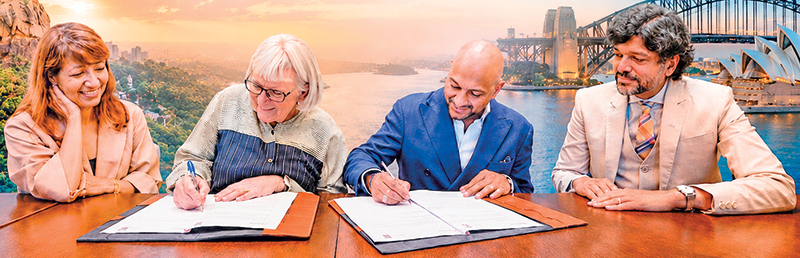
The Australian Broadcasting Corporation (ABC Australia) has signed a Memorandum of Understanding with Sri Lanka’s Maharaja Media Network (MMN), marking a significant expansion of media cooperation aimed at strengthening content exchange, co-productions and professional collaboration across the Indo-Pacific.
The agreement builds on an initial broadcast partnership established in 2022 and an expanded licensing arrangement in 2023, under which ABC programming was made available free-to-air to Sri Lankan audiences through MTV Channel (Private) Limited, part of the Capital Maharaja Group.
Under the new framework, the two organisations will collaborate across television, radio and digital platforms, with a focus on co-produced content, editorial exchange, training opportunities and joint storytelling initiatives.
MMN, Sri Lanka’s largest media network, operates across television, radio, digital media, music and film, including MTV Channel (Private) Limited and MBC Networks (Private) Limited.
Australian High Commission officials described the agreement as a deepening of regional media ties. “This will cover co-production, content sharing and broader cooperation across the Asia-Pacific in telling stories that speak to both countries,” said Matthew Duckworth.
ABC International Head Claire M. Gorman said the partnership reflected a shared commitment to public-interest media and stronger regional storytelling.
Capital Maharaja Group Director Chevaan Daniel said the relationship, which began during Sri Lanka’s economic crisis in 2022, had grown through continued collaboration, including during the 2025 Ditwah cyclone response.

Oscar-winning Star Wars editor Marcia Lucas dies aged 80

Hundreds arrested in France after wild Champions League celebrations

‘Disappointing’ – Sangakkara on Sam Curran turning out for Surrey with IPL still on

Truck carrying Afghan returnees from Pakistan flips on highway, killing 18

PSG beat Arsenal to win back-to-back Champions League titles after shootout

What Hegseth’s comments at Shangri-La Dialogue say about US foreign policy

‘Dates have the highest sugar content to fight Coronavirus’

Sunday Island 27 December – Headlines

#SundayIsland 17th December – Headlines

Sunday Island – 28th March

Sunday Island Headlines – 21 March

Sunday Island – 21st February – Headlines
-

 News6 days ago
Police probe underway to ascertain links between criminals deported from UAE and local politicians
-
 News5 days ago
Easter Sunday carnage: Court told Maulana’s statement cannot be accepted without cross-examination
-
 News1 day ago
IMF urges Lanka not to meddle with exchange rate
-
 News5 days ago
UK passport holder hiding here wants to have deportation order rescinded to leave without blemish
-
 Opinion5 days ago
Undermining the democratic political framework
-

 Features3 days ago
The Division Bell Mystery
-

 News6 days ago
Dickoya double murder suspect arrested
-
 Midweek Review4 days ago
Israeli-US aggression won’t go unanswered -Iranian Ambassador