
Business
Sampath Bank wins Euromoney and Asiamoney Awards for Corporate Social Responsibility

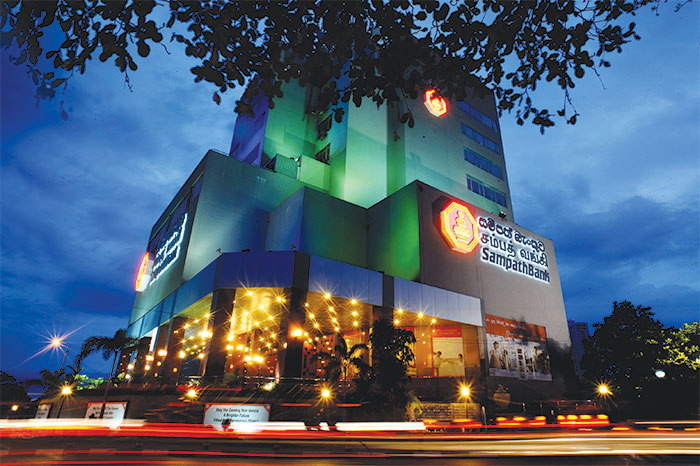
Sampath Bank was recently recognized as Sri Lanka’s best bank for social responsibility by Asiamoney and Market Leader CSR from Euromoney magazines. Both lauded Sampath Bank’s innovative approach and the impact of its successful social outreach programs, and wrote approvingly of how the Bank adapted to difficult circumstances. Euromoney Market Leaders makes an independent appraisal of the leading financial service providers across key banking categories in each market. The result of a rigorous assessment process, these rankings are part of Euromoney magazine’s awards programs that recognize financial institutions for their accomplishments and capabilities within a 12-month period against the backdrop of global events. In the confined world of international banking and finance, Euromoney and Asiamoney awards are the coin of the realm.
Both magazines noted in separate statements that as working capital dwindled during the coronavirus pandemic, Sampath supersized its ‘diriya’ loan scheme for small and medium-sized enterprises, prioritizing green lending. It also scaled up sustainable lending to help Sri Lanka reach one of its environmental objectives: to ensure that by 2030, 70% of the country’s energy will come from renewable sources. Sampath Bank helped support Sri Lanka’s import/export industry, prioritizing prudent management of its foreign currency position. The Bank acted pre-emptively to procure more foreign currency early in the year, and ensured uninterrupted inflows of essential foods and pharmaceuticals. Facing unprecedented, the Bank responded with out-of-the-box thinking and novel solutions. Heeding the Central Bank’s directive to reschedule existing non-performing loans of pandemic-affected businesses, Sampath Bank negotiated mutually acceptable repayment plans. It also distributed with fees for returned cheques, stopped cheques and late payments. When the second wave of the pandemic hit in 2021, Sampath Bank restructured some loans, offering customized deferment plans to help corporate customers ease out of their financial crunch.
Sampath Bank also expanded its ‘Waweta Jeewayak’ tank restoration initiative and its ‘Sampath Saviya’ entrepreneurship development program, and donated medical equipment to help state hospitals cope with COVID outbreaks. Both Euromoney and Asiamoney also commended Sampath Bank for strengthening its core business, noting that the Bank balanced growth, risks and costs: Net interest income rose 23.2% from the previous year and after-tax profit increased 55.2%. The Bank’s efforts to pare down operating costs paid off as well: its cost-to-income ratio dropped to 35.3% from the previous year’s 43.5%. The magazines credited much of Sampath Bank’s outstanding performance to its active monitoring of impairment risks and its efforts to absorb losses during a perfect storm of health, socioeconomic and political crises. “It is an impressive achievement,” they concluded.
“I was delighted to hear that both Euromoney and Asiamoney magazines recognized Sampath Bank as Sri Lanka’s Market Leader CSR and Best Bank for Corporate and Social Responsibility respectively,” said Nanda Fernando – Managing Director, Sampath Bank PLC. “Their editorial boards gave us these awards for our resilience in the face of seemingly intractable problems, and for the way we innovated our way through a very tough year. We are not over the problems of 2022, but we face the future with confidence.”
Sampath Bank is a 100% local bank that has deeply rooted itself in the lives of the people of Sri Lanka. Established in 1987, the bank has become a state-of-the-art financial institution that continues to be a market leader today thanks to its constant innovation and customer focused approach to business. It has introduced many firsts to the Sri Lankan banking sector including introducing ATMs to Sri Lanka, extended banking hours, slip-less banking and adaptation of block-chain technology to name a few. As part of its visionary 2022 approach, the bank is steadily transforming itself into a ‘tech company engaged in banking,’ from the traditional approach of a bank adopting technology.









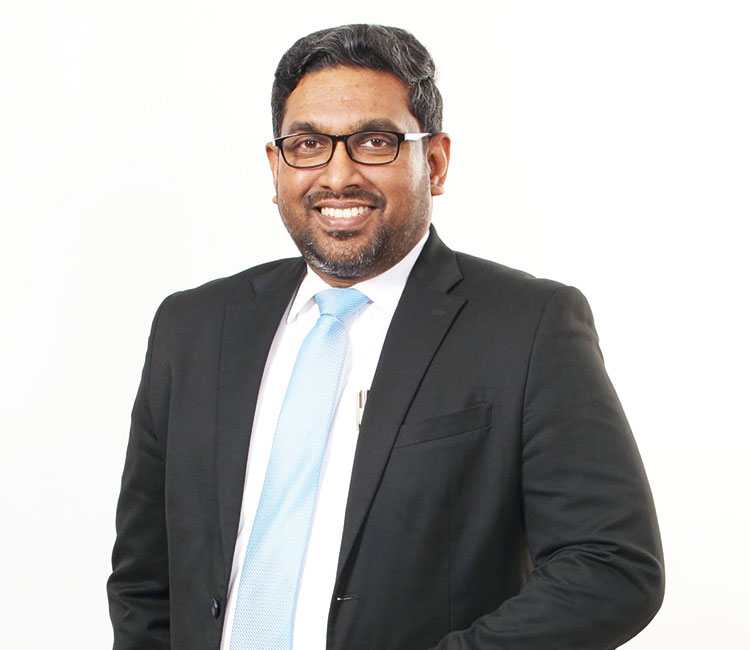
Sri Lanka Insurance Life (SLIC Life), the nation’s largest and strongest Life Insurer, is pleased to announce the appointment of Dr. Sameera Dharmasena as its new Chief Executive Officer, effective 22nd September 2026.
Dr. Dharmasena is a distinguished insurance professional with over 21 years of experience in the Sri Lankan insurance industry, having held senior leadership positions across several leading insurance companies affiliated with some of Sri Lanka’s largest business conglomerates. His extensive career spans both local and multinational insurance environments, bringing together broad industry expertise, strategic leadership and a strong commitment to the advancement of the insurance profession.

By Hiran H. Senewiratne
The CSE yesterday indicated mixed reactions as the oil price hike and other external and internal factors moved the All Share Price Index on a downward trajectory.
The All Share Price Index went down by 18.26 points, while the S and P SL20 declined by 1.19 points.
Turnover stood at Rs 1.3 billion with five crossings. Those crossings were: Pickme crossed 500,000 shares to the tune of Rs 77.5 million; its shares traded at Rs 155, Lanka IOC 542,000 shares crossed for Rs 70 million; its shares traded at Rs 130, Access Engineering 800,000 shares crossed to the tune of Rs 64 million; its shares traded at Rs 80, Dipped Products 1 million shares crossed to the tune of Rs 63 million; its shares sold at Rs 52 and Sampath Bank 450,000 shares crossed for Rs 63 million; its shares sold at Rs 140.
In the retail market companies that mainly contributed to the turnover were; Pickme Rs 134 million (854,000 shares traded), Cal Found Rs 110 million (8.5 million shares traded), Dipped Products Rs 109 million (1.8 million shares traded), Access Engineering Rs 80 (999,000 shares traded), Kotagala Plantations Rs 50 million (6.2 million shares traded), JKH Rs 44 million (2.3 million shares traded) and Sampath Bank Rs 28 million (199,000 shares traded). During the day 46 million share volumes changed hands in 10696 transactions.
It is said that transport sector related counters, especially Pickme, led the market. Further manufacturing sector counters, especially JKH and Dipped Products, also performed well. Banking sector counters, especially Sampath Bank, performed significantly.
Meanwhile, People’s Leasing & Finance announced that its debenture issue to raise up to Rs 10 billion was oversubscribed after receiving applications exceeding Rs 10 billion , closing the issue on September 23.
Colombo Dockyard disclosed share dealings by director-related entity Senthilverl Holdings, which purchased and sold 17,086 shares at Rs 119 and Rs 122 each, on September 22.
Yesterday the rupee was quoted at Rs 330.00/80 to the US dollar in the spot market from Rs 329.50/75 the previous day, while bond yields edged up slightly, dealers said.
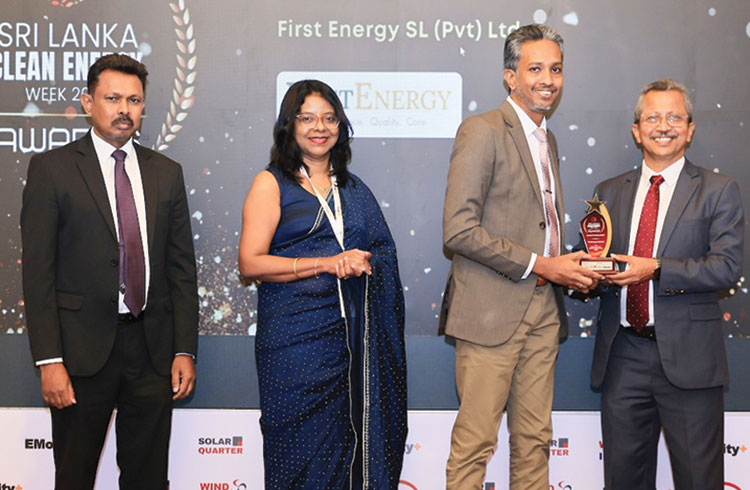
First Energy SL (Pvt) Ltd has won two awards at the Sri Lanka Clean Energy Week Leadership Awards 2026 for a building-integrated solar installation at the new People’s Bank head office in Colombo. The awards were presented on 21 August 2026 at Hotel Marino, Colombo, during Sri Lanka Clean Energy Week, an industry event organised by SolarQuarter.
The company received Project of the Year: Building-Integrated Solar (BIPV) and Technology Innovation of the Year: Building-Integrated Solar (BIPV). Both awards were made for the same project.
The installation sits at the top of the bank’s 24-storey head office, where solar modules form a waterproof architectural roof over a terrace more than 75 metres above street level. First Energy says it is the first system of its nature in Sri Lanka.
Conventional rooftop solar is mounted onto a finished building. In a building-integrated system the modules are the building element itself. Here the array takes the place of what would otherwise have been a solid pergola roof, and has to keep rain out as well as generate electricity.
The architectural design called for a pergola with a set spacing and a particular quality of filtered light on the terrace below. Standard solar modules are made in fixed sizes with minimum light passthrough, and none suited the design. The modules were therefore fully custom-made to the architectural requirements, featuring both custom dimensions and a reduced cell density, allowing part of the daylight to pass through to the terrace.

Are religions getting redundant in the modern world?

‘The Bullet that Missed’

Four arrested with 62,100 narcotic pills in Kotahena

Police probe abduction and sexual abuse of 13-year-old girl at Galle Face

National media guidelines for reporting on children ready

One dead, another missing in Kitulgala drowning

‘Dates have the highest sugar content to fight Coronavirus’

Sunday Island 27 December – Headlines

#SundayIsland 17th December – Headlines

Sunday Island – 28th March

Sunday Island Headlines – 21 March

Sunday Island – 21st February – Headlines
-

 News6 days ago
Shanakiyan urges urgent action over reported death sentence for Lankan in Saudi Arabia
-

 News7 days ago
Bid for Basil’s extradition nears final stage: Police
-

 News5 days ago
Namal Rajapaksa Buddhist gambit fails, bail denied
-

 Features5 days ago
Why the spelling Sri Lankan names in English vary
-

 Features5 days ago
Three bands, a new identity: Sri Lankan wolf snake recognised as distinct species
-
 Business5 days ago
SLIIT holds largest-ever convocation
-

 News5 days ago
Govt monitors reported Saudi death sentence – Foreign Ministry
-

 News5 days ago
Vehicle prices drop by up to Rs. 1 mn, says importers’ body