
Latest News
Rohit powers India into semis; Australia’s hopes take a hit


Rohit Sharma is the reason India are in the T20 World Cup 2024 semi-finals. He was sublime. But then again he has been for a long time, simply with his commitment to an attacking game at personal cost. It deserves credit but until now it’s come in intangible form. Perhaps in five days’ time, it will take the shape of an ICC trophy.
On a sunny morning in St Lucia, India’s captain scored 76 of his 92 runs in boundaries and left Australia with nowhere to hide. He even prompted them into mistakes. A total of 205 built on a series of broken records proved too much. It even offered insulation against Travis Head and that, in recent times, has been so rare it’s almost unheard of. Australia may yet make the final four, but they need Bangladesh to do them a favour and beat Afghanistan (by non-colossal margins) in St Vincent.
On November 19, he was supposed to lead his team to glory but instead walked away with tears in his eyes. On June 24, he had reason to believe all that hurt might rise up again when his opening partner and world-beating bestie Virat Kohli fell for a duck. Some might have taken a backward step. Rohit took Mitchell Starc for 29 runs in an over instead. He was 50 off 19 in the fifth over. The other end had contributed 2 off 13. India’s 52 was the lowest score at which an individual player had brought up a half-century in T20Is where ball-by-ball data is available. Rohit was not playing.
Australia, though, played right into Rohit’s hands. Starc, for example, kept going full. It’s his one job. Try to find swing. Try to break stumps. But at the Daren Sammy Stadium, that was the wrong length. Josh Hazlewood showed the way there. He pitched up only two times in his entire spell and those were yorkers. Every other ball was on a length or just short of it and he came away with figures of 1 for 14. Rohit was invited to play his front-foot shots 24 times and he scored 71 runs, including seven of his eight sixes and five of his seven fours.
Six of the 11 overs that Rohit was out there for went for double-digits. He was batting like he does in ODI cricket, when he’s 200 not out. Going down on one knee and slog sweeping Pat Cummins, who came into this game with back-to-back hat-tricks, for a six that thudded onto the roof of the stadium. Coming down the track like water flowing down a cliff – so devastatingly smooth – to smack Marcus Stoinis on the up over extra cover. Trying a version of the scoop but ending up with a version of the pull – new addition to the playlist. Bottom line was everything he was doing was working for him. Even a defensive push to cover had such an aura behind it that Australia ended up misfielding and giving up a second run.
India scored 10 fours and 10 sixes while Rohit was at the crease. After he fell, they could manage only nine combined. Starc deserves credit for that. He came back in the 12th over, shifted his angle around the wicket to deny Rohit the freedom of his arms, and although he still went full, this time he took pace off and that made enough of a difference. The bat couldn’t touch ball and the stumps lay broken. Starc’s slower delivery took out Suryakumar Yadav too, right in the middle of a masterclass of his own, scoring his runs in a way that don’t always make sense. Cummins, once again, was the unlucky recipient as a ball that was close to the wide line ended up with a home on the square-leg boundary.
India went 21 deliveries without a boundary between the 15th and 18th overs but they still managed a finishing kick as Hardik Pandya nailed three sixes in the final two overs to push the total past 200.
David Warner fell in the first over of the chase and now there is risk that his 6 off 6 might be his last international outing. Australia still had batters capable of dictating terms out there though. Mitchell Marsh took the wicket-taker Arshdeep Singh for two fours and a six in an over and Head did even better by hitting Jasprit Bumrah off the length he likes to bowl with the new ball. That made the India quick turn to plan B – yorkers – and under pressure even he missed one and bowled a full toss. Australia finished the powerplay at 65 for 1, five runs better than India. Marsh’s power game and Head’s incredible skill at clearing his front leg and somehow opening vast swathes of the outfield on both sides had flipped the script.
India needed something special and it arrived in the form of Axar Patel. He was a few yards off the fence at deep square leg, which seemed like an error considering it was Marsh on strike. The slog sweep flew off his bat. Flat. Hard. Destined to go for six. A support staff member was even ducking for cover fearing it would beat the fielder. But Axar didn’t let it. He leapt up, went for it with both hands, and got it with just his right. It was one of those that had to stick and it did. Every last one of his team-mates ran up to him to celebrate that wicket. Against the run of play, a partnership of 81 off 48 was broken.
Glenn Maxwell was busy negating the advantage India had thanks to the quality of their spinners. He saw that Ravindra Jadeja had no one on the boundary at third man and for that reason alone he went reverse sweep, which meant he was hitting with the turn, but against the wind, which when it was strong enough to basically carry Hardik away as he was running in to bowl, posed a significant problem. Maxwell’s wrists somehow overcame that. He was looking dangerous. Maybe enough to take on Kuldeep Yadav. So he charged at India’s wristspinner, and got bowled. That googly should be framed up on a wall somewhere. It messed with Maxwell on so many levels. It was slower than he wanted it to be. It was shorter than he needed it to be. It turned the exact opposite way. And it left his stumps a mess. The dip on that ball was everything.
India struck twice in the three overs that followed, one of which was Bumrah foxing Head with his offcutter. Needing 53 from the last 18, the best Australia could do was reduce the margin of defeat.
Brief scores:
India 205 for 5 in 20 overs (Rohit Sharma 92, Suryakumar Yadav 31, Shivam Dube 28, Hardik Pandya 27*; Mitchell Starc 2-45, Josh Hazlewood 1-14, Marcus Stoinis 2-56) beat Australia 181 for 7 in 20 overs (Travis Head 76, Mitchell Marsh 37, Glenn Maxwell 20; Arshdeep Singh 3-37, Jasprit Bumrah 1-29, Axar Patel 1-21, Kuldeep Yadav 2-24) by 24 runs
[Cricinfo]


Asif Khan the UAE batter, has been banned for 15 months after admitting to having tested positive for a banned substance – “a metabolite of mesterolone” – in an out-of-competition test conducted in September 2025, the ICC said in a statement on Thursday.
The statement said that Asif, 36, “had admitted the violation” of Article 2.1 of the ICC’s anti-doping code and accepted the period of ineligibility “pursuant to a case resolution agreement entered into with the World Anti-Doping Agency and the ICC”, which means there is no right to appeal on the part of the player.
The sanction is effective from September 8, 2025 and will run until December 7, 2026.
“Asif may return to training with a team or use the facilities of a club or other ICC Member organisation from 8 October 2026 but will only be eligible to play from 8 December,” the statement added. “The player’s individual results from 8 September 2025 until his provisional suspension on 29 December 2025 have been disqualified, along with all resulting consequences, including the loss of any medals, points, prize money or prizes.”
Asif, a former Pakistan Under-19 cricketer, made his UAE debut in March 2022 in an ODI against Oman in the ICC’s Cricket World Cup League 2. He turned out in 38 ODIs and 56 T20Is between then and September 2025.
The last three of those T20Is, against India, Oman and Pakistan in the T20 Asia Cup in 2025, came after September 8, and will be removed from his record.
[Cricinfo]

On Wednesday, part of a glacier collapsed high in the Himalayas, triggering catastrophic flooding along the Nepal-Tibet border.
At least 160 people have been confirmed dead, while nearly 1,500 people are missing across Nepal and China’s Tibet.
In Nepal, 826 people are missing, including almost 600 foreign tourists, according to police and tourism officials. Across the border, Chinese state media reported that 558 people were missing in Tibet’s Gyirong County, including 260 foreign nationals.
Here is what we know about what triggered the disaster, where the floods struck, and the risks facing the rapidly warming Himalayan region.
What happened in Nepal?
At about 8:40am local time (02:55 GMT) on Wednesday, flash floods and mudslides swept through mountainous areas along the Nepal-Tibet border, killing at least 157 people in Nepal and three in Tibet and leaving nearly 1,500 people missing across the region.
A huge flood of water, mud and rocks swept through the Lhende Khola river valley, engulfing villages and destroying homes and critical infrastructure. At least 19 bridges and about 40km (25 miles) of roads were washed away.
Nepalese soldiers and rescue teams have been deployed with helicopters, drones and search dogs, but high river levels, damaged roads and mud have complicated efforts to reach some of the worst-hit areas.
Across the border in Tibet, deep sediment has also delayed Chinese rescue teams trying to reach the border zone.
Officials were caught off-guard by the floods on Wednesday because it was not raining, according to local news editors
The disaster appears to have begun high in the Himalayas, where part of a glacier collapsed, triggering a chain of events that caused a powerful surge of water and debris downstream
Satellite imagery showed that a substantial section of the lower end of the glacier broke away at an elevation of about 5,200 metres (17,000 feet), plunging about 1,200 metres (3,900ft) onto the valley floor, gathering rock and sediment as it fell.
The resulting ice-rock avalanche struck the Lhende River in Tibet, about 20km (12 miles) northeast of the Nepal-China border crossing. Debris temporarily blocked the river before the natural dam gave way, releasing a powerful flood downstream.
Early reports suggested that a magnitude 4.4 earthquake had triggered the collapse. However, the United States Geological Survey (USGS) later revised its assessment, saying the seismic signal had been generated by the landslide itself rather than an earthquake.
The landslide eventually registered as a magnitude 5.2 seismic event.
Where exactly did the floods happen?
The disaster struck the mountainous Nepal-Tibet border region, with some of the worst damage in Nepal’s Rasuwa district, immediately south of the Chinese border.
The initial surge entered the Lhende Khola, which feeds into the Bhote Koshi and then the Trishuli River, carrying floodwaters south through Nepal. Water levels in the Trishuli reportedly rose by as much as 9 metres (27 ft) in just 30 minutes.
In the Rasuwa district, Timure and Syapru Besi were among the affected settlements. Further downstream, flooding reached parts of Nepal’s Nuwakot and Dhading districts, damaging homes, roads and other infrastructure.
Across the border in Tibet, mud and debris hit Gyirong Port in the Shigatse region.
The Trishuli eventually joins the Narayani River, which crosses into India’s Bihar state, where it is known as the Gandak River.
What do we know about the victims?
At least 160 people have been confirmed dead, while nearly 1,500 remain missing on both sides of the Nepal-Tibet border.
- Nepal: Police have recovered at least 157 bodies.
- Tibet: Authorities have reported at least three deaths in Gyirong County, where 558 people are missing, including 260 foreign nationals.
“My brother-in-law had a liquor store here. I got a call from him this morning, and they were crying and said their entire house had been swept away,” Raju Bhadel, a local businessman in Nepal, told Al Jazeera.
Manoj Mishra, a teacher, described seeing vehicles and people being carried away by the floodwaters in Nepal. “I saw around nine trucks being swept away by the floods, including people. It’s a heartbreaking incident,” he said.

Who is missing?
Nearly 1,500 people are missing across Nepal and Tibet, including at least 800 foreign nationals.
In Nepal, 826 people were reported missing, including almost 600 foreign tourists, according to police and tourism officials. The missing tourists come from more than two dozen countries.
Among those reported missing in Nepal are:
- India: 177
- United States: 63
- Australia: 34
- United Kingdom: 33
- Canada: 25
Authorities have not yet provided a complete nationality breakdown for all the missing foreign nationals.
Across the border, Chinese state broadcaster CCTV said 558 people were missing in Tibet’s Gyirong County, including 260 foreign nationals.
Many of those caught up in the disaster were pilgrims travelling towards Kailash Mansarovar in Tibet. Tourism officials are working to account for groups that had been travelling through the region when the floods struck.
The injured and rescued
At least 65 people were being treated for injuries in local hospitals and in Kathmandu.
More than 5,000 Nepalese army and police personnel have been mobilised for the rescue operation, while helicopters are searching for survivors and delivering emergency supplies to communities cut off by damaged roads and flooding.
Survivors from badly affected areas have also been evacuated by military helicopter, including some taken to hospitals in Kathmandu.
Countries and international organisations have offered emergency assistance, funding and technical support as rescue operations continue in Nepal and Tibet.
Humanitarian and financial aid
India has sent a rescue aircraft carrying about 10 tonnes of emergency supplies to Nepal, including temporary shelters, blankets, hygiene kits, solar lamps and medicines.
Indian Prime Minister Narendra Modi spoke with Nepalese Prime Minister Balendra Shah and pledged India’s support.
The International Federation of Red Cross and Red Crescent Societies (IFRC) has released 1 million Swiss francs ($1.2m) in emergency funding to support the Nepal Red Cross Society’s relief operations and damage assessments.
The United Nations has deployed personnel in Nepal to support government-led relief efforts, while its office in China has said it is ready to assist rescue operations in Tibet.
UN Secretary-General Antonio Guterres expressed his condolences to those affected and said the organisation stood in solidarity with communities hit by the disaster.
The European Union has activated its Copernicus Emergency Management Service, which uses satellite imagery to map disaster zones and provide information that can help authorities assess damage and coordinate rescue operations.
South Korea has established a government task force after several South Korean nationals working at a hydropower project were reported missing. Seoul said it planned to send a rapid-response team involving government, fire and police personnel to Nepal to assist with the search.
The United States said it was sending a disaster response adviser and providing $500,000 in assistance.
Canadian Prime Minister Mark Carney said Canada was closely following the situation, describing the floods as “absolutely devastating”.
On the Chinese side, President Xi Jinping ordered an “all-out” search-and-rescue operation for people missing in Tibet and called for efforts to prevent further disasters.
Scientists are still investigating what triggered the glacier collapse, and it is too early to determine how much climate change contributed to this specific event.
However, the disaster comes against a backdrop of rapid warming and glacial loss across the Himalayas. Glaciers across the Hindu Kush Himalaya mountain range – which spans Afghanistan, Bangladesh, Bhutan, China, India, Myanmar, Nepal and Pakistan – lost ice 65 percent faster between 2011 and 2020 than during the previous decade. Nepal’s glaciers have lost close to one-third of their ice volume in roughly three decades.
As glaciers retreat, mountain slopes can become increasingly unstable, and meltwater can accumulate in or around glaciers, increasing the potential for sudden floods.
Satellite observations showed unusually warm conditions around the affected glacier before the collapse, with snow cover diminishing considerably and exposing more bare ice.
Researchers are investigating whether melting contributed to the glacier’s instability, but a direct link between climate change and this week’s collapse has not been established.
What is the situation now?
More than 5,000 Nepalese army and police personnel are searching for survivors and recovering bodies, while helicopters are delivering tents, food and other emergency supplies to communities cut off by the floods.
Officials have warned that the death toll is likely to rise as rescuers reach areas that remain inaccessible because of damaged roads, high water levels and thick layers of mud.
In Tibet, Chinese authorities are also monitoring a still-dammed lake upstream from the disaster zone in Gyirong that could complicate rescue efforts and pose a further flood risk.
[Aljazeera]
Latest News
UPDATE: Flash flood on Nepal-Tibet border kills more than 100, with hundreds of tourists missing
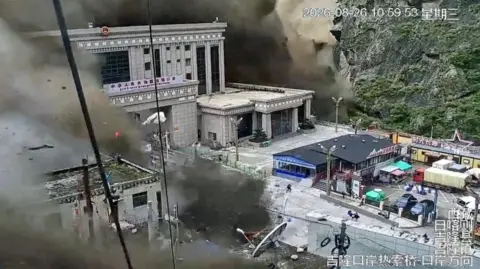
More than 100 people have been killed in Nepal and Tibet, and hundreds of tourists are missing, after a massive flash flood and mudslide
The missing tourists include more than 100 from India, 54 from the US, and 33 from the UK, as well as more than 100 from Nepal itself, according to Nepal’s tourist board. The area is popular with pilgrims and trekker.
Dozens of police officers and army prtxonnel are also missing, as well as power workers. My family was swept away in front of me, one woman tells us – she and her son survived by climbing to a rooftop
In Tibet, Chinese state media report three dead and 265 missing, CCTV from Tibet shows a wall of water and mud hitting buildings at a border crossing.
Authorities initially thought an earthquake may have triggered a landslide – the US Geological Survey now says the sesimic energy was instead generated by a landslide.
(BBC)

US golfer Gogel gets six-month ban for betting

UAE’s Asif Khan handed 15-month ban for using a banned substance

Nepal-Tibet floods: What happened, what caused them and who is missing?

Showers above 50 mm are likely in the Western, Sabaragamuwa and North-western provinces and in Kandy, Nuwara-Eliya, Galle and Matara districts

Patali alleges NPP conspiring to put off elections indefinitely

August 15 Super Dvora tragedy: Search continues for missing officer’s body

‘Dates have the highest sugar content to fight Coronavirus’

Sunday Island 27 December – Headlines

#SundayIsland 17th December – Headlines

Sunday Island – 28th March

Sunday Island Headlines – 21 March

Sunday Island – 21st February – Headlines
-

 News6 days ago
Country’s first woman Surveyor General appointed
-

 Business5 days ago
SriLankan Airlines makes ShakthiSAT Mission possible for talented Sri Lankan student
-

 Features6 days ago
Medical education in Sri Lanka: Then and now
-
 Latest News6 days ago
Imran Khan moved to private hospital amid deteriorating health
-

 Latest News6 days ago
Government has declared 21, 22 and 23 August 2026 as national days of mourning
-

 Features4 days ago
My secondary schooling after Royal Primary
-

 Latest News5 days ago
Tharanga edges out Chopra in 88m javelin battle
-

 News6 days ago
22A: Opp. demands all available SC judges hear petitions