
Features
Returning to Sri Lanka, becoming MD of Reckitt’s in SL at age 33 and then Chairman

(Excerpted from the memoirs of Lalith de Mel)
He returned to a Sri Lanka going through a difficult phase due to the JVP uprising. There were curfews and a sense of fear in the air. His predecessor in Sri Lanka had a young family and was glad to get away from the chaos that prevailed and left a few days before he returned.
There was the usual tension that prevails when a colleague becomes the boss. He left for Brazil as a colleague and returned as the boss. This was short-lived as it was not a complete surprise and they probably expected it to happen.
He had a very relaxed style. No ties, short-sleeved shirt to work, and coloured tunic top and sarong in the evenings (he still does this) and everyone was asked to call everyone including the MD by their first name. This was a big change. The foreign MDs wore a jacket and tie but took the jacket off when they got to their office. The immediate direct reports referred to the MD as ‘Mister’. No first names.
A difficult economic environment
During his entire period as Managing Director, there was a difficult external environment. The Trotskyis version of Marxists had joined Mrs. Bandaranaike’s Government and were destroying the economy. They pushed through land reform, a ceiling on housing, and the nationalization of the estates. It was done in a hurried and unplanned fashion and instead of leading to a resurgence in economic activity, it led to a collapse of the economy. Import licences for raw materials were restricted, leaving no room for new activities and expansion
Pharmaceuticals
Over the years he had developed a special affinity for pharmaceuticals. He worked closely with the UK Pharmaceutical division which provided support and guidance to the overseas businesses. He had regular technical discussions with them about creating promotional material for doctors and whenever there was a pharmaceutical conference anywhere in the Group he was invited to attend.
This letter from the UK Group Director responsible for Pharmaceuticals illustrates their respect for him as a pharmaceutical man.
“Your letter reference 349 of June 2 on the merits of Disprin in comparison with ordinary Aspirin has been the subject of close and detailed study by myself and my colleagues in the Pharmaceutical Division. I apologize for the length of time it has taken to reply to it but I can assure you that this is rather a mark of the seriousness with which the matter has been approached rather than of neglect.
“There is little doubt that your efforts in Sri Lanka with some assistance from the UK have succeeded in producing the best possible case for Disprin based on all available evidence. So effective is it, in fact, that the Pharmaceutical Division is itself adopting much of it incorporation in their own activity.”
This was the start of being recognized as very competent pharmaceutical man and from then on he worked with them as a member of the top pharmaceutical team whilst performing his various regional director roles. This eventually resulted in his appointment as the Group Director for Worldwide Pharmaceuticals.
The pharmaceutical industry was under attack. Prof Bibile had a plan that he fortunately could not implement. His plan did not make good sense. His plan to ban brand names completely was nonsensical. A person wanting a bottle of Dettol would have had to ask for Chloroxylenol solution. His concept of a limited formulary of drugs was shot down by the medical profession. When all this was floundering, his grand plan was to make the multinational pharmaceutical companies contract manufacturers for his State Pharmaceutical Corporation. They were summoned for a meeting chaired by Dr. N.M. Perera.
He was then Chairman of the Pharmaceutical Manufacturers Association. After consulting their respective parent companies, they had adopted a common position. Despite being harangued and threatened by Dr. N.M. Perera, the manufacturers flatly refused to manufacture for Prof. Bibile. Then Bill Williams, Managing Director of the Pfizer business, pointed out forcefully that if they were not paid full, fair, just and equitable compensation, the US Hickenlooper Amendment would kick in, which would prevent the USA providing aid in any form to Ceylon.
There was a stunned silence and then Dr. Perera proclaimed that the industry would be nationalized. Nothing happened thereafter. It was an end to the fanciful dreams of Prof Bibile, who then left our shores and died shortly thereafter.
The Marxists were kicked out of the Government but the economy continued to struggle. He continued what he had been doing before he went to Brazil, namely growing the brands, but he had to move out of the seat of driving brands as a Marketing Director.
However, he kept his finger on marketing as in those times it was very much a command and control culture. Managing Directors gave directives and management executed them. There was discussion and senior managers had the opportunity to express their views but there was no delegation of key decision-making.
An interesting diversion from the difficult business environment was the marketing of condoms. The International Planned Parenthood Federation in the UK wanted to experiment with mass marketing of condoms. They were available at that time all over the world, but only in pharmacies. To make an impact in terms of birth control, it was important to make them available through the retail network.
The IPPF had identified Ceylon as the market to test this concept. They had persuaded Anandatissa de Alwis who had an advertising agency to take on the advertising for this project. Ananda who was an old friend then approached him and wanted him to participate in developing the marketing concept and wanted Reckitt & Colman to handle the distribution. He (Lalith) was quite convinced that it was a good social marketing project but he had the daunting task of getting approval from the lords and masters in the UK.
So he wrote them a nice letter and was pleased that they were very positive and gave the OK to market condoms in Sri Lanka. Now they agonized over a name and the name eventually selected was Preethi. He returned home and told his wife that at long last they found a name and it was Preethi. She smiled and reminded him that it was her first name, and so he had said, “Now you’ll be famous, your name will be on every packet of condoms!”
The project was very successful. IPPF was very pleased. From then on condoms have been freely available in the retail network. He was very happy to have been a part of this campaign.
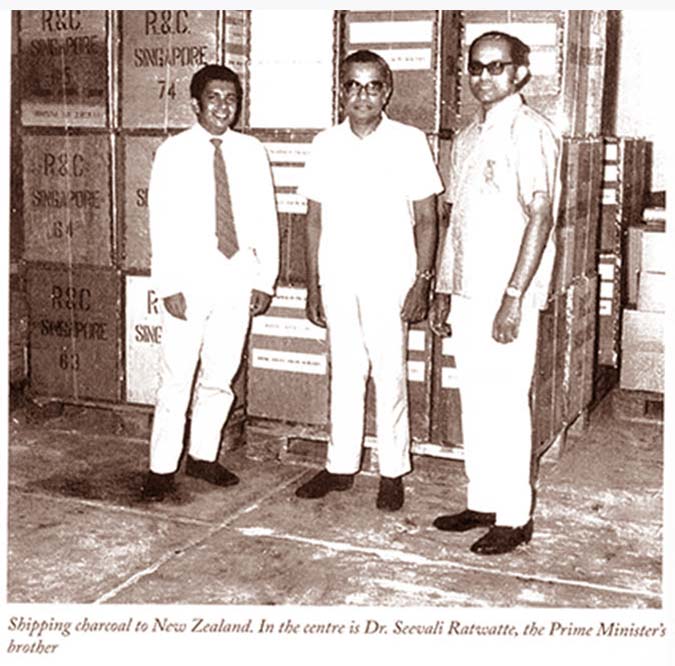
They were difficult times and they had to look for various innovative ideas to grow the business. One such project was to export charcoal for barbecues to New Zealand.
He was very keen to market bottled water but he could not convince Corporate HQ in UK that this was a feasible proposition. Looking at what has happened with bottled water, it was a tragedy that it was not implemented. During this time he played an active role with a few others to create the Sri Lanka Institute of Marketing (SLIM). He was the third President of SLIM.
Reckitt & Colman of Ceylon was a public company and when he was the Managing Director, the Chairman of the company was John West, who was the Chairman of Reckitt & Colman of India. He came four times a year for Board Meetings. But in 1975, it was decided that the Indian Chairman need not visit and Lalith was made the Chairman of the company. That was the first time a Sri Lankan was a Chairman of a multinational company in Sri Lanka. He reported to a Regional Director based in Corporate HQ, which by then had moved from Hull to London.
He visited the business from time to time and so did various corporate staff. His Regional Director reported to Ted Wright, the Main Holding Board Director responsible for all the overseas businesses.
Ted Wright was of course a powerful individual in the Group and he too would visit overseas businesses. He made a visit to the businesses in the sub-continent and came to Sri Lanka when he was Chairman. When Lalith next went to Corporate HQ on one of his regular visits, he was asked to see Ted Wright. After a little chat about the business and the country, he was asked whether he would come and work at Corporate HQ in London.
He was very happy in Sri Lanka. He had no problems managing the business and there were early signs that there could be a change of government in the offing with a new government that was supportive of the private sector.
But he realized he could not continue to be Chairman of Reckitt & Colman Sri Lanka forever and that if he didn’t move, after a few years they would probably want to have a new head for the Sri Lankan business. So with some reluctance he agreed to move to the UK. At that time he was not sure about his exact job. He was told the grade, which was one rung below a main board director and that the role would be at Corporate Headquarters. So he had many discussions with various people including Ted Wright in London and the final decision was that he would be appointed a Regional Director in London and he would take over the role from his then boss.










It has become fashionable to criticise the US for its recent conduct toward Iran. This is not an attempt to defend or rationalise the US’s actions. Rather, it seeks to inject perspective into an increasingly a historical debate. What is often missing is institutional memory: An understanding of how the present international order was constructed and the conditions under which it emerged.
The “rules-based order” was forged in the aftermath of two catastrophic wars. Earlier efforts had faltered. Woodrow Wilson’s proposal for a League of Nations after World War I was rejected by the US Senate. Yet, it introduced a lasting premise: International order could be consciously designed, not left solely to shifting power balances. That premise returned after World War II. The Dumbarton Oaks process laid the groundwork for the UN, while Bretton Woods established the global financial architecture.
These frameworks shaped modern norms of security, finance, trade, and governance. The US played the central role in this design, providing leadership even as it engaged selectively- remaining outside certain frameworks while shaping others. This underscored a central reality: Power and principle have always coexisted uneasily within it.
This order most be understood against the destruction that preceded it. Industrial warfare, aerial bombardment, and weapons capable of unprecedented devastation reshaped both the ethics and limits of conflict. The post-war system emerged from this trauma, anchored in a fragile consensus of “never again”, even as authority remained concentrated among five powers.
The rise of China, the re-emergence of India, and the growing assertiveness of Russia and regional powers are reshaping the global balance. Technological disruption and renewed competition over energy and resources are transforming the nature of power. In this environment, some American strategists argue that the US risks strategic drift Iran, in this view, becomes more than a regional issue; it serves as a platform for signalling resolve – not only to Tehran, but to Beijing and beyond. Actions taken in one theatre are intended to shape perceptions of credibility across multiple fronts.
Recent actions suggest that while the US retains unmatched military reach, it has exercised a level of restraint. The avoidance of escalation into the most extreme forms of warfare indicates that certain thresholds in great-power conflict remain intact. If current trends persist-where power increasingly substitutes for principle — this won’t remain a uniquely American dilemma.
Other major powers may face similar choices. As capabilities expand, the temptation to act outside established norms may grow. What begins as a context-specific deviation can harden into accepted practice. This is the paradox of great power transition: What begins as an exception risk becoming a precedent The question now is whether existing systems are capable of renewal. Ad hoc frameworks may stabilise the present, but risk orphaning the future. Without a broader framework, they risk managing disorder rather than designing order. The Dumbarton Oaks process was a structured diplomatic effort shaped by competing visions and compromise. A contemporary equivalent would be more complex, reflecting a more diffuse distribution of power and lower levels of trust Such an effort must include the US, China, India, the EU, Russia, and other key powers.
India could serve as a credible convenor capable of bridging divides. Its position -engaged with multiple powers yet not formally aligned – gives it a degree of convening legitimacy. Nalanda-the world’s first university – offers an appropriate symbolic setting for such dialogue, evoking knowledge exchange across civilisations rather than competition among them.
Milinda Moragoda is a former cabinet minister and diplomat from Sri Lanka and founder of the Pathfinder Foundation, a strategic affairs think tank could be contacted atemail@milinda.org. This article was published in Hindustan Times on 2026.04.19)
By Milinda Moragoda

The combination of father and daughter, Shafi and Jana, as a duo, turned out to be a very rewarding experience, indeed, and now they have advanced to Section 8 – a high-energy, funk-driven, jazz-oriented live band, blending pop, rock, funk, country, and jazz.
Guitar wizard Shafi is a highly accomplished lead guitarist with extensive international experience, having performed across Germany, Australia, the Maldives, Canada, and multiple global destinations.

Shafi: Guitar wizard, at the helm of Section 8

Jana: Dynamic and captivating lead vocalist
He is best known as a lead guitarist of Wildfire, one of Sri Lanka’s most recognised bands, while Jana is a dynamic and captivating lead vocalist with over a decade of professional performing experience.
Jana’s musical journey started early, through choir, laying the foundation for her strong vocal control and confident stage presence.
Having also performed with various local bands, and collaborated with seasoned musicians, Jana has developed a versatile style that blends energy, emotion, and audience connection.
The father and daughter combination performed in the Maldives for two years and then returned home and formed Section 8, combining international stage experience with a sharp understanding of what it takes to move a crowd.
In fact, Shafi and Jana performed together, as a duo, for over seven years, including long-term overseas contracts, building a strong musical partnership and a deep understanding of international audiences and live entertainment standards.
Section 8 is relatively new to the scene – just two years old – but the outfit has already built a strong reputation, performing at private events, weddings, bars, and concerts.
The band is known for its adaptability, professionalism, and engaging stage presence, and consistently delivers a premium live entertainment experience, focused on energy, groove, and audience connection.
Section 8 is also a popular name across Sri Lanka’s live music circuit, regularly performing at venues such as Gatz, Jazzabel, Honey Beach, and The Main Sports Bar, as well as across the southern coast, including Hikkaduwa, Ahangama, Mirissa, and Galle.
What’s more, they performed two consecutive years at Petti Mirissa for their New Year’s gala, captivating international audiences present with high-energy performance, specially designed for large-scale celebrations.
With a strong following among international visitors, the band has become a standout act within the tourist entertainment scene, as well.
Their performances are tailored to diverse audiences, blending international hits with dance-driven sets, while also incorporating strong jazz influences that add depth, musicianship, and versatility to their sound.
The rest of the members of Section 8 are also extremely talented and experienced musicians:
Suresh – Drummer, with over 20 years of international experience.
Dimantha – Keyboardist, with global exposure across multiple countries.
Dilhara – Bassist and multi-instrumentalist, also a composer and producer, with technical expertise.

Rajiv Sebastian could be classified as an innovative performer.
Yes, he certainly has plenty of surprises up his sleeves and that’s what makes him extremely popular with his fans.
Rajiv & The Clan are now 35 years in the showbiz scene and Rajiv says he has plans to celebrate this special occasion … in a unique way!
According to Rajiv, the memories of Clarence, Neville, Baig, Rukmani, Wally and many more, in its original flavour, will be relived on 14th July.
“We will be celebrating our anniversary at the Grand Maitland (in front of the SSC playground) on 14th July, at 7.00pm, and you will feel the inspiration of an amazing night you’ve never seen before,” says Rajiv, adding that all the performers will be dressed up in the beautiful sixties attire, and use musical instruments never seen before.
In fact, Rajiv left for London, last week, and is scheduled to perform at four different venues, and at each venue his outfit is going to be different, he says, with the sarong being very much a part of the scene.

INS NIREEKSHAK makes port call in Colombo

Advisory for Severe Lightning issued to the Western, Sabaragamuwa, Central, North-western, North-central, Southern, Uva provinces, and Mannar, Vavuniya, Ampara, Batticaloa districts

US, Iran exchange threats as fragile ceasefire set to expire

Six Foreign Envoys Present Credentials to President Dissanayake

Tilak ends Mumbai Indian’s losing streak with 45-ball century

Showers or thundershowers will occur at most places of the island after 1.00 pm

‘Dates have the highest sugar content to fight Coronavirus’

Sunday Island 27 December – Headlines

#SundayIsland 17th December – Headlines

Sunday Island – 28th March

Sunday Island Headlines – 21 March

Sunday Island – 21st February – Headlines
-

 Business4 days ago
Harnessing nature’s wisdom: Experts highlight “Resist–Align” path to resilience
-

 News6 days ago
PNS TAIMUR & ASLAT set sail from Colombo
-

 News4 days ago
Gratiaen Trust announces longlist for the 33rd Annual Gratiaen Prize
-

 News3 days ago
From Nuwara Eliya to Dubai: Isha Holdings markets Agri products abroad
-

 News4 days ago
Heroin haul transported on 50-million-rupee contract
-

 Latest News5 days ago
Singapore Zoo’s first Sri Lankan leopard cubs make their public debut
-

 Opinion2 days ago
Shutting roof top solar panels – a crime
-

 News15 hours ago
Rs 13 bn NDB fraud: Int’l forensic audit ordered