
Latest News
Red-hot Australia defend 253 to win fourth Under-19 World Cup

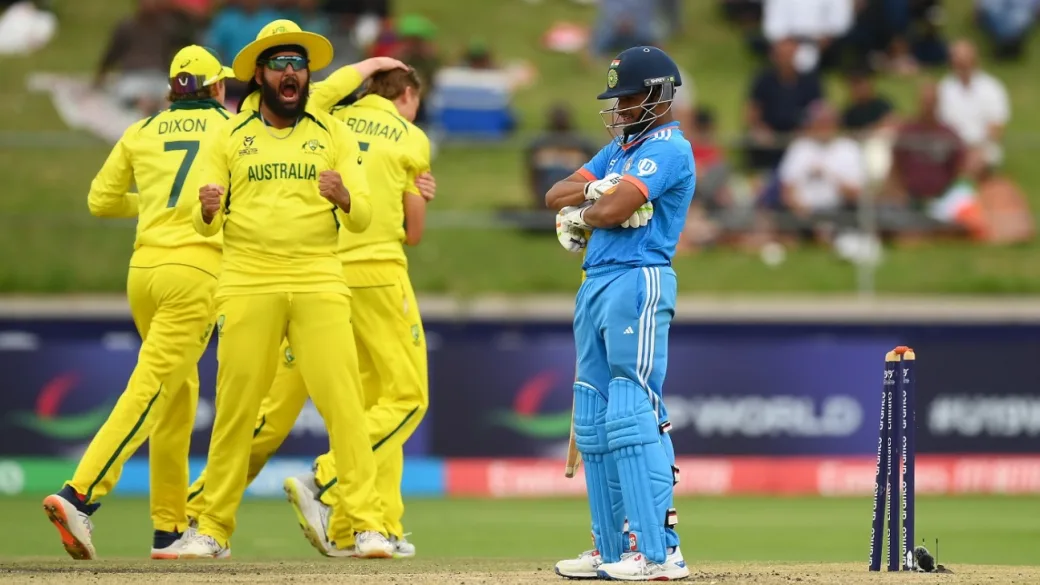
A fearsome four-pronged pace attack, spearheaded by the thunderous Callum Vidler and Mabli Beardman who had Anrich Nortje transfixed to the action, led Australia to Under-19 World Cup glory in Benoni.
The pace pack snuffed out six Indian wickets to bring their unbeaten campaign to a juddering halt after the top order had no answer to Australia’s heat and hostility. Beardman inflicted maximum damage, finishing with 3 for 15 off seven overs.
The win was also, in no small part, thanks to a vital contribution from middle-order batter Harias Singh who injected momentum into Australia’s innings to top score with 55. In doing so, Harjas repaid the faith of the team management after a lean run had him score just 49 runs, including a highest of 17, in six innings prior to the final.
Most admirable was the manner in which he overcame a slow start and made up for it with his superb takedown of India’s excellent spinners that powered them to 253 for 7, which was 79 too many for India.
After losing twice previously to India in the finals of the Under-19 World Cup (in 2012 and 2018), Hugh Weibgen’s class of 2024 won the title for the first time since Mitchell Marsh’s batch won in 2010. Australia have now beaten India in three ICC finals back-to-back.
India’s chase hardly got out of second gear. Adarsh Singh, the opener, painstakingly made 47 and hung around till the 31st over in the hope of trying to pull off a late heist after the top order that brushed past attacks in the lead up to the knockouts folded cheaply.
A miscued pull to a sharp Beardman bouncer, just an over after he had hooked a short ball for six, had Adarsh gloving to wicketkeeper Ryan Hicks all but sealed it for Australia as India slumped to 115 for 7.
Murugan Abhishek peppered boundaries in a ninth-wicket stand of 46 with Naman Tiwari to bring India’s equation into double figures – they needed 88 off the last 10 overs with two wickets in hand. But there was never really a sense that they were pushing for an unlikely win; they were simply delaying the inevitable.
The final stamp of victory was achieved in the 44rd over when Tom Straker, their semi-final hero over Pakistan, packed off Tiwari to trigger massive celebrations in the Australian camp as they lifted their fourth title overall.
India’s downfall began in the third over itself when Vidler had Arshin Kulkarni nicking behind with a perfect outswinger. Musheer Khan, India’s highest run-scorer, should’ve been out for zero in the very next over by Charlie Anderson but was put down at slip by Harry Dixon.
Musheer hung around to duck and weave his way out of trouble, and had just begun to open up having played a rasping on-drive to get going, but played back to a full delivery and was out bowled to Beardman.
Uday Saharan, the captain, came into the game without being dismissed for single figures. His calmness helped India prevail in the semi-final, but he was out gliding one to backward point for 9. When Sachin Dhas, the in-form batter, fell nicking behind to offspinner Raf MacMillan in his very first over, India were truly on the ropes.
With the ball, however, things were slightly different. Raj Limbani got the ball talking with his big inswing and clean bowled Sam Konstas for an eight-ball duck in the third over. Weibgen and Dixon then repaired the innings with a steady 78-run stand for the second wicket.
Dixon took the attack early on to Naman Tiwari, pulling him seriously for a six in his very first over, but then knuckled down as India brought on spin in just the fourth over. Weibgen, who eventually made 48, displayed excellent footwork against spin.
Off the pacers, especially Limbani, he profited from making a quick adjustment by taking a middle-and-off stump guard and getting outside the line of the stumps to eliminate lbw shouts. Australia seemed to be slowly consolidating until Saharan’s stroke of genius that brought back Tiwari for only his 2nd over in the 21st over delivered a double-strike.
Tiwari first had Weibgen hit one straight to Musheer at point and then followed that up with Dixon looping one to cover with a spongy bouncer that stopped on him. From 94 for 1, Australia were 99 for 3 and in need of a serious repair job.
Harjas came in to bat under pressure of the scoreboard as well as his own poor form leading into this game. He pottered around to make 5 off 21 before flicking a switch. Harjas broke the shackles in the 28th over when he launched part-timer Priyanshu Moliya down the ground and then quickly enough bludgeoned a slog sweep off Murugan for six to get going.
Ryan Hicks was a little more busy, enterprising and used pace to steer the ball nicely behind square. The two had added 66 when Hicks fell lbw to Limbani. Harjas then raised his half-century but couldn’t quite kick on. However, Australia found another gem in Oliver Peake who played the role of a finisher to perfection.
His 43-ball 46 helped add more fuel to Harjas’ surge that eventually helped them post 253, which on this surface with plenty of zip and bounce proved way more than they needed, especially given the fire power Australia had with the ball.
Brief scores:
Australia Under 19s 253 for 7 in 50 overs (Harry Dixon 42, Harjas Singh 55, Hugh Weibgen 48, Ryan Hicks 20, Oliver Peake 46*; Raj Limbani 3-68, Narman Tiwari 2-36) beat India Under 19s 174 in 43.5 overs (Adarsh Singh 47, Musheer Khan 22, Murugan Abishek 42; Callum Vidler 2-35, Mahli Beardman 3-15, Raf MacMillan 3-43) by 79 runs








President Anura Kumara Dissanayake today (20) paid his last respects to the remains of Most Venerable Kappetiyagoda Siri Wimala Thera, Anunayake of the Sri Lanka Ramanna Maha Nikaya and Chief Incumbent of the Rajopawanaramaya Temple in Gatambe, Kandy, who passed away.
The President visited the Rajopawanaramaya Temple in Gatambe, Kandy, where the remains of the Thera are lying, and paid his last respects. He subsequently expressed his deepest condolences to the Maha Sangha and the temple’s Dayaka Sabha, who are mourning the passing of the Thera.
Central Province Governor and Consultant Physician Dr Harsha Suranga Fernando, Kandy District Secretary Indika Udawatta and several others were present.
President’s Media Division (PMD)

India opener Shafali Verma has received an official reprimand and a demerit point for breaching Level 1 of the ICC Code of Conduct during the second T20I against Zimbabwe on Sunday.
Shafali, an ICC release said, breached Article 2.2 of the ICC Code of Conduct for Players and Player Support Personnel, which relates to “abuse of cricket equipment or clothing, ground equipment or fixtures and fittings during an International Match.”
It was Shafali’s first offence in a 24-month period.
The incident occurred in the 12th over of Zimbabwe’s innings when Shafali threw the ball into the ground in frustration after dropping a chance at mid-off offered by Chipo Mugeri-Tiripano off Sree Charani.
Shafali admitted the offence and accepted the sanction proposed by match referee GS Lakshmi, which meant there was no need for a formal hearing.
Level 1 breaches carry a minimum penalty of an official reprimand, a maximum penalty of 50% of a player’s match fee, and one or two demerit points.
India currently lead the three-match series 2-0 with the third game to be played on Tuesday evening. The T20Is will be followed by three ODIs in Vadodara from October 23.
(Cricinfo)

A total of 146 players will be competing for 27 available slots in the WPL 2027 mini auction on October 28 in Kochi. Of these, England batter Sophia Dunkley and Australia captain Sophie Molineux are the only two players who have listed themselves at the maximum base price of INR 50 lakh.
The auction pool has 119 Indian players, including 22 capped and 97 uncapped players, with 20 slots available for Indian players. The overseas pool has 27 players – 14 capped and 13 uncapped – including six from Associate teams, with seven slots available.
G Kamalini (released by Mumbai Indians), Kiran Navigre (released by U P Warriorz), Heather Graham and Jess Jonassen have registered at the second-highest base price of INR 40 lakh, while a total of 30 players have registered at INR 30 lakh.
Among the notable absentees are West Indies allrounder Deandra Dottin, who was released by UPW, and Australia legspinner Alana King, who was released by Delhi Capitals. Lizelle Lee, who was DC’s highest run-scorer last season, has also not listed herself after being released by the franchise.
What the teams look like going into the auction
Only two English players – Dunkley and Kira Chathli (INR 10 lakh) – have registered for the auction, with several others, including Danni Wyatt-Hodge, Alice Capsey, Dani Gibson, Lauren Filer and Linsey Smith opting to skip the WPL next year.
Cricinfo has learned that England are likely to play three T20Is in Sri Lanka in early February, which will clash with the final week of the WPL. While the ECB is likely to allow players to stay in India to complete the tournament, most players have instead chosen to prioritise their international commitments ahead of the Champions Trophy later that month.
The relatively low salaries on offer at the WPL are also understood to be a factor in many English players deciding not to register, with most internationals earning significantly more to play in the Hundred (up to £190,000 last year) than the highest permitted base price in the WPL of INR 50 lakh (£40,000 approx).
Molineux was part of the Royal Challengers Bengaluru [RCB] title-winning squad in 2024, and had bagged 12 wickets in ten games at an economy rate of 7.31. She was retained by RCB for the 2025 season but a knee injury ruled her out of the season. Dunkley, meanwhile, played for Gujarat Giants [GT] in 2023 before opting not to register for the 2024 season. She went unsold in the 2025 auction.
Among the premier internationals who have listed themselves for INR 30 lakh are Australia allrounder Grace Harris (released by RCB), Sri Lanka captain Chamari Athapaththu, South Africa left-arm spinner Nonkululeko Mlaba and South Africa allrounder Chloe Tryon.
UPW, who released nine players, will go into the auction with the biggest purse of INR 3.75 crore.
[Cricinfo]

State patronage for the cremation ceremony of the late deputy prelate (Anu Nayaka Thero) of the Sri Laka Ramangya Maha Nikaya, Gatambe Rajopawanramadhipatha, Siri Chandawimala Wanshalankara, Chandrakeerthi Sri Amarawansha, Sadhdharmawageeshwara, Shasanashobhanna Most Venerable Keppetiyagoda Siriwimalabhidhana Thero
Implementation of Suraksha Student Insurance Program for the Year 2026/2027

Environmental laws will be enforced equally against everyone

President pays last respects to Most Venerable Kappetiyagoda Siri Wimala Thera

Shafali receives demerit point for breaching Level 1 of ICC code of conduct

Heavy showers about 100 mm are likely at some places in the Northern, North-central, Central, Eastern, North-western and Uva provinces

‘Dates have the highest sugar content to fight Coronavirus’

Sunday Island 27 December – Headlines

#SundayIsland 17th December – Headlines

Sunday Island – 28th March

Sunday Island Headlines – 21 March

Sunday Island – 21st February – Headlines
-

 Features3 days ago
Kotahena:A Small Enclave, An Extraordinary Legacy
-

 News7 days ago
Sri Lanka, India caught in US-Iran ship crisis
-
 News4 days ago
Asgiri Mahanayake calls for immediate release of Gnanasara Thera
-

 Latest News7 days ago
Missiles intercepted near Riyadh after Saudi coalition hits Yemen fuel depot
-
 Latest News7 days ago
Kusal Mendis’ unbeaten 87 hands Sri Lanka consolation win
-

 News2 days ago
Record 1,600 students take Russian Classical Ballet examination in Sri Lanka
-
 News6 days ago
AC President recuses himself from hearing prison attire case pertaining to Gnanasara Thera
-

 Latest News7 days ago
Heavy showers above 100 mm are likely at some places in the Western, Sabaragamuwa, Southern, Central, and North-western provinces and in Anuradhapura district.