
Features
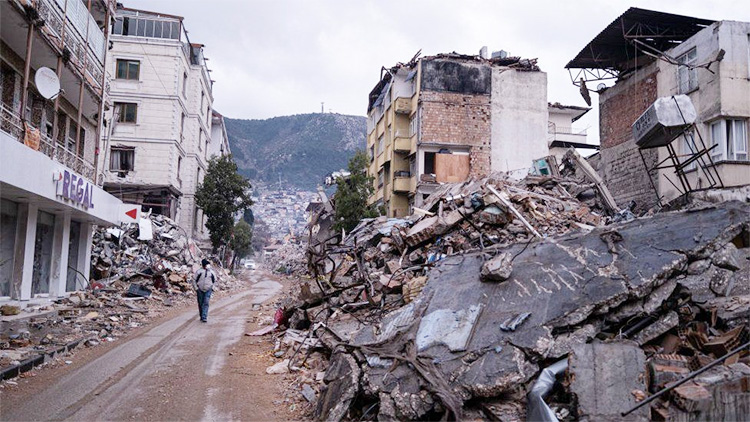
Recent earth tremors in Sri Lanka

– a critical review in relation with such activity in Tamil Nadu and the orogenesis of Himalayas based on a new theory of cratons and mobile belts in the Indian peninsular
By DULIP JAYAWARDENA
Former Director Geological Survey Department and retired Economic Affairs Officer, United Nations ESCAP
There were recent reports of earth tremors in the Buttala and Wellawaya areas in Sri Lanka and statements made by local earth scientists failed to give any scientific explanations as regards such activity.
An attempt is made to explain such activity in relation to seismicity in Sri Lanka compared to Tamil Nadu as well as the orogenesis of the Himalayas in relation to a new theory of cratons and fold belts in India and its extrapolation to Sri Lanka.
There was a news item in the local media that if a major earthquake occurs in the Himalayan region there will be tremors felt in Colombo as well as in Jaffna.
Historical seismicity in the Himalayan region has been analysed and its slip potential in the 21 Century recorded (Rodger Bilham roger.bilham@clorado.edu ).
The seismicity of Sri Lanka and Tamil Nadu are compared to understand mountain building in the two regions as Sri Lanka resemble crystalline metamorphic rocks of South India.
It is recommended that the theory cratons and mobile belts that has been postulated in India focusing on the Tamil Nadu region be extended to Sri Lanka to explain present earth tremors in Buttala and Wellawaya areas.
COMPARISON OF ALTITUDES AND SEISMIC RECORDS BETWEEN SRI LANKA AND TAMIL NADU
The highest mountains in Sri Lanka are Pidurutalagala (2524 metres msl), Kirigalpotha (2396 metres msl), and Samalakanda – Adam’s Peak (2243 metres msl)
As compared to Sri Lanka the heights of 77 mountains range from 2695 meters msl to 522 metres msl from the Indian Peninsular.
Tamil Nadu, which is a part of Peninsular India, compared to the highest peneplain of Sri Lanka (Wadia 1945), has three mountains namely Anamuda (2395 metres msl ) , Meesapullimala (2640 metres msl) and Kolabetta (2629 metres msl) -Wikipedia.
Accordingly, it is evident that the highest mountains in Sri Lanka can be closely related to those of Tamil Nadu subject to the same orogenesis or mountain building.
SEISMIC HAZARD ANALYSES FOR STATE OF TAMIL NADU SOUTH INDIA
A study by G. P. Ganapathy Assistant Professor, Centre for Disaster Mitigation and Management VIT University Vellore 632 014 Tamil Nadu India seismigans@yahoo.com and Rajaratnam S. Professor, Centre for Disaster Mitigation and Management, Anna University Chennai 600 025 Tamil Nadu, India ( drrajarathnam@yahoo.com ) have extensively analyzed seismic potential sources of Tamil Nadu State and are summarised in Table 2 of their paper titled, “Seismic Hazard Analyses for Tamil Nadu State: A Deterministic Approach “and published in the Jour. Engr. Geol. Vol.XXXV1 NO1.4
Tamil Nadu State covers 130 ,058 sq. km approximately twice the size of Sri Lanka which encompasses only 65 000 sq. km. Figure 1 gives a large number of lineaments which are seismic prone and it is interesting to note that such lineaments especially in the South Block may extend to Sri Lanka and Figure 2 indicate identified seismic potential sources in this block.
SEISMIC POTENTIAL SOURCES OF TAMIL NADU
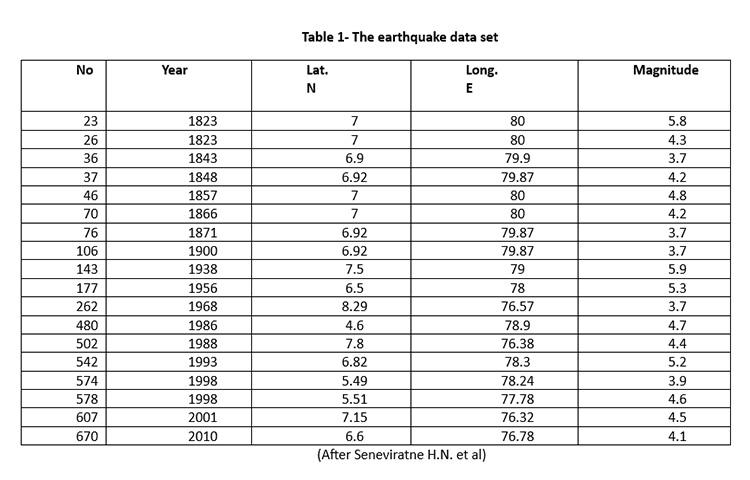 Table 1 of the above research paper analyses seven sources seismic potential sources with lengths varying from 315 km to 42 km with cumulative number of earthquakes ranging from 5 to 1 with magnitudes varying from 6.0 to 5.0 (M) observed from historical /instrumental earthquakes and peak ground acceleration (PGA) in g determined using m varying from 0.212 to 0.078 . It is noted that PGA is high in earthquakes with magnitude 6.0 and low in magnitude 3. Further PGA in Chennai, Coimbatore, Salem, Madurai and Tiruchirappalli cities varies from 0.107g, 0.133g, 0.012g ,0.77g and 0.113 g respectively. It is noted that the southeastern part of the State shows high values because of a high earthquake data for the years 1800 to 2004 It also explains that the southern part of the State which may extend to Sri Lanka shows comparatively low seismic hazards.
SEISMIC RECORDS AND POTENTIAL OF SRI LANKA
It is reported that Sri Lanka had no seismic records up to 1800. However from the period 1615 to 1800 earthquakes were reported close to Sri Lanka in the northern Indian Ocean and Coimbatore- Nilgiri Hills. (Seneviratne H.N et al ( DOI :http://doi.org/10.4038/engineer.v53i2.7412)
Newspaper reports are available in the National Archives, Sri Lanka in 1882 ,1924, 1938 and 1944(Ceylon Observer) on earthquakes that had occurred during these years. However no deaths have been reported although there was damage to property (Gunasekera K.W (2000) Sunday Observer ,p34)
Seismic records from 1909 to 1992 were from a seismograph installed in 1909. However, no data are available since 1992 as it was not fully functional.
It is reported that from the year 1823 to 2010 earth tremors and earthquakes in Sri Lanka varied from 5.9 to 3.7 on the Richter Scale and most of such tremors were recorded in the Comorin Ridge Failed Mannar Rift Zone (Seneviratne et.al).
Sri Lanka has been identified as a Mid Plate Platelet lying between Antarctica -India -Africa and Madagascar ( Curry 1984 adopted by Crawford (1974 )and Katz (1978).
In 1823 there was an earthquake of 5.8 Magnitude at Mandawela , in close proximity of Colombo with coordinates 7deg. Lat. and 80 deg. Long. There were no deaths but damage to property were recorded. There was also an earthquake of 5.9 Magnitude at Lat. N 6.5 and Long 79 E close to Kurunegala.
It is interesting to note that Sri Lanka within a latitude of 7.8731 deg. North and 80.7718 East had 18 earthquakes or tremors between the period 1823 to 2010 a period of 187 years. However, the number of tremors of insignificant nature during this period was 670.
SEISMIC RECORDS IN SRI LANKA AFTER 1992
-
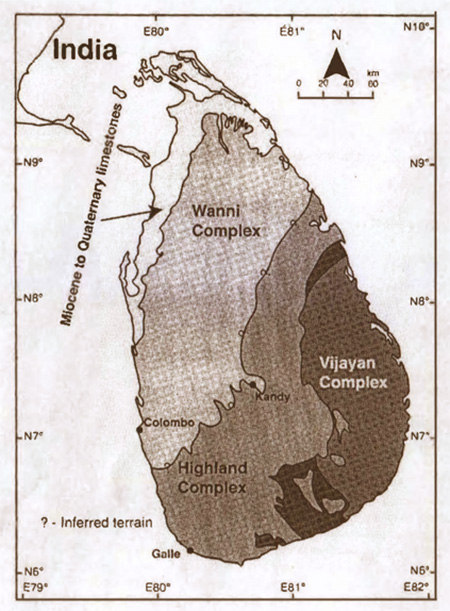
- Fig. 1. Schematic geological map of Sri Lanka, after Kroner et al 2013
-
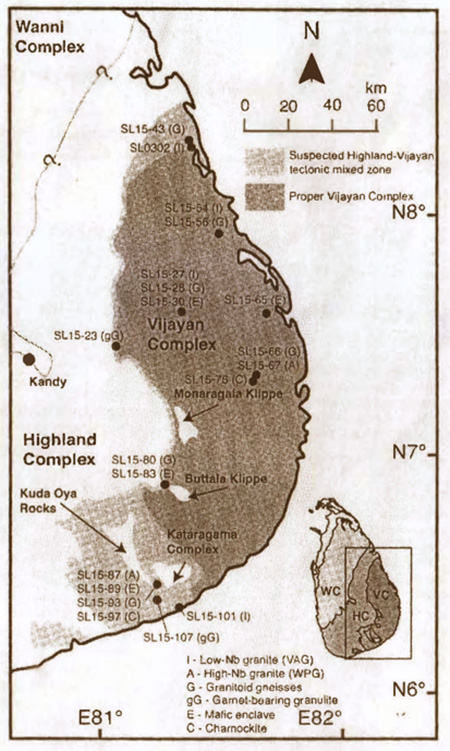
- Fig. 2. Map of Vijyana Complex with locations of sampling, edited after Kroner et al 2013. The tectonic mixed zone between the Highland Complex and the Vijayan Complex is highlighted as light-grey in colour.
The Geological Survey and Mines Bureau (GSMB) commissioned three seismometers, one at Pallekelle in year 2000 (PALK) connected to the Global Seismic Network (GSN)and the others in 2010 Mahakandarawa (MALK) connected to GEOFON) Network and Hakmana (HALK)connected to GEOFON (Geo-Network operated by Germany).
It is of importance that a network of seismometers be established in Colombo and the Western Province and a network of seismometers covering the entire Island to establish relationship between earthquakes and development activity accelerated recently in Sri Lanka. (Senaviratne H.N. et. al. 2020)
It has also been revealed that an earthquake of magnitude 6.9 (475-year return period) along the Mannar Rift Zone identified earlier in this report.
SRI LANKA HAS THE LOWEST GRAVITY RECORDED IN THE WORLD
The European Space Agency (ESA) carried out a four-and-a-half-year Gravity Field and Steady – State Ocean Circulation Explorer (GOCE) mission to learn what constitutes the surface beneath the Earth and discovered that the lowest negative gravity was south of Sri Lanka.
A geoid is the equipotential surface that coincides over the oceans with the same sea level. It is noted that the earth becomes flattened around the equator and the distance from equatorial areas to the center of the Earth is more than from the poles to the center. (Roar media Sachith Mendis (https://roar.media/english/life/reports/sri-lanka-least-earth-place-world )
It is also revealed that launching of space satellites will be much cheaper due the low gravity and due to no land surface directly south of Sri Lanka.
EARTHQUAKE OF 1615 IN SRI LANKA
An earthquake of magnitude 8 or 9 on the Richter scale was reported on 14 April 1615 evening offshore that caused extensive damage in western part of the Island. The worst hit area was Colombo and 2 per cent of Colombo Fort was destroyed. It has been reported that nearly 200 houses were destroyed with nearly 2000 casualties. Accordingly, moderate sized earthquakes cannot be ruled out in Sri Lanka. (Muhandiram P. M. S. S. B. <https: loes18.wildapricot.org/article _earthquakes-text= According to this document2 % of Colombo Fort got destroyed.
GRAVITY MAP OF SRI LANKA
A Gravity Map of Sri Lanka was compiled and produced in 1975 by the Geological Survey Department (present GSMB) on the scale of 1: 1. 000,000 by T. Hatherton, D. B. Pattiarachchi and V. V. C. Ranasinghe with an appendix by R.B. Evans.
A total of 1,170 points were established covering the whole Island in respect to 19 base stations and about 87 per cent of observations where in areas less than 150 meters msl.
The horizontal distance and heights of the 1971 gravity observations were from 1 -inch topographic maps covering Sri Lanka.
Most of these gravity stations were tied up with the trigonometrical survey stations of the Survey Department. When these stations were opened it was revealed that there was movement due to upliftment.
A contour map of complete Bouguer (gravity anomaly corrected to the height of its measurement) anomalies with the locations of gravity observations was produced.
The gravity map has revealed a negative gravity low on the Highland -Vijayan boundary in the east of Sri Lanka.
(To be concluded)


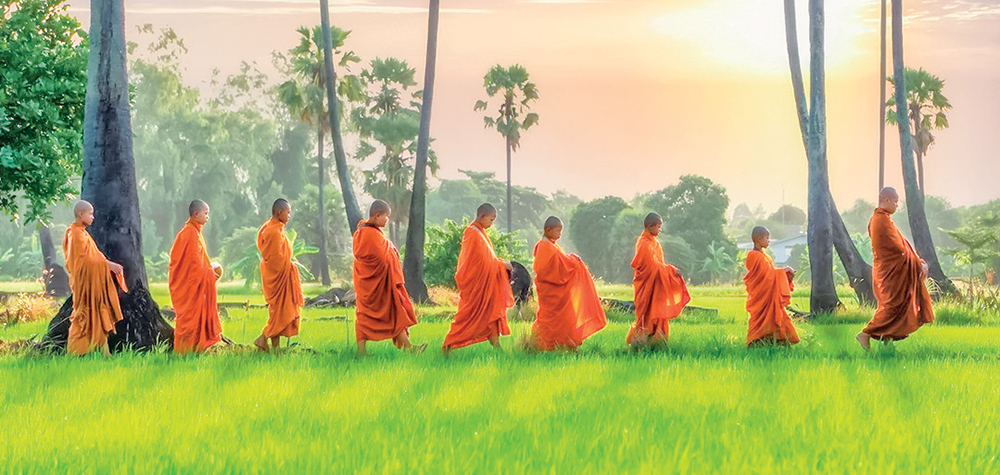
The underlying issue in Anuradhapura is a struggle between a few families who, for years, have waged a quiet cold war over control of the Udamaluwa. Similar situations exist in Mihintale as well. These places, among others, are treated as treasures of Buddhism but, in practice, function as tightly controlled economic centres. The same pattern repeats in Kandy around the Temple of the Sacred Tooth Relic and in Kataragama at the shrine of God Kataragama. Variations of it exist across religious spaces of Islam, Catholicism, and Hinduism too, where institutional authority becomes indistinguishable from localised power networks. What is presented as sacred order often operates as inherited control.
It is indeed devastating to see situations where parents have no alternative but to expose their children to predators in robes for survival. This has nothing to do with religion itself, but with human pathology in the context of survival. These are the questions that demand answers, not superficial responses that treat symptoms while ignoring the conditions that produce them. What is more shocking and disturbing is not the tragedy itself, but the reactions to it. Social media has overwhelmed us, not towards understanding, but towards a fragmented cognitive state with no exit route.
A friend of mine in Nairobi used to keep all his electronic devices at home and go into the forest once a month, spending days there before returning. He called it “detoxification”, but in reality it was an escape from a system that no longer allows uninterrupted thought. Daily life is now saturated with unnecessary content, and attention itself has become a commodity extracted, processed, and sold back to us. This is where we have become unable to understand what really drives certain tragedies we endlessly react to, while remaining blind to the systems that quietly manufacture them.
Multi-dimensional poverty
Poverty is structural, poverty is political, and poverty is functional; it is a tool and a manoeuvring force of power. The question is no longer whether poverty exists, but who benefits from its persistence, and who is forced to survive within it. From education to medicine to basic food supply chains, countries like Sri Lanka are not simply mismanaged; they are structurally captured by a small number of actors who remain stable regardless of who is formally in power. Small-scale enterprises and NGO circuits that circulate foreign funding to “solve structural issues” often operate as hollow administrative performances, producing reports rather than transformation.
Poverty is not merely the absence of money. It is the absence of bandwidth, absence of protection, absence of time, and absence of cognitive stability. As Sendhil Mullainathan and Eldar Shafir state, “Scarcity captures the mind. Just as the starving subjects had food on their mind, when we experience scarcity of any kind, we become absorbed by it.” This is a description of how human cognition is structurally reorganized under constraint. Scarcity does not sit outside the person; it occupies them.
They also state, “Scarcity leads us to borrow and pushes us deeper into scarcity.” That is the mechanism that must be confronted without euphemism. Poverty is not only deprivation; it is a self-reinforcing trap in which survival decisions generate the next layer of crisis. Once a society crosses a certain threshold of scarcity, it stops producing long-term reasoning as a default condition. It produces short-term survival logic, often mistaken by outsiders for irrationality.
It is precisely here that public discourse becomes intellectually dishonest. Everything is translated into moral language because moral language is easier than structural analysis. But morality without structure becomes theatre. It produces outrage, not understanding, and repetition, not reform.
It is indeed brutal when an individual wearing religious insignia—whether robe, symbol, or institutional identity—is accused of acts that fundamentally contradict the moral authority attached to that position. It is equally brutal when institutions that depend entirely on trust begin to function as shields rather than safeguards. But the deeper question is not shock. The deeper question is what kind of social condition produces families who see placement within such institutions not only as devotion, but as a survival strategy under constraint.
Ethical decision-making
That is where the argument collapses into its most uncomfortable form. Poverty does not produce ethical decision-making environments. It produces constrained optimization under pressure. When food insecurity, debt, and social instability converge, institutional spaces that appear stable become transactional destinations for survival rather than moral choices. To interpret this as purely cultural failure is to deliberately ignore the structural compression of options.
Mullainathan and Shafir describe this clearly: “Instead of saying that scarcity ‘focuses,’ we could just as easily say that scarcity causes us to tunnel: to focus single-mindedly on managing the scarcity at hand.” That tunnelling effect is not abstract. It is visible wherever long-term planning collapses under immediate pressure. Systems then misread this as irresponsibility, when it is in fact cognitive overload produced by structure.
What is rarely acknowledged is how deeply this extends into governance itself. Institutions increasingly operate as if they are managing rational, unconstrained individuals. In reality, they are interacting with populations whose cognitive bandwidth is already structurally taxed. The result is policy failure interpreted as public non-compliance, enforcement interpreted as moral correction, and reform interpreted as communication failure rather than design failure.
Social media has intensified this distortion. It does not merely spread information; it destroys sequencing. Structural problems require temporal depth. Social media removes that depth and replaces it with instantaneous judgment. Every event becomes a surface object, detached from causality. The outcome is a society permanently reacting and never diagnosing.
Poverty, in this environment, becomes invisible in its real form. It is not seen as a continuous structural condition but as episodic failure. A scandal appears, is consumed, and disappears. Another replaces it. Nothing accumulates into understanding because attention itself is exhausted before synthesis can occur.
Modern Condition
The modern condition reflects a reversal of earlier social organization, where human relationships are embedded within abstract systems of finance, law, and administration that often fail to recognize the lived constraints of those they govern. In this disembedded state, institutions increasingly misinterpret human behaviour as their capacity for structural understanding weakens. At the same time, attempts to resolve systemic failures through expanding administrative complexity produce diminishing returns: more regulation, oversight, and reporting generate less coherence. Over time, institutions shift from functional effectiveness to symbolic performance, maintaining the appearance of control rather than achieving it.
This is why public outrage repeatedly fails to translate into structural change. Outrage is not a tool of reconstruction. It is a signal of system fatigue. It circulates, intensifies, and dissipates without altering the underlying architecture. Meanwhile, the conditions that produce repetition remain intact.
The most persistent illusion is that these are separate problems: poverty here, institutional misuse there, media distortion elsewhere. They are not separate. They are expressions of a single condition in which scarcity, complexity, symbolic authority, and fragmented enforcement interact without coordination. The system does not fail in one place; it fails in the gaps between these layers.
Symbolic systems
What makes this condition more severe is that symbolic systems continue to operate at full strength even when structural systems degrade. Religious identity remains powerful. Political rhetoric remains strong. Cultural symbolism remains intact. But enforcement capacity, institutional coherence, and social trust degrade beneath them. That gap is where instability grows. Until that gap is addressed at the level of structure rather than sentiment, repetition remains inevitable. New scandals will emerge, new interpretations will circulate, and new cycles of outrage will follow. Nothing resolves because nothing is being reconstructed beneath the surface of reaction.
This is no longer repairable through adjustment or rhetoric. It is a form of decay that persists until it exhausts itself, because the mechanisms meant to correct it are now part of the same failure. It continues until rupture, not reform. At that point, instability ceases to be episodic and becomes structural. Pressure will accumulate into breakdown, and what follows will not be managed transition but forced reversal. The responsibility lies with those who govern these institutions to prevent that trajectory, not through language, but through change. The drama is ending; farce is over; what we are witnessing is tragedy unfolding with unprecedented consequences.
by Nilantha Ilangamuwa
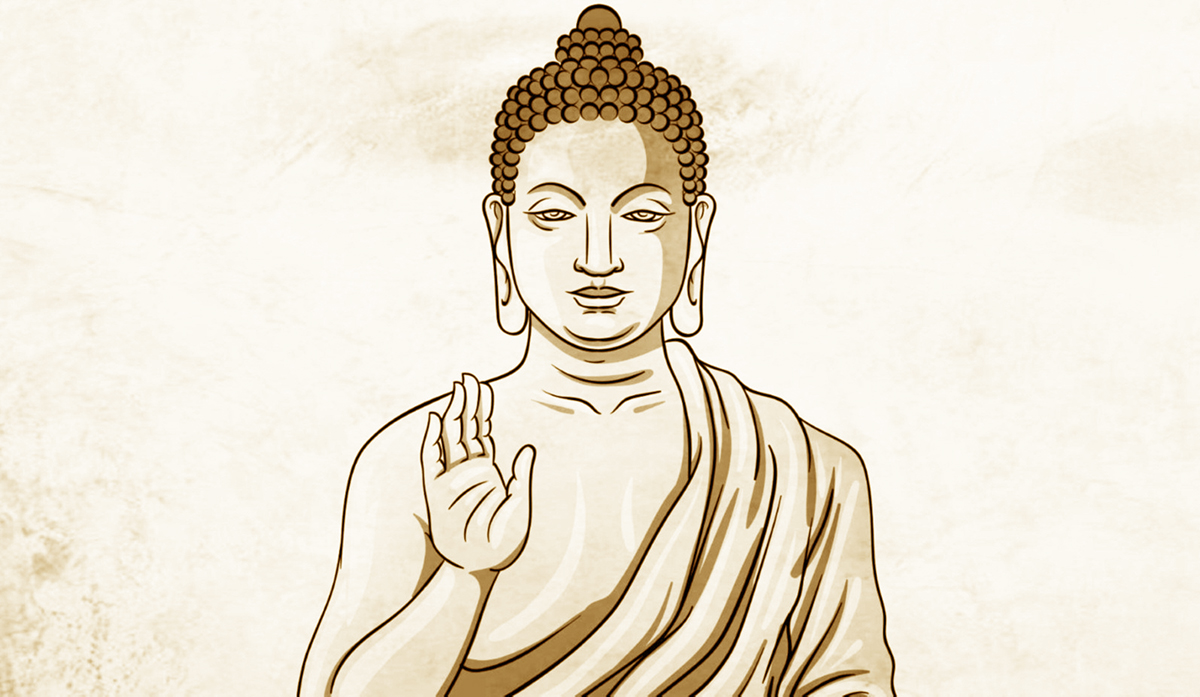
As Sri Lanka celebrates the birth, Enlightenment and the Parinibbana of the Buddha, almost a month after the rest of the Buddhist-world did so, there is widespread discussion about threats to Buddha Sasana provoked by some recent incidents. Regarding the views expressed about postponing Vesak celebrations in my article ‘May Day and postponement Vesak 2026’ (The Island, 25 May), my very good friend Dr Upali Abeysiri has sent me the following comments: “The Mahanayakas have a good reason to postpone Vesak. The dawning of the full moon has to be on the same constellation (nekatha) as when the Buddha was born and attained enlightenment. Although Adhi Poya is reckoned as the second full moon arising in the same calendar month, this is supposed to be an odd exception.” Though it would have been ideal if a consensus could have been reached prior to the split of celebrations, perhaps, it does not matter very much as celebrations occur on a symbolic rather than an actual date, there being no historical or archaeological evidence confirming exact dates.
Whilst there are no direct threats to Buddha Dhamma, as the expanding horizons of science continue to confirm the fundamentals of Buddha Dhamma, there is no doubt whatsoever that there are threats to Buddha Sasana. However, these threats become important as the Buddha Sasana performs the pivotal role in protecting and propagating the Dhamma and, hence, become an indirect threat to Dhamma itself. Therefore, it should be the concern of all Buddhists and it is in this spirit I am making some comments which some may interpret as disrespectful to the Maha Sangha. I can reassure that my intentions are entirely directed towards the preservation of the Buddha Dhamma and Sasana. Though the Buddha proclaimed that the Sasana consists of Bhikkhu, Bhikkhuni, Upasaka and Upasika, for all practical purposes Sasana had been led by Bhikkhus, often at the expense of others.
There is hardly any doubt that there are external forces at play in Sri Lanka and even some Buddhists seem to object to Sri Lanka being called a Buddhist country. Interestingly, no one seems to object to countries like the UK and the USA being called Christian counties. I
There is no registration or baptism in Buddhism and there are no rewards for Buddhists for conversions. As I pointed out in a previous article, ‘How does the Buddha differ’ (The Island, 1 May) unlike most other religions, Buddhism is not a ‘high-demand’ religion, nor ‘law-based’ religion and is not exclusivist. Perhaps, it is this liberalism, pacifism and gentleness, which are the real strengths, that are being exploited as weaknesses by others.
There will always be external threats and the Buddha too faced many during his lifetime. Before addressing those, is it not more important to address the threats within? One of the most important problems seems to be the breakdown of discipline. Bhikkhus are bound by Vinaya rules, laid down by the Buddha and some recent incidents highlight total deviations. Though there were many previous incidents like unsubstantiated claims of Arahanthood, Bhikkhus attacking each other on YouTube and Bhikkhus conducting YouTube channels, not for the propagation of the Dhamma but for the accumulation of rupees, attention was focused after the detection of 22 young monks carrying narcotic drugs.
Though many commentators were quick to condemn the Sangha on this account, we need to go deeper. Narcotic menace has become a huge problem in Sri Lanka and it looks as if the drug lords would resort to anything to achieve their objectives. Though it looks as if some gullible young monks had been duped by drug lords, we need to question why it was possible. Is it due to the lack of supervision of these novices by their seniors that allowed them to accept a request in a WhatsApp group? Should there be checks and balances on foreign travel by Bhikkhus?
What shocked Buddhists was what followed next; the arrest of the Nayaka of Atamasthana for allegedly having sex with a minor. Anuradhapura was our first capital and Sri Maha Bodhi is the longest surviving authenticated tree in the world. Ruwanweliseya and Jetawanaramaya were among the ten tallest man-made structures in the ancient world, Jetawanaramaya still holding the Guiness record for the largest stupa in the world. Cyberspace is full of theories. Whilst some have condemned the Nayaka Thero even before the conclusion of inquiries whilst others claim that this was a coup by another Nayaka Thera in an attempt of succession.
I was intrigued, reading in a Sri Lankan newspaper about the 80th birthday celebrations of a Nayaka priest, who was convicted in London in 2012 of historical child sex abuse and sentenced to seven years in prison. I remember the case very well as he was the head of the Vihara, we had our first contact on relocating to the UK. I also remember his devotees, who believed that he was wrongly accused, collecting over £50,000 for an appeal. In spite of being represented by one of the top Barristers in the UK, the conviction was upheld but the jail-term was reduced by a year. His name is still on the sex-offenders register in the UK and he is permanently prevented from association with children. One can argue that as he has served the sentence and not reoffended, this should not be held against him but what baffled me is that he is still being referred to as the Chief Sangha Nayaka. Should a person on the sex-offenders register be the Chief Sangha Nayaka?
It is high time we put our own house in order before fighting the external enemies. It is reported that the former president CBK has written to the Mahanayakas requesting urgent reform and we should be obliged to her for taking the lead.
There are many aspects that need urgent reform, the first being removal of caste barriers practiced by some Nikayas, which is the greatest insult to the Buddha who promoted equality. The second is the active encouragement of Bhikkhuni Sasana which has not happened in spite of the landmark ruling by the supreme court. The third is the establishment of proper disciplinary processes under a single Adhikarana Sangha Nayaka with powers and support than allowing the government to take over the control of even non-criminal Vinaya matters.
There are many other issues that need settlement like the controversy of the land of Buddha’s birth which seems to linger on. An expert committee should hear all evidence and settle this issue once and for all.
As I have pointed out on many occasions in these columns, it is high time a Dhamma Sangayana was held, as the last one was 70 years ago. Ideally, it should be different with active participation of lay experts as well. It is the duty of us Buddhists to ensure that the words of wisdom of the Buddha continue to enlighten generations to come.
By Dr Upul Wijayawardhana
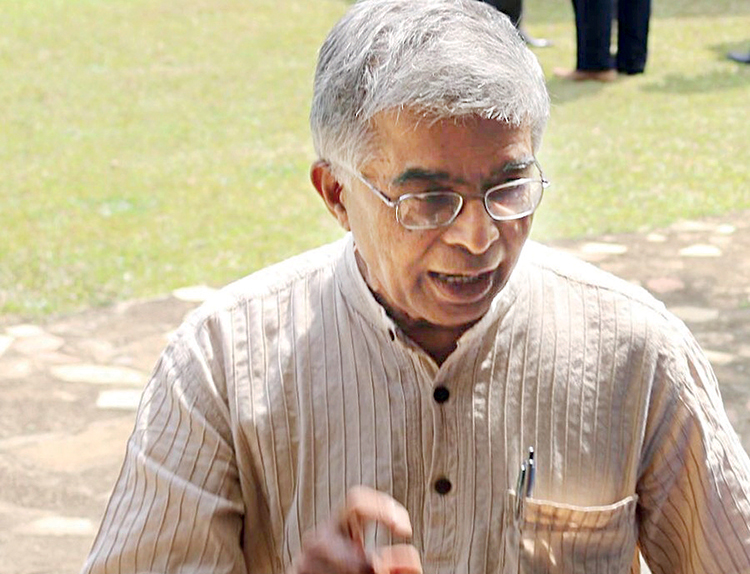
The University of Ceylon, Peradeniya, was in our time, a less-crowded residential university, where everybody knew everybody else or at least knew of everybody else.
I knew of Emeritus Professor Vijaya Kumar of the Department of Chemistry at Peradeniya, or Kumar, as we referred to him fondly, before I got to know him. His dear wife Savitri, also a member of the academic staff of the Department of Chemistry, was nicknamed Kumee, by some of their students (of which vintage is unknown to me) and the duo were thereafter referred to affectionately as Kumar and Kumee.
The Faculty of Science became a regular haunt of mine as I would go there in the company of my batchmates to attend lectures on Basic Mathematics given by Professor Maheswaran, as it was a requirement for our General Arts Qualifying Examinations. I would also go there to listen to some excellent talks under a programme that was held in the auditorium of the Science Faculty referred to as “Popular Science Gossip”. The “gossip” at these talks were not confined solely to science but were broad enough to include Literature, History and other branches of knowledge as well. I would often spot Kumar in the audience at these talks or bump into him in the corridors of the Science Faculty. But I got to know him personally only after he became the Warden of Arunachalam, my hall of residence, during my undergraduate years initially, and later, as a member of the academic staff of the Department of English.
Our Science Faculty undergraduate contemporaries, especially those at Arunachalam Hall and its immediate neighbour, Jayatilaka Hall, both within a stone’s throw away from the Science Faculty, shared many an anecdote about Kumar and their other lecturers. One of these anecdotes, had to do with a spectacular (motor car) driving feat of Kumar’s. Legend has it that he drove from his university bungalow-home to the Faculty of Science deploying only the reverse gear of his car! Kumar, on hearing of this, had told certain of his student friends, including some who became his colleagues later on, that this story is one of the biggest yarns he had heard in his life!
Some of his one-time younger colleagues, now in retirement like Kumar, tell me that Kumar exuded warmth and friendliness in all of his professional and administrative interactions with others in the wider university community. But there was no warmth or mercy for those who indulged in the unsavoury pastime of student ‘ragging’. He was a very strong proponent of the need to ensure to all freshers an environment free of the menace of ‘ragging’. He remained ever-vigilant during the ‘ragging’ season. There are stories of his chasing ‘raggers’ and catching them. Professor Maheswaran, who later became an intimate friend and remains so after more than half a century, was another who was fiercely opposed to ‘ragging’. I was a personal witness to Mahes chasing a ‘ragger’ up and down the stairs of the main library to nab him. Yet another of his students has noted that Kumar’s office room in the Faculty was a total mess at all times. It had tables, piled so high with books and documents that one could not easily spot Kumar at his desk. He, however, had the knack of pulling out from amidst the clutter, any document that he needed at any given time. If anybody were to volunteer to help tidy his desk, Kumar would respond firmly with “Don’t you touch my desk!”.
Kumar, like several of his colleagues in the other faculties as well, had his own eccentricities. According to information received from reliable sources, Kumar who taught Organic Chemistry used to carry his lecture notes in his shirt or trouser pocket with ‘the entire lecture condensed in point form on a half-sheet or half of a half-sheet of paper’. The way he rummaged through his sling bag filled to the brim with stuff to find an item that he needed was another ritual that amused onlookers.
Kumar, interestingly enough is a Royal-cum-Thomian product, in that he had his primary education at S.Thomas’ Prep School, Kollupitiya and the entirety of his secondary education at Royal College, which he entered in 1953. In a note written by Kumar himself, he notes that despite having had excellent teachers at Royal, his was not a notable school career. He goes on to say that “the only achievement I could boast of was my being the joint-winner of the school General Knowledge Prize”. However, he had been active in a Scout Group outside of school (1st Port of Colombo, Sea Scouts) where he “was Queen’s Scout, Patrol leader, and later, Assistant Scout Master”.
Kumar entered the Faculty of Science of the University of Ceylon in 1961 and secured from it an honours degree in Chemistry in 1965. He joined the academic staff of the Department of Chemistry in the Faculty of Science, University of Ceylon, Peradeniya in 1965 and left the following year for Magdalen College at Oxford University, from which institution he obtained his doctorate in Chemistry. His entire teaching career was at Peradeniya, where in the period 2003-2006 he served as the Dean of the Faculty of Science, a position that his late father-in-law had held a few decades earlier.
Among the other highlights of his career are: Chairman of the Industrial Technology Institute (formerly the Ceylon Institute of Scientific and Industrial Research, CISIR); Member (representing Sri Lanka) of the Geneva-based UN Commission on Science and Technology from 1999 to 2007 and its President from 2001-2003; President of the Sri Lanka Estate Workers Union from 1989 onwards; Member of the Politburo of the Lanka Sama Samaja Party from 1988 to 2014 and currently, a member of the Executive Committee of the National People’s Power (NPP).
Vijaya and Savitri Kumar are parents of daughters Shamala and Ramya, who are following in the footsteps of their parents: with the former teaching in the Department of Agricultural Economics in the Faculty of Agriculture, University of Peradeniya and the latter, in the Department of Community Medicine at the University of Jaffna.
(I wish to thank the following who assisted me in the writing of this brief essay: Mr. Bandula Warnakulasuriya, Emeritus Professor Ratnayake Bandara, Professor Mahinda Wickramaratne, Professor Swarna Wimalasiri and Mr. Manik de Silva).
*Editor’s note: Prof. Vijaya Kumar, a member of the NPP’s National Executive Committee and is still active in politics turns 84 today. This article by Tissa Jayatilaka, former Executive Director of the United States – Sri Lanka Fulbright Commission for Mutual Academic Exchange, was written for an upcoming collection of essays on Kumar’s life by his friends.
(Colombo Telegraph)
By Tissa Jayatilaka

‘Disappointing’ – Sangakkara on Sam Curran turning out for Surrey with IPL still on

Truck carrying Afghan returnees from Pakistan flips on highway, killing 18

PSG beat Arsenal to win back-to-back Champions League titles after shootout

What Hegseth’s comments at Shangri-La Dialogue say about US foreign policy

Home comfort vs championship pedigree as Gujarat Titans and Royal Challengers Bengaluru collide in IPL 2026 final

Minhas’ record-breaking debut sets up handsome Pakistan victory

‘Dates have the highest sugar content to fight Coronavirus’

Sunday Island 27 December – Headlines

#SundayIsland 17th December – Headlines

Sunday Island – 28th March

Sunday Island Headlines – 21 March

Sunday Island – 21st February – Headlines
-
 News6 days ago
Police probe underway to ascertain links between criminals deported from UAE and local politicians
-
 News5 days ago
Easter Sunday carnage: Court told Maulana’s statement cannot be accepted without cross-examination
-

 News1 day ago
IMF urges Lanka not to meddle with exchange rate
-
 News5 days ago
UK passport holder hiding here wants to have deportation order rescinded to leave without blemish
-
 Opinion5 days ago
Undermining the democratic political framework
-

 Features2 days ago
The Division Bell Mystery
-
 News6 days ago
Dickoya double murder suspect arrested
-
 Midweek Review4 days ago
Israeli-US aggression won’t go unanswered -Iranian Ambassador