
Features
Prince Charles protected his red & swollen hand with namaste greetings and Clinton loved kiri-peni

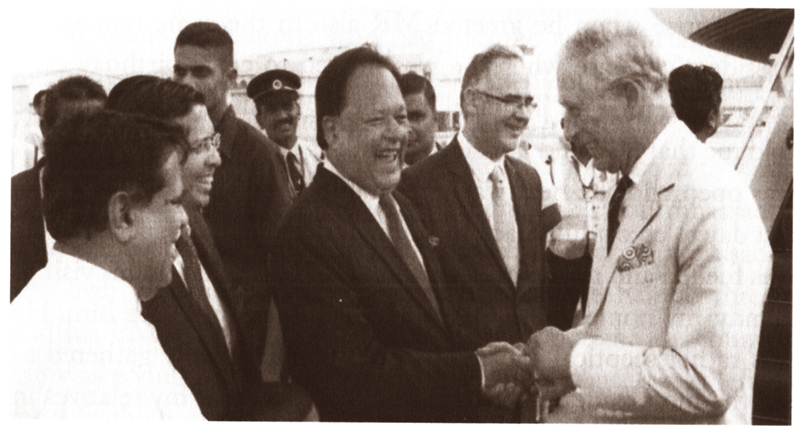
Minister in attendance to distinguished guests
One of my responsibilities as a Minister under MR was to be “the Minister in Attendance” to important state guests who visited Sri Lanka. They were mostly a diverse as well as an amiable lot and I enjoyed interacting with them. Since I had been on several delegations with DG M’ Bow, who was treated on a par with a senior minister by member states in my UNESCO days, I knew the ropes and could undertake my task with confidence. I had also been on several Presidential delegations with CBK and Mahinda Rajapaksa where they had been greeted with high honours by a Minister in Attendance.
The most interesting of these visitors was Prince Charles [now King] who arrived in 2013 for the CHOGM meeting hi Colombo. He arrived at Katunayake on his birthday. When I greeted him and extended our best wishes I found that his hand was swollen and turning red. On inquiry he told me that shaking hands had become a painful exercise for him. I respectfully suggested to him that he should greet his admirers in the oriental manner. He laughingly agreed and greeted the long line which had formed to shake hands with him in our traditional way.
On the way to Colombo he thanked me for my advice. Imagine my surprise when he greeted MR also in the same manner in President’s House where he was invited to cut a birthday cake before he retired to “Tintagel” for the night. The following day he told me that he could not sleep a wink as the window in his room was open and the heat was unbearable. I met him again on the last day to escort him back to Katunayake where his special plane was fueled and ready for departure. I told him that on his visit to Kandy, my home town, the people had lined up to see him. He was rather sceptical and replied that people usually gathered to see the motorcade rather than him. I replied that my relatives in Kandy had come to see him personally and he was pleased.
He had a pleasant sense of humour. When one of our heads of the navy who had been with Charles in Dartmouth presented him with a set of cuff links with royal insignia embossed on it, he replied that he cannot wear it as that insignia could only be worn by a King or Queen. We could see that he enjoyed his stay in Sri Lanka and we ourselves felt his warmth and were sorry to say goodbye as he waved to us from the top of the stairs to the plane and went inside. A week later I received an invitation from him to attend a conference he had convened with African Heads of State to save the African elephant. That was his way of saying “thank you” and at the reception held at Buckingham Palace for the participants he greeted me and introduced me to his son William who was then sharing some of his official duties.
I spoke to William and invited him to visit Sri Lanka. He replied that already his father and grandfather had told him about the beauty of the country. All in all it was a pleasant interlude conducted in a genteel manner. Not so was my interaction with David Cameron, then PM of UK and later Foreign Minister. He too had come for CHOGM but his mind was set on the forthcoming general election in UK. He was determined to keep his distance from the Sri Lankan government for the benefit of Tamil voters back home who had become an important factor in about forty “swing constituencies” which could determine the result of the election either way.
We had arranged for a convoy of vehicles but he asked for only one and he and I sped towards Colombo to avoid the press while leaving the UK High Commissioner to bring his staff and luggage to the hotel. The poor High Commissioner was overwhelmed by the presence of both the heir to throne and his PM being put in his charge in an “outlandish” country. He was trying hard to please his PM while Charles was left to me.
On the way to Colombo and away from cameras, Cameron became more amiable. I saw that he was impressed by the view along our Katunayake highway which had been opened the day before. I invited him to visit Sri Lanka again with his family for a holiday and he told me that he had not expected the country to be so beautiful. But he was preoccupied with the coming election which was based on his rash decision to go to the people on the Brexit issue. His advisors had prepared an agenda to satisfy Tamil voters back home with a meeting with Muralitharan and a visit to Jaffna to play cricket. I told him that Murali was not a Jaffna Tamil and that he was a constituent of mine in Kandy. MR also treated Cameron as just another participating PM and put him in the last row for the “family photo”.
On the way back after a better understanding of the ethnic issue here he was subdued on his way to Katunayake and London. I was pleased recently when Cameron, now out of office, spent a holiday with his family in Sri Lanka just as I suggested on his first visit for CHOGM in 2013. Close on their heels came the Prime Minister of Pakistan Asif Ali Zardari, better known as the husband of late Benazir Bhutto. He was not a popular leader having been accused of corruption and known as “Mr. Ten Percent”. He was previously the Minister of Investments and had a dismal record.
However Pakistan has always been a good friend of Sri Lanka, partly because it needed friends to the south of India. Whatever his critics said, I found that Zardari was a sympathetic character who was full of good humour. He was mostly interested in business and I suggested that his family should invest in enterprises in Sri Lanka. He was interested and said that his son was keen on politics but that his daughter took after him and was more likely to invest here.
On returning he invited me to be his personal guest in his residence in Karachi. Unfortunately I did not avail myself of that offer since there were more pressing political issues at home. Twice I had to represent President Rajapaksa in Uganda and once in Ethiopia. President Musaweni was a personal friend of MR and could be considered the best friend of our country in Africa. He supported us in all the international fora. Uganda was of special interest to me as a Trinitian. Before he took over the Principalship ofTrinity, AG Fraser, the legendary teacher and Christian missionary, had been Principal of a missionary school in Uganda.
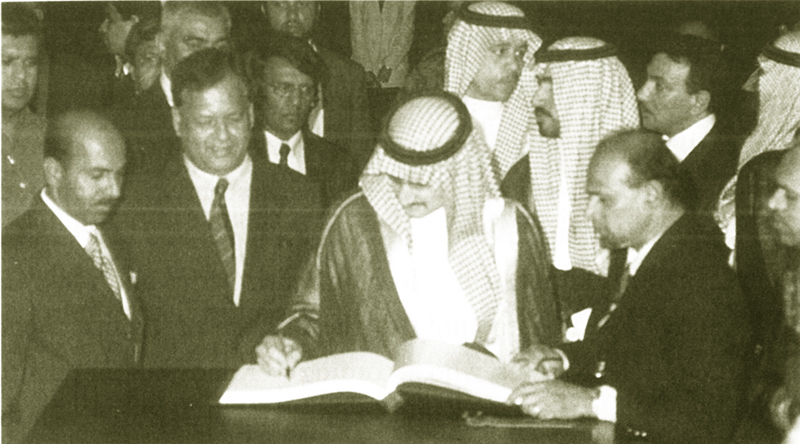
Greeting Prince Al-Walid, The owner of Kingdom Holdings
When he came to Trinity, Fraser brought over several bright Ugandans to study in Kandy. The exploits of the Kagwa brothers, especially Micheal Kagwa, is the stuff of legend in Trinity and Kandy town. They were great rugby players and even simple Kandy townspeople in my youth would talk in awe of the “Kalu” sportsmen. Micheal later went to UK where he qualified as a barrister and practiced in Kampala. He later was elevated to the bench and was considered an aristocratic but popular judge. He fell foul of Idi Amin and was killed in a brutal fashion.
In Kampala I was told of Micheal Kagwa Jnr. his son but he had left for South Africa and I lost an opportunity to add something to the folklore of Trinity about the indomitable Kagwas, who according to Kandy bazaar gossip, spoke good Sinhalese, especially words of abuse! My brief visit to Addis Abbaba in Ethiopia was to convey our President’s wish to get that country’s support for us in Geneva.
The visit to the Presidential palace in Addis was a memorable one The PM was a Harvard educated, cultivated person who occupied the palace of legendary King Haile Selassie [1930-1974].
It was full of the lion motif which symbolized the royal dynasty. It is said that during Haile Selassie’s time he had tame lions roaming around in the palace. The PM was very sympathetic to our request. He told me that the US was pressing him to support their motion. However due to our efforts he would instruct his officials to abstain from voting for the motion in Geneva. His country too had ethnic problems and his administration was under attack from different tribes. So he was sympathetic to our position in Geneva.
With friends I visited the Ethiopian market where goods from the outlying areas were brought in large volume for sale in the city. Especially interesting was the sale of the world’s best cotton cloth which was bought up in big lots by garment manufacturers in Ethiopia and Egypt for their factories.
I also accompanied two of the most senior and influential Middle Eastern potentates when they visited Sri Lanka. They were Al Thani, the Prime Minister and then the dominant statesman of Qatar and Al-Assad, the Finance Minister of Saudi Arabia and her former representative to OPEC. Each of them were high flyers in the region then, though they have now been replaced by a younger generation of leaders. Al-Thani was a tall, handsome figure with a commanding presence. He ran the country on behalf of the Emir who too was an Al-Thani. Additionally he was the Chairman of Qatar airlines which he built up to become a major global airline.
After arriving in the hotel he gave me a tough assignment which was out of his agreed schedule. He told me that he had one of the world’s biggest collections of gems and he wished to examine, and if satisfactory, buy some Sri Lankan gems. This was a tough call but I had to match up to the challenge since it appeared to be one of Al Thani’s expectations of this tour. A bureaucratic reply would have soured his view of Sri Lanka. After some thought I called up Raynor Nanayakkara who was a specialist gem dealer for Tom Ellawela.
I asked Raynor to come to the Hilton with his best gems. Fortunately he obliged immediately after my call. Al-Thani spent a considerable amount of time delightedly assessing the gems before him. A problem arose because Raynor did not have certificates for the gems. Our host solved many problems by inviting Raynor to Doha with his selection of gems. I was worried that we may be breaking customs regulations if he decided to take the gems with him. But his solution was perfect and we all broke up for the night satisfied that all, including the befuddled Qatari ambassador, were happy about our guest’s simple solution.
There is an interesting sequel to this visit. A few weeks later Al Thani called me from Doha to say that his daughter and her friends who were studying in England, were on their way for a tour of Sri Lanka and he would like to give my name to them as a contact in case of an emergency. Naturally I agreed and he later called me to thank me and say that his daughter had a delightful stay and had no occasion to call on my assistance. After this friendly encounter whenever I went to Washington for IMF meetings I would be invited by the Qatari Finance Minister for tea and a friendly conversation regarding assistance to Sri Lanka, at the Four Seasons hotel in Georgetown in which he was lodged.
He told me that he had been requested by his PM Al ‘Mani to invite me. Similarly I would meet Al-Assad of Saudi Arabia twice a year in Washington. He was quite powerful in IMF and WB circles as his country was a major contributor to special funds set up by those organizations. We got on well and he would always bring the head of the Saudi Fund for our meetings so that we could review their projects in Sri Lanka and allocate more funds for projects in the pipeline.
I persuaded the two of them to visit our country, observe some projects in progress and discuss future funding. The visit was a success and the Saudi Fund and the Gulf Fund became significant donors for some of our projects. Press conferences were arranged for both Al-Thani and Al-Assad. Our journalists quizzed them about migrant workers in their countries. Both assured that our workers were among the best of expatriates and that they had put in place legal remedies against exploitation. Anyway I was satisfied that we could strike a blow on behalf of our workers.
During CBK’s time I was assigned to meet Bill Clinton on one of his visits. I went with his and my friend Harry Jayawardene, who had contributed liberally to the Clinton Fund and whose daughter was working for the Clinton Foundation in New York. The ex-President arrived with a stunning Indian beauty who was introduced as his Secretary. We lodged him at the Colombo Hilton. Asked about his dinner Clinton replied that in Asia he always preferred to eat a simple diet of curd and treacle. Harry and I combed Colombo to find him a pot of our “Kiri Peni” which he later said that he enjoyed very much. After the Tsunami I was a member of CBK’s team that went to Washington to discuss World Bank and IMF assistance for rehabilitation. In a grand gesture Bill Clinton came to our meeting to support our claims.
(This volume is available at the Vijitha Yapa Bookshop)
(Excerpted from Volume 3 of Sarath Amunugama autobiography)


The legal processes are steadily closing in on some of the most controversial cases that have remained as open questions without closure for many years. These include the Easter Sunday bombings of 2019, the Treasury bond scam that erupted in 2015, and a range of corruption allegations that became synonymous with successive governments over the past two or more decades. What once appeared to be stalled investigations are now showing signs of movement through the courts and investigative agencies. Recent developments suggest that these long running cases are entering a decisive phase. In the Easter Sunday attacks investigation, new arrests and investigations have brought renewed attention to allegations that extend beyond the immediate perpetrators and into questions of intelligence failures and possible political complicity. The arrest and detention of former intelligence chief Suresh Sallay under the Prevention of Terrorism Act has intensified public interest in uncovering the full truth behind the attacks.
The Treasury bond scam has also re-entered the spotlight. The Supreme Court has recently overturned legal obstacles that had prevented prosecutions from proceeding and directed that the case moves forward expeditiously. This has reopened one of the most sophisticated financial scandals in the country’s recent history and brought several prominent political and financial figures back under legal scrutiny. As those implicated in these unresolved cases are leading figures from previous governments, which have spanned both sides of the political divide since Independence, it can well be imagined that there is tremendous opposition to the gradually enveloping legal processes that is both seen and unseen.
These cases that are now being investigated cut across political camps and involve individuals who occupied some of the highest offices in the country. The result is that resistance to accountability is likely to emerge from many quarters. Still to be opened are the thousands of cases of persons gone missing during the war. Presidential Commissions have been appointed with regard to them, but there has been no serious investigations of the type now taking place.
In these circumstances, it can be surmised that the government led by those who are new to power would wish to retain a maximum of power to face the pushback that is bound to emerge from those in the opposition who have wielded power for generations. The government may calculate that this is not the time to disperse authority or reduce the instruments of state power available to it. Instead, it may believe that a period of centralised control is necessary if investigations, prosecutions and reforms are to proceed without interference.
Provincial Elections
It appears that the opposition’s efforts to mobilise the people and public opinion against the government have not been successful so far. One such instance was the attempt to generate opposition to price increases. Although people have undoubtedly been affected by rising prices and economic difficulties, these efforts failed to gather significant momentum. Another attempt came when President Dissanayake predicted that opposition politicians would face imprisonment in the month of May as legal cases progressed, though this has not happened. Critics claimed that such remarks suggested an intention to influence judicial outcomes. Yet this criticism also failed to gain traction among the public. The likely reason is that public memory remains fresh. Many people continue to associate previous governments with economic mismanagement, corruption scandals, abuse of power and the eventual economic collapse. In comparison, the present government continues to enjoy a reservoir of public goodwill and credibility. As long as legal action appears to be based on evidence and proper process, the public seems prepared to give the government the benefit of the doubt.
The government’s deliberate and cautious approach to political reform that would reduce its centralised power needs to be seen in this context. The monthly approval by Parliament of the emergency regulations is justified by the government as due to the continuing need to respond to the devastation caused by Cyclone Ditwah. However, when viewed together with the reluctance to hold provincial council elections on the grounds of electoral reform, the failure to repeal the Prevention of Terrorism Act and the postponement of constitutional reform, they all appear to reflect a preference for retaining maximum control at a politically sensitive moment. There is a logic to this approach. Governments facing major legal and political confrontations often seek stability and control. So does every despot. However, there is also a downside.
When political competition is denied to legitimate outlets, it often finds expression in confrontation, obstruction and polarisation. The advantage of prioritising the conduct of provincial council elections at this time is that it could reduce the political pressures that are building up. The main opposition parties are united in calling for these elections to be held. Conducting them would provide an opportunity for opposition political parties to obtain a measure of democratic representation and political authority at the provincial level. This would be especially true in the northern and eastern provinces, in which the ethnic and religious minorities predominate. It cannot be forgotten that the provincial council system was developed as a constructive response to the ethnic conflict. Elections at the provincial level would create opportunities for a new generation of political leaders to emerge through democratic competition rather than patronage. Many of those now facing legal scrutiny belong to an older generation to whose needs the younger may be less deferential.
Two Pillars
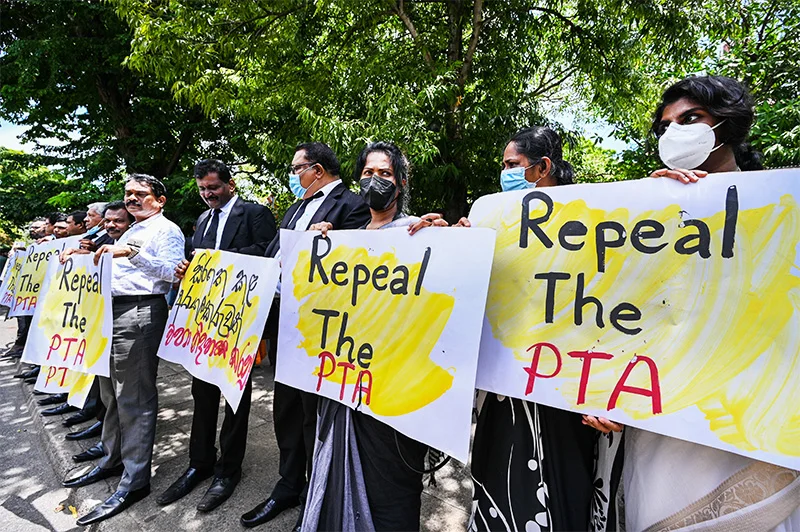
Another reform that could command bipartisan support is the repeal of the Prevention of Terrorism Act. The PTA has once again become controversial because it is being used in situations that extend beyond its original purpose. The detention of former intelligence chief Suresh Sallay under the Act, the continued incarceration of some Tamil detainees from the war period, and the arrest of individuals accused of speech related offences have all revived concerns regarding prolonged detention without trial and excessive executive power. The reason the PTA has been difficult to repeal is that it is closely associated with concerns regarding national security and territorial integrity. Introduced in 1979 as a temporary measure to confront the emerging separatist conflict, it survived through decades of war and has remained on the statute books long after the conflict ended.
At the same time, history shows that extraordinary powers are likely to be misused. Laws that permit detention without trial or broad executive discretion are rarely confined to their original purpose. Governments of different political parties have used such powers against opponents and critics. The temptation to do so is inherent in the possession of unchecked authority. The way forward could therefore be a combination of accountability and reform. The government should continue to support independent investigations and prosecutions in major corruption and security related cases. Demonstrating political will in this regard would strengthen public confidence in the rule of law and reinforce the principle that no individual is above the law. The PTA could be replaced with legislation that amends the Criminal Procedure Code and Penal Code in a manner that addresses legitimate security concerns while complying with democratic norms and human rights standards.
There are also international dimensions to consider. The European Union has repeatedly linked governance and human rights reforms, including reform of the PTA, to Sri Lanka’s continuing access to the GSP Plus trade concession. Progress on these issues would strengthen Sri Lanka’s international standing at a time when economic recovery remains a national priority. The government has a rare opportunity. It possesses a strong electoral mandate, public goodwill and a reputation for integrity that previous governments lacked. It can combine the pursuit of justice in long delayed cases with meaningful democratic reforms that reduce political resistance and broaden public support. At this time, accountability and power sharing are the two pillars which Sri Lankans need to be committed to build a just and democratic society for a better future without delay. Failure now would make for a long period of waiting for the next time.
by Jehan Perera

 A public university relies on its teachers in fulfilling its responsibilities to the wider community. While teaching remains the chief responsibility of the academic staff, they also conduct research and play a central role in keeping the university a vibrant space where they and students can freely participate in conversations that concern not just routine classroom education but also society at large. The broader intellectual culture and intellectual integrity of a university thus depend on how its academics perform their functions. Therefore, universities should take the task of recruiting their academics seriously. It is important to ensure that this task is done responsibly, transparently and credibly through a fair, thorough and multi-phased evaluation process.
As both an applicant and a member of selection panels for recruitment, I hold that the recruitment procedures, currently in place in our university system, require radical reforms. Echoing some of the concerns raised by Kaushalya Perera in her Kuppi article on recruitment in March 2026, I focus on the limitations I have observed and experienced, specifically in the recruitment of Lecturer (Probationary) and Senior Lecturer positions. The article also aims to explore how these shortcomings could be addressed.
The Advertisement
Recruitment for Lecturer (Probationary) and Senior Lecturer positions is done through an open-advertisement which also involves an interview with shortlisted candidates. Advertisements are finalised in line with a template issued by the Registrar’s Office. Generally, an initial draft, prepared by the Registrar’s Office, is sent to the relevant academic departments for revisions. The revisions have to be made within the template provided, which allows space for the mention of only specialisation requirements.
It should be noted that not all revisions to the advertisement, suggested by the Department Head, are accepted in the next round. Deans, Vice Chancellors and Registrars, who have very little understanding of the disciplines associated with the position, sometimes reject the changes proposed by the Department. Technocratic in their thinking, they don’t recognise that an academic programme can be taught by persons with specialisation in another overlapping discipline. For instance, a position in English, at a university in Sri Lanka, is very well suited to not just those who have postgraduate qualifications in literary studies but also those who are from the disciplines of Applied Linguistics, Cultural Studies or Translation Studies, as these areas are taught as sub-fields of English studies at most universities in the country. These disciplinary overlaps, even when pointed out by Heads, are often overlooked by our administrators.
In place of this process, dominated by academic administrators and registrars, the advertisement should ideally emerge, from the relevant department, in the form of a comprehensive job description. It should mention the nature of the position advertised, the kind of teaching (and research) expected, how the position relates to other positions in the department, in terms of specialisation and workload, and the ways in which the recruited candidate would contribute to overall institutional development.
There can be no one-size-fits-all model when it comes to recruitment. Individual departments vary in size, strength and specialisation requirements. Departments with sizable academic staff may want to emphasise specialisation during recruitment, whereas smaller departments may prefer generalists who can handle a wide-array of courses. Specifying the rationale for the requirements included in the job description may help potential applicants get an understanding of the position advertised and the selection panel to conduct the evaluation process in a fair manner.
Review of Applications
Once applications are received, we sometimes find promising candidates but with qualifications that don’t carry in their title the name of the discipline or the department in which the position is advertised. Sometimes the disciplines or fields of specialisation that appear in the advertisement and the ones that appear in the qualifications are not identical in nomenclature, even though the research undertaken by the applicant during their graduate studies is strongly relevant to the position advertised. Even when such applications are accompanied by strong and relevant publications, our system does not view them positively. Instead, nomenclatural differences are used to reject promising candidates. Such differences are also used as a pretext when universities want to exclude a candidate for their cultural background, political beliefs or other reasons. Even if academic departments recognise such applications, at the next stage, the administrators of the university try to veto them. We lose inter-disciplinary scholars of high academic standing because of the high-handedness of university administrators.
Selection Panels
Selection panels for academic positions typically comprise the Vice Chancellor, the Dean of the Faculty, the Head of the Department, two academics nominated by the Senate and two members of the University Council. In the case of programmes/disciplines jointly housed under a single department, if the Head comes from a discipline other than the one in which the position is advertised, they may not be able to contribute in an informed manner to the recruitment process. However, some Heads refuse to appoint nominees from the relevant discipline in their place as they view sitting on selection panels as their exclusive privilege.
Sometimes university Senates do not take the appointment of Senate nominees seriously. These appointments are decided in a hurry without serious deliberations at senate meetings packed with numerous agenda items. Sometimes even if the relevant department has suitable academics to serve as Senate nominees, the Senate chooses academics from other departments or disciplines who do not have a nuanced understanding of the requirements of the position advertised and its disciplinary parameters. Sometimes specialists in the relevant discipline may not be available at a university. On such occasions, Senates tend to fill up the positions with academics from other disciplines, instead of inviting external nominees from other universities. At a state university in Sri Lanka, I was interviewed thrice for academic positions by selection panels that comprised not even one specialist from the relevant discipline.
The Marking Scheme
The marking schemes used in recruitment have their own drawbacks. Publications are sometimes evaluated for their quantity rather than quality. The opinion of the subject specialist is not sought or taken seriously when a candidate’s research is evaluated. This is why our universities are saddled with academics who engage in plagiarism or predatory publishing. The evaluation process should be tightened in such a way to bar the entry of those who lack academic integrity.
It is worrying to see that marking schemes and schemes of recruitment penalise applicants who have excelled in their graduate studies and are well-reputed for their recent research and publications just because they did not earn a first-class or second-class upper-division pass at the undergraduate level. Our narrow focus on a candidate’s first degree prevents us from giving due recognition to how that person has gained intellectual depth over the years. Some marking rubrics, which allocate points for eye-contact and posture during the interview, dilute the seriousness associated with the academic position, de-prioritise scholarship and turn the interview process into a stage performance.
Cultural Credibility
In recruitment, many universities look for cultural credibility (a term that I borrow from the work of Sulaxana Hippisley) as an unwritten requirement. Some departments are reluctant to hire applicants who are not their alumni. Some selection panels discriminate against candidates from certain ethnic or religious backgrounds. In some departments, women are rejected because they are likely to go on maternity leave or have more domestic responsibilities than men. Gender and sexual minorities have to mute and censor their identities at interviews because they are likely to face rejection if they openly declare their orientation. We have no policies and procedures in place to ensure recruitment is conducted in an inclusive way that sees diversity as a strength.
The Way-forward
When recruitment fails, the entire intellectual culture of that university takes a hit, and several generations of students are affected. Some of the current problems, related to quality in our higher education system, stem from bad recruitment policies and practices. Instead of trying to address these issues through rigorous and inclusive recruitment practices, we try to seek solutions via band-aids like quality assurance and workshops on curriculum writing and pedagogy for university academics.
In developing alternative recruitment policies and practices, we have to demand that the needs and expectations of individual departments are heard. Our selection panels should include more subject specialists than administrators and council nominees. Most of the evaluation should be completed before the interviews, and interviews should be treated as opportunities to get to know candidates in person and pose clarifying questions rather than as occasions for full-scale evaluation. We have to be open and receptive to new, inter-disciplinary scholarship and cultural, ethnic and gender diversity. If we are unwilling to introspect and bring about these reforms and revise our marking schemes, we will continue to recruit the wrong candidates and thereby fail our students and the wider community.
Mahendran Thiruvarangan is a Senior Lecturer attached to the Department of Linguistics & English at the University of Jaffna.
(Kuppi is a politics and pedagogy happening on the margins of the lecture hall that parodies, subverts, and simultaneously reaffirms social hierarchies.)
by Mahendran Thiruvarangan
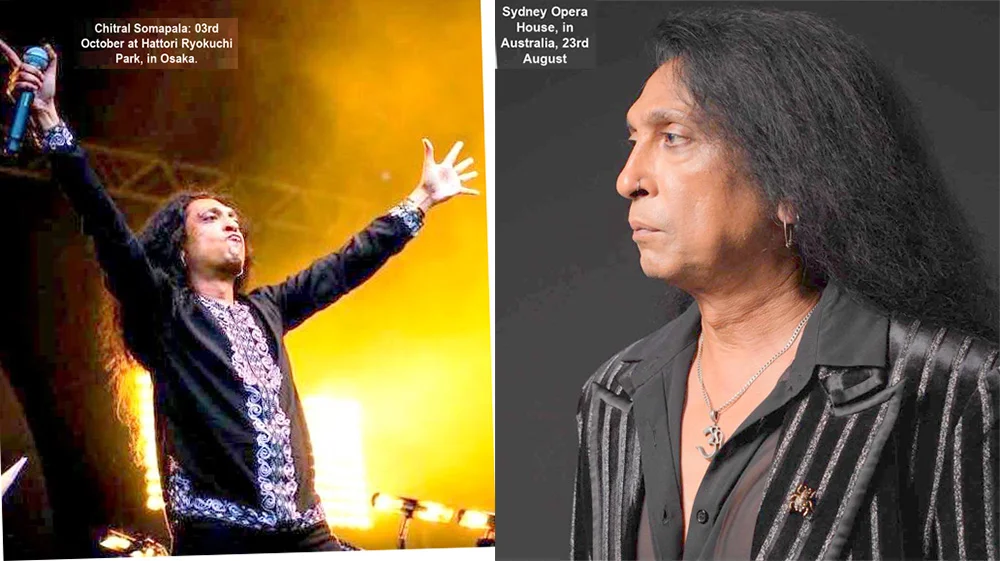
 Chitral ‘Chity’ Somapala, now based in Sweden, has been active in the music scene for many years, and is known for his hard rock work with European bands like Firewind, Power Quest, and Avalon.
In Sri Lanka, he’s a household name and that’s the reason why he checks out the local scene, on a regular basis, keeping rock music lovers in the groove.
His shows are invariably ‘full house’’ events.
Sri Lanka’s rock star is now ready to do the needful … in Japan, and rock fans in that part of the world are already gearing themselves up for a rock explosion, with Chitral in the spotlight.
The show is scheduled for 03rd October, 2026, at the Hattori Ryokuchi Park, in Osaka, with Wayo.
The blast off is from 1.00 pm onwards.
However, before he checks out the Osaka scene, Chitral has another important date in his itinerary – a spectacular Sri Lankan musical extravaganza at the Sydney Opera House, in Australia.
The concert is titled Rhythms of Sri Lanka and will be held on 23rd August, 2026.
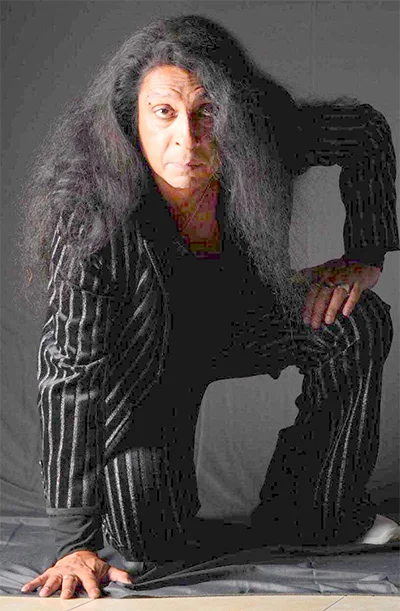
Back in Colombo soon to oblige local rock fans
Although Chitral Somapala is, indeed, a big name, as a rock artiste, he also revives the music of his parents, as well, often performing their music, along with his own songs, at live programmes.
In fact, the album ‘Dambulugale’, released in 2018, which is a tribute to his parents, famous Sri Lankan musicians P. L. A. Somapala and Chitra Somapala, turned out to be a massive hit, not only in Sri Lanka, but with Sri Lankans the world over.
The album, a compilation of various cover songs, previously written and performed by his parents, was dedicated to Chitral’s parents, and released on the 70th anniversary of Sri Lanka’s independence.
He also dropped ‘Chitral Somapala Live In Concert’, in 2023, with 22 tracks, and has several other releases to his credit.
Besides his rocking career, Chitral was asked by veteran film directors Chandran Rutnam, Asoka Handagama, Priyantha Colombage, Udayakantha and Shameera Naotunna to contribute his talent for their soundtracks, and he won a Presidential award and an International award for the movie ‘Let Her Cry’ by Asoka Handagama.
Chitral will be back in Colombo soon with another rocker for his fans, so watch out for Rock Meets Reggae.

India A beat Sri Lanka A by 8 runs in thriller

T20 World Cup: Hosts, defending champions and a bunch of hopefuls in Group 2

Trump booed in New York as he becomes first US president to attend NBA Finals

Food Policy and Security Committee meets

Auguste, Andrew and Springer recalled to West Indies’ T20I squad

China’s Xi, North Korea’s Kim pledge to boost ties at rare Pyongyang summit

‘Dates have the highest sugar content to fight Coronavirus’

Sunday Island 27 December – Headlines

#SundayIsland 17th December – Headlines

Sunday Island – 28th March

Sunday Island Headlines – 21 March

Sunday Island – 21st February – Headlines
-
 Latest News6 days ago
Kusal Mendis, Pathum Nissanka, bowlers put Sri Lanka 1-0 up
-
 News6 days ago
New US tariffs proposed on 60 countries, including Sri Lanka
-
 Features5 days ago
Power crept into the Sangha and is now tearing it apart
-

 Features5 days ago
Kondachchi wind farm and battery storage project to boost energy security, says Power Ministry Secretary
-
 Features5 days ago
Saudi Arabia sets new benchmark in Hajj management as 1.7 million pilgrims complete sacred journey
-

 News4 days ago
Asst. Manager, security officer arrested over Rs 30 mn snatch at Horana PB branch
-
 News3 days ago
Women’s T20 World Cup 2026 warm-up: Chamari Athapaththu’s 94 helps Sri Lanka beat Pakistan
-

 Editorial2 days ago
Probe Sallay’s complaint