
Features
India’s federalist check, America’s unitary President, and postcolonial Britain’s powerless PM

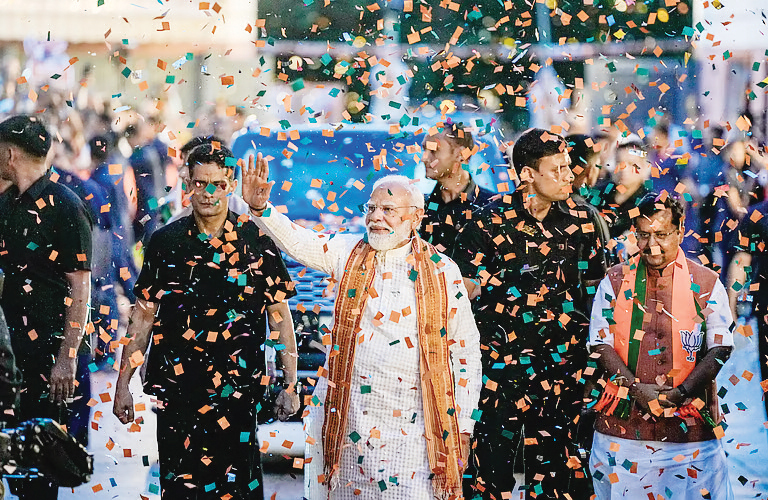
Prime Minister Modi’s BJP scored a massive victory in the April State Assembly election in West Bengal. With the victory in West Bengal, the BJP now rules every state along the Gangetic plain. “The lotus is blooming from Gangotri to Gangasagar,” Modi told cheering BJP cadres in the party headquarters in Delhi. It is “BJP from Bihar to Bengal,” he went on. The BJP already has a virtual stranglehold over India’s Hindi belt states in the middle and its multilingual western states. Only the south stands out, rebuffing the BJP one more time even while throwing out the incumbent governments in Kerala and Tamil Nadu.
The new governments in the two southern states have one thing in common – not to become Modi’s state agents. Of the other three southern states that did not have elections this year, the ruling Telugu Desam Party (TDP) is part of the BJP-led National Democratic Alliance (NDA), while Karnataka and Telangana are governed by the Congress-led Indian National Development Inclusive Alliance (INDIA).
Besides Kerala, Tamil Nadu and West Bengals, this year’s state elections were also held in the smaller state of Assam in northeast, and Union Territory Puducherry near Tamil Nadu. BJP led alliances were in power and were re-elected in both jurisdictions. But it is the victory in West Bengal that has removed from the political scene one of Modi’s and the BJP’s main regional detractors – the defeated West Bengal Chief Minister Mamata Banerjee and her Trinamool Congress. By that measure the federal check on the Prime Minister, by far the only domestic check on Modi and the BJP government, has been proportionately weakened. More importantly, the defeats of Mamata and Trinamool Congress in West Bengal, and Stalin and the DMK in Tamil Nadu, the struggling opposition alliance INDIA has lost its most seasoned regional heavyweights.
For want of a King
Inasmuch as India is the world’s largest federal parliamentary democracy, it would be interesting, if not instructive, to compare its current situation with the chaotic situations in the US – the world’s oldest, federal and presidential democracy, and in the UK – the world’s oldest parliamentary democracy. Ironically, India and the US are republics while only the UK has a King, but it is the King of England who is now actually protective of parliamentary democracy unlike the Prime Minister of India and the President of the United States. In the case of the United Kingdom, where democracy is well and thriving going by the recent local elections, not even the King can save his beleaguered Prime Minister, Sir Keir Starmer, who is facing expulsion by his Party for the trouncing it got in the local polls and defeats in Scotland and in Wales.
Yes, Scotland and Wales, not to mention England. Unitary Britain is now devolved enough to be federal. To Britain’s further credit, it holds its elections when due regardless of who is in power and regardless of whether the ruling party is in a position to win or lose. Not quite in Sri Lanka, needless to say, the timing of election has become the executive’s prerogative. And in that respect the still new NPP government is no different from every other government – yes – since independence, to recite the NPP mantra, correctly for once. One redeeming difference could be that there seems to be no consultation with astrologers, if indeed it is true.
That said, Britain’s Starmer is a strange political phenomenon. A highly accomplished lawyer, a Labour activist since his teen years and MP since 2015, duly elected as Labour leader in 2020, and Leader of the Opposition from 2020 to 2024 as the Conservatives descended into chaos in government, Starmer led the Labour Party to a massive victory in 2024 winning 411 of the 585 seats in the House of Commons, and winning in Scotland and Wales as well. But that victory was lopsided – the Labour had won 70% of the seats in parliament with only 34% in the popular vote share. Starmer’s personal popularity was a dismal 5%. A “loveless landslide,” pundits aptly chimed in. The lovelessness is now showing.
For all his impressive Labour Party resume, Sir Keir Starmer simply lacks the basic political touch with the people. He posses neither the sales charm of Tony Blair or the political heft of Gordon Brown. The lackluster performance of his government was compounded by a grave political misjudgement in the appointment of Labour’s well connected, yet the oldest Party hack, Peter Mandelson as British Ambassador to the US. Mandelson’s nefarious connections to Jeffrey Epstein, the disgraced the American pedophile, shook the British establishment including the Royal Family. Starmer became the whipping boy for all of Britain’s political angsts.
In fairness, Starmer is also symptom of the crisis in British politics, a crisis that is rooted in the country’s sluggish economy and its political ambivalence. To save his bacon, Starmer is literally going back to the future – promising to nationalize steel and vowing to reverse Brexit without undoing it. Obviously, these measures resonate well with the British public. Paradoxically, at the same time, the British voters are not averse to voting for Nigel Farage’s Reform UK, the successor to his Brexit Party that conned old Britishers into leaving the European Union. While Reform’s wins in the local elections are truly impressive, it is also true the combined Labour-Liberal-Green votes easily outnumber Reform’s support. A common electoral alliance of the three would seem logical but may not be feasible.
A leadership battle is brewing in the Labour Party. Starmer seems determined not to quit, despite calls for his departure by four resigning ministers and over 100 MPs. He seems to think that he can withstand a leadership challenge which seems likely to come from the Health Secretary, Wes Streeting. It will be a bruising battle and could turn out to be a pyrrhic victory for the winner. For now, the Prime Minister is going through the motions including the customary King’s Speech delivered on Wednesday laying out the government’s agenda for the new session of parliament.
Before the Labour Party’s local election debacle and the current crisis, the King and Queen of England visited the United States of America to commemorate the 250th Anniversary of American independence. Addressing a Joint Session of the Congress on April 28, King Charles III evoked the central significance of Magna Carta, the Great English Charter of 1215, for the American Bill of Rights of 1791, and as “the foundation of the principle that Executive power is subject to checks and balances.” The King even noted that Magna Carta has been “cited in at least 160 Supreme Court cases since 1789.”
What the King could obviously not have said is the fact that the hallowed principle of checks and balances involving Executive power is being blatantly violated by America’s president unlike at any time before in the country’s 250 year history. Interestingly, according to the same source that totted up the 160 Supreme Court cases citing Magna Carta, the current Court under CJ John Roberts has not cited the Magan Carta in any of its rulings. Not even in the case involving President Trump and presidential immunity and the ruling in which it has given the current incumbent the freedom to act ignoring Congress, and without checks and balances.
Trump has combined and adopted two controversial presidential traditions that arose in the 20th century. The ‘imperial presidency’ of Richard Nixon that was soon reined in the aftermath of Watergate, and the ‘unitary presidency’ of Ronald Reagan aimed to remove the shackles after Watergate and assert that a president had absolute power over the executive branch. The conservative Supreme Courts judges subscribe to the unitary school and are happy to use their majority to entrench it judicially, while deliberately ignoring Trump’s excesses as passing problems. Trump has chosen imperial bullying as his foreign policy weapon, and ignoring checks and balances for domestic administration.
The war in Iran has exposed Trump’s limitations overseas even as it has worsened his unpopularity at home among all Americans except his core MAGA supporters. The Chinese seem to be making this obvious in the reception they are giving Trump this week in Beijing that is quite a comedown from the grandness of the reception he was given during his first term state visit. Trump would certainly be hoping for China to use its influence on Iran to get a deal to end the war. While the war now appears to be in a prolonged stalemate, there is no respite for the global economy from the crisis that the war has created. Neither Iran nor China is in any hurry to help Trump out. The war is his making and he is bearing the cross for it. He can blame Netanyahu but that will be admitting failure. And the Americans are virtually stuck with him until his term runs out.
In Britain, members of parliament can come together to overthrow an unpopular government, the cabinet of ministers of the Conservative Party can force a Prime Minister to quit, or the government members of the Labour Party can get rid of their Prime Minister by forcing a leadership contest. By rule and convention, the parliamentary system provides such flexibility between elections. There is always the risk of revolving door Prime Ministers as it has happened with the Conservative Party government in 2022. But no British Prime Minister can wreak havoc and stay in power for his full term, as President Trump is proving to be in the US. The November midterm elections to Congress are widely expected to flip control of the House to Democrats, and potentially of the Senate as well. Both assemblies are under Republican control now and Trump has dictatorial power over the Republican Party in both the House and the Senate. There is no separation of powers and there are no checks and balances at the federal level on the executive.
To avoid Democrats taking control of the House in November, Trump is forcing the states under Republican governments to rejig electoral boundaries and regulate voting rights by insisting on impractical identification and location requirements. The Supreme Court has taken a hands off approach to these matters by conveniently calling them political issues. Put another way, rights can be denied so long as they are a political matter. But Trump is not having his way as not all the Republican states are ready to do the President’s bidding. And the states under Democrats are doing their own rejigging, and the whole political system is narcissistically caught up in this electoral mayhem. There is little space, time and energy left to deal with ‘the excursion’ in Iran and its economic effects on the world.
India’s Midterm
In India, on the other hand, to complete the circle of my detour today, Prime Minister Modi and the BJP government would seem to have been able to execute, rather easily, election interferences in some of the state assembly elections – that President Trump is unable to achieve in time for the November midterm elections in America. The Election Commission of India, traditionally one of the more trusted public institutions in the country, has recently been facing allegations of fraud, manipulation, and tampering with electoral lists to remove real names and fake names. These misdoings are also alleged to have been undertaken by election officials to favour the ruling BJP government.
These allegations first surfaced in the assembly elections in Bihar last year, and are now alleged to have been a major factor in West Bengal elections this April. Central to these allegations is the Special Intensive Revision process that is used to update electoral lists by verifying voter information, including relocations, deaths etc. In Bihar, the intensively revised new voter list showed 72.4 million voter names – 6.5 million fewer than the previous list. The publication of the omitted names and opportunity to appeal have not been straightforward. The BJP/NDA won the November 2025 election in Bihar with 202 out 243 seats, and BJP alone won the largest number of seats for the time in Bihar. The defeated opposition contended that the SIR scheme played a role in the BJP’s runaway victory.
Bihar’s electoral experience repeated itself in West Bengal this year and with even more allegations about the Special Intensive Revision process. The BJP/NDA won 207 seats out of the total 294 seats, with Trinamool (grassroots) Congress winning 80 seats, and Bengal’s once mighty Communist Party, under a very popular Chief Minister Jyoti Basu for over 30 years, reduced to a humiliating single seat. The SIR allegations contend that in over 100 seats that BJP won, the number of voters eliminated by SIR is greater than the difference in the number of votes between the BJP and Trinamool. Modi and the BJP also played the anti-Muslim card vigorously, raising the spectre of illegal migrants from Bangladesh. The same anti-Muslim playbook of Trump and every other right wingnut in Europe.
Perhaps for the first time in 40 years, the same political party is in government in Delhi and in Kolkata, and it creates a new dynamic for the triangular relationship between India, West Bengal and Bangladesh. Through the early partition of Bengal and the later bifurcation of the two distant (East and West) wings of Pakistan, the cross-border Hindu-Muslim populations of the two countries have maintained their cultural affinities and even established a sizable informal economy between them. The concern now is that if the relationship between Delhi and Dhaka were to deteriorate that could impact the livelihood of millions of people who now straddle the border for economic survival.
In the two southern states of Kerala and Tamil Nadu, the incumbent governments were thrown, but with a difference in what replaced them. In Kerala, the Communist Party Marxist (CPM) and to far lesser extent, the Communist Party of India (CPI) have maintained their strong bases unlike their rather corrupt comrades in West Bengal. Elections have periodically swung between the Left Democratic Front (LDF) of the two Communist Parties and smaller parties, and the other progressives, and the United Democratic Front (UDF) led by the Congress Party and also somewhat left of centre. The LDF won the last two elections and was hoping for a threepeat.
The voters thought otherwise and gave the reins to the UDF with a convincing 97 out of 140 seats. Kerala now turns out to be the most secular political home for the Indian National Congress, once the great banyan tree of all political organizations in India. Nehru once opined without exaggeration: ” India is Congress, Congress is India.” The greater historical irony is that it was Rahul Gandh’s grandmother Indira Gandhi, as Congress President without any elected position, who masterminded the presidential expulsion of Kerala’s, and the world’s, first elected Communist Government led by EMS Namboodiripad in 1959.
Tamil Nadu is a different story and is literally writing a new script after electing actor-turned politician Joseph Vijay and his Tamilaga Vettri Kazhagam (Tamil Nadu Victory Party) with the largest majority – 108 out of 234 seats, 10 seats below the required majority. For the first time, there will be a new government in Tamil Nadu without either of the Dravidian duo – the DMK and its alter ego ADMK. The ruling DMK was widely expected to win, and Chief Minister Stalin had run an efficient administration. But ruling familial corruption, in spite of the Chief Minister, a sense of boredom among otherwise well ensconced young voters would seem to have propelled the matinee star to the seat of power. He is now in government with the support of the Congress Party and the two Communist Parties. But there are two scripts to the State of Tamil Nadu: the political script that is all theatrical, and the economic script that is all good business. Tamil Nadu is one of the strongest economies in India. That is often lost in the commentaries on the state’s theatrical politics. The challenge to the new Chief Minister is to keep the economy going and not go into a slump.
by Rajan Philips


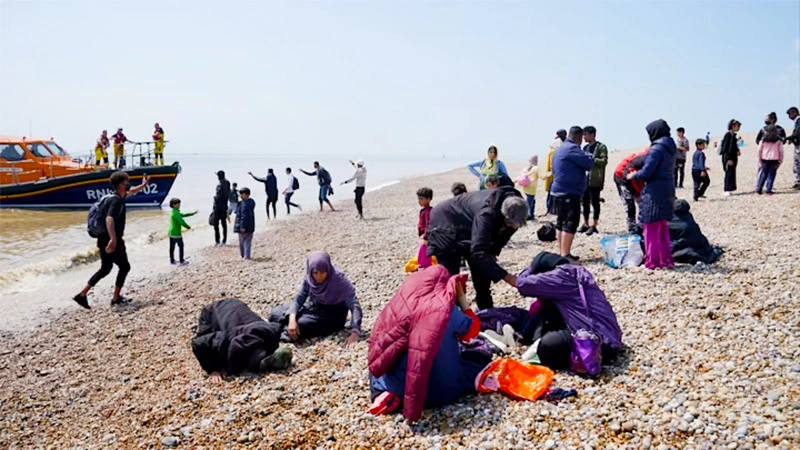
 The announcement by the US authorities of an anti-migrant stance during a recent commemoration in France of the epochal D-Day Landings of June 6, 1944, ought to strike impartial observers as a supreme irony. Whereas what should have been expected was a vibrant celebration of the beginning of the process of Western Europe freeing itself decisively from Nazi or fascist control during the crucial stages of World War Two, this was not to be.
What the world heard instead was a call to contemporary Western Europe to arm itself against a seemingly rising and threatening migrant presence in the region. In other words, the migrant must be despised and ‘shown the door’.
Instead of a commemoration that rejoiced in the flourishing of liberal democracy and its values what one got was a strong affirmation of fascism and racial chauvinism. US Defense Secretary Pete Hegseth vented his spleen against the migrant or foreigner presence in Europe reportedly thus: ‘Sadly today different European beaches are stormed by different dangerous ideologies.’ To ‘beaches in Spain and Italy and Greece and Bulgaria, boats and men arrive. When will European capitals do something about that invasion?’
While at the outbreak of World War Two it was Nazi Germany that was doing the invading and bringing some principal European countries under its suzerainty, this time around we are being given to understand that it’s migrants to the West who are seeking to colonize the latter. It goes without saying that such inflammatory rhetoric would have the deleterious effect of keeping racial tensions alive in the West and jeopardize all possibilities of the countries concerned cementing and maintaining social stability.
The Trump administration gives the impression of taking a leaf from the politically underdeveloped regions of the South to keep the US polity stable and united. In South Asia, for instance, we are not short of ambitious demagogues who use what is referred to as the ‘race card’ to gather unto themselves a following and thereby further their political fortunes. By seeking to stir and sustain anti-migrant hysteria, the Trump administration is also essentially replicating Nazi Germany’s policy of anti-Semitism. That is, fascism is very much alive in the US under President Trump.
Such efforts at churning racial hysteria at this juncture in the US should not come as a surprise. For all intents and purposes, the Trump administration is nowhere near achieving its aims in West Asia, for instance, in the short term. It has failed to bring Iran down to its knees, as it hoped to do, but is adopting the expedient of keeping the world guessing and confused on what it is doing in the region, since it cannot withdraw from the theatre in a hurry without losing face.
While perhaps working out an escape strategy the Trump administration it seems, is hoping to maintain its following at home intact and silent by playing on their racial biases and insecurities. Hence, the anti-foreigner campaign.
Simultaneously, the Trump administration will need to keep a close eye on how economic pressures on the domestic front are panning out. Anti-administration sentiments first break to the surface at meal tables. On this score, the news cannot be good because the average US family’s spending power ought to be shrinking on account of rising energy and oil prices. Consequently, it would not be a bad idea to keep the attention of the US consumer diverted by adeptly playing ‘the race card’; once again, lessons from intellectually bankrupt Southern politicians are coming in handy.
To be sure such comparisons many politicians in vibrantly democratic countries would find quite unflattering. But the stark truth is that racism cannot be tolerated in civilized societies and those politicians who resort to it risk being branded as racists of the first degree. In fact they could be seen as being on par with the likes of German dictator Adolph Hitler and his close collaborators.
However, on the question of migrant policy the Trump administration would likely be at polar opposites with the most vibrant of liberal democracies of the West. This will be the case with the UK, France and Italy for instance. The latter continue to keep their doors open to legal migrants and they are likely to view a virtual blanket ban on migrants as reprehensible.
Moreover, in the foremost democracies of the West debates are vibrantly ongoing on the need to keep racism or any hint of it completely outlawed in the public plane. There is the case of the UK, for instance, where the authorities continue to emphatically pinpoint their adherence to the principle of anti-racism in the conduct of public affairs.
One proof of the above was the parliamentary debate relating to the killing of 18-year-old Henry Nowak in Southampton. Police handling of the victim came in for sharp scrutiny by particularly the opposition in the House of Commons but there seemed to be a consensus over the main political divide that the matter should not be politicized.
Moreover, the UK authorities stressed in the House the government’s strict adherence to the policy of non-racism. It was also pointed out that British institutions set up to manage racism at the national, county and neighbourhood levels, for example, were very much intact. In fact, Sri Lanka could gain considerably by studying and implementing locally, legislation modeled on the relevant UK laws if it is in earnest when it speaks of ‘reconciliation’.
Accordingly, it is highly unlikely that Western Europe would ‘cave in’, so to speak, to US pressure on issues related to migration. The liberal democracies of Western Europe in particular would remain for the foreseeable future migrant-welcoming, multi-ethnic and plural democracies.
Nor is it likely that Western Europe would be passively receptive to US demands that it drastically increases its defense spending to meet the latter’s aims. Within the Western fold the EU is remaining committed to backing Ukraine, for instance, in its ongoing armed resistance to the Russian invasion and it is not giving any indication of being deferent to US pressure.
However, although tensions would continue to bristle within US-Western Europe relations on the above and numerous other matters of contention it would be far too premature to announce a parting of company between the two sections of the West. In that sense, the post-World War Two order remains essentially intact. There are still many things in common between the two, particular on the economic plane, that will ensure the continuance of the partnership.
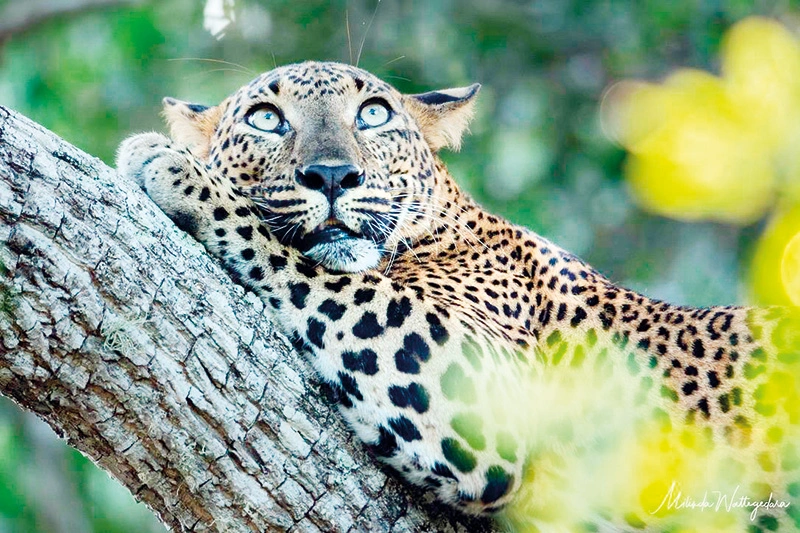
The first rays of dawn creep over the ancient rocks of Yala. The Indian Ocean glimmers in the distance, and the wilderness slowly awakens. Somewhere amid the scrub jungle, a pair of amber eyes scans the landscape.
For wildlife conservationist and leopard researcher Milinda Wattegedara, moments such as these have defined more than a decade of dedication to one of Sri Lanka’s most iconic creatures—the Sri Lankan leopard.
What began as fascination evolved into a remarkable conservation journey that has transformed the understanding of Yala’s leopard population and placed Sri Lanka firmly on the global wildlife research map.
“Long before I ever lifted a camera, leopards had already captured my imagination,” says Wattegedara. “What fascinated me was not merely their beauty but the complexity of their lives—their hunting strategies, movements, reproductive behaviour and their remarkable ability to adapt to changing environments.”
That fascination led to the birth of the Yala Leopard Diary in 2013, an ambitious long-term project dedicated to documenting individual leopards and unraveling the mysteries surrounding their lives.
For many visitors, a leopard sighting is a fleeting thrill. For Wattegedara and his team, every encounter is a chapter in an ongoing scientific story.
“Each photograph was never the end of an encounter,” he explains. “It was the beginning of deeper questions. How did a particular leopard use the landscape? How did its behaviour change with the seasons? What environmental pressures shaped its decisions?”
These questions drove years of meticulous fieldwork. Every sighting was carefully recorded with details including location, habitat, behaviour, date and time. Photographs were analysed to identify individual animals through unique spot patterns, allowing researchers to distinguish one leopard from another with remarkable accuracy.
What followed was groundbreaking.
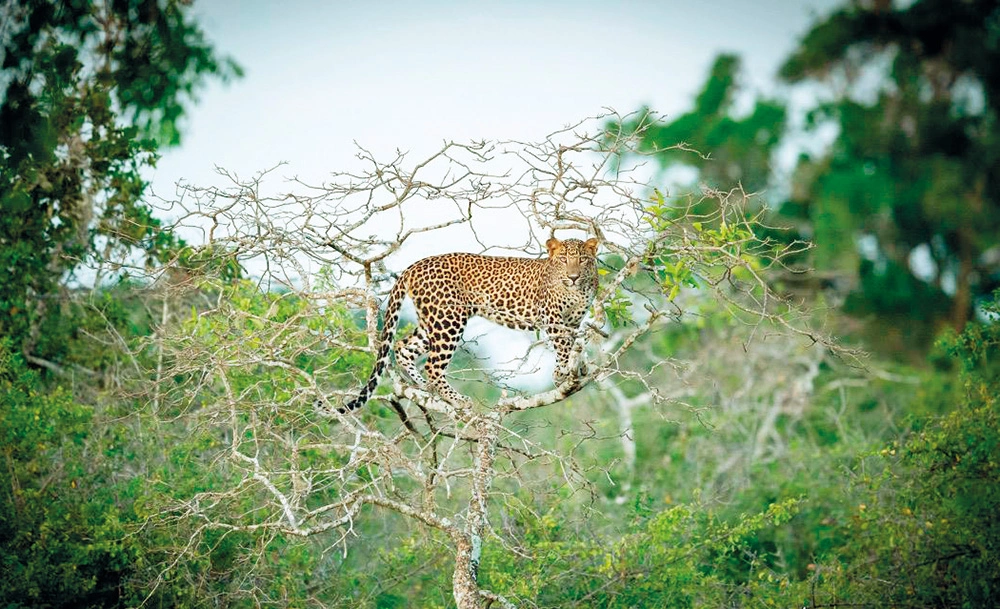
YF77 “Shelly” pauses in quiet observation, embodying the alertness
and grace that define Yala’s leopard population.
From 2013 to 2026, the Yala Leopard Diary identified an astonishing 189 individual leopards within the Yala Block 1. The research revealed a leopard density of approximately 0.524 leopards per square kilometre, making Yala one of the highest leopard-density landscapes ever recorded anywhere in the world.
Such findings have elevated Yala’s status among global wildlife researchers.
Nestled between the Indian Ocean and a mosaic of habitats, ranging from rocky outcrops to dense scrub forests, Yala offers an ecological stage unlike any other.
Here, leopards are photographed silhouetted against ocean horizons, perched atop ancient granite formations, resting on tree branches and stalking prey across sunlit grasslands.
The images tell stories of extraordinary lives.
There is Haminee, a devoted mother navigating the challenges of raising cubs in a competitive landscape. There is Lucas, one of Yala’s most frequently documented males, striding confidently across the Gonalabba Plains with the vast ocean forming an unforgettable backdrop.
There is Ruki demonstrating the species’ incredible strength by hoisting prey onto branches, and Shelly, quietly surveying her surroundings in a moment of feline vigilance.
Together, these individuals have become familiar characters in a living wilderness drama.
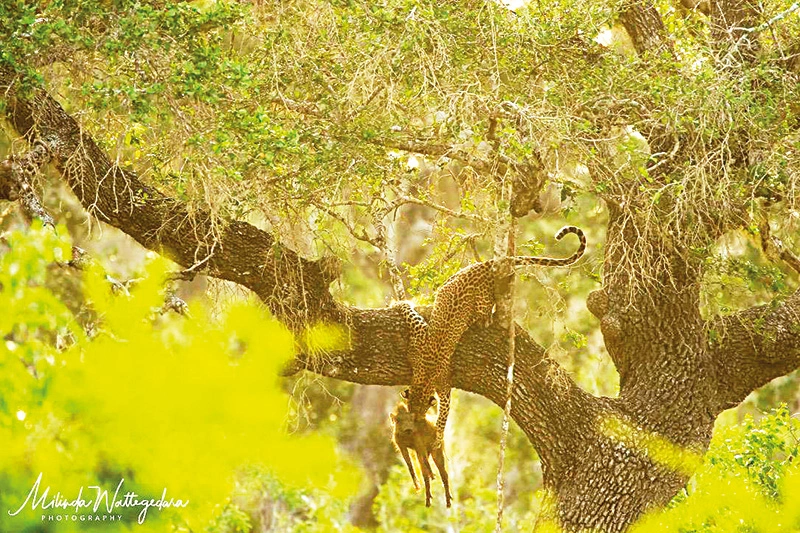
YM31 “Ruki” secures prey on a branch, illustrating the remarkable strength and coordination of the Sri Lankan leopard.
Recognising the immense value of long-term documentation, Wattegedara joined forces with fellow researchers Dushyantha Silva, Raveendra Siriwardana and Mevan Piyasena to establish the Yala Leopard Centre in 2020.
Located at the Palatupana entrance to the Yala National Park, the centre is believed to be the world’s first information facility dedicated exclusively to leopards.
“The centre serves as a repository of knowledge, accumulated through years of observation and research,” Wattegedara says. “Our goal is to connect visitors with the science behind conservation and foster a deeper appreciation of these magnificent animals.”
The project’s impact extends far beyond Sri Lanka’s borders.
Research arising from the Yala Leopard Diary has been published in internationally recognised scientific journals. One study introduced an innovative framework for identifying individual leopards, while another documented an extraordinary and previously unrecorded case of a leopard cub being consecutively adopted by two different adult females—first a relative and later an unrelated leopardess.
The discovery attracted international scientific attention and highlighted the complexity of leopard social behaviour.
Yet for Wattegedara, the most important lesson remains one of humility.
“One conclusion has become increasingly clear,” he reflects. “Our understanding of these leopards remains far from complete. We are only beginning to understand how they live, adapt and persist in one of Sri Lanka’s most dynamic protected landscapes.”
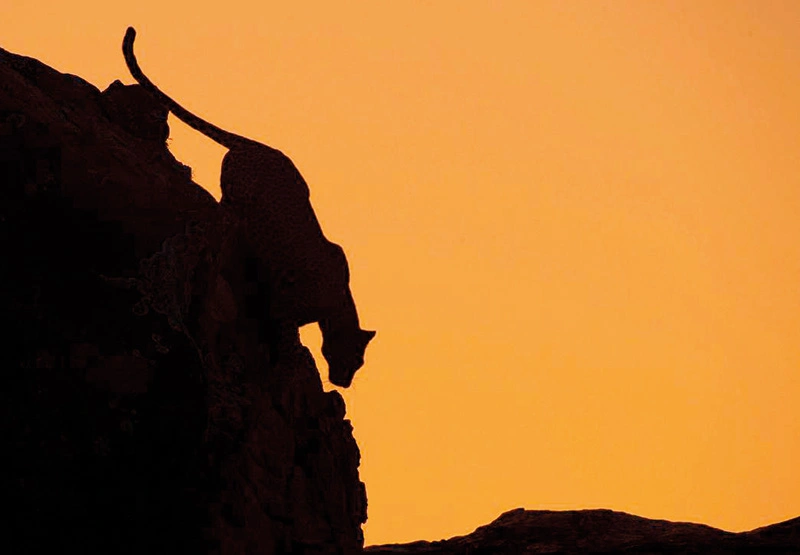
YF15 “Hope” descends Rukvila Rock at dawn, showcasing the agility and adaptability of Yala’s leopards.
His words underscore an essential conservation truth: the more we learn about nature, the more mysteries emerge.
As Sri Lanka navigates growing environmental challenges, the Yala Leopard Diary stands as a shining example of what sustained observation, scientific curiosity and public engagement can achieve.
Beyond the stunning photographs and remarkable sightings lies something even more valuable—a growing body of knowledge capable of informing future conservation decisions and ensuring that future generations inherit a wilderness where leopards continue to roam free.
For more than a decade, Wattegedara and his colleagues have followed the tracks of Yala’s elusive predators through dust, rain and scorching heat.
Their work has revealed that every leopard has a story, every sighting has significance and every photograph can contribute to conservation.
And perhaps, most importantly, it has reminded us that the golden ghosts of Yala still have many secrets left to share.
By Ifham Nizam

 Sri Lankans are quite active, all around the globe.
News has just come my way, from Glasgow, in Scotland, where the glamour of masks, music, dancing, and community spirit, came together, in spectacular fashion, at Masquerade Night, bringing together members of the Sri Lankan community for an evening filled with music, fashion, food and entertainment.
Organised by Mahesh Balaaratchi (DJ Mowgli) together with Sulochana Asmone, Hiroshini, Prasad, Ashi, and Shawn, the evening provided guests with an opportunity to socialise, enjoy live entertainment, and celebrate in a unique and elegant setting.
Guests arrived from 6:00 pm, dressed in formal attire and decorative masks, creating a colourful and vibrant atmosphere throughout the venue.

DJ Mowgli: The main
organiser of
Masquerade Night
There was a delicious selection of Sri Lankan cuisine and street food, which proved popular throughout the evening.
The buffet offered a variety of traditional favourites, giving attendees a taste of home while adding to the festive atmosphere.
Entertainment was provided by DJ Mowgli, whose performance kept the audience engaged throughout the night. His playlist featured a mixture of popular favourites, dance classics, and cultural music, remixed for a younger generation.
One of the highlights of the evening was the Baila session, which brought a distinctly Sri Lankan flavour to the event.
The Baila segment highlighted the importance of preserving and celebrating cultural traditions, while bringing people together through music and dance.
As familiar rhythms filled the room, guests enthusiastically took to the dance floor, creating one of the most memorable moments of the night.
 The crowd was described as lively, energetic, and welcoming, with attendees embracing the spirit of the masquerade theme while enjoying the opportunity to reconnect with friends and meet new people. The family-friendly atmosphere ensured that guests of all ages could take part in the celebrations.
The festivities continued until midnight and included a range of competitions and entertainment.
Children and adults alike participated in fashion shows, while guests competed for awards in several ‘Best Dressed’ categories.
The creativity and effort displayed in both costumes and formal wear added an extra layer of excitement to the evening.
As the final songs played and guests prepared to leave, many were already looking forward to the next Event Night.
The evening’s proceedings were handled by Sam, Mahela and Isuru.
Their enthusiasm reflected the growing popularity of these gatherings and their increasing importance, within the local community calendar.
A series of community events has continued to grow in popularity among the Sri Lankans in Glasgow, with Halloween Night coming up on 31st October.

Prabhsimran, Gaikwad, Tilak score fifties in DLS loss to Afghanistan A

India-born Nikhil Chaudhary called into Australia T20I squad

Men’s ODI World Cup 2027 set to run from October 4 to November 21

UN Humanitarian Priorities Plan (HPP) for Cyclone Ditwah successfully concluded

President chairs discussion on potential El Niño impacts and institutional preparedness

New Sasakawa Memorial Sri Lanka–Japan Cultural Centre reflects enduring friendship between Sri Lanka and Japan – PM

‘Dates have the highest sugar content to fight Coronavirus’

Sunday Island 27 December – Headlines

#SundayIsland 17th December – Headlines

Sunday Island – 28th March

Sunday Island Headlines – 21 March

Sunday Island – 21st February – Headlines
-
 Features7 days ago
Power crept into the Sangha and is now tearing it apart
-
 Features7 days ago
Kondachchi wind farm and battery storage project to boost energy security, says Power Ministry Secretary
-

 News5 days ago
Women’s T20 World Cup 2026 warm-up: Chamari Athapaththu’s 94 helps Sri Lanka beat Pakistan
-
 Features7 days ago
Saudi Arabia sets new benchmark in Hajj management as 1.7 million pilgrims complete sacred journey
-

 News6 days ago
Asst. Manager, security officer arrested over Rs 30 mn snatch at Horana PB branch
-

 Editorial4 days ago
Probe Sallay’s complaint
-

 News5 days ago
Lankan-Canadian inducted to Toronto Sports Hall of Fame
-
 News2 days ago
Local firms move millions of dollars overseas for phantom imports: Govt.