
Features
President-elect Trump and First Lady Elonia celebrate Thanksgiving at Mar a Lago


Many Trump dubious cabinet nominations unlikely to be confirmed
by Vijaya Chandrasoma
I would like to explain why I continue writing so shamelessly about a subject about which recent events have proved I know next to nothing.
In my defense, the news I have reported over the years has been always been based on facts and the traditional “reliable sources”. Unfortunately, my opinions and predictions have been personal and out of touch with the current political and social climate prevailing in the United States, which has changed substantially since the turn of the century.
I had little interest in politics in the USA during the two decades I lived there. We spent the 90s struggling for survival, doing menial jobs, which is the lot of most immigrants without American educational qualifications and work experience. But by the time I decided to retire in Sri Lanka 20 years later, we had achieved the one ambition that mattered to us. Our children had grasped the wonderful educational opportunities available during the Clinton years to kids who were prepared to work hard, as mine were. They have been amply rewarded for their efforts.
My imagination was captured by the noble aspirations of Senator Barack Obama, an African-American who, in 2008, was shooting for the skies, against all odds. I was a valued volunteer in the Obama presidential campaign office in Phoenix, Arizona, performing such vital tasks as licking stamps and answering telephones in my thick Sri Lankan accent. When Obama was elected the first black president in US history, I, like many an American, was elated that my adopted country had finally turned the racist corner. Man, were we wrong!
I retired in Sri Lanka after the war at home ended in 2009. I had little interest in Sri Lankan politics, though I was struck with grief and disgust at the way our politicians were stealing our beautiful island blind, robbing from the poorest of the poor. But like many self-serving dilettantes of the privileged class, able to comfortably weather these deteriorating economic conditions, my social conscience was conspicuous in its cynical absence.
In any event, I dared not protest against the corrupt politicians in “power”, who held no brook with those who attempted to publicly exercise their constitutional rights of free speech including publication, armed as they were with their own extra-military goon-squads and the infamous “white vans”. Journalism in Sri Lanka was not, in those days, the healthiest of occupations.
I have every confidence that, prayerfully not too late, we have finally replaced a series of crooked governments since Independence with a patriotic leader and a party of politicians intent only on the country’s prosperity and not on their own. A government elected with enormous goodwill, with the hope that a nation with great resources, human and natural, will be administered competently to finally reach its full potential.
With the kind of integrity, discipline and national pride that has transformed Singapore, a shanty town in the 1960s, to one of the most advanced, prosperous city-states in the world, Sri Lanka in the 1950s was one of the richest of British colonies. We could have surpassed Singapore if we had our own Lee Kwan Yew, who once famously said. “I had to choose between democracy and discipline. I chose discipline”.
There is every hope that our present leader will be that Sri Lankan Lee Kwan Yew, even 70 years too late, who will also choose ruthless discipline against international-scale corruption, political extravagance and departmental wastage, the disgusting hallmark of every past Sri Lankan government, which had reached a crescendo of corruption in the new century.
Democracy is a luxury we can enjoy after we have set our house in order. Just like Singapore, a vibrant, prosperous, disciplined democracy today.
So long as President Obama was rescuing the USA from the near economic recession he inherited from the younger Bush, and doing so with competence, grace, compassion, without a trace of political or personal scandal; and so long as my adopted home was progressing inexorably towards its final destination of that Shining City on a Hill, I found no need to express my thoughts on paper.
Until the nation hit a roadblock, when the despicable Donald Trump defeated Hillary Clinton, probably the most qualified candidate in history, for the presidency in 2016. An election that proved conclusively that America remained a deeply racially and ideologically polarized nation. In a perverse sort of way, we should thank Trump and the Republican Party for exposing how Americans really feel, which is far removed from the sanctimonious bull shit they have been feeding the world over the years.
I felt compelled to write, for my own pleasure, an essay about the disaster that my adopted home had wrought upon itself. I sent this essay to my aunt, Ms. Vijita Fernando, distinguished Gratiaen Prize winning journalist/author, who had spoilt me relentlessly since I was in my early teens. She encouraged me to submit this essay to my old friend, the editor of the Sunday Island, who, to my surprise, published it. So at age 75, I became a “journalist”, and enjoyed the heady emotion of seeing my name in print. Writing also provided me with the occupational therapy that helped me occupy my time with a pastime I had always enjoyed.
Donald Trump had inherited a booming economy from President Obama, with 75 weeks of consecutive economic growth and the lowest unemployment rate in decades. I will not repeat details of Trump’s disastrous first term, with enormous tax cuts to benefit the wealthiest, moronic claims that climate change was a hoax and deregulation of environmental pollution laws imposed by President Obama; criminal mismanagement of the Covid pandemic which cost over 650,000 American lives; these were just the “highlights”.
I continued writing on a regular basis about Trump’s criminal misadventures, and when the US electorate came to its senses and dumped him in 2020 in a landslide, and elected President Biden, my relief was palpable. I published a book (for friends and family, not for sale, you may call it an ego trip), which ended with the speech of Oliver Cromwell, on the forcible expulsion of the corrupt and duplicitous Rump Parliament in England in 1653. The last words of that speech were:
“Go, get you out! Make haste! Ye venal slaves be gone! So! Take that shining bauble there, and lock up the doors.
“IN THE NAME OF GOD GO!”
Most appropriate words for Trump and his neo-Nazi Republican cronies of 2020.
Only, those venal bastards didn’t go. Instead, the MAGA (Make America Great Again), white supremacist section of the Republican Party, incited by defeated but incumbent President Trump, tried to violently impede the peaceful transition of power, when a white supremacist mob stormed the Capitol. A felony of sedition. Trump left the White House without observing any of the traditional ceremonies for the changing of the presidential guard. In leaving, he stole boxes of top-secret documents which belonged to the National Archives. A felony of espionage.
The leaders of the Republican Party, who initially denounced Trump, and held him accountable for the crime of inciting the insurrection on January 6, endangering their own miserable lives and the lives of their Congressional colleagues, changed their tune, kissed the ring and made him their Supreme Leader.
So I decided to resume writing, with the ambition of compiling a second book when the criminal Trump, saddled with four indictments, 91 felonies, impending sociopathic dementia and dictatorial hallucinations, would surely be decisively defeated in the presidential election of 2024.
I was, yet again, proved spectacularly wrong. I had, yet again, shown my complete ignorance of the national psyche of the modern United States.
A totally different American electorate, one which voted against the incumbent Democratic administration purely because of high prices and inflation; which voted instead for a proven loser who led a Party which openly espoused a campaign of fear and racial hatred. An electorate too myopic to see that these current high prices and inflation were the result of the near recession that the Biden administration inherited, which had, after four long years, been brought under control by rational and bipartisan legislation. They paid no heed to the opinion of leading economists that the US economy was the strongest and the “envy of the world”. And would only get better.
Instead, they opted for an administration whose proposed economic policies of high tariffs and tax cuts for billionaires and corporations will only bring more grief to the working classes; and whose authoritarian, white supremacist policies will spell the end of democracy in the cradle of democracy.
Even women, who had been deprived of their reproductive freedoms by the most corrupt right wing Supreme Court in history; black males and Latinos, who had been the brunt of Trump’s obscene insults; they incredibly supported this obviously white supremacist authoritarian movement.
A movement financed by billionaires, led by the richest man in the world, Elon Musk, who had financed the Trump election campaign and has been his constant companion at Mar a Lago since the election, the honored family guest at Thanksgiving.
I will conclude this essay with a few undeniable facts. Trump’s felonious conduct is beyond doubt. He has been elected president for a second term, with a jail sentence and trials for felony charges for sedition, obstruction of justice and espionage hanging over him, which would have seen him languishing in federal prison for the rest of his life had he lost the election.
Trump’s selected cabinet is composed almost entirely of yes-men and women, singularly lacking in the morals, intelligence and qualifications, even the confidence of traditional allies, to manage the departments of the most powerful country on the world. Their only essential qualification – blind loyalty to Trump.
Trump’s nomination for Attorney General, depraved Congressman Matt Gaetz, was forced to withdraw his nomination when swirling allegations of sex trafficking and raping underage girls made his confirmation impossible by even Trump’s lapdog majority Senate.
His choice for Secretary of Defense, Pete Hegseth, is a doozy. A marine who served two tours in Afghanistan and Iraq, his only “administrative” experience is as a weekend television host on Fox TV. He has numerous police charges for drunken and disorderly conduct, and sexual assault. Hegseth also believes that torture like waterboarding and war crimes are justified under certain circumstances, and women have no role in military combat. He flaunts a white supremacist tattoo on his body. A lifelong alcoholic, who his Fox colleagues say was often drunk on the job, he has sworn to lay off the booze if confirmed. He even got his mommy to plead on Fox TV that her son is “a changed man”, capable of running the largest bureaucracy in the nation, with three million employees worldwide and an annual budget of $850 billion. After all, he did promise to stay sober on the job.
Hegseth will probably not survive the confirmation process in even the most servile Senate in history. Nor will several other of Trump’s highly dubious cabinet choices : Kash Patel (FBI Director), Tulsi Gabbard (Director of National Intelligence), Robert F. Kennedy Jr (Health Secretary), to name just three. But not to worry, there are plenty more of those creepy nutcases around that Trump will ultimately get confirmed. All they’ll have to do to keep their jobs would be to nod.
President Biden had earlier indicated that he would not be using his presidential powers to pardon his son, Hunter, who had been on trial for two minor charges, committed when he was a drug addict. One, for tax evasion – the back taxes have since been fully paid, with late fees. Two, for the purchase of a gun while he was a drug addict, which was never used in the commission of a crime. A Class E felony, which would been dismissed with a slap on the wrist for a first offender, had his name been anything but Biden.
Hunter is completely sober today.
But President Biden, mindful of the retribution threatened by the Trump’s nominees for Attorney General, Pam Bondi and FBI Director, Kash Patel, against Trump’s imagined “enemies”, knew that Hunter would be tormented, and have the book thrown at him, to a maximum of 17 years’ jail time.
So President Biden lied, he undeniably abused his power and went back on his word to grant Hunter a full pardon. Which any father would have done for his son in a heartbeat.
As the saying goes, Democrats are expected to be flawless, while Republicans can be as lawless as they please. Biden’s pardon had the hypocritical Republicans screaming foul, claiming that he was guilty of gross abuse of power. Forgetting the traitors and fraudsters Trump had pardoned during his first term, and has promised to pardon in his second. They are insisting that, as a quid pro quo, Biden should pardon Trump for his conviction of 34 felonies, and other indictments of sedition, obstruction of justice and espionage, for which he is awaiting trial. The moral equivalent of pardoning a traitor as a quid pro quo for pardoning a jaywalker!
President Biden would be well advised to give advance pardons to himself, Special Counsel Jack Smith, Liz Cheney, Dr. Fauci and those named “enemies from within” like Nancy Pelosi and Adam Schiff that Trump has threatened to prosecute and imprison after his inauguration.
Trump has told us exactly what he’s going to do when he is in power, and Wannabe Hitler is not playing games. With white supremacists and neo-Nazi “strategists” like Jason Miller, Stephen Miller and Steve Bannon in Trump’s backroom, and a supporting cast of thousands of Christian nationalists and avaricious billionaires, America had better fasten its collective seatbelts.
The tragedy for the ages is that the majority of the citizens of the most educated, powerful and richest nation in the world has elected to be led, with the powers of a monarch, by a self-confessed white supremacist on the cusp of dementia, an illiterate, cruel wannabe dictator and a political party of violent Nazi Brownshirts.
Shades of the Third Reich in Germany in 1932, with the caricature American Hitler elected as the Fuhrer.
I hope I am wrong, as usual.

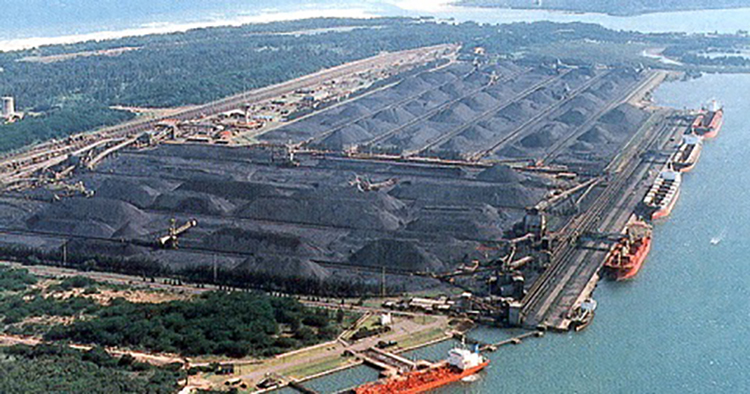
In an artful move that has wrongfooted its critics, the NPP government would seem to have orchestrated the resignation of Energy Minister Kumara Jayakody and Ministry Secretary Udayanga Hemapala, while simultaneously appointing a Special Presidential Commission of Inquiry to investigate whether any irregularities or unlawful actions have taken place in the business of importing coal for the Lakvijaya power station, by the state-owned Lanka Coal Company (Private) Limited. The Lanka Coal Company (LCC) had been created as early as 2008 under the Companies Act, following a cabinet decision in 2006, for the stated purpose of importing coal for power generation not only at Lakvijaya, but also other potential thermal power stations. The presidential COI could technically cover the entire lifespan of the LCC.
While the usual busybodies are busy raking the NPP government over substandard coal brought from South Africa by an Indian supplier who had not paid the full registration fee on time, the focus should really be on the performance of the LCC from its inception to the current sensation. The sole reason for the LCC’s being is to bring home about 40 +/- shiploads of coal that (at 60,000 Metric Tonnes of coal per shipload) for a total of approximately 2.25 million MT – the amount of coal that Lakvijaya requires for burning in one year to generate power at the full 900MW installed capacity.
Because of Lakvijaya’s location on the west coast, at Norochcholai, in the Puttalam District, without a proper harbour facility, the shipment is restricted to the six/seven-month non-monsoonal period – from September/October in one year to March/April the next. 40 +/- shiploads over six/seven months work out to six or seven ships a month. So, the company has the luxury of the other six/seven months (March/April to September/October) every year to plan, procure and deliver 2.25 million MT of coal to Lakvijaya, at competitive prices and to the required quality standards. Remember, it is not uranium we are importing, but coal. For one whole company that should be a QED (quite easily done) job – you would think. On the contrary, it has hardly been a QED.
The first question that comes to mind is whether a whole company is needed to arrange six to seven shiploads of coal a month for six months of the year. Now that a Presidential Commission of Inquiry (COI) has been set up, it would be interesting to see whether the Commission would also look into the reasons why the cabinet of ministers in 2006 decided to establish a new company for shipping coal. This was five years before the first phase of Lakvijaya power generation was completed in 2011 at one third (300MW) capacity, with full (900MW) generative capacity reached three years later in 2014. The construction of Lakvijaya had begun in 2006 and the LCC was created in 2007.
The country is familiar with all the construction delays and post construction problems of the storied power plant, but all the delays at the power plant should have given the LCC time to plan and put in place a streamlined mechanism for supplying coal. That has not been the case at all. That leads to other obvious questions – which are really about missing information regarding the sourcing and procurement of coal and ensuring its quality.
Sourcing and Procuring
First sourcing. It is generally known that the LCC has been importing coal from Australia, Indonesia, Russia – the world’s top three coal exporters, as well as South Africa. But there is no information on a supplier’s association with a particular country-source or the implications of switching from one country-source to another depending on the selection of a supplier. This information is not presented either in company documents (provided on its website and two annual reports (2017 & 2020) that are online) or in the audit reports including the most recent one which is also the most extensive one. As well, there is no source comparison by price or by quality – especially for the critical heating or calorific value, which is considered a “rank parameter” in quality evaluation of coal, and is fundamental to using coal in thermal power generation.
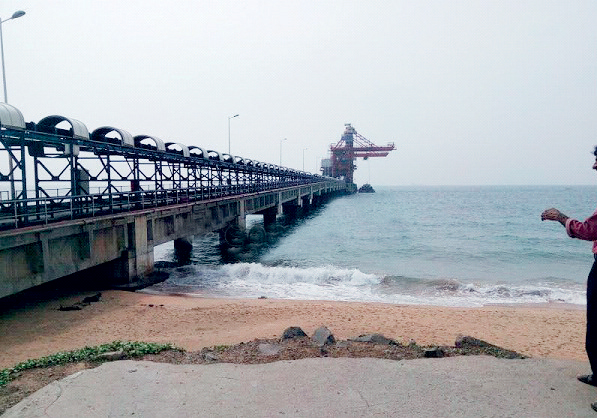
Point of Unloading: Lakvijaya Jetty
The second question or missing piece of information is about procurement. Every January, if I am not mistaken, the LCC calls for registration of suppliers based on past procurement experience, including conformance with quality standards, and corporate business performance. The LCC publishes the “Standard Values for Coal” for each year, which include the Gross Calorific Value (GCV, usually greater than 6,150 kcal/kg), moisture and material percentage contents, and grain sizes. These requirements are based on the manufacturer’s specifications, as they should be.
Registration applications are reviewed and approved for registration by cabinet-appointed committees mostly made up of senior CEB and relevant Ministry officials, and LCC and Lakvijaya representatives. What is not available is a historical record of registered suppliers, their quality history, and changes over time. This record could also include bid takers from among the registered suppliers, tender details and prices, and selected suppliers. The absence of such record and trend analysis would likely have been a factor in creating opportunities for alleged fraud, preferential selections and the compromising of quality standards.
The third question and concern is about the quality of imported coal, especially the minimum calorific value for efficient operation of the turbines. Far more than the other two, the quality issue has been front and centre in all the news about coal over the years, and it became the subject of some detailed analysis in the April 2026 Special Audit Report on Coal Procurement.
For the 2025/2026 coal supply, 26 registered suppliers were invited to bid on 18 August 2025, 11 of them responded, and their bids were opened on 15 September 2025. Quite a short window. Of the 11 bidders, only two had previously supplied coal exceeding the rejection threshold of 5,900 kcal/kg GCV; eight of them had both exceeded and fallen short of the threshold in their previous supplies; one did not exceed the threshold at all; and the last one did not provide any GCV information. The tender was awarded to Trident Chemphar Limited of India, whose past GCV record indicates supplying nearly 300,000MT of coal exceeding 5,900 GCV, and twice as much, nearly 600,000MT, under 5,900 GCV.
As noted in the Special Audit Report, Trident had not paid the full registration fee of $5,000 when bids were sent out on 18 August 2025 and should not have a received the invitation to bid. However, the LCC would seem to have found a way to have the tender documents sent to Trident, accept Trident’s late payment of the balance due of the registration fee, and have its registration ratified four days later on 22 August 2025. As the Audit Report has correctly observed, this was a violation of the principle of fairness in procurement, especially involving competitive bidding on a tender of substantial value.
Heat Quality and Testing
As I noted earlier, the LPP’s “Standard Values for Coal” stipulates a GCV (Gross Calorific Value) greater than 6,150 kcal/kg). A lower value of 5,900 kcal/kg is used as the benchmark to reject coal loads that fall below that value. In other words, the practice has been to use 6,150 kcal/kg as the quality standard for supply, rejecting loads that come under 5,900 kcal/kg, and making price adjustments for loads with GCV that fall between the two values. Lowering the tender threshold to 5,900 opens the door for accepting supplies under what (5,900) was earlier the rejection threshold as the new normal.
The lowering of the quality requirement before and after an apparent cabinet authorization came into effect 23 June 2023 apparently after a cabinet decision. Before June 2023, eligible suppliers should have supplied a minimum of one million MT in the previous 36 months, of which at least 50% (500,000 MT) should have equaled or exceeded the rejection threshold of 5,900 GCV. After June 2023, the business turnover was reduced from one million to half a million metric tonnes, and the quality amount was reduced from 500,000 MT to 100,000 MT. These changes came home to roost in the procurement of coal for the 2025/2026 period under the new (NPP) government.
As I have noted, the selected supplier, Trident Chemphar Limited of India, did not have a good record for heat quality supply, the company’s 36-month record indicating only one third of its supply exceeded the 5,900 GCV requirement. But it was still higher than the new, but lower, standard of a supply record of 100,000 MT exceeding 5,900 GCV. But worse was yet to come.
The Trident tender provides for only 1.5 million MT of coal and of the 2.32 million MT of coal required for 2025/2026. To procure the balance and to add redundancy to the main Trident supply (which is rather puzzling), the LCC initiated a second tender in January 2026 – interestingly, not for the full 800,000 MT balance, but only 300,000 MT of it. And the second competitive tender following all proper evaluation was awarded to Taranjot Resources (Pvt) Limited, also of India. Taranjot was one of the unsuccessful bidders in the August-September 2025 tender and had the distinction of being the only one who had recorded an entire 36-month supply of coal (100% of 1.1 million MT) under 5,900 GCV. Go Figure!
The price comparisons are also revealing. Trident’s price is $98.5 CFR per MT for a total price of $148 million (SLR 45 billion) for supplying 1.5 million MT of coal. Taranjot’s price for supplying 300,000 MT of coal is $142 CFR per MT for a total price of $42.6 million (SLR 13 billion). For comparison, Taranjot’s unit price was $105 CFR per MT, three months earlier, in the main tender that was awarded to Trident. Inexplicable as it is, this fixation to switch between term tenders and spot tenders has been demonstrated by the Lanka Coal Company from the time it started procuring coal for Lakvijaya. The reasons for this are another matter that the Presidential COI will hopefully look into.
To make matters worse, Trident’s actual supply turned out to be worse than its tender. The Special Audit Report provides the results of the quality tests on the coal that was supplied by Trident in its first nine shipments before 17 February 2026. There were three categories of tests performed over nine criteria, including the Gross Calorific Value (GCV) on samples taken from each shipment of coal – first at the Port of Loading, the Richards Bay Coal Terminal in South Africa, second at the Port of Discharge, and third in the Lakvijaya Laboratory – both in Puttalam, Sri Lanka.
The Port of Loading tests showed far better results on each criterion for each of the nine shipments than the Port of Discharge tests and the Laboratory tests. Specific to the GCV heat criterion, the South African tests showed the coal in seven of the nine shipments exceeded the standard value of 6,150 kcal/kg; one of them registered 6,053, just under standard value; and the other at 5,904, just above the rejection threshold. The discharge point tests in Sri Lanka showed none of the shipments meeting or exceeding the standard value (6,150), with only two exceeding 6,000 kcal/kg. The Laboratory test results were the worst, with every one of the nine shipments registering below the rejection threshold of 5,900 kcal/kg, with five of them between 5,000 and 5,500 kcal/kg, and the other four between 4,500 and 5,000 kcal/kg.
The discrepancies in the results should not be surprising given the rather shoddy arrangements for testing at the South African end. Although testing at the source is the supplier’s responsibility subject to LCC’s approval, it is reasonable to expect that after about 15 years in this business the LCC would have set up a pool of accredited testing agencies that it could draw from for each tender. The test agent, or a pool of them, should be identified in the tender to avoid shopping around after the award.
The Special Audit Report includes extensive calculations of the energy (kilowatt-hour) and cost implications of using low calorific coal. The calculations are based on a comparison with the supply of coal between 2020 and 2025. There were 194 shipments during that period, and all of them exceeded 6,000 kcal/kg GCV, with 139 out of 194 (72%) exceeding the standard value requirement of 6,150 kcal/kg. The country-sources of these shipments are not known, and there is no information about the tests conducted on samples from these shipments, including the consistency or discrepancy between test results from the three testing locations. Curiously, this period includes the 2023/2024/2025 years which came after the June 2023 changes in quality standards, but shipments in this period do not seem to have been adversely impacted by the June 2023 changes. This overlap is not identified or noted in the Audit Report.
The Report indicates that the average consumption of coal in the 2020-2025 period was 375 grams per kwh, in comparison to the higher average consumption rate of 444 gm/kwh estimated for the coal supplied by Trident, based on coal consumption and power generation information from Lakvijaya operators. The use of lower calorific coal triggers excessive coal consumption, inefficient power generation, and the need for alternative energy sources to compensate for the shortfall in coal power generation. The Audit Report estimates the cost of excessive coal consumption associated with Trident’s nine shipments to be SLR 2.24 million. At the same time, the supply agreement includes penalty for non-compliance which is estimated to be SLR 2.32 million. These estimates are useful indicators of the order of magnitude of losses when tenders go wrong. But they will be vigorously challenged if penalties are imposed or contract is terminated.
The current low calorific coal fiasco is not the first instance of tender sloppiness involving the Lanka Coal Company. There have been allegations of fraud when coal was purchased from Australia. In 2014, there was another controversy when after selecting a Singapore shipping company for supplying coal from Indonesia, the tender was altered to include a port of origin in Russia. In 2016, the Supreme Court declared a coal supply tender null and void and ordered it to be superseded by a new tender call. In 2017, then Minister of Power and Renewable Energy, Ranjith Siyambalapitiya, dissolved the entire LCC Board of Directors, over procurement malpractices between 2009 and 2016. While the NPP did inherit a mess, it also had enough time to review and rectify the tender process, to eliminate malpractices and live up to its own promises.
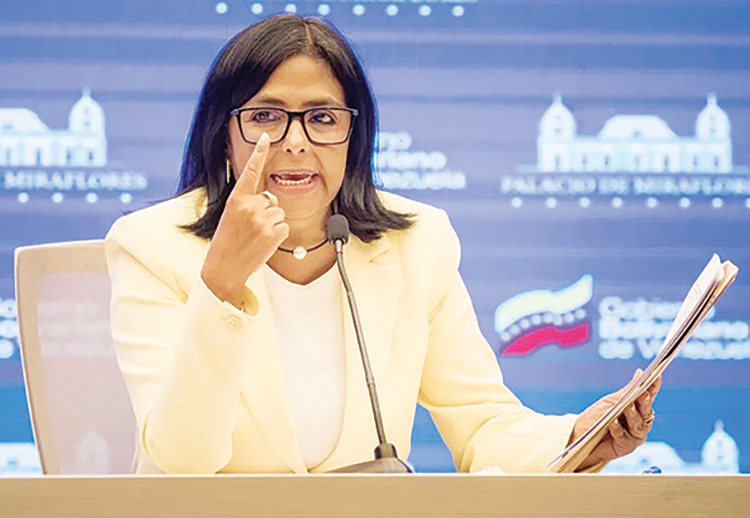
Real politics is always played in grey areas; decisions are not made in parliamentary chambers or presidential palaces but in hotel corridors, private aircraft, and the quiet geometry of negotiated survival. What is presented as constitutional order is often only the visible skin of a deeper machinery where power is not declared but assembled. Most commentary on Venezuela portrays the removal of Nicolás Maduro as a sudden rupture that dismantled an entrenched centre of authority and rapidly produced a new governing nucleus around Delcy Rodríguez, reframing the state not as continuity but as immediate reconfiguration under a new operational centre of power.
The claim is simple in outline and explosive in implication: Maduro removed, detained abroad, his political inner circle dismantled; Rodríguez elevated from vice-presidential operator to acting head of state, inheriting not a ceremonial vacancy but a fractured state requiring immediate recomposition. Whether one treats this as confirmed fact, speculative journalism, or a constructed political scenario, the effect is the same in analytical terms. It produces a vacuum, and in politics vacuums are never empty. They are filled immediately, often brutally, and almost always by those closest to the mechanisms of control rather than the symbols of legitimacy.
Rodríguez, in this framing, is not behaving like a transitional leader waiting for instructions. She is behaving like an administrator of consolidation. Her public language repeatedly returns to a controlled moral vocabulary: Venezuela, she insists, is “forging a path of national reunification”, “free from the divisions of classism and racism”, and rooted “in the pursuit of peace.” It is a carefully constructed grammar of stabilisation. Nothing in it is accidental. Reunification replaces rupture. Peace replaces conflict. Inclusion replaces accusation. It is the language of systems attempting to re-legitimise themselves after fracture.
Yet language in moments like this does not describe reality so much as attempt to discipline it. Every invocation of unity implies prior fragmentation. Every appeal to peace implies a preceding logic of coercion. What is being built is not only a political order but an interpretive frame in which that order can survive scrutiny.
Reports associated with this narrative describe rapid administrative restructuring: ministerial changes, security realignments, and renewed engagement with global financial institutions, including the International Monetary Fund. The return of financial dialogue after years of rupture is framed as a restoration of economic normality, yet it also functions as something more fundamental: conditional recognition. Access to financial systems is never neutral. It is a form of admission into an international order that confers legitimacy as much as liquidity.
A frequently cited poll attributed to this period places Rodríguez at 73 per cent approval among Venezuelans. Whether statistically rigorous or politically constructed, the number itself performs a different function. It stabilises perception. In transitional environments, polling is rarely about measurement alone; it is about producing the sensation of consensus in moments where consensus is structurally fragile. Numbers become instruments of narrative control rather than reflections of social reality.
What emerges across these accounts is a dual reading of Rodríguez’s role. For supporters, she is the stabiliser of a collapsing system, the figure capable of converting disorder into administrative continuity. For critics, she is the executor of elite reconfiguration, replacing one closed network with another while maintaining the architecture of concentrated power. Both readings contain truth, not because they agree, but because transitional power almost always generates contradictory interpretations of the same actions.
The deeper logic resembles a familiar political pattern: when central authority collapses, the question is not who is most legitimate but who is most capable of controlling institutions that actually matter. Security structures, financial channels, energy infrastructure, and diplomatic access become the real terrain of power. Ideology becomes secondary to control of operational systems. In that sense, Rodríguez is not an anomaly but a product of a very old political problem: how to maintain state coherence when legitimacy is contested and authority has been disrupted.
There is a long historical memory for this kind of moment. Rome did not end its republic through a single act but through incremental consolidation, where Augustus transformed emergency authority into a permanent structure while preserving republican language. Power changed form without changing vocabulary. In post-revolutionary France, figures like Talleyrand survived every ideological shift by treating loyalty as subordinate to institutional survival. The pattern is not moral; it is structural. Systems under stress reward adaptability over conviction.
The uncomfortable implication is that such transitions rarely offer clean moral categories. The language of betrayal and loyalty becomes unstable when applied to environments where institutional survival itself depends on the reconfiguration of alliances. What appears as betrayal from one perspective can appear as necessity from another. Politics in such contexts is not a question of ethical clarity but of functional continuity under pressure.
Even the symbolic inheritance of Chávez-era rhetoric complicates interpretation. His denunciation of Western power as “the devil” once represented ideological confrontation with global systems of influence. In the current configuration of events, however, the same state tradition appears to be engaging selectively with those same systems through financial reintegration and diplomatic recalibration. The contradiction is not unique to Venezuela; it is a recurring feature of states that move from confrontation to survival pragmatism. Ideological purity rarely survives institutional stress.
Rodríguez, within this contested framing, operates at the intersection of these contradictions. She is simultaneously presented as guardian of sovereignty and manager of reintegration into the Western financial structures. She speaks in the language of resistance while engaging in the mechanics of external normalisation. That duality is not incoherence; it is the condition of governance under constraint, where no single ideological position can fully account for the demands of survival.
It is tempting to describe this as either redemption or capture, but both interpretations flatten the reality of transitional authority. What exists instead is a corridor of constrained decision-making, where every action is shaped by pressure from multiple directions: internal fragmentation, external expectation, institutional inertia. Within that corridor, politics becomes less about declaring direction and more about preventing collapse.
This is why the figure of Rodríguez generates such divergent readings. She is not operating in a stable system where legitimacy is settled. She is operating in a system where legitimacy itself is part of the struggle. Every reform is also a negotiation. Every consolidation is also a risk. Every gesture of unity is also an act of exclusion somewhere else in the structure.
The deeper political lesson is that modern state transitions rarely resemble the narratives used to describe them. They are not clean breaks or linear progressions. They are layered adjustments in which old structures are partially dismantled, partially preserved, and partially repurposed. The result is not resolution but managed ambiguity.
In that sense, Rodríguez is not an exception but an expression of a broader political condition: the necessity of governing through instability rather than after it. Whether one interprets that as betrayal or transformation depends less on evidence than on political positioning. The structure itself does not resolve the ambiguity; it produces it. The irony is that political systems often attempt to justify themselves through historical memory while simultaneously repeating its most uncomfortable patterns. When power changes hands, justice changes meaning. As the old saying goes, in politics, loyalty is a currency that devalues quickly.
by Nilantha Ilangamuwa
This is the first of a two-part essay, from my remarks at a speech I delivered at the Kolamba Kamatha Festival on Saturday, 28 March 2026.
By Uditha Devapriya
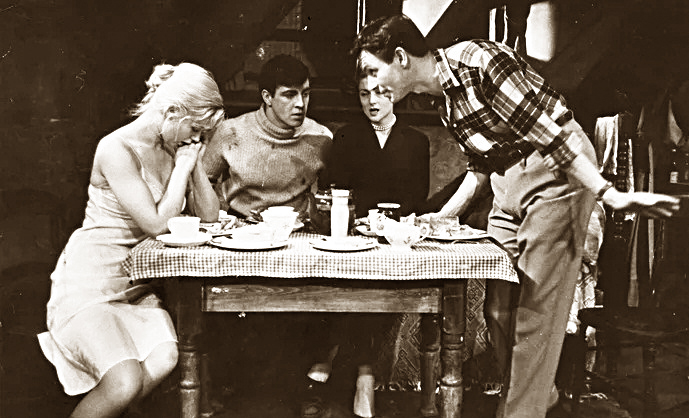
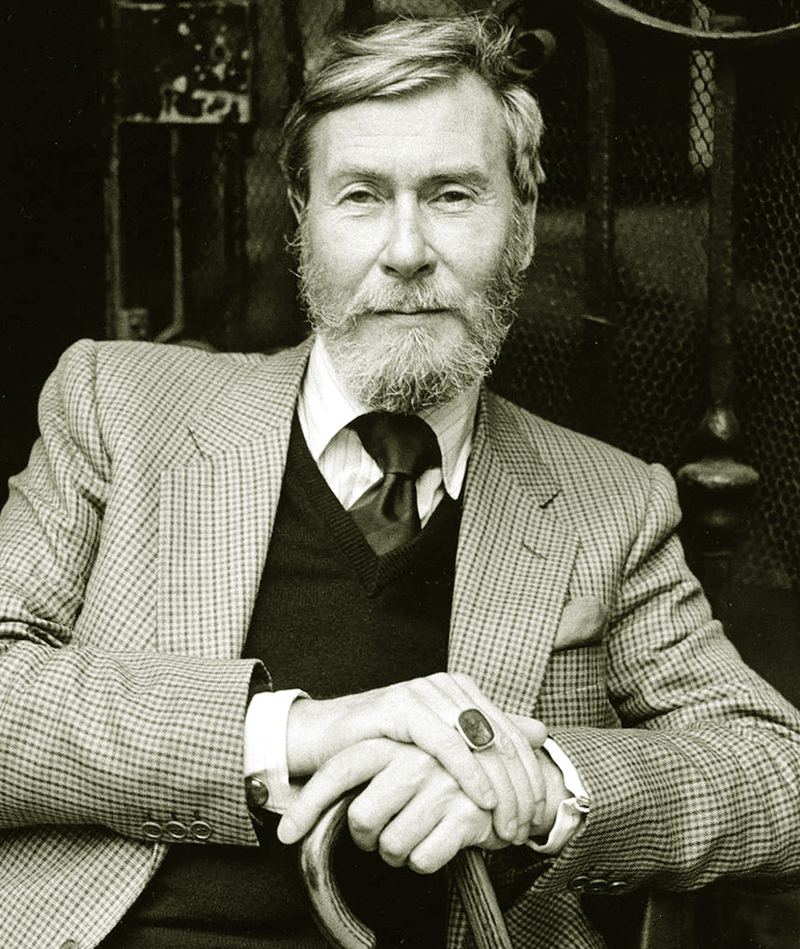
 The 8th of May 1956 is considered as a watershed in the history of the British theatre. On that day a play was staged which would change the shape and face of British drama. Two years earlier a stage director, George Devine, had cofounded an organisation for staging plays by young, radical writers. It called itself the English Stage Company, the ESC. On 2 April 1956, the ESC purchased the Royal Court Theatre in London.
For its first season the company’s founders planned a cycle of five plays. The first of these was a fairly tame drama by Angus Wilson, The Mulberry Tree. The second was a production of Arthur Miller’s The Crucible. Both these had been directed several times before. In the case of The Crucible, by 1956 it had already become a classic of contemporary theatre. It was the third play that would break ground, for the ESC, the Royal Court Theatre, and British drama in general. This was John Osborne’s Look Back in Anger.
A searing look into the class system and the institution of marriage in post-war Britain, Look Back in Anger delved into ideas and themes which few British playwrights had probed with such frankness. Almost immediately it created an uproar. Many newspapers railed against it and gave it negative or lukewarm reviews. It was described as “intense, angry, feverish, and undisciplined” in one paper and “unspeakably dirty and squalid” in another. Even critics who seemed sympathetic to the story sounded caution on its themes.
The only exception was Kenneth Tynan. A highly respected critic, as outspoken as the writers and dramatists he championed, Tynan became quite receptive to Osborne’s play. Writing in The Observer, one of the oldest newspapers in the UK, he commented that it symbolised a growing rift between an older, conservative generation and a younger, more outspoken one in the context of postwar Britain. Questioning its critics, he praised Osborne for being true to life and in doing so producing a “minor miracle.”
Tynan ended his review with these words.
“I doubt if I could love anyone who did not wish to see Look Back in Anger. It is the best young play of its decade.”
John Osborne
The review was published five days after the play, on 13 May 1956. Six months later, on 3 November 1956 at the University of Ceylon in Peradeniya, Sri Lanka, the University Sinhalese Drama Circle staged Maname. Written and directed by Ediriweera Sarachchandra, based on a Buddhist jataka tale and anchored in a fusion of various theatrical styles, Maname became as representative of a new theatre in Sri Lanka as Look Back in Anger had been of a new theatre in Britain. After it made its way to other parts of the country, including Colombo, the press began reviewing it with as much curiosity as with Osborne’s play. Unlike the latter, however, the press gave Maname positive notices.
One of the more perceptive reviews was written by the critic and journalist Regi Siriwardena. Published in the Ceylon Daily News a few days after it was staged, Siriwardena noted that Maname represented a breakthrough in theatrical form. He argued that it was quite unlike what the Sinhalese Drama Circle or the flagship dramatic society at the University of Ceylon, DramSoc, had staged in the 1940s and 1950s. At that time the Sinhalese Drama Circle had presented local adaptations of European dramatists, from Moliere to Gogol to Chekhov. Maname did away with these trends and promoted a new theatre among Sinhala-speaking and bilingual audiences. This would be known as stylised drama.
Reflecting on these developments 25 years later, Siriwardena speculated about the social composition of those who watched Sarachchandra’s play.
Sugathapala de Silva, founder of Apè Kattiya
“… from my impressions of the spectators who came to performances of Maname in its early years at the Borella YMBA [Young Men’s Buddhist Association] and Lumbini, I would hazard the guess that the new audience of 1956 and immediately succeeding years was composed predominantly of urban lower middle-class Sinhala speaking people.”
He argued that this underlay a much bigger achievement.
“What Maname effected then was to give the bilingual artists working in the theatre – Professor Sarachchandra and those who came in his wake: Gunasena Galappatti, Dayananda Gunawardena, and Henry Jayasena – an opening to the Sinhala-speaking lower middle class… Apart from the intrinsic dramatic achievement of Maname… [I]t was in consonance with the climate of Sinhala cultural revivalism in and after 1956.”
Siriwardena added that for most Sinhala-speaking audiences Maname contrasted strongly with the “hybrid” nurti theatre of the 1920s and 1930s. Influenced if not inflected by Parsi and European theatre, by the 1950s nurti was perceived as standing outside the canon of indigenous or national art in Sri Lanka. Though Maname was inflected by multiple cultural and artistic forms, including kabuki, for Sinhala-speaking audiences it seemed to represent a more rooted and authentic experience.
In the context of the performing arts, terms like “rooted”, “authentic”, “native”, “national”, and “indigenous” are, of course, very politically charged. It would be dangerous to deploy these terms and claim that one conception of drama is superior to the rest. Yet what is interesting is how differently cultural sentiments shaped the reception to Look Back in Anger in Britain and Maname in Sri Lanka.
In their respective countries, these plays ushered in a new idiom and broke down artistic barriers. But while Look Back in Anger was celebrated by a young generation for its unconventional themes and attitudes, Maname was praised by another generation for conforming to notions of indigeneity and authenticity.
This difference should tell us something about the social conditions that in Sri Lanka laid the foundations of plays such as Maname, and generated a wave of rebellion, resurgence, and revival which fostered a very outspoken set of playwrights. These younger artists were not just receptive to what was happening in other societies. They were also part and parcel of the most significant generational shift in their own country, in post-independence Sri Lanka: arguably one of the most important in any former colonial society.
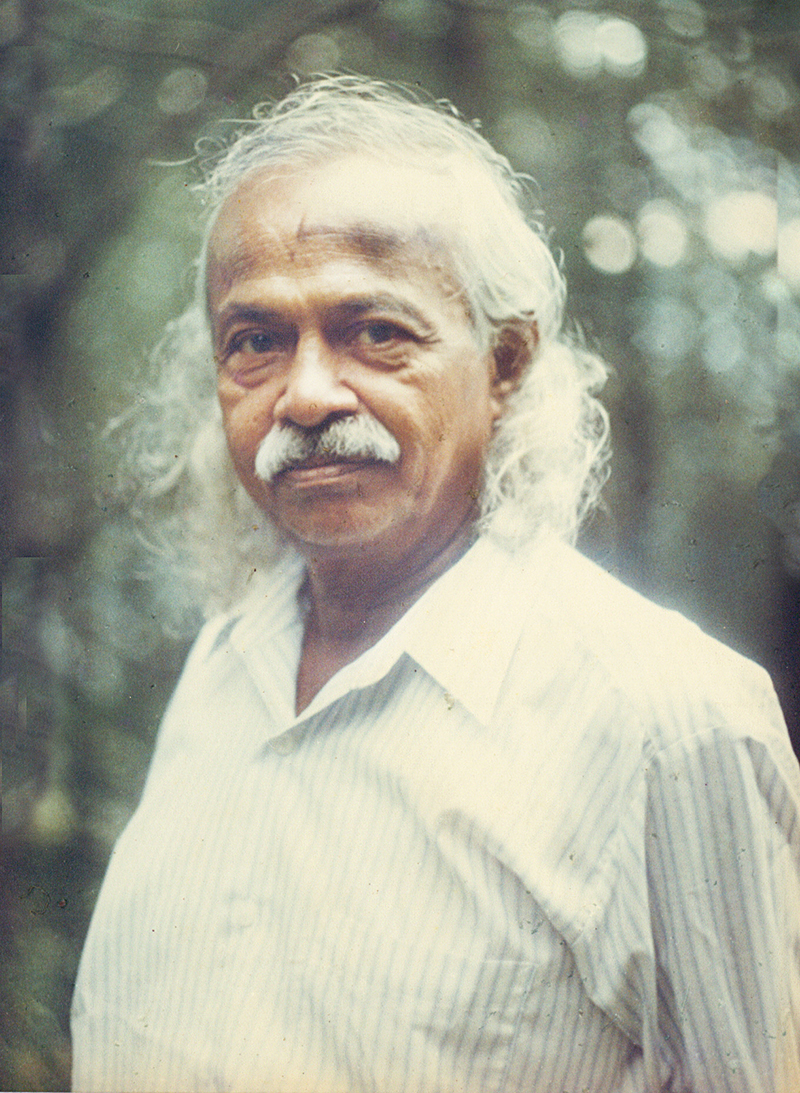
In postwar Britain the generation of playwrights who banded around John Osborne and Look Back in Anger called themselves the Angry Young Men. Post-independence Sri Lanka’s Angry Young Men banded together in opposition to stylised theatre, while at the same time seeking encouragement and inspiration from their predecessors. These playwrights had their leaders and figureheads. Among them was Sugathapala de Silva.
Before we talk about Sugathapala de Silva, however, it’s important that we understand the extent to which postwar generational shifts and the changing undercurrents of the Sinhala theatre influenced him. As importantly, we need to understand the way in which this generation of artistes came together, and the ways in which they differed from each other. The rest of the presentation will focus on these two themes.
If the starting point to all this is 1956, my initial observation is that the cultural revival unleashed that year was contradicted by the same social and political forces that contributed to that revival. This contradiction is best seen when contrasting the initial reception to Sarachchandra’s drama with the criticisms it attracted in later years. While no one should doubt the achievements of Maname and Sinhabahu, those who followed Sarachchandra in the Sinhala theatre had very different conceptions of that theatre.
This contradiction becomes more interesting when we realise that in countries like Britain the trajectory of the theatre was more clearcut and predictable.
In Britain, the Second World War had destroyed much of its cultural infrastructure, including theatres and film halls. Yet within 10 years, a new theatre had been born, and a new generation of writers had taken root. The rupture was gradual, but when it came, it opened an entire avenue of possibilities for British theatre, cinema, and literature.
This was seen not so much in the opening of new theatres, schools, and workshops as an influx of new talent to old institutions, such as the Royal Academy of Dramatic Art, or RADA. Such developments were made possible, in part, by scholarships these institutions began offering as well as a spurt in enthusiasm for the theatre among non-elite groups. This is what helped actors like Peter O’Toole and Richard Burton get established. In an interview, O’Toole recalled how he entered RADA, just when it was opening its doors.
“A chum of mine… and I hitch-hiked our way into London to begin our lives and we jumped off the lorry, the truck, at a station called Houston and we were aiming for a men’s hostel. … And we were plodding down and I looked on my left and it said, ‘The Royal Academy of Dramatic Art’ and my chum said, ‘Well, if you’re going to be an actor this is the kind of shop where they deal with such matters, so why don’t you pop in?’… One thing led to another and I found myself, that afternoon even, turning up for the first interview and then I did an audition and [another] audition, and found, to my surprise that I was in.”
Evocative as it is, the passage underscores the point that the rupture which shook the British theatre loose was gradual and yet unfolded in one go. In Sri Lanka, on the other hand, we can discern not one but two ruptures vis-a-vis the Sinhala theatre: political revolt and cultural revival in 1956, followed by a rejection of theatrical and artistic forms which 1956 had valorised and popularised.
Let me deconstruct this further. Whereas in Britain the revival of theatre and the emergence of a radical class of dramatists was simultaneous, in Sri Lanka these developments unfolded sequentially. I suggest that this was not just necessary, but also unavoidable.
Uditha Devapriya is an independent researcher, author, columnist, and analyst whose work spans international relations, history, anthropology, and politics. He holds an LL.B. from the University of London and a Postgraduate Diploma in International Relations from the Bandaranaike Centre for International Studies (BCIS). In 2024 he was a participant in the International Visitor Leadership Program (IVLP) conducted by the US State Department. From 2022 to 2025 he served as Chief International Relations Analyst at Factum, an Asia-Pacific focused foreign policy think-tank. In 2025 he did two lecture stints in India, one as a Resident Fellow at the Kautilya School of Public Policy in Hyderabad and another on art and culture at the India International Centre in New Delhi. Since 2023, he has authored books on Sri Lankan institutions and public figures while pursuing research projects spanning art, culture, history, and geopolitics. He can be reached at udakdev1@gmail.comudakdev1@gmail.com.

Russian circumnavigation team arrive in Sri Lanka

Trump unhurt after shots fired at White House correspondents’ dinner

Sooryavanshi ton in vain as Sunrisers Hyderabad raze a 229 chase

Prabhsimran, Shreyas upstage Rahul’s 152* to mow down record T20 chase

Showers expected in the Western, Sabaragamuwa and North-western provinces and in Galle, Matara, Kandy and Nuwara-Eliya districts after 2.00 pm.

Heat Index at Caution Level in the Northern, North-central, North-western, Western, Sabaragamuwa, Southern, and Eastern provinces and in Monaragala district during the day time

‘Dates have the highest sugar content to fight Coronavirus’

Sunday Island 27 December – Headlines

#SundayIsland 17th December – Headlines

Sunday Island – 28th March

Sunday Island Headlines – 21 March

Sunday Island – 21st February – Headlines
-
 News6 days ago
Rs 13 bn NDB fraud: Int’l forensic audit ordered
-

 News4 days ago
Lanka faces crisis of conscience over fate of animals: Call for compassion, law reform, and ethical responsibility
-

 Opinion7 days ago
Shutting roof top solar panels – a crime
-
 News3 days ago
Whistleblowers ask Treasury Chief to resign over theft of USD 2.5 mn
-

 News3 days ago
No cyber hack: Fintech expert exposes shocking legacy flaws that led to $2.5 million theft
-
 News7 days ago
Church calls for Deputy Defence Minister’s removal, establishment of Independent Prosecutor’s Office
-
 News4 days ago
USD 2 mn bribe: CID ordered to arrest Shasheendra R, warrant issued against ex-SriLankan CEO’s wife
-

 Features7 days ago
The Digital Pulse: How AI is redefining health care in Sri Lanka?