
Foreign News
Pakistan election: Final results give Khan-backed candidates lead

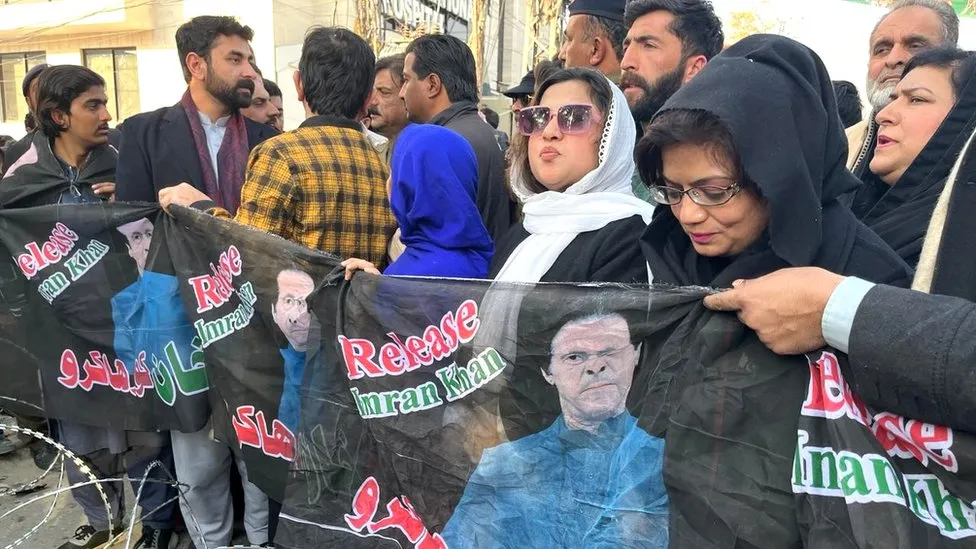
The final results in Pakistan’s general election have put independent candidates backed by jailed ex-PM Imran Khan’s PTI party in the lead.
Independents won 101 of the National Assembly seats. BBC analysis shows 93 of them went to PTI-backed candidates.
That puts them ahead of ex-PM Nawaz Sharif’s PMLN who won 75 and it is unclear who will form a government.
As wrangling continues, independent candidates who did not win have flooded courts with vote-rigging allegations.
Both the PTI, which was blocked from taking part in the election, and Mr Sharif’s PMLN say they want to form the next government.
The result was a surprise as most observers had expected Mr Sharif’s party – widely seen as having the powerful military’s backing – to win given Mr Khan had been jailed on charges ranging from corruption to having married illegally and his party was barred from the ballot sheet.
To govern, a candidate has to show they are at the head of a coalition with a simple majority of 169 seats in the National Assembly.
Bilawal Bhutto from the PPP, which received the third largest number of votes, has said that they have not had any formal discussions with Imran Khan’s PTI or Nawaz Sharif’s PMLN. But the PMLN have said that Mr Bhutto’s father did meet for an informal meeting with Mr Sharif’s brother in Lahore.
The Karachi-based MQM party has also made a surprising return in the polls, winning 17 seats, and could play a role in any coalition.
Of the National Assembly’s 366 seats, 266 are decided by direct voting and 70 are reserved – 60 for women and 10 for non-Muslims – and these are allocated according to the strength of each party in the assembly.
Under Pakistan’s rules, independent candidates are not eligible to be allocated reserved seats in parliament.
On Sunday police blocked streets near the electoral commission building in the city of Rawalpindi in anticipation of protests, while police in Islamabad said action would be taken against demonstrators.

The PTI’s chairman had called for peaceful protests outside electoral commission offices where they were concerned about “forged” results.
On Saturday, Mr Sharif – who is thought to be favoured by the military – called for other parties to help him form a unity government.
Experts have warned Pakistan may be facing a “prolonged period of political instability”.
Dr Farzana Shaikh from the Chatham House think tank told the BBC that the Khan-linked independents were unlikely to be allowed to form a government and many people feared a “weak and unstable coalition” would result from any tie-up between Mr Sharif and the PPP.
Meanwhile at least six PTI-backed candidates who did not win their seats, have lodged legal challenges in the courts to try to get them overturned. Among them is Yasmin Rashid who stood against Mr Sharif in Lahore. The petitioners allege collusion in the alteration of election results on specific forms.
Pakistani officials have denied any irregularities.
(BBC)






King Charles has hosted a spectacular state banquet for the president and first lady of Nigeria, praising the strengths of Nigeria’s partnership with the UK.
After greeting the 160 guests in the Yoruba language, the King spoke of the “living bridge” of the Nigerian community in the UK, in a speech in St George’s Hall at Windsor Castle.
Famous figures at the banquet included England rugby union captain, Maro Itoje, Olympic athlete Christine Ohuruogu and poet Sir Ben Okri, alongside senior royals including Queen Camilla and the Prince and Princess of Wales.
There were special adaptations for Muslims, with the banquet taking place in the fasting month of Ramadan.
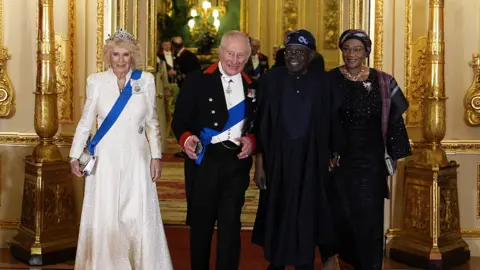
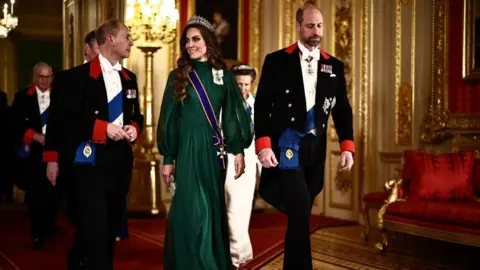
A prayer room was set aside in Windsor Castle and the usual lunch hosted by the King on such state visits did not take place.
It’s become a tradition to invent a cocktail for state visits – and in this case the “crimson bloom” was made from non-alcoholic ingredients, combining the Nigerian drink Zobo with English rose soda and hibiscus and ginger syrup.
There were also alcoholic drinks available for guests in St George’s Hall, including fine red and white wines, port and whisky.
The King’s speech reflected on the importance of religious tolerance, in which “people of different faiths can, do, and must live alongside one another in peace”.
He also told President Bola Ahmed Tinubu and First Lady Oluremi Tinubu of the importance of partners such as Nigeria and the UK standing together in difficult times “when rain clouds gather”.
As well as diplomatic ties, King Charles spoke of “Afrobeats filling our concert halls and Nollywood captivating our screens”.
There was also a reflection by the King on the “painful marks” of a shared history, in a reference to colonialism.
“I do not seek to offer words that dissolve the past, for no words can,” said the King, but he hoped for a more optimistic future “worthy of those who bore the pains of the past”.
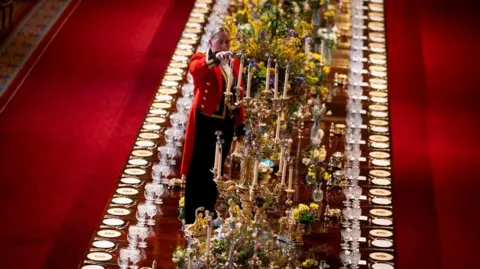
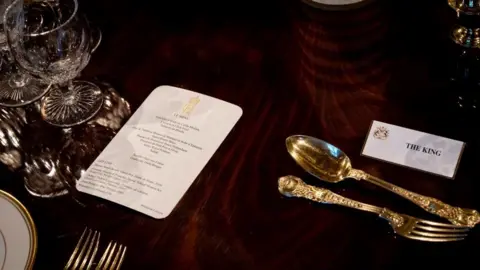
The banquet, on an elaborately decorated table filled with spring flowers, saw a meat-free menu.
It included:
- Soft boiled quail egg tartlet with watercress and kale and a basil sabayon
- Fillet of turbot, lobster mousse wrapped in spinach, beurre blanc sauce, sprouting broccoli with hollandaise sauce, fricassee of peas and broad beans, Jersey Royal potatoes
- Iced blackcurrant souffle with red fruit coulis
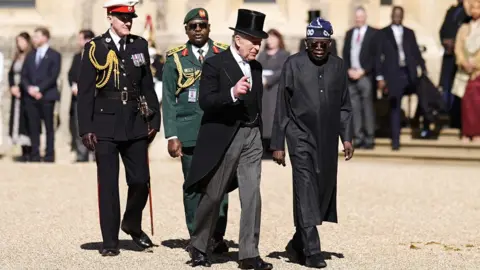
The two-day state visit began on Wednesday morning with a ceremonial welcome at Windsor.
In warm spring sunshine, the president and first lady – wearing traditional robes – were given the ceremonial grandeur of a royal welcome.
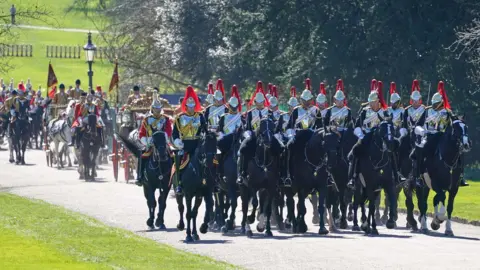
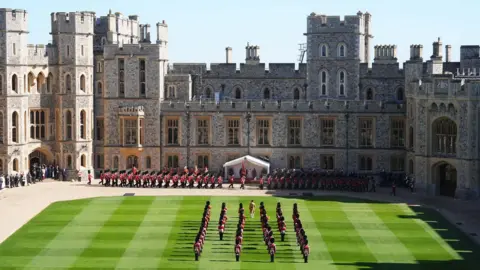
There was a carriage procession, bringing the Nigerian visitors into the quadrangle inside Windsor Castle, where a military band, with careful symmetry, paraded on the chequerboard lawn.
There was a gun salute, national anthems were played, guards were inspected and the Household Cavalry kicked up dust as they paraded inside the castle, in front of a viewing stand for the King and Queen and their visitors.
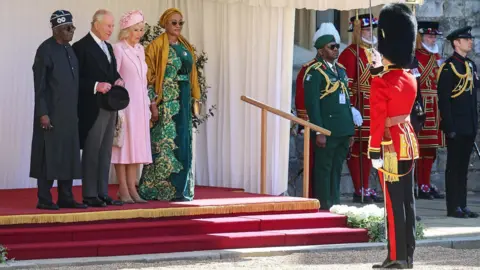
Official gifts were exchanged. The president and Mrs Tinubu were given hand-crafted pottery, a silver photo frame containing a picture of the King and Queen and a silver and enamel bowl.
In return, the King and Queen were given a traditional Yoruba statuette and a jewellery box featuring the faces of important Nigerian women.
President Tinubu is a Muslim and his wife is a Christian and the couple attended an interfaith event at Windsor Castle, designed to build bridges between religions.
It’s at a time of tensions within Nigeria, with a series of suspected suicide bombings this week in the north-eastern state of Borno, in which at least 23 people were killed and 108 injured in attacks blamed on hard-line Islamist militants from the Boko Haram group.
This is Nigeria’s first state visit to the UK for 37 years and such visits are a way of building relationships with international partners.
The Nigeria visit will see a strengthening of business links, including financial services. And there are personal and family connections, with more than 270,000 Nigerian-born people living in the UK.
“This state visit is about turning a historic relationship into a modern economic partnership – transforming trust into opportunity,” said Nigeria’s government spokesman Mohammed Idris.
“Nigeria’s economic reforms are unlocking the potential of Africa’s largest consumer market. The United Kingdom is a natural partner in what comes next.”
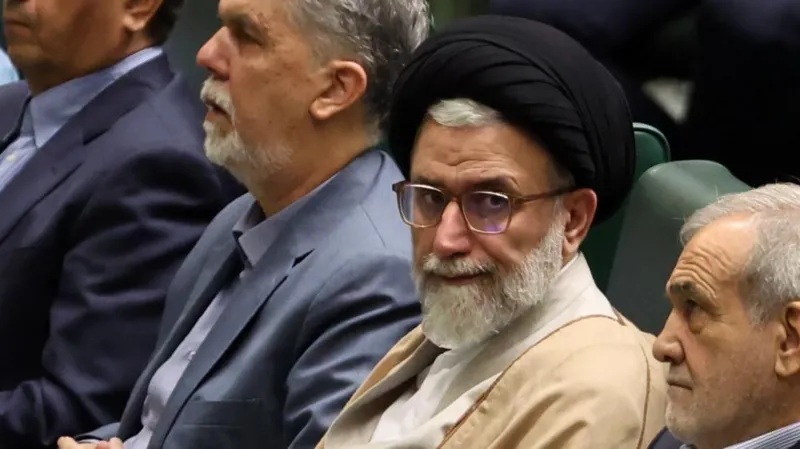
Iran’s intelligence minister Esmail Khatib has been killed, the country’s president has confirmed.
Masoud Pezeshkian said the “cowardly assassination” had left Iran “in deep mourning”, after Israel said on Wednesday it had killed Khatib in an air strike.
It comes a day after Israel announced it had killed Iran’s top security official, Ali Larijani, and head of the paramilitary Basij force, Gholamreza Soleimani, in strikes.
Since the assassination of Supreme Leader Ayatollah Ali Khamenei on the first day of the war on 28 February, multiple senior Iranian officials and commanders have been killed in efforts by Israel and the US to weaken the regime’s leadership.
In a post on X, Pezeshkian extended his condolences to the Iranian people over the officials’ deaths, adding he was “certain their path will continue more steadfastly than before”.
Speaking to the BBC, a woman from Tehran said the “killing of Khatib might help the people since he was among the leadership”.
“It might be that when people come out after a call to protest, the likelihood of them being killed is lower now,” she said. “Even though they all have replacements, these were the main figures.”
Earlier on Wednesday, Israel’s defence minister Israel Katz announced that Khatib had been “eliminated” in an Israeli strike on Tehran.
“Prime Minister Benjamin Netanyahu and I have authorised the IDF to eliminate any senior Iranian official for whom the intelligence and operational circle has been closed, without the need for additional approval,” he said.
[BBC]

Ten people have been killed after a fire broke out in the trauma centre of a government hospital in the eastern Indian state of Odisha.
All the victims were patients, while 11 hospital staff are being treated for burns suffered while trying to rescue patients, state Chief Minister Mohan Charan Majhi said.
The fire – suspected to have been caused by an electrical short circuit – started in the trauma care ICU of SCB Medical College and Hospital in Cuttack city around 02:30 local time on Monday (21:00 GMT Sunday).
Hospital fires are often reported in India, with many blamed on electrical faults. Last October, six critically ill patients were killed in an ICU fire in Rajasthan state.
In 2024, a blaze in the neonatal ICU of a medical college in northern Jhansi city killed at least 10 new born babies. In 2021, a fire in the ICU of Vijay Vallabh hospital in the western city of Virar killed 13 patients receiving treatment for Covid-19. Another fire in 2021 at a newborn care unit in Bhandara district in western state Maharashtra killed 10 infants.
In Odisha, the blaze was brought under control after fire service personnel rushed to the hospital. Patients were moved to other departments inside the same hospital, officials said.
SCB Medical College and Hospital is one of the largest government-run medical facilities in Odisha.
Speaking to reporters after visiting the hospital, Majhi said the fire affected the trauma care ICU as well as an adjoining ICU and wards.
Majhi said medical staff and security personnel “risked their lives” during the rescue operation and some of them were injured, adding that the government had directed officials to ensure proper treatment for those hurt in the incident.
The state government has announced financial compensation for the families of the victims. Majhi said he has ordered a judicial inquiry into the incident and said strict action would be taken against anyone found responsible.
Short circuits are among the most common causes of hospital fires in India. Hospitals are particularly vulnerable to fires because they contain a lot of electrical equipment, oxygen systems and patients who often cannot be moved quickly during emergencies.
[BBC]

King Charles praises ‘living bridge’ with Nigeria at glitzy banquet

Our objective is to ensure that the Commission to Investigate Allegations of Bribery or Corruption operates as an independent institution, free from any external influence – PM

Showers above 50 mm can be expected at some places in the Central, Sabaragamuwa and Uva provinces and in Ampara district.

Oil nears $110 a barrel after gas field strike

Iran’s intelligence minister Esmail Khatib killed in air strike

Heat Index at ‘Caution Level’ in the Western, Sabaragamuwa, North-central, Southern and North-western provinces and in Monaragala, Mannar, Vavuniya and Mullaitivu districts

‘Dates have the highest sugar content to fight Coronavirus’

Sunday Island 27 December – Headlines

#SundayIsland 17th December – Headlines

Sunday Island – 28th March

Sunday Island Headlines – 21 March

Sunday Island – 21st February – Headlines
-

 Business4 days ago
Browns EV launches fast-charging BAW E7 Pro at Rs. 5.8 million
-

 Life style5 days ago
From culture to empowerment: Indonesia’s vision for Sri Lanka
-

 News2 days ago
CIABOC questions Ex-President GR on house for CJ’s maid
-
 Business6 days ago
Sri Lanka Institute of Information Technology raises the bar for academic excellence
-
 Opinion7 days ago
M. D. Banda: Memories of Appachchi – II
-

 Life style5 days ago
Ranjith Fernando celebrates cricketing journey with Hob Nails to Spikes
-

 Latest News5 days ago
QR code system will be implemented for fuel with effect from 06.00 a.m. today (15th)
-

 News3 days ago
Australian HC debunks misleading travel risk claims for Sri Lanka