
Features
My doctorate in medicine, honoris causa, from the University of Uppsala, Sweden

(Excerpted from Memories that Linger: My journey through the world of disability
by Padmani Mendis)
With their experience in Vietnam, Radda Barnen (RB) then included childhood disability and CBR (Community Based Rehabilitation) in many of their other country programmes. Soon after their own tragedy under Pol Pot, I was in Cambodia next door; then across to Yemen, first the two Yemens which were divided as north and south and then again after it was united as one; also to Guinea Bissau and the Cape Verde islands in Africa. For Afghan professionals working in disability we conducted frequent courses in Peshawar, Pakistan. International workers did not go into Afghanistan for any length of time in those days.
For all these years of guidance and companionship I enjoyed from Kristina Fenno, she is forever remembered. Kristina was Sweden’s former Children’s Ombudsman. Now still using her love of children everywhere, she was at Radda Barnen part time. She once said to me, “Padmani, I join you whenever I can because every time I do I learn something new.” One of the greatest compliments I have ever had, and this from an outstanding lady.
Meeting disabled people in all these countries was my good fortune. Working with Radda Barnen was an important part of that. Which took me often to Sweden and to my great good fortune to know the Swedish people, to learn from them and I believe, to have been loved by them.
International Child Health Unit, Uppsala University, Sweden
I was carrying out my first task for Radda Barnen and located at the Provincial People’s Committee Meeting Complex in My Tho, the capital city of Vietnam’s Tieng Giang province. The course was to increase the capacity of mid-level workers in the health system to carry out tasks in CBR. We had planned it to be a one-month long course. Mid-level workers included assistant doctors, nurses, Red Cross workers and others. With a maximum three-years of basic training. This I think was the first exposure the provincial health system at this level had to any international support.
And so, this was the first such learning experience for these participants, and they were enjoying it. They responded unexpectedly to my learner-centred teaching methodology. The workshop atmosphere was relaxed and intensively participatory, the sessions a continuous interactive dialogue. All of us enjoyed learning through debate and discussion. Such a different teaching-learning experience from the formal lecture-based one I had in the People’s Republic of China. But which I had also enjoyed in a very different way.
My national counterpart and interpreter through my many years of work for RB in Vietnam (VN) was Dr. Tran Trong Hai. His own relaxed approach to teaching and his sense of humour added to the whole experience for all. Dr. Hai was, incidentally, a Consultant in Childhood Disability. He was the Director of the Rehabilitation Department at the Olaf Palme Institute for Children in Hanoi, the only such specialised hospital in the country.
Dr. Hai’s boss in Hanoi was Prof. Nguyen Thu Nhan, the director of the hospital. Her support enabled CBR to grow rapidly in VN. Olaf Palme was the Swedish Prime Minister I mentioned earlier in this section. It was in this context that he recognised VN soon after her victory over the Americans. With diplomatic relations established and an agreement on what was then called “Aid”, and now called “Development Cooperation”. Sweden was only country to do this at that time.
Prof. Yngve Hofvander
With contribution from Dr. Hai’s unending store of tall stories and jokes there was much fun and laughter in the classroom. At times excessively loud. I was conscious that another teaching course had started that day about a week after ours on the floor beneath us, but not what it was about. Until, as we closed for that day, a stranger came hastily up the stairs to talk with me. He was tall, well-built and both light-skinned and light-haired. Hard to say blond; obviously a Swede.
This is how I met Professor Yngve Hofvander, Head of International Child Health or ICH of Uppsala University, Sweden. The second Viking to have a strong influence in changing the course of my life. The first was of course Einar Helander. Hofvander had inquired from the health people what was happening upstairs with all that noise. Being told it was someone from Sweden he came as soon as he could to meet me.
I had first to tell him all about what I was doing and who I was. And then I found out that he himself was teaching a group of Primary Health Care doctors about neo-natal care and the importance of breastfeeding in infancy. This was, I found out later, an area of health for which he was known the world over. He had been to the local market that afternoon with his group to look for tools such as weighing scales and other instruments they could adapt and use for monitoring the growth of babies.
He was in My Tho for only two days. We spent both evenings together. Saying, “there was so much to talk about,” is too obvious. One significant question he had for me related to the fact that his staff in Uppsala had suggested that the International Child Health Unit initiate international education on CBR for professionals. Being colleagues, he had talked about it with Einar. And what did I think about it? You know what my answer was.
From Vietnam to Uppsala University, Sweden
So it was one November soon after, I was myself at the ICH, at Uppsala University, as the principal resource person on a course called “International Course on Disability in Developing Countries”. And I continued to be invited for it, I think, for a period of eight or nine years. My module called “CBR” was usually four days and the longest on the course.
Each course module was carefully evaluated. And for the best evaluation on each course, I had a competitor, a senior Swedish medical teacher at the ICH. When I received the evaluation by post each year, my most urgent task was to compare our two evaluations. And happy I am to say that I was seldom disappointed.
Every course had participants from Scandinavian countries as well as from some developing ones. These countries were some that I had been to before and could reference. In a few instances participants had their sponsors invite me to visit them later.
It was in this way that Tarja Ihamaki had the Evangelical Lutheran Church of Finland invite me to Namibia on two occasions. Once to introduce CBR and the other to carry out a holistic evaluation of their disability work.
Doctor of Medicine, Honoris Causa
One year, it was probably 1989, while I was carrying out my teaching module, I noticed that at regular intervals, various ICH staff members would come in to sit quietly as observers at the back of the lecture room. This was obviously deliberate. I took no notice of it. Well, I had no other choice really. Three months or so later I knew what it had been about. The staff were, in their own way, assessing me. Assessing my suitability for something very, very special – a recommendation they would make to Uppsala University through the Faculty of Medicine.
In May 1990 Uppsala University awarded me a Doctorate in Medicine, Honoris Causa, In recognition of my contribution to the global development of CBR as a strategy for the upliftment of the quality of life of disabled people in developing countries. This was beyond my wildest expectations. To me it was recognition of CBR from a global academic leader renowned for its search for scientific knowledge. I came to know later that Alfred Nobel too received an honorary doctorate from the same university just over a hundred years before me.
Uppsala University invited me to the convocation to be held on June 01, 1990. Yngve was my formal host on behalf of the University. I was to be in Uppsala for three days and he had the task of arranging a programme for me. He asked me what I would like to do. I said, could I please visit Linkoping University. I had read about the work they were pioneering in problem-based learning. Later I adapted what I learned there to my own teaching in CBR.
The Convocation
June 1st was a Friday. It was shortly before seven in the morning and there we were, a happy group sitting on the grassy hillside of Uppsala Castle. Overlooking the Linnaeus Botanical Gardens. A tradition observed by Yngve and his lovely wife Ruth-Marie was that, whenever they had someone associated with the ICH being given a special award like this, they hosted breakfast on the grounds of Uppsala Castle.
Yngve and Ruth-Marie had invited all the ICH staff. Also those who knew me from Radda Barnen in Stockholm. So there we were a group of around 20 or so. Ruth-Marie was a specialist and a teacher of cookery. She had prepared the most delicious Swedish open sandwiches and other finger foods. Served with piping hot coffee. Partaken over conversation and camaraderie at a joyous get together. On the morning of a very special day for me – the convocation. I was to become an Honorary Doctor.
But why were we here so early in the morning? Because when the Uppsala Cathedral clock struck seven, the two huge guns placed on the castle grounds would fire their cannon. One canon for each person who the University would make an Honorary Doctor that day. We had come to the castle grounds to listen to the canon that was fired for me. Later that morning a second canon would be fired for me. I’ll come to that soon.
By elevev that morning I was dressed and ready for the vehicle that would take me to the University. For the occasion, my sister-in-law Sita had helped me choose a silk saree in peacock blue with a striking broad pink and silver border and pallu. This was the most I had spent for a saree in the 51 years of my life until then – five thousand rupees.
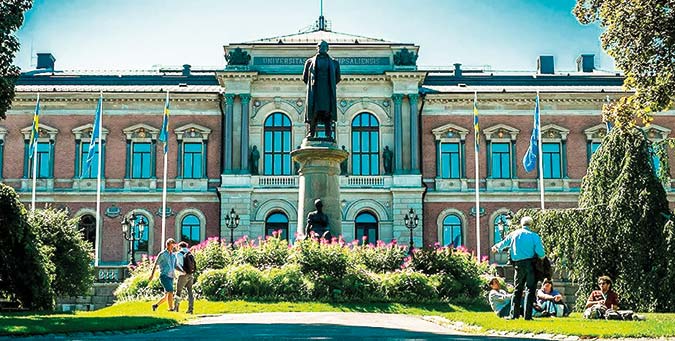
As well as from Uppsala, the other honorary doctors were from the universities of Yale, New York, Cornell, Berkeley (California), Oxford, Manchester, Berlin, Osaka and Linkoping. Together with the would-be honorary doctors, special guests and university dignitaries, I was waiting in a large hall on the ground floor of what was called quite simply the “University Building”. It dated back to 1877. Seemed to be based on Greek architectural style, both the exterior and interior were magnificent. Corridor roofs and that of each room were a series of high domes supported by elaborate pillars rounding off at the top to extend their support to the domes. Everywhere from the dome to the floor was covered with statues, portraits, paintings, sculptures and carvings, many of the most intricate design.
Within this continuing magnificence, at 11.45 sharp we were taken in procession along a winding staircase to what is called the Aula or Auditorium. In China what would be called the Great Hall.
Leading us were flag bearers in colourful Swedish traditional dress, both young women and men students. Some carried flags of the university, others carried flags representing the Swedish provinces from whence they came. We, the special ones followed the Vice Chancellor with the university dignitaries following. Up the winding stairs we went and to our seats on the dais. And all this to the sound of resounding music. I feel the exuberance that overwhelmed me as if it was yesterday.
Events on Mount Parnassus
While on the dais, we first stood to the National Anthem and tribute to King Carl Gustav VI of Sweden who was the Chancellor of this prestigious university. This was followed by speeches – in the Swedish style, very brief. Soon it was my turn. My name was called by the Vice Chancellor.
I stood up and he read out my citation. He invited me to the podium. I moved forward recalling that I was to climb Mount Parnassus, the Greek Mount of Learning which was symbolised by the podium. And as I climbed up, the Vice Chancellor, standing at the mountain top extended to me his hand to symbolically help me up. At the same time saying, “Welcome, Mrs. Mendis.”
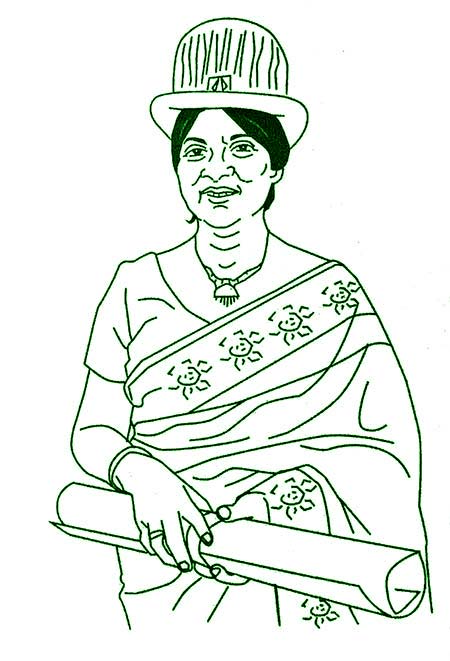
First, on my head he placed the traditional hat from the Faculty of Medicine symbolising freedom and power. And as he placed the hat on my head my second canon was fired from the Castle grounds. We heard it as close and as significantly as if it were outside the window.
Then on my ring finger he placed the doctoral ring of gold, symbolising faithfulness towards science and scholarship. The ring has engraved on its inside my name and the date of the convocation, and encircling it on the outside is the rod of Aesculapius, the Greek God of Medicine and son of Apollo.
To my hand he gave me an elaborate certificate of conferment. It confirms the rights that are due to doctoral graduates.
Thereafter, taking my hand again, he turned me around and saying, “Farwell Honorary Doctora Mendis,” he moved me to the steps. I came down from Mount Parnassus. An Honorary Doctor of Medicine of the University of Uppsala, Sweden.
More conferments followed, including that of doctoral degrees to Faculty Members. And then the Exit Ceremony, as elaborate as the one that brought us in. With the music as resounding. That anything Swedish based on their culture would be so full of colour, of tradition and of symbolism was a complete surprise to me. I had thought of the Swedes as being somewhat staid and matter-of-fact until I got to know them. They are sensitive, gentle giants filled with empathy and warmth and a concern for sharing.
And sentimental as I am, my two canon shells sit atop an antique cupboard, while the certificate is framed in one to match it and hangs on the wall nearby. Both positioned subtly but still to be seen by any visitor to my home. The hat is safe in my wardrobe and taken out once in a while, when I need strength. The ring on my finger is a constant reminder of all that I need to be reminded about.
The end of a Special Day
This was not the end of the ceremonies. A gala banquet followed in the evening and was held inside the castle. Hosted by the university. It was Yngve and Ruth-Marie who took me there. It was of course a white tie, tails and white waistcoat affair with the many who had decorations displaying them on their coats or round their necks. In spite of speeches and numerous toasts the evening came to an end all too soon.
There were two individuals who were constantly in my thoughts all through that special day. One, Gunnel – I missed her so. We would have shared the joy of the event together. And the other, Einar of course. It was he who started it all. In Solo, Indonesia, when we first met in December 1978. Now, in 1990 when he heard about my award he wrote, “You have got this only because you earned it… You have worked in a very low-status area and one in which prizes are seldom received.” Einar was particularly pleased because Uppsala was his Alma Mater. Through me, he had come full circle.
And with that must my memories of that day end.








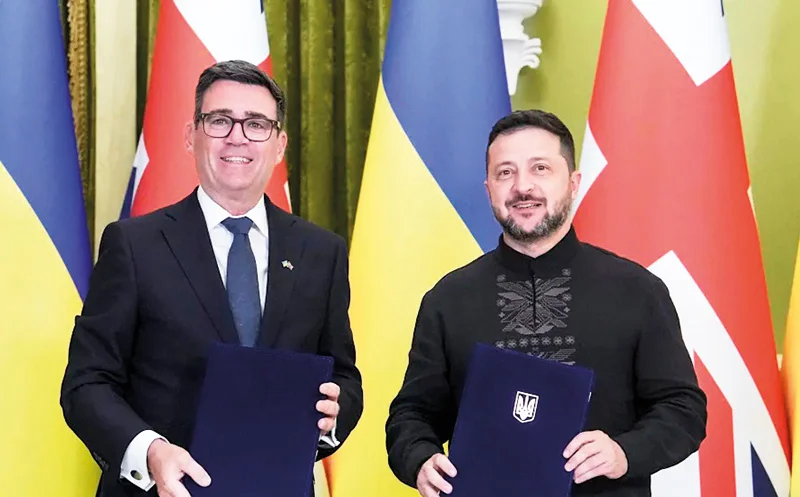
 The present offer by the UK to strengthen Ukraine’s defense capabilities in the missile technology field in particular comes as ‘a stitch in time’ and the initiative is also likely to be appreciated considerably by democratic opinion world wide for the possible morale-boosting effect it would have on Ukraine. Besides continuous arms support, the conviction that the world’s frontline democracies are behind it would prove a huge plus in Ukraine’s eyes in its grinding fightback against the Russian invasion.
While continued US support for Ukraine could not be considered ‘a given’ any more, British Prime Minister Andy Burnham’s words during a recent visit to Kyiv that the UK would stand by Ukraine ‘for as long as it takes’ is the kind of assurance that Ukraine needs at present. For, the conflict in Ukraine is essentially a war of liberation conducted by the latter against an invader and deeply at issue here is the upholding of International Law and its foundational concepts, such as national sovereignty and a nation’s right to political self-determination. The world of democracy is of the firm view that the latter ideals cannot be compromised, come what may.
The UK has its work cut out in this connection. It would find it difficult to convince the Trump administration that it should staunchly stand by Ukraine but it could campaign vigorously with the rest of the West and the EU fold in particular to unflaggingly support the embattled and over-run country.
Ukraine has shown an impressive adeptness in using drone technology in particular against her enemy and has even manufactured her own hardware in this respect but using the relevant blueprints handed over by the UK for the manufacture of more sophisticated cruise missiles, for instance, may prove financially difficult, going forward. It is left to be seen whether the UK and the rest of the West who are with Ukraine will continue to be with her, considering their own rising financial constraints.
The latter impediments could only multiply in the future. Oil, gas and energy prices are on the rise and the latter costs are glaringly reflected in kitchens and meal tables the world over. As we go along consumer discontent would steadily intensify and governments, East and West, would need to figure out with considerable rigour and foresight how such disaffection could be ably managed. Failing which, in most democratic societies, the chances are that publics would be out on the streets demanding that their grievances be redressed forthwith.
These rising concerns are reflected in a recent move by some EU governments to consider imposing what is described as ‘a windfall tax’ on the profits specified major oil companies operating within their shores have made in the wake of the US-Israel war on Iran. The rationale apparently is to use such tax earnings to cushion the rising cost of living of their publics and bolster the respective countries’ social expenditure.
In a recent letter to the president of the EU Council the EU governments referred to said, among other things, while drawing attention to the ‘discontent that is growing over the rising cost of living’: ‘A common approach’ is needed that ‘ensures those who profit from the crisis contribute their share to reducing the burden on the general population.’ Meanwhile, Oxfam with reference to the above development is on record as calling for a ‘permanent windfall tax of at least 50% on profits exceeding a 10% return on investment.’
Such are the rising economic pressures on the majority of Western governments. The question to be posed is how consistent they would be in their assistance to Ukraine if they decide consensually to stand by her. The soaring cost of living in the West compels the conclusion that there could be no guarantee that Western assistance to Ukraine, particularly in the defense and security fields, would be of a longstanding kind.
Of particular concern would be the fact that the weapons systems on offer from the UK to Ukraine could be increasingly costly to manufacture going forward. Besides they would need to be manufactured and put into action without delay.
However, these considerations should in no way deflect Ukraine’s supporters from the principled policy stance of defending her to the extent possible. Because at issue is the defense of International Law and the democratic system of government from their enemies; fascism and authoritarian rule.
While during World Wars 1 and 2 the US was with the major democracies of the West, this time around with regard to Ukraine, the US has chosen to be at cross-purposes with them. For instance, in relation to tariff matters and defense expenditure, in the NATO context, the US is pursuing a hard line which puts it at polar opposites with the West. Thus it is no longer possible to talk unreservedly of a ‘Western democratic alliance’. Put plainly, the cause of democratic development has been weakened.
A measure of relief for the supporters of Ukraine in the West could come by way of the upcoming mid-term polls in the US. If the Democratic Party fares well in them the pressure would be on the Trump administration to defer to opposition opinion at home, accommodate the best interests of Ukraine in its West European policy and perhaps even work towards a diplomatic solution to the Ukraine crisis in cooperation with Russia. Accordingly, the Democratic Party would need to put the Trump administration on the defensive, so to speak.
Until such time Ukraine’s Western supporters have no choice but to remain committed to it, ensure its steadfast defense against the invasion and work judiciously towards keeping the economic pressures at home in check.
Interestingly, at the present juncture in international politics the US could be said to be more weak than strong. For example, it has to some extent been militarily humbled by Iran; so much so it is resorting to economic means to keep Iran in check.
In keeping with this strategy, the US has launched ‘a new big wave of anti-Iran economic sanctions’ at the time of writing, aimed at cutting Iran away from all its major income sources. Some of these relate to digital assets, technology, gold, aviation and shipping. The hoped for result is the complete severance of Iran from the US dollar system.
However, while the UK and EU have no choice but to adhere to their policy of backing Ukraine, going forward they would need to dialogue more closely with the US and ensure that it cooperates with them on outstanding questions, such as Ukraine and the strengthening of democracy. The well being of the world is served when the latter aim is pursued.
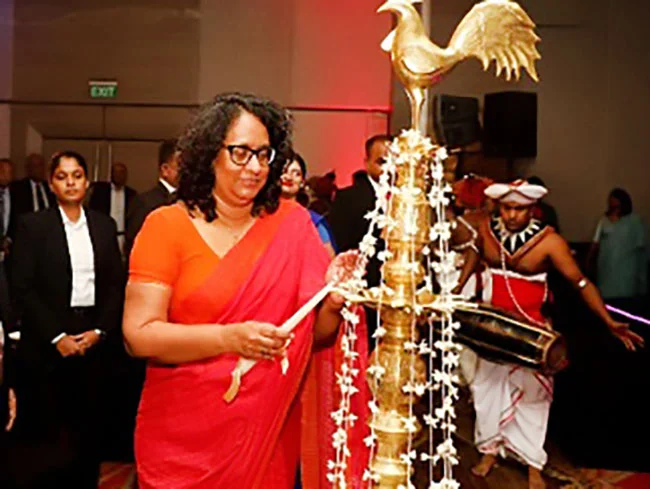
OPA 39th Annual Conference calls for Sri Lanka to move Beyond Recovery towards Sustainable Transformation
The Orgnisation of Professional Associations (OPA) successfully concluded its 39th Annual Conference, held recently at the Cinnamon Grand Colombo, under the theme “Envisioning Sri Lanka: Beyond Recovery”.
Held under the patronage of Jayantha Gallehewa, President of the OPA, with the leadership and guidance of Tisara De Silva, President-Elect and Chairman of the 39th Annual Conference, the Conference brought together leading professionals, academics, business leaders and representatives of the public and private sectors to deliberate on Sri Lanka’s next phase of national development.
The Inaugural Session, on August 2026, was graced by Prime Minister Dr. Harini Amarasuriya, as the Chief Guest; Andrew Patrick, British High Commissioner to Sri Lanka, as the Guest of Honour; and Murtaza Jafferjee, Chairman of the Advocata Institute, Sri Lanka, as the Keynote Speaker.
In her address, Prime Minister Dr. Harini Amarasuriya emphasised that overcoming the economic crisis alone should not be Sri Lanka’s ultimate objective, stressing that recovery must serve as the foundation for a broader economic and institutional transformation necessary for sustainable national progress. Reflecting on the difficult period experienced by the country, the Prime Minister noted that Sri Lanka had faced significant economic, social and institutional challenges, which had weakened public confidence and created uncertainty about the country’s future.
She stressed that “recovery only provides the foundation” and that Sri Lanka can move forward sustainably only by using that foundation to bring about meaningful transformation.
The Prime Minister observed that the theme of the OPA’s 39th Annual Conference, “Envisioning Sri Lanka: Beyond Recovery,” aptly encapsulated these national aspirations. She emphasised that Sri Lanka’s objective should not merely be to return to the conditions that existed before the crisis, but to forge a stronger national foundation characterised by robust institutions, a resilient economy, high-quality public services and an enabling environment in which every citizen has the opportunity to thrive.
She further underscored that Sri Lanka’s future development cannot be secured through economic growth and physical development alone. She emphasised that the effective mobilisation of the country’s knowledge, skills and professional expertise, is equally essential to achieving sustainable and inclusive national progress
The Technical Sessions held on 12 August 2026 brought together 19 distinguished experts and professionals representing academia, industry, banking and finance, public health, technology, management and business leadership. Their diverse expertise provided a multidisciplinary platform to examine the critical challenges, emerging opportunities and strategic choices that will shape Sri Lanka’s next phase of development, with particular emphasis on economic transformation, institutional strengthening, digitalisation, private-sector growth, human capital and sustainable development.
The deliberations were structured around four principal sub-themes: “Resilient Recovery and Sustainable Economic Development”; “Future Readiness: Innovation & Transformation”; “Policy for Impact: Advancing Equity, Sustainable Living, and National Well-Being”; and “Leadership, Governance and National Responsibility.”
Across these thematic areas, the sessions explored the structural reforms, institutional requirements and policy choices necessary to move Sri Lanka beyond economic stabilisation towards a more productive, competitive, resilient and inclusive economy. The discussions brought together diverse professional perspectives, enabling participants to examine national priorities through economic, technological, industrial, financial, social and governance lenses.
Particular emphasis was placed on the need to move beyond the diagnosis of problems towards pragmatic, evidence-based and implementable solutions. The deliberations recognised that sustainable national progress requires not only sound policies, but also effective institutions, professional competence, innovation, responsible leadership and the capacity to translate policy into tangible outcomes.
The sessions further underscored the importance of collaboration across sectors, recognising that Sri Lanka’s complex development challenges cannot be addressed in isolation. Stronger engagement among Government, private sector, professional associations, academia and civil society was identified as essential to fostering a coherent national response and ensuring that professional knowledge and expertise are effectively translated into policy and action.
Collectively, the Technical Sessions provided a substantive platform for knowledge exchange, critical reflection and forward-looking dialogue, reinforcing the OPA’s commitment to bringing the country’s professional expertise to bear on the task of building a resilient, innovative, equitable and prosperous Sri Lanka.
The OPA expressed its sincere appreciation to Prime Minister Dr. Harini Amarasuriya, the Chief Guest; Andrew Patrick, British High Commissioner to Sri Lanka and Guest of Honour; and Murtaza Jafferjee, Chairman of the Advocata Institute, Sri Lanka and Keynote Speaker, for their distinguished contributions to the Conference.
Much of what the 39th Annual Conference achieved would not have been possible without the leadership, commitment and generous contributions of Jayantha Gallehewa, President of the OPA; Tisara De Silva, President-Elect and Chairman of the 39th Annual Conference; Eng. Ravi Rupasinghe, General Secretary; Dharshana Wijemanne, Treasurer; Bhanu Wijayaratne, Convener & the Chairman of the Session Planning Committee of the 39th Annual Conference Committee, Past Presidents and Office Bearers; Presidents and representatives of Member Associations; members of the Executive Councils and General Forum; and the distinguished Session Chairmen, Resource Persons and professionals who shared their time, expertise and insights in pursuit of the Conference’s shared vision. The OPA remains immensely grateful to all those whose collective contributions enriched the 39th Annual Conference and strengthened its role as a meaningful platform for professional exchange, informed dialogue and national reflection.

 For Sri Lankans living 14,000 kilometres from home, the sound of home has never felt closer — and that’s thanks to one man and his band.
Since stepping into the spotlight, Gamini Hemalal and the Ceymphony Band have turned into the heartbeat of the Sri Lankan community in Toronto.
Their mission is simple: bring the music, bring the memories, bring the people together. And it’s working.
What turned out to be the talk-of-the-town was their intimate musical evening with Sri Lanka’s legendary crooner Sohan Weerasinghe.

Sohan Weerasinghe: Had
everyone on their feet at the
Angus Glen Golf Club, in
Toronto, Canada
It was a ‘full house’ long before the big date. Tickets vanished within days — demand was that overwhelming.
According to those who were there, it was a truly amazing evening. The hall was packed, the energy electric. Sohan didn’t just sing — he owned the stage.
With his velvet vocals, his charm, and that signature style, he had everyone on their feet. The ladies, especially, couldn’t get enough. No wonder they call him “The Ladies’ Man!”
One attendee summed it up perfectly:
“We had so much fun. It is truly a blessing to have our kids around us, enjoying these beautiful moments together. Thank you, Gamini Hemalal, for such a wonderful evening, with an amazing crowd and an incredible atmosphere. Your hard work and dedication truly made it a special night.
“We also need to say a big thank you to the Ceymphony Band for delivering such an outstanding performance. You all were absolutely amazing! Our entire family had a fantastic time, and we truly enjoyed every moment.

Ceymphony Band: Extremely popular in the scene in Toronto
“Wishing you all continued success. Keep up the amazing work, we can’t wait for the next.”
And the next is already on the cards: ‘Halloween Pissu Baila Party 2026,’ on Friday, 30th October, at the famous Angus Glen Golf Club.
Gamini promises a crazy night of baila, music, dancing and Halloween vibes with the Ceymphony Band. Action runs from 8:00 PM to 12:00 midnight, with plenty of prizes to be won.

Gamini Hemalal: Amazing work for the Sri Lankan community,
in Toronto, Canada
Gamini is also putting together a special event, connected with the 2027 Avurudu celebrations — ‘Avurudu Musical Show 2027,’ a uniquely styled musical Avurudu celebration … Ceymphony Band style.
It’s scheduled to be held on Saturday, 10th April, 2027, also at the Angus Glen Golf Club.
Through music, Gamini Hemalal and Ceymphony are doing what diaspora bands do best — they’re shrinking the distance between two worlds.
One baila beat at a time, one full house at a time, they’re making sure that even in Canada, Sri Lankans feel like home.
Yes, there is plenty of action, indeed, for the Sri Lankan community in Toronto, Canada.

More than 360 dead, 1,400 missing in Nepal and Tibet after Himalayan floods

Bosnian Serb convicted war criminal Ratko Mladic dies

Prince of Wales to celebrate 150th anniversary with six-a-side cricket

Unyielding Dinusha, spirited tail hold off India to save Colombo Test

US golfer Gogel gets six-month ban for betting

UAE’s Asif Khan handed 15-month ban for using a banned substance

‘Dates have the highest sugar content to fight Coronavirus’

Sunday Island 27 December – Headlines

#SundayIsland 17th December – Headlines

Sunday Island – 28th March

Sunday Island Headlines – 21 March

Sunday Island – 21st February – Headlines
-
 News7 days ago
Country’s first woman Surveyor General appointed
-
 Business6 days ago
SriLankan Airlines makes ShakthiSAT Mission possible for talented Sri Lankan student
-
 Features7 days ago
Medical education in Sri Lanka: Then and now
-
 Latest News7 days ago
Imran Khan moved to private hospital amid deteriorating health
-
 Latest News7 days ago
Government has declared 21, 22 and 23 August 2026 as national days of mourning
-
 Features5 days ago
My secondary schooling after Royal Primary
-
 Features5 days ago
From the First to the 22nd: A short history of Amendment Politics and Reform Frustrations
-
 News7 days ago
22A: Opp. demands all available SC judges hear petitions