
Features
Mastering Showbiz… Music, Food & Fashion In Oman


CONFESSIONS OF A GLOBAL GYPSY
Dr. Chandana (Chandi) Jayawardena DPhil
President – Chandi J. Associates Inc. Consulting, Canada
Founder & Administrator – Global Hospitality Forum
chandij@sympatico.ca
More Music Shows …
Having produced, annually, The Island Music Awards shows on three occasions, I did my largest show in Sri Lanka in 1992. It was The Island Music Awards 1991, staged at the largest hall in Sri Lanka – BMICH National Convention Centre. At that time, I was the General Manager of Mount Lavinia Hotel and the Catering Services at BMICH. This was my last major production before I left Sri Lanka for good, and I was keen to do something spectacular and memorable.
As usual, as the first step I developed a concept for the show with input from many musicians. In brainstorming with a large group of creative people (some with strong personalities), at times the discussions can be prolonged with ideas people reluctant to compromise.
Therefore, on this occasion, I came with my vision for the show and then requested input from the musicians. It worked well. I accepted most of their suggestions and the team fine-tuned the concept. With that, we were able to take this show to a much higher level, in production terms, than all of the previous shows that I had produced in Sri Lanka.
In addition to employees of the hotel and BMICH, our production team for that show comprised 153 professionals (musicians, dancers, choreographers, set designers, sound engineers, lighting engineers, special effects professionals, make-up artists, photographers, video recorders and my favourite stage manager – Kenneth Honter).
I added two new features to this show – a complete dress rehearsal the day before opening, and the show video launched on TV a week later. We commenced the show exactly at 7:00 pm with a full attendance of 1,506.
As written on my concept document and the detailed cue sheet, we had two segments with contrasting sub-themes. For each segment, we used contrasting music, choreographed dance acts, special effects, lighting and sound. It had two major ‘ambitious’ set changes with unprecedented special effects, to enhance the two segments of the show.
Nature
The first half was themed: ‘Nature’ with waterfalls, large trees, mist and 34 little ballerinas performing as butterflies, birds, blossoming flowers in a rainforest waking up early in the morning. A gentle ray of the morning sun gradually made the lead singer of the first song visible to the audience. It was slow moving and misty using greens and blues in the backdrops with subtle lighting. It was a gentle and happy celebration of our beautiful nature.
Future
The second half was themed ‘Future’ with humankind advancing with science and flying rockets, but destroying our planet with short sighted policies, unwanted wars and disruptions. It was fast moving, with sounds of explosions and smoke, using red and orange in the backdrops with flashing lighting. In one scene a rocket landed on the stage, militants came out of the rocket and took a performing singer as a prisoner before flying away from the BMICH stage. It was a warning that we are selfishly destroying our planet.
The audience loved the theatrics of this last show. The contrast of these two concepts conveyed a powerful message. I selected only 12 songs to be performed in between segments of award presentations. By then I had learnt that ideally a good show should not exceed two and half hours, including a 20-minute interval.
The trick is to end the show at a peak when the audience is craving for more, instead of prolonging the show for over three hours. In most of the shows I produced over the years, a finale with a popular song sung by many of the stars of the show was a signature ending. Often the audience joined in singing the final song with the musicians while giving a standing ovation.
With Noeline and Sohan, I co-wrote two new songs aligned with the two segment themes of the show (they did most of the work!). The song, ‘Nature’ dominated the top of the pop charts in Sri Lanka for several weeks, and a year later, Noeline and I jointly won The Island Music Award for the ‘Composer of the Year.’
The experiences I gained in showbiz productions in Sri Lanka were memorable and useful in the next phase of my career as an expatriate hotelier when I produced more shows in the Middle East, South America and the Caribbean. In the 1990s I hosted many stars including Angela Bassett and Harry Belafonte. I was also involved in collaborating in music stage productions featuring Dionne Warwick, Ernie Smith, Byron Lee and the Dragonaires etc. in Jamaica.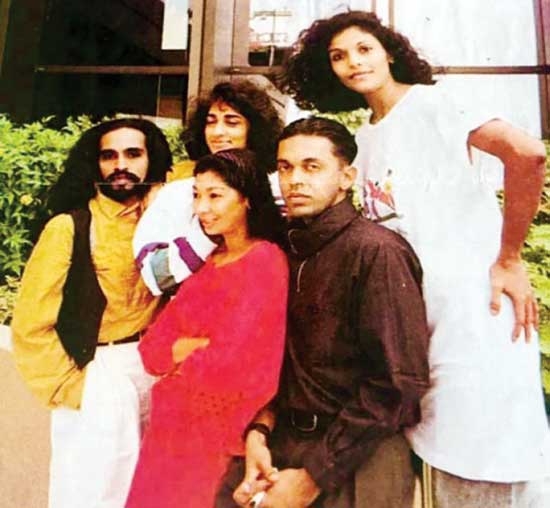
One day in 1998, I hosted the former British Prime Minister, John Major, for a glass of champagne in my office at Le Meridien Jamaica Pegasus Hotel. When he saw some photographs of shows I had produced and stars I had hosted, he was very impressed. With a big smile on his face, he took time to go through all the photographs in my office. For sure, “There’s No Business Like Show Business!”
Looking for Opportunities to Collaborate
Le Galadari Meridien Hotel produced a string of large, music shows with top Sri Lankan musicians and café theatres with international musicians. The hotel became the Mecca of the international and western music scene of Colombo in the late 1980s. We held regular, international food festivals in our restaurants and made Colombo 2000 the only five-star night club with a seven-night operation. Producing our own shows were a lot of fun and definitely increased our banquet income. These initiatives helped my team to achieve record food and beverage revenues and the highest departmental profits since the inception of this 500-room five-star hotel.
In my capacity as the Director of Food and Beverage, I was looking for new opportunities for collaborations to further enhance our reputation and business. When a reputed hair-dresser returning to Sri Lanka after making a name for himself in England, organized a large hair style show in our ballroom with professional models, I was surprised by the popularity of that show. They managed to fill the ballroom.
By then we had a smooth running operation and a team very familiar with all aspects of stage production, logistical coordination (box office, set up, quick catering during the interval etc.) and promotion of large music shows. I wondered if we were ready to diversify to large fashion shows…….
A Mega Festival in Oman
“I am Vijay Vijeyakumaar, the Financial Controller of Oman Sheraton. Do you have 15 minutes to discuss a business opportunity in Muscat?” a Sri Lankan hotel guest approached me during my lunch time ‘meeting and greeting’ walkabout in the restaurants. I invited him to lunch and we had a productive discussion.
Having heard that Le Galadari Meridien Hotel recently handled three highly successful Sri Lankan food festivals in the Far East and the Middle East, he was interested in collaborating with us. As there were no Sheraton hotels in Sri Lanka and no Le Meridien hotels in Oman, there was no conflict of interest.
I told him that I will request our Executive Chef to recommend three cooks to go to Oman. Vijay had a different plan. He said, “We will provide airline tickets, full board accommodation for two of your cooks and an executive event coordinator”.
“What we are planning will not be just a food festival, but a mega festival with a series of events with Sri Lankan music, fashion dresses by Orientations, top models, fashion designers, choreographers, Kandyan dancers, cultural shows, gems, crafts, an Orchid exhibition etc. We have already partnered with Air Lanka and the Sri Lankan Embassy in Oman, who are generously supporting Oman Sheraton”, Vijay added. When I asked what my role would be, he said, “Oman Sheraton is requesting you to kindly coordinate and lead the food and entertainment aspects of the festival.”
I loved that challenge. I quickly coordinated food requisitions for 12 large buffets, buffet decorations and recruiting entertainers and a few others to travel with us to Oman. I worked very closely with Vijay. Eventually, we took a versatile team of 54 Sri Lankans to Oman to take part in this mega festival.
Our team included a well-known Sri Lankan choreographer and fashion promoter, Senaka De Silva, who arranged for a group of top fashion models. Fashion designer, Mangala Innocence (Samaraweera), and Sohan and the X-Periments band also joined us. I negotiated with Executive Chef Emile Castillo to release his Banquet Chef and Head Staff Cook to accompany me to prepare buffet lunches and dinners for six days in Muscat. The whole team was accommodated at Oman Sheraton. Most of us spent 10 days in Muscat.
By observing Senaka De Silva’s talent and professionalism in choreography and versatility in visual and performing arts, I became more interested and knowledgeable about fashion shows. In addition to his team of fashion models, two festival hosts – my wife, and socialite Radha de Mel became additional models for some of the daily fashion shows.
In Muscat, while coordinating the 54-member Sri Lankan team, I became extremely busy. For a few of them it was their first-ever overseas trip. That meant me spending some extra time speaking in a coach and advisor role, as well.
Although Vijay promised five Indian cooks from Oman Sheraton to assist the Banquet Chef and Head Staff Cook from Colombo, I faced a big challenge in Muscat. The German Executive Chef of Oman Sheraton refused to release any cooks from his team to assist with the preparations of the 25 Sri Lankan dishes that I had included in the buffet menu.In spite of my PR and diplomatic approach in dealing with the Executive Chef, he refused to change his stand. “I have only 35 in my team to prepare food for six restaurants and banquets! I simply cannot spare any of them to do advance preparations for you. The Financial Controller does not understand my operational challenges!” He put his foot down.
“Look here, Chef. I have been in your shoes. I understand your challenges very clearly, but two Sri Lankans cannot simply prepare 12 buffets for 200 customers per meal. You may have to pay some overtime to your cooks, or arrange some hotel school students to help in your kitchens. We need assistance to increase your food revenue significantly over the next week!” I emphasised.
Eventually, we negotiated and agreed that the Executive Chef will allocate just two Indian cooks. As that was not enough support, I decided to prepare one third of the dishes myself. I delegated some of my non-catering responsibilities in Muscat to Sohan Weerasinghe. I found some extra chef uniforms in the Sheraton uniform room and jumped into action in the kitchen. I cooked on all six days. Le Galadari Meridien Hotel’s Banquet Chef and Head Staff Cook were pleasantly surprised and highly appreciative of my efforts in the kitchen.
Fortunately, my background as a former Executive Chef and my experience in leading two, large Sri Lankan food festivals in Hong Kong and Singapore in the early 1980s, became handy. However, having been out of touch with cooking for some years, it took a couple of days for me to get back to the rhythm of cooking large quantities.
The Executive Chef of the Sheraton was very impressed with the professional operation we ran in his Indian kitchen, while keeping his food cost percentage low. “None of the Food & Beverage Managers or Directors I have worked with in the past, could have done that in a kitchen!” he joked and became a supportive friend.
There was a large community of Sri Lankan workers in Oman, who were keen to come to our buffets, but the Sheraton pricing was far too high for most of them. Therefore, I convinced the hotel to have a limited menu buffet at an affordable price on a Friday when most Lankan workers were off duty. Sohan and the X-Periments entertained over 1,200 Lankan workers who gathered on the lawns of the Oman Sheraton for that additional event. Sohan compèred in Sinhala, to the loud cheers of homesick Sri Lankans. It was extra work for us in the kitchen, but we enjoyed pleasing a large group of Lankans away from their homes and families, saving money to remit.
The food part of the festival was very popular. Omani customers also liked Sri Lankan culture, fashions, tea, gems, orchids and music. The festival was a big success. After my non-stop cooking for six days, I was exhausted. I slept for a full day after the festival was over, while the rest of the Sri Lankan delegation were taken on sight-seeing tours. I told myself, “No more food festivals!” but in the mid-1990s, I organized and led two more large Sri Lankan food festivals in Guyana and Jamaica. Never say never again!
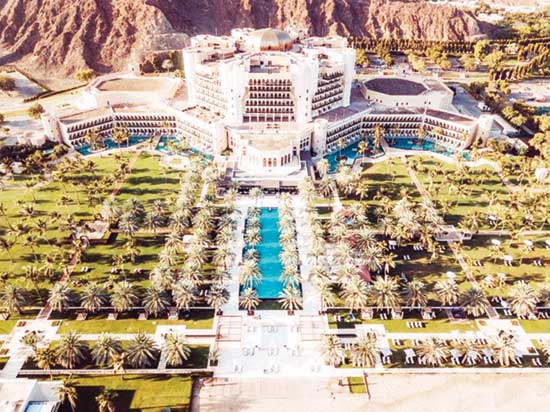
I did a short tour of the country the day before I left Oman. That tour included a visit to Al Bustan Palace, one of the most luxurious and expensive hotels in the world. At that time, it was managed by InterContinental, but without permission to change the name of the hotel. Surprisingly, it also had a very low occupancy. None the less, it was a prestigious management contract for InterContinential.I liked Oman. 18 years later when I was offered the position of CEO for a company owning five hotels in Oman, managed by Aitken Spence Hotels, I was pleased. However, I did not accept that offer, simply because my family did not want to leave Canada to live in the Middle East.
Creating the first Fashion Model of the Year Event
From my occasional chats with Senaka while in Oman stemmed an idea and the concept of the first-ever ‘Fashion Model of the Year’ competition and a grand finale fashion show in Sri Lanka. This new annual contest and show was conceptualized soon after we returned from Oman. It was held later that year with Senaka as the choreographer, Le Galadari Meridien as the venue and host and myself as the producer.



Illegal Foreign Exchange, Undiyal, Hawala and Money Laundering, A Four-Part Investigative Series
Forex Platforms, Cryptocurrency, AI and the New Financial Battlefield
THE INVISIBLE FINANCIAL EMPIRE – PART III
The Boyfriend Who Was Never Real
 Priya, a 34-year-old professional in Colombo, met “David” on LinkedIn. He claimed to work in fintech in Singapore. For six weeks they exchanged messages daily, about work, about life, about a recent trip he had taken to the Maldives. Eventually, the conversation turned, gently and naturally, to money.
“I’ve been trading on this platform, let me show you,” he said, sharing a screenshot of a sleek trading dashboard showing consistent, impressive returns.
Priya invested a small amount first, $500. Within days, her dashboard showed it had grown to $650. She withdrew $100 successfully, just to test it. It worked. Encouraged, she invested more. Then more. Over two months, she transferred a total of $42,000 into the platform.
When she tried to withdraw her full balance, the platform demanded a “regulatory release fee” of $8,000 before funds could be unlocked. She paid it. Then another fee appeared. Then the platform stopped responding altogether. “David” vanished. The trading dashboard, the customer support chat, the entire brokerage, all of it had never been real.
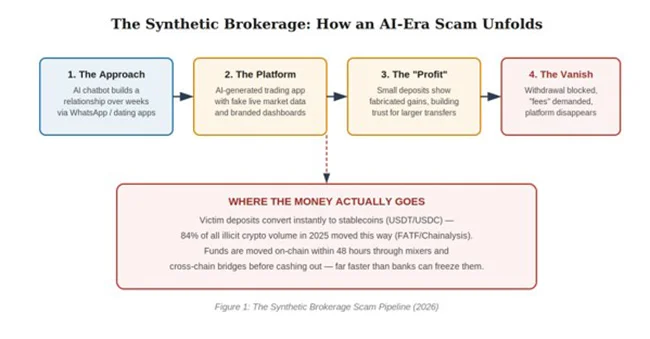
This is what investigators now call “pig butchering”, and, in 2026, the most disturbing development is not the scam itself, which has existed for years, but what now powers it: artificial intelligence has industrialised the entire operation.
From Manual Fraud to Machine-Generated Deception
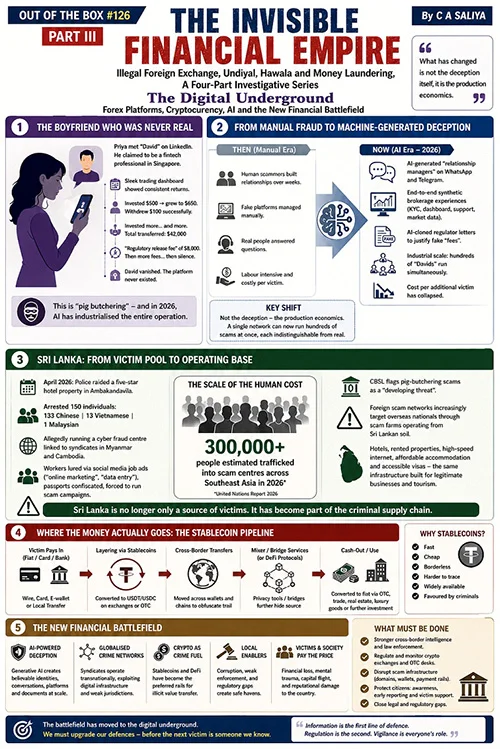 For most of the past decade, romance-and-investment scams, like the one that targeted Priya, required enormous manual labour. Scam operations, many of them staffed by trafficked workers held against their will in compounds across Myanmar, Cambodia, and Laos, needed real humans to build relationships with victims over weeks, manage fake trading platforms, and respond convincingly to questions.
That labour-intensive model has now been substantially automated. According to financial-crime researchers tracking this shift through 2026, threat actors are standing up entire AI-generated “brokerage” experiences end-to-end, complete with KYC onboarding, branded customer-service chat, animated portfolio dashboards, and falsified live market data feeds, and operating them at industrial scale against multiple victims simultaneously. Generative-AI relationship managers now front the WhatsApp and Telegram conversations that once required real human scammers. AI-cloned regulator letters are generated on demand to justify the fake “release fees” that drain victims a final time before the platform disappears.
What has changed is not the deception itself, it is the production economics. The cost of running a credible synthetic brokerage against one additional victim has collapsed, meaning a single criminal network can now run hundreds of “Davids” simultaneously, each one indistinguishable from a genuine fintech professional until it is too late. (Figure 01)
Sri Lanka: From Victim Pool to Operating Base
Sri Lanka’s relationship to this global scam economy has shifted in an alarming direction over the past two years. The country is no longer only a source of victims, it has become an operating base for the criminal networks themselves.
In April, 2026, Sri Lankan police raided a five-star hotel property, in Ambakandavila, and arrested 150 individuals, including 133 Chinese nationals, 13 Vietnamese nationals, and one Malaysian national, allegedly running a cyber fraud centre with links to international criminal syndicates, based in Myanmar and Cambodia. Investigators say the operation followed a now-familiar regional pattern: recruiters advertise “online marketing” or “data entry” jobs on social media to lure foreign workers to Sri Lanka, confiscate their passports on arrival, and force them to operate scam campaigns under threat.
The Central Bank of Sri Lanka has formally flagged pig-butchering scams as a “developing threat,” warning that foreign scam networks are increasingly targeting overseas nationals through scam farms operating from Sri Lankan soil. A 2026 United Nations report estimated that at least 300,000 people have been trafficked into scam centres across Southeast Asia.
This is not an abstract international problem. It is unfolding in hotels and rented properties across the country, exploiting the same infrastructure, high-speed internet, affordable accommodation, accessible tourist visas, that Sri Lanka has built to attract legitimate digital businesses and tourists.
Where the Money Actually Goes: The Stablecoin Pipeline
Behind every successful pig-butchering scam sits a laundering pipeline that has been transformed almost as dramatically as the scams themselves, and the transformation has a single dominant feature: stablecoins.
According to the Financial Action Task Force’s March 2026, report, drawing on analysis from blockchain intelligence firms Chainalysis and TRM Labs, stablecoins accounted for 84% of the USD 154 billion in illicit virtual asset transaction volume recorded in 2025, the highest share ever observed, and a dramatic jump from just 15% only a few years earlier. TRM Labs separately found that illicit entities received USD 141 billion in stablecoins, in 2025 alone, the highest level observed in five years. (See Table 01)
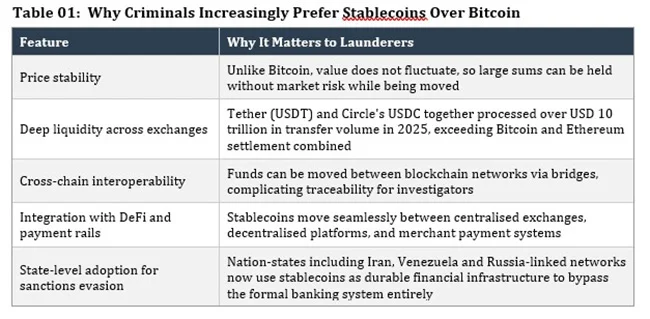
The scale of state-level abuse is striking. A Russian sanctions-evasion network built around the ruble-pegged stablecoin A7A5 processed more than USD 72 billion in total volume in 2025.
Fighting Fire with Fire: AI on the Defensive Side
The same artificial intelligence reshaping financial crime is also, out of necessity, reshaping the defence against it. Legacy anti-money laundering systems, built on static, rule-based thresholds, have proven badly outmatched by AI-generated fraud operating at machine speed. Research cited by compliance technology analysts suggests that between 90% and 95% of alerts generated by legacy AML systems are false positives, consuming enormous investigator time while genuinely suspicious activity slips through.
This is not a frictionless transition. AI models are notoriously difficult to explain to regulators and examiners in the way traditional rule-based systems are. The practical compromise emerging across the industry is a hybrid model: AI handles the initial scoring and prioritisation of risk, while documented rule-based logic still governs the final decision that must be defensible to a regulator.
The Regulatory Response: Catching Up to the Digital Frontier
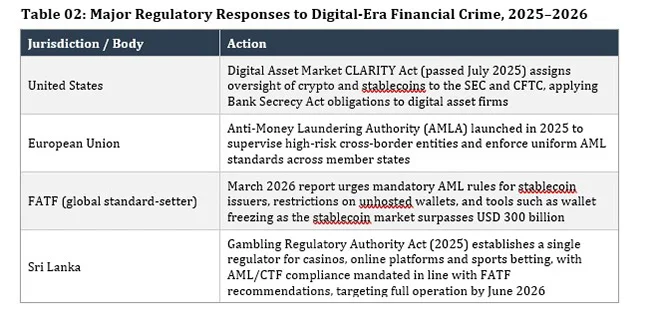
Regulators worldwide have begun moving to close the most dangerous gaps exposed by this digital transformation of financial crime. (See Table 02)
What Comes Next
We have now traced this investigation from the centuries-old mechanics of Hawala and Undiyal, through the three-stage architecture that turns criminal proceeds into apparently legitimate wealth, to the AI-generated frontier of digital financial crime reshaping all of it at machine speed.
In our concluding instalment, Part IV: “Sri Lanka at the Crossroads: Economic Consequences, Organised Crime and the Road Ahead”, we bring this series home. We examine precisely what all of this costs Sri Lanka in hard economic terms: lost remittances, exchange rate pressure, tax revenue forgone, and the 2026 FATF evaluation that will determine whether the country’s institutions can demonstrate, with evidence rather than legislation alone, that they are equal to this challenge. We close with a practical policy roadmap.
(The writer, a senior Chartered Accountant and professional banker, is Professor at SLIIT, Malabe.
Views expressed in this article are personal.)
Features
‘There are no private universities in Sri Lanka’ – some considerations for higher education reform
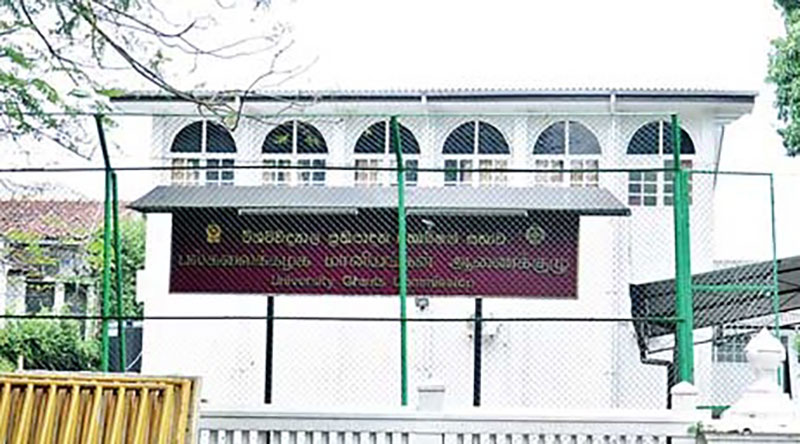
 Academics involved in education policy like to say that there is no such thing as a private university in Sri Lanka. The only ‘universities’ in the country are state universities; anything else offering degrees is a private higher education institution (HEI). This position is technically accurate. Yet, in the discourse and imagination of the public, private universities are very real – people teach in them, students register in them, families pay fees, and such degree holders enter job markets in Sri Lanka and outside.
For decades, activists concerned for public higher education have ignored or resisted looking at private HEIs, as if such scrutiny would taint them. Others have worked in both types of institutions, carrying practices from each to the other. The apex body governing state universities, the UGC, has, meanwhile, ignored the concept of conflict of interest and appointed individuals in private higher education in committees and leadership positions. It is unsurprising then that some of the ideologies informing private higher education appear in reform agendas in the state sector.
This is a good time then to consider the varying types of private HEIs around us, and to take a look at some of the issues within them in the hope that higher education reform agendas will include private, as well as state higher education.
What is a ‘private university’?
First, some clarifications. In the public imaginary, a ‘private university’ is typically an institution that provides a foreign or local degree for which the student makes a payment. But this broad classification encompasses a host of diverse institutions and types of degrees which I detail below.
The Non-State Higher Education Division (NSHE) of the Ministry of Education has recognised 295 degrees by 32 institutions. Most of these are private companies and include a handful of established, well-known private HEIs that are ‘university like’. The degrees are local degrees conferred by the institutions accredited by the NSHE Division. While private HEIs conferring local degrees must be accredited by the NSHE Division, there appears to be no legal consequence for not doing so. In addition, there are several permutations of the private degree that miss the net of this Division and the Standing Committee on Accreditation and Quality Assurance (SCAQA) that assists this Division.
For one, degrees conferred by foreign universities offered, via these same private HEIs, are not vetted by the NSHE Division. Secondly, there is a growing plethora of private HEIs which have either no physical presence locally or only a dubious presence. The University Grants Commission has notified the public, through their website, that foreign universities listed in the Commonwealth Universities Yearbook and the World Higher Education Database are recognised, but refrained from giving any other details – which degrees? Offered by what modes? These details are not known. Some of the foreign universities in the lists may be legitimate entities in their own land but the degrees conferred locally, in their name, may not adhere to curriculum or teaching specifications of the NSHE Division or the UGC.
Another troubling phenomenon is the ‘top up degree’, which appears to work on the same principle as that of a pre-paid mobile connection: if I have a Diploma or an HND of a sort, I am eligible to complete a course of study which provides me with a degree, usually from a foreign university. The idea that someone who does not initially qualify for a degree programme should be able to work their way towards one is a progressive notion. This is the concept that open and distance learning (ODL) was based on initially, but which is now sadly exploited. ODL models are expected to provide opportunity for learning for those who may be excluded from traditional learning institutions. In Sri Lanka, however, we have seen ODL become a marketplace offering easy to obtain, for-fee qualifications by institutions with little commitment to superior teaching and learning.
Finally, a perusal of the many types of private HEIs and their varied degrees bring to mind another question – how should the private degrees, provided by state institutions (that are not educational institutions), be regulated? Who should do so?
All of these create a host of problems for the public – for hopeful students and parents and trusting employers. For the higher education sector, recruitment of academic staff, too, has become difficult due to this plethora of ambiguous higher education qualifications, as I discussed in a previous Kuppi article (‘Recruiting academics to state universities’).
Some issues in private HEIs – a bellwether for change in state universities
In this second part of this article, I will discuss some aspects of work in private HEIs – albeit the more established institutions – given that such issues may appear in reform agendas in future.
Across state universities, all permanent staff of a specific category are paid according to the same criteria. The picture is not so clear when it comes to private HEIs since they are different entities legally, typically companies. Private HEIs have salary scales and financial incentives that are different to each other. The more established private HEIs reportedly have attractive renumeration packages, possibly a reason for academics of state universities migrating eagerly to such institutions during sabbatical years and on retirement. This may not of course be the case with other less established, or improperly registered HEIs of which we know little. Academic staff of these more accepted private HEIs seem to value the high financial remuneration they receive (in comparison to state universities) as something that makes their work rewarding.
Attractive remuneration is important to sustain the good life and is at times seen as the institution’s way of encouraging good work. Yet, this has implications for the future of the institution: to continue to deliver on promised financial packages, institutions must continue to have large profit margins. One strategy has been to enroll multiple cohorts of students per year, even up to three or four intakes per year. This can result in exploitative work conditions, since staff must cater to all these cohorts in that same year. If there is inadequate staff, employees are further burdened. On the other hand, if there is a sudden drop in enrolments (degrees can go out of fashion) unexpected layoffs occur. Similar to other sectors that employ short-term contract staff – including state universities – in private HEIs, too, individual teachers, who are on short term contracts that need regular renewal, can feel pressured to work under difficult or exploitative conditions.
At the same time, even in the more established private HEIs, work norms differ from those of state universities in that they include promotional work that keeps the institution’s name in the eye of the public. The Marketing (or similarly named) unit comes up in conversations as one of the most important departments. It appears to weigh in on decision-making related to the number of staff, the amount of re-sits per exams, and other pedagogically important matters. This is a worrying example of how financial rationales interfere with pedagogically or academically sound processes, resulting in problematic results in the classroom. On the plus side, junior colleagues, who had experience in both state and private HEIs, also felt that they faced less harassment in private HEIs – primarily due to the private HEIs ability to take swift action in reported cases of harassment. This is a real indictment on state institutions and their reluctance to address chronic issues of harassment in our universities.
Yet, while we hear much about problems in state universities, we hardly hear of problems that staff in private HEIs face. One rationale for a lack of public expressions by staff is that expressions of discontent might lead to trouble given the importance of reputation for private HEIs. The worry about reputational damage is a growing concern in state universities, too, as evidenced by social media policies and internal conversations on reputational damage, consequent to negative publicity. Institutional worries of reputational damage are harmful in the long run since these impact not only freedom of expression by student and staff, but also research that is possible in and about the education sector.
Some thoughts at the end…
A close look at the private higher education sector is important given its strong presence in the country. Impending reform needs to regulate this diverse array of higher education offerings in the private sector, as well as the state institutions that offer privately-funded options of higher education (a topic for a separate Kuppi on its own). It is time we carefully considered how to build a whole system of higher education out of this broken mess.
Kaushalya Perera is a senior lecturer at the University of Colombo.
Kuppi is a politics and pedagogy happening on the margins of the lecture hall that parodies, subverts, and simultaneously reaffirms social hierarchies.

Singer Nish Peiris is set to take the next big step in her music journey.
The talented vocalist, who has been seen and heard in the scene here for a short while, and was also featured with the now-defunct band, Inner Vision, has announced that she will be fully committing to her solo career, after completing her degree this year.
“I’m finishing my degree this year, and after that I’ll be fully committing to my solo music career,” Nish told The Island.
“I’ve already got a few tours lined up for next year, so I’m really excited for what’s ahead.”
Fans, no doubt, will remember Nish for her smooth voice and stage presence, and the good news is that she is now ready to chart her own path and bring new music to audiences at home and abroad.
With tours already planned for 2027, the year 2026 promises to be an exciting year for the young artiste as she steps into the spotlight on her own.
We wish Nish every success in this new chapter!

True leadership is not about titles or power, but about acting responsibly for the well-being of others – Prime Minister

A few showers will occur in the Western, Sabaragamuwa and North-western provinces and in Kandy, Nuwara-Eliya, Galle and Matara districts

Customs asked to resume probe or face legal action

Outgoing Chinese Ambassador Qi Zhenhong bids farewell to Mahanayake Theras

Move to extend retirement age of top judges: BASL asks govt. to stop process pending meaningful consultations

Govt. mum on identities of JVP founder’s wife and children

‘Dates have the highest sugar content to fight Coronavirus’

Sunday Island 27 December – Headlines

#SundayIsland 17th December – Headlines

Sunday Island – 28th March

Sunday Island Headlines – 21 March

Sunday Island – 21st February – Headlines
-
 Features3 days ago
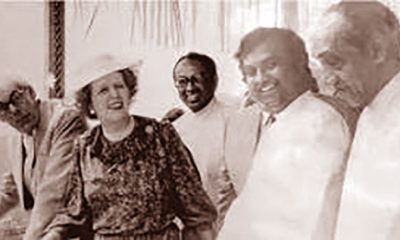
Two memorable excerpts from a former SLAF commander’s memoir
-

 Business3 days ago
‘Giving up was never an option’: The fisherman who fought back after losing millions in SL
-

 Latest News4 days ago
Davis cup Asia/Oceania Group IV 2026 to be held in Colombo from 20th to 25th July
-

 Features3 days ago
Erdoğan’s New Republic
-
 Life style3 days ago
Taste of the Swiss Alps comes to Colombo
-
 News4 days ago
Evidence recorded in money laundering case against Yoshitha Rajapaksa
-
 News4 days ago
Dengue outbreak gallops ahead: Infections surpasses 73,455, leaving 50 dead
-

 News5 days ago
Money laundering case against Yoshitha, fixed for pre-trial conference