
News
Lankans shouldering mountain of mental issues brought on by series of traumatic events since 2019 – experts


By Rathindra Kuruwita
Sri Lankans have been facing a series of traumatic events since 2019, and they have had a serious impact on their mental health, Dr. Kanthi Hettigoda, chartered clinical psychologist and senior lecturer, Department of Psychology, at the University of Peradeniya, says.
Asked whether the economic crisis can trigger trauma in individuals, Dr. Hettigoda said that it could occur, depending on their personality as well as the extent of the impact.
“Trauma can occur if someone experiences unexpected and significant changes. These changes can be those that affect them materially, or thinking patterns. Due to the economic crisis, a large number of people do not know what to expect next, and they might feel that the future will only be bad. Then they might experience trauma. There are people who have lost jobs, gone bankrupt, etc., due to the current crisis,” she said.
Dr. Hettigoda said that prior to the economic crisis, which began in 2022, Sri Lankans have been experiencing a series of economic and social crises. These events started from the Easter Sunday attacks, she said.
“Then we faced COVID, and now an economic crisis. So, a number of quite shocking events have accumulated. Easter Sunday attacks was definitely a trauma for all, COVID, too, can be traumatic, depending on the experiences someone faced, and the current socio-economic crisis have led to many negative emotions and outcomes,” she said.
Dr. Hettigoda opined that based on her practice and what she had observed at University, as an academic, most people were facing adjustment issues. There is a lot of anger, frustration, and disgust among Sri Lankans, in general. Unfortunately, given that Sri Lankans do not receive any education on mental health, a lot of people don’t know that they are showing symptoms of mental health issues, she said.
“Most don’t know what’s happening inside them. So, when they do not understand what’s going on, they fight within themselves and they fight with those who are closest to them. As a University academic, I see young people who are frustrated, and sometimes these frustrations are taken out on people around them and sometimes there is maladaptive behaviour”, she observed.
Meanwhile, Rushma Mohammed-Fronczak, clinical psychologist and ACE Certified Personal Trainer, who practises in Kandy, said that in the past year a lot of people had sought help for trauma, adjustment-related stresses, etc.
“There is severe anxiety about the future and this is the culmination of a series of events, over four years. Sri Lankans have a lot of problems, this is nothing new. Over the years, or even decades, they had developed coping mechanisms that helped them achieve mental wellbeing. What happened during COVID was that people were not able to engage in activities that helped them keep their wellbeing, things that helped you stay de-stressed. Couples discovered traumatic things about each other given that they were to spend the entire day with each other,” she said.
These led to many social issues, including an increase in domestic abuse during COVID. Mohammed-Fronczak said the economic crisis had occurred at a time when people started believing that things would get better following COVID-related restrictions.
“That hope got snatched away for a large part of the population. That brings in anxiety and hypervigilance. Crisis had the ripple effect of the crisis,” she said.
Dr. Hettigoda said given that once a person approaches a qualified mental health professional, identifying what’s wrong with a person is not difficult. However, most people do not seek health, mostly due to the lack of mental health literacy among Sri Lankans.
The Sri Lankan government, and other stakeholders ,in the mental health promotion sector, need to provide a good psychological education. Even University students, or executive level officers, are not aware of common issues, like the symptoms of depression, she said.
Mohammed-Fronczak added that even those who have a rudimentary understanding of mental health issues, resort to looking up symptoms on the internet, where there is much inaccurate information. Sri Lankans need to be taught mental health literacy as there can be many typical, as well as atypical manifestations of mental health issues.
“Individuals themselves can be their smoke alarms. Everyone is an expert on themselves, and mental health professionals are only a guide, mirror or a safety net for some time. You are the expert of your own life, everyone has a version of what’s a good quality of life. It can be getting six hours of sleep, being able to enjoy the food, having time to spend with family and friends. These things help you keep grounded. You can use this baseline and notice changes,” she said.
A major problem in Sri Lanka is that there is a lack of research and a lack of qualified mental health professionals. Moreover, there is no link between researchers and professionals to share findings or discuss developments, Mohammed-Fronczak said.
“In other countries, researchers know what each other is doing. Here, we have a good set of people; they might be doing research in their own pockets. I wouldn’t know them, and they wouldn’t know what I am doing. We need a hub of information,” she said.



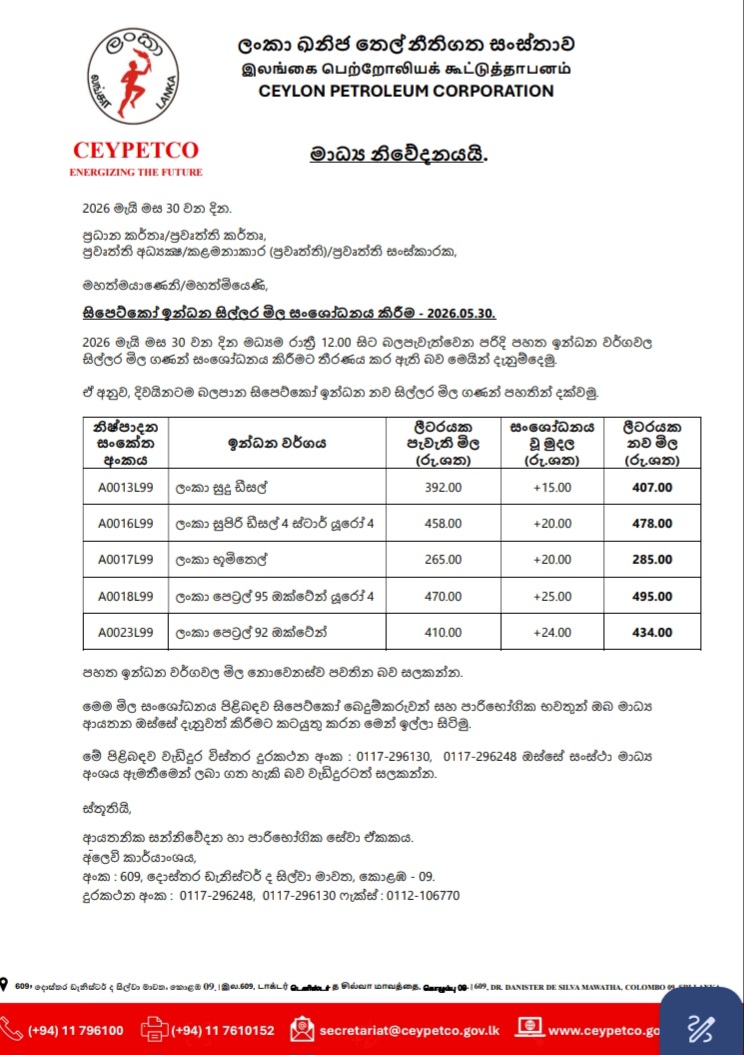
The Ceylon Petroleum Corporation (CEYPETCO) has announced a revision of fuel prices, effective from midnight on Saturday (May 30).
Accordingly,
the price of Auto Diesel has been increased by Rs. 15 to Rs.407 per liter,
the price of Super Diesel has been increased by Rs. 20 to Rs. 478 per liter.
the price of Petrol 92 Octane has been increased by Rs. 24 to Rs. 434 per liter
the price of Petrol 95 Octane up by Rs. 25 to Rs. 495 per liter
the price of kerosene by Rs. 20 to Rs. 285 per liter.

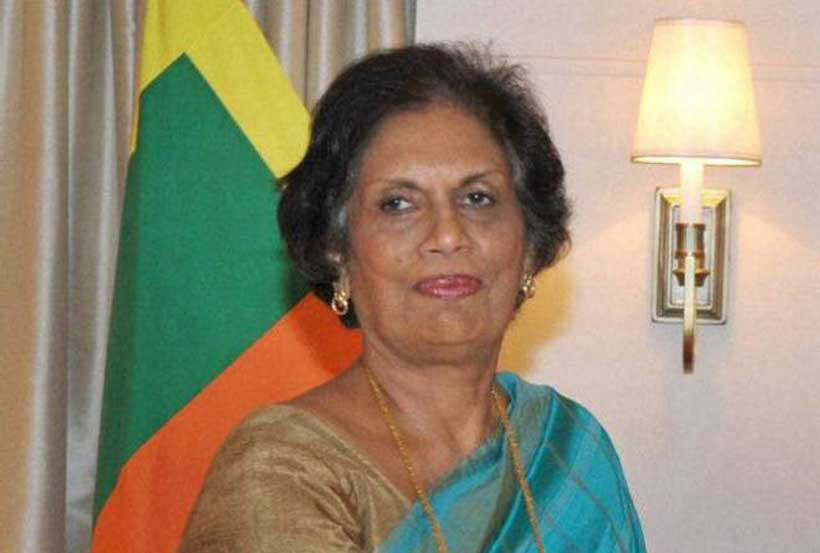
Former President Chandrika Bandaranaike Kumaratunga has called for a comprehensive reform programme within Sri Lanka’s Buddhist clergy, warning that repeated efforts to strengthen the Sasana have in the past been derailed by opposition from within sections of the Sangha itself.
In a statement addressed to the Mahanayake Theras of the three Buddhist chapters, Kumaratunga stressed that the long-term preservation of Buddhism depends on safeguarding both the Dhamma and Vinaya, or disciplinary code, and urged urgent internal reform to address what she described as deep-rooted structural weaknesses.
She noted that Buddhist history has consistently demonstrated that periods of institutional crisis were addressed through reform processes, citing precedents from the First Buddhist Council to reforms during the Kandyan era under Welivita Sri Saranankara Thera.
Referring to post-independence efforts, Kumaratunga said initiatives taken during the 1956 Bandaranaike administration to strengthen Buddhism were left incomplete following the assassination of former Prime Minister S.W.R.D. Bandaranaike.
She further stated that during her own presidency, plans to convene a Buddhist Council under the guidance of the late Madihe Pannasiha Mahanayake Thera had received government backing but were ultimately abandoned due to resistance from certain sections within the clergy.
The former President alleged that, on both occasions, vested interests benefiting from existing weaknesses within the Buddhist establishment had worked to obstruct meaningful reform efforts.
Warning that Buddhism in Sri Lanka is currently facing serious challenges, she called for a broad internal dialogue within the Sangha to identify root causes and implement both short- and long-term corrective measures.
Kumaratunga urged the Mahanayake Theras to take the lead in convening a Dharma Sanghayana, or Buddhist Council, and said she was prepared to work with senior lay Buddhist leaders to support such an initiative.
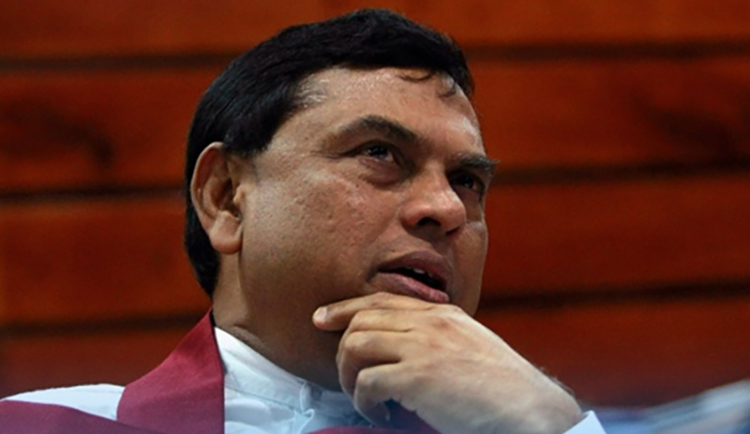
The Colombo Fort Magistrate’s Court on Friday ordered the arrest of former Minister Basil Rajapaksa, Tourism Promotion Bureau Chairman Bhashwara Gunaratne, Managing Director Rumi Jauffer and several others over the alleged misuse of Rs. 7.8 million belonging to the Tourism Promotion Authority during the 2014 Uva Provincial Council election campaign.
Magistrate Pasan Amarasena directed the Criminal Investigation Department (CID) to arrest and produce the suspects before court, after it was informed that they would be named under the Public Property Act on the advice of the Attorney General.
The CID told court that attempts to take the suspects into custody from their residences had been unsuccessful as they were not present.
The Magistrate also imposed an overseas travel ban on the suspects and ordered that the Controller of Immigration and Emigration be notified.
Investigations have reportedly revealed that the funds were used to print 12,000 T-shirts bearing an image of former President Mahinda Rajapaksa on one side and the name of a political party on the other.
According to the CID, the T-shirts were later distributed at a political event held in the Monaragala District.

Oscar-winning Star Wars editor Marcia Lucas dies aged 80

Hundreds arrested in France after wild Champions League celebrations

‘Disappointing’ – Sangakkara on Sam Curran turning out for Surrey with IPL still on

Truck carrying Afghan returnees from Pakistan flips on highway, killing 18

PSG beat Arsenal to win back-to-back Champions League titles after shootout

What Hegseth’s comments at Shangri-La Dialogue say about US foreign policy

‘Dates have the highest sugar content to fight Coronavirus’

Sunday Island 27 December – Headlines

#SundayIsland 17th December – Headlines

Sunday Island – 28th March

Sunday Island Headlines – 21 March

Sunday Island – 21st February – Headlines
-
 News7 days ago
Police probe underway to ascertain links between criminals deported from UAE and local politicians
-
 News2 days ago
IMF urges Lanka not to meddle with exchange rate
-
 News6 days ago
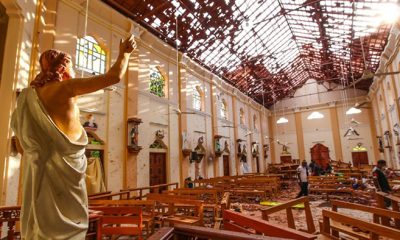
Easter Sunday carnage: Court told Maulana’s statement cannot be accepted without cross-examination
-
 News6 days ago
UK passport holder hiding here wants to have deportation order rescinded to leave without blemish
-
 Opinion6 days ago
Undermining the democratic political framework
-

 Features3 days ago
The Division Bell Mystery
-
 News7 days ago
Dickoya double murder suspect arrested
-
 Midweek Review5 days ago
Israeli-US aggression won’t go unanswered -Iranian Ambassador