
News
Lanka imports nano-fertiliser from India despite local scientist discovering the concept 10 years ago

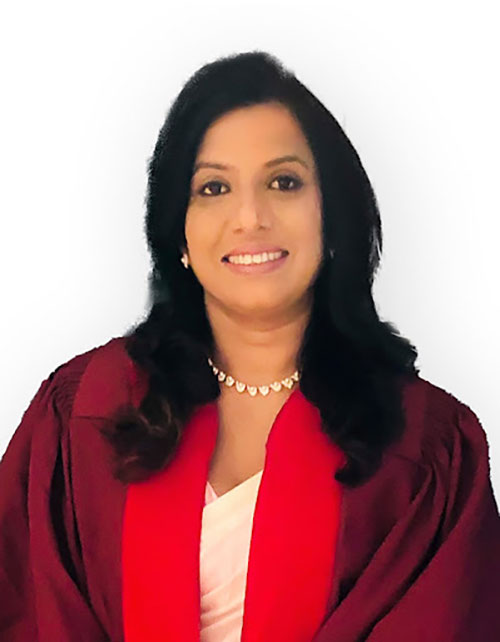
It is unfortunate that Sri Lanka has to import advanced nano-fertiliser from India although the Sri Lankan scientists invented it 10 years back, the University of Sri Jayewardenepura says..
Text of the media statement: “Sri Lanka is a country which was once considered as the “granary of the ancient east”; today we try to win back this status by making a paradigm shift in agricultural practices. “NANO” has become the buzz word among the people now. It’s unfortunate that we have to import advanced nano-fertiliser from India while our own scientists discovered the concept 10 years back!
“Prof. Nilwala Kottegoda, Head of the Department of Chemistry at the University of Sri Jayewardenepura and the team at Sri Lanka Institute of Nanotechnology (SLINTEC) developed a new nano-fertiliser product in 2010 and received four US patents at a time where nano-fertiliser was new to the scientific community. Thus, the technology for the production of efficient nano-fertiliser was introduced to the world about 11 years ago from Sri Lanka. This innovation was rated as a global first by the World Intellectual Property Organisation and Prof. Kottegoda was selected as one of the nine most inventive women scientists, based on this new concept.
“In this innovation, urea molecules were anchored onto biocompatible hydroxyapatite nanoparticles thus minimising the wastage of urea as gaseous emissions and water-soluble leachates. This new solid fertiliser contains 40% of nitrogen while supplying plant-available 6% phosphorus when applied to the soil. The efficacy of the fertiliser has been tested at the farmer field level for tea and rice. The field trials suggest that the new formulation reduces 25-40% nitrogen usage with a yield improvement of up to 20 %. The process has been scaled up to pilot-scale production.
“Prof. Kottegoda’s research team at the USJ has further developed a greener process of nano-fertiliser production that has minimum energy, water, and environmental footprint. They also have explored a method to introduce other nutrients into the same formulation thus increasing its potential as a “mother of fertilizer”. This extended innovation has already received two patents belonging to USJ.
“Commercial production of high efficiency nano-fertiliSer has not yet commenced in Sri Lanka. But a leading fertiliser manufacturing company in India, anticipating the future value of the discovery, had purchased the technology in 2013 for commercial exploitation through the Sri Lankan government. However, patent rights are retained with SLINTEC. Therefore, Sri Lanka to this day, still has production rights over this product, meaning that the potential for Sri Lanka to become a manufacturing hub for this product does exist. But it’s unfortunate, today, the Sri Lankan government has to import nano-fertiliser from India at a huge cost.
“There is no action plan yet for the production of nano-fertilisers in Sri Lanka, which are highly efficient, economically viable and environmentally friendly”, said Prof. Nilwala Kottegoda.”


The Cabinet of Ministers approved the resolution forwarded by the Minister of Health and Mass Media to relocate the Deniyaya Base Hospital after constructing a new hospital with a capacity of 300 beds at an estimated cost of Rupees 6,000 million.
The Southern Provincial Department of Health has acquired a plot of land in Handford estate which is approximately 03 kilometres away from the town for this purpose.
News
Cabinet nod to legally empower methodology for implementing the ‘Praja Shakthi’ poverty alleviation national movement


The Cabinet of Ministers granted approval for the resolution furnished by the Minister of Rural Development, Social Security and Community Empowerment to instruct the Legal Draftsman to draft a bill to legally empower the implementation of ‘Praja Shakthi’ (Strength of the Community) poverty alleviation national movement
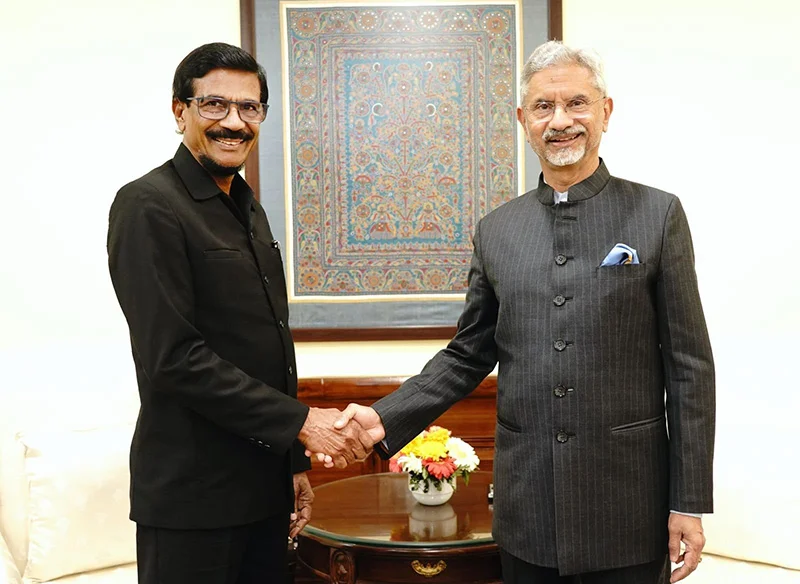
…preliminary work started on new Constitution
JVP General Secretary Tilvin Silva yesterday (17) maintained that the NPP government was not under Indian pressure to hold the long delayed Provincial Council elections.
The top JVP official said so appearing on Sirasa Pathikada, anchored by Asoka Dias. Tilvin Silva said that neither the devolution nor terrorism issues had been discussed during his meeting with External Affairs Minister Dr. S. Jaishankar and Deputy National Security Advisor Pavan Kapoor, in New Delhi. This was Tilvin Silva’s first visit to India.
Declaring that politics hadn’t been on the agenda, the JVPer said that the Indian focus was entirely on economic development and technology.
The JVP General Secretary visited India under the Indian Council for Cultural Relations’ (ICCR) Distinguished Visitors Programme from 5-12 February 2026. General Secretary Silva was accompanied by Kitnan Selvaraj, MP, Ilankumaran Karunanathan, MP, JVP Central Committee Member Janaka Adhikari, JVP’s Media Unit Head Hemathilaka Gamage and Member of JVP’s International Relations Department Kalpana Madhubhashini. The delegation visited New Delhi, Ahmedabad and Thiruvananthapuram.
Responding to another query, Tilvin Silva said that Dr. S. Jaishankar had reiterated that India would always remain a true and trusted partner for Sri Lanka, in accordance with its ‘Neighbourhood First Policy’ and Vision ‘MAHASAGAR.’
Referring to the second JVP insurrection in the late 1980s, the JVPer claimed that they had not been against India but responded to the actions of the then Indian government.
Sri Lanka enacted the 13th Amendment to the Constitution in the wake of the Indo-Lanka peace accord of July 1987 to pave the way for Provincial Councils.
Tilvin Silva said that since they came to power, Indo-Sri Lanka relations had changed. “India has realised we could work together,” he said.
The JVP official said that preliminary work was underway, regarding the formulation of a new Constitution. The abolition of executive presidency and creation of an Office of President sans executive powers, too, would be addressed, he said, adding that the strengthening of the legislature was the other issue at hand.
Pointing out that the NPP had 2/3 majority in Parliament and could introduce a new Constitution on their own, Tilvin Silva said that they intended to obtain views of all and study the past processes in a bid to secure consensus. The JVP, as the party that campaigned against the introduction of executive presidency, way back in 1978, would lead the current effort to do away with the existing Constitution, he said.
Tilvin promised that they would implement what was in their manifesto.
The interviewer also raised the issue of abolishing the pensions for ex-Presidents. Tilvin Silva said that the Supreme Court, too, had approved the move to abolish pensions to ex-MPs. Therefore there was no issue with that, however, the ex-Presidents pensions couldn’t be done away with as they were made through the Constitution. That would be addressed when the government introduced a new Constitution in consultation with other stakeholders.
By Shamindra Ferdinando

India look to go into Super Eight stage with all-win record

Cabinet approves construction of new 300 bed Base Hospital in Deniyaya

Heavy showers about 100 mm are likely at some places in the Eastern, Uva and North-central provinces and in Matale and Nuwara-Eliya districts

Cabinet nod to legally empower methodology for implementing the ‘Praja Shakthi’ poverty alleviation national movement

NPP not under Indian pressure to hold PC polls – JVP

Battery storage drive to power Sri Lanka’s renewable leap

‘Dates have the highest sugar content to fight Coronavirus’

Sunday Island 27 December – Headlines

#SundayIsland 17th December – Headlines

Sunday Island – 28th March

Sunday Island Headlines – 21 March

Sunday Island – 21st February – Headlines
-
 Life style3 days ago
Marriot new GM Suranga
-

 Business2 days ago
Ministry of Brands to launch Sri Lanka’s first off-price retail destination
-
 Features3 days ago
Monks’ march, in America and Sri Lanka
-
 Opinion6 days ago
Will computers ever be intelligent?
-
 Features3 days ago
The Rise of Takaichi
-

 Features3 days ago
Wetlands of Sri Lanka:
-

 News3 days ago
Thailand to recruit 10,000 Lankans under new labour pact
-
 News3 days ago
Massive Sangha confab to address alleged injustices against monks