
Sports
Isipatana down S. Thomas’ in extra time to enter schools’ rugby final


By A Special Sports Correspondent
Isipatana huffed and puffed before pulling off a sensational 25-20 win over S.Thomas’ College during extra time in their semi-final rugby encounter of the President’s trophy knockout tournament worked off at Royal Sports Complex on Sunday (September 8).
Isipatana once again pulled off victory from the jaws of defeat thanks to a last gasp try by playmaker Shaahid Zumri as the two teams were stretched to go into extra time. The scores were deadlocked at 20 all at the long whistle of referee Pradeep Veheranga. The tournament organisers gave instructions to play two sessions of five minutes each to find a winner and the green shirts prevailed over S.Thomas’; producing the match winner in the first session of extra time. Isipatana will now meet St. Peter’s in the schools’ knockout final which is scheduled for September 15.
The Thomians dominated play in both halves and led Isipatana during most parts of the game. Isipatana had their tails up for a brief period in the first half with an early try by Abdullah Faizer, but the Thomians came back aggressively with a try by M. Karunaratne and a penalty by skipper Yehan Bulathsinhalage to lead 10-7 at half time.
S.Thomas’ played their hearts out in the second half and earned an important try through Udan Bulathsinhalage. The lads from Mount Lavinia also managed to turn pressure into points through a penalty which was kicked right by their skipper. But Isipatana were breathing behind their backs and found their way back into the game through tries by Nimantha Sandeepa, Kavin Tharusha and eventually Zumri which helped Isipatana save face and record a sensational come from behind victory. Amazingly the green shirts were down to 14 players in the final 13 minutes of the game when Kalindu Shenal was sent off for dangerous tackling.
On Saturday, St. Peter’s qualified for the schools knockout tournament final by beating Wesley in the other semi final which was worked off in Colombo. The Peterites beat Wesley by 23 points to 20.
Althaf dazzles in Trinity’s Bradby Shield win
Trinity College ended a nine- year wait to clinch the converted Bradby Shield when they beat arch rivals Royal College in the second leg of their annual rugby encounter at Pallakele Stadium on Saturday (September 7). The game was tagged as the 78th encounter in rugby between the two schools.
The winners relied heavily on the boot of kicking sensation Shaan Althaf who took the mantle of leading from the front and bringing victory to his team. Althaf contributed 20 points in a Trinity score of 25 which comprised one try, one conversion and six penalties. Royal responded with two tries, two conversions and three penalties and even led at half time with a score of 20 points against 13 by Trinity.
Trinity also won the first leg played in Colombo with a score of 17 points against 16 by Royal and had a total aggregate of 42 points against 39 by Royal in this edition of the series. Trinity last won the shield before this memorable game -played on Saturday -when they were led by Tharinda Ratwatte in 2014.
There were moments in the second half where it looked like Royal would prevail over the host team, but Trinity’s Althaf changed all that with a well taken monster of a penalty from 53 metres out and followed that up with his sixth and final penalty to seal the game for his team.
The solitary try scorer for Trinity was Minula Yaddehige who crossed the Royal goal line in the first half.
The players who impressed for Royal were Yowan Pathirana and Ayyash Shiyam, who touched down once each while Idris Farook and Nabeel Yehiya did the honours for Royal in the kicking department.

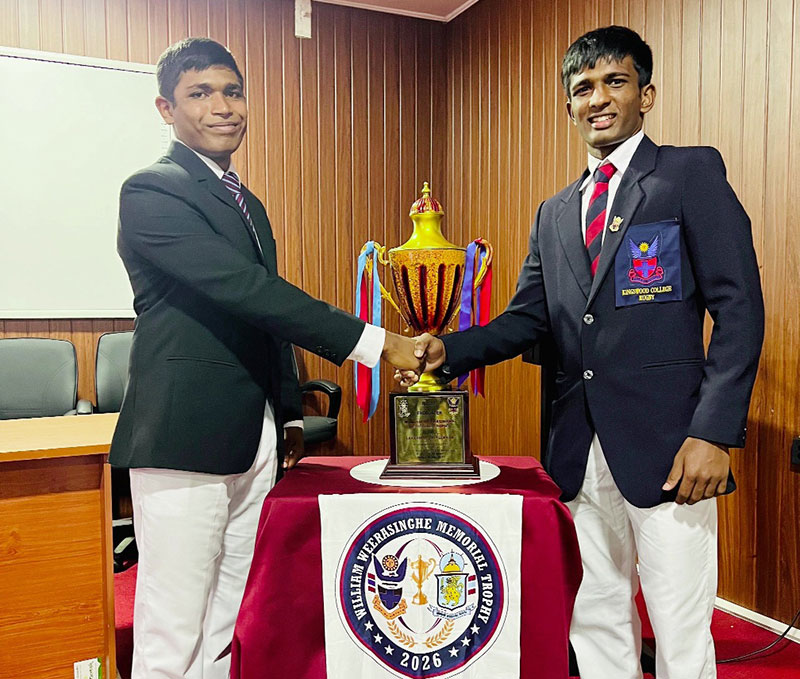
The annual rugby encounter between Dharmaraja College and Kingswood College, played for the William Weerasinghe Memorial Trophy, is set to take place today (July 11, 2026), at 4:00 PM at the Bogambara Stadium, Kandy.
The official unveiling of the trophy took place this week at the Dharmaraja College premises with the participation of the Principals of the two schools, teachers-in-charge of sports, coaches, the Rugby teams, and several distinguished guests, including Dharmaraja College Old Boys’ Association President Mahesh Wijetunga, Kingswood College Old Boys’ Association President Muditha Abeykoon,
Text and Pic by SK Samaranayake

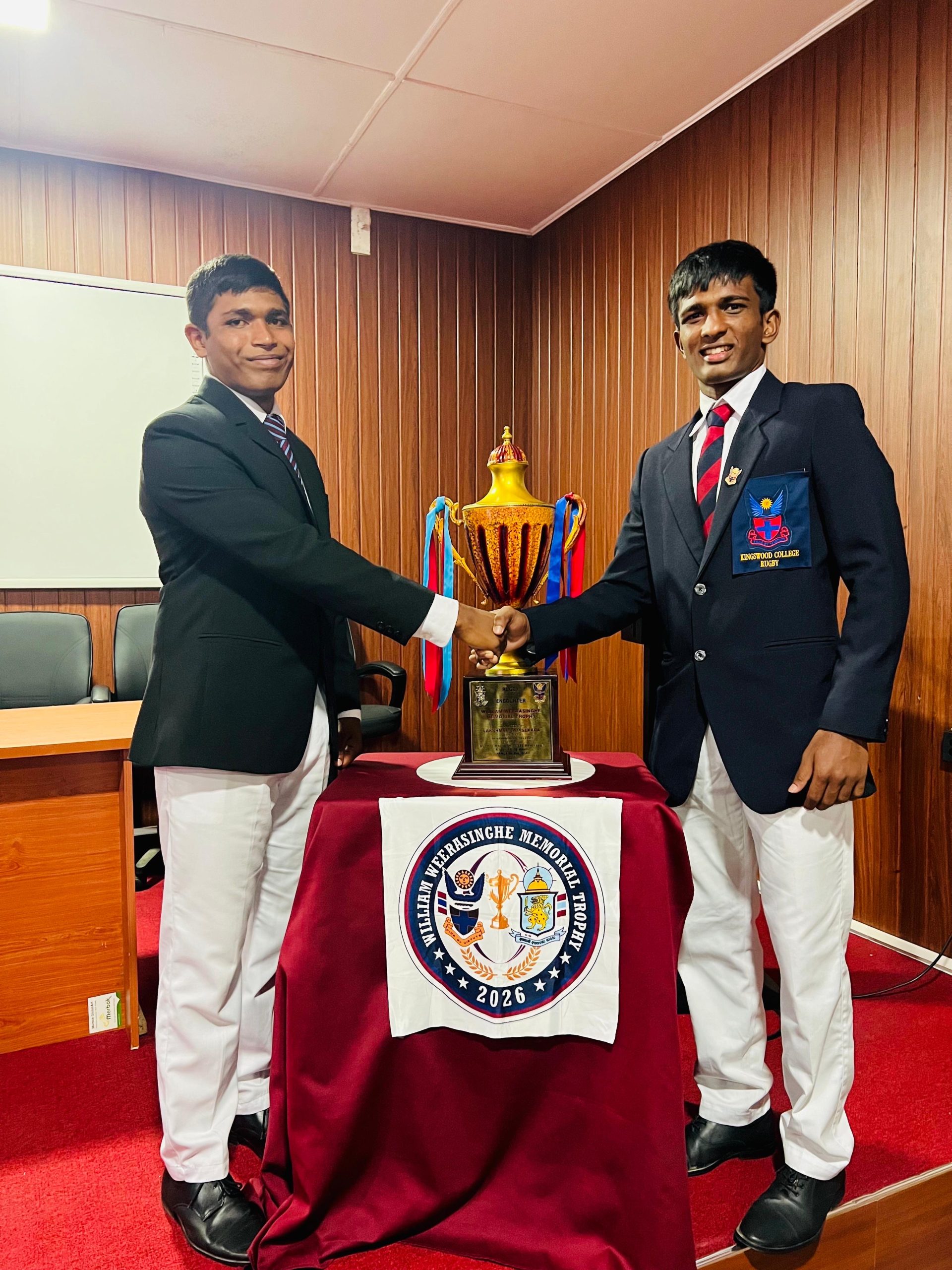
The annual rugby encounter between Dharmaraja College and Kingswood College, played for the William Weerasinghe Memorial Trophy, is set to take place tomorrow (July 11, 2026), at 4:00 PM at the Bogambara Stadium, Kandy.
The official unveiling of the trophy took place this week at the Dharmaraja College premises with the participation of the Principals of the two schools, teachers-in-charge of sports, coaches, the Rugby teams, and several distinguished guests, including Dharmaraja College Old Boys’ Association President Mahesh Wijetunga, Kingswood College Old Boys’ Association President Muditha Abeykoon,
by S K SAMARANAYAKE
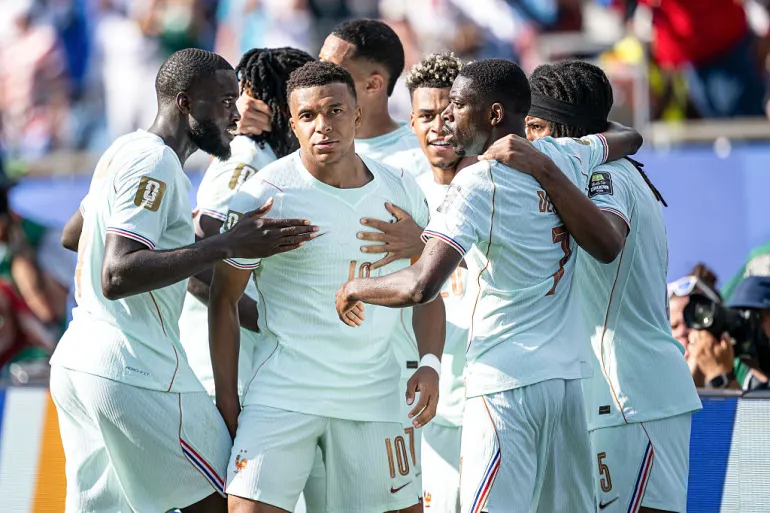
Kylian Mbappe and Ousmane Dembele were on target as France surged past Morocco 2-0 to book their place in the World Cup semifinals.
Mbappe curled in his eighth goal of the tournament on 60 minutes on Thursday before Dembele doubled Les Bleus’ lead six minutes later to settle a clinical victory at the Gillette Stadium outside Boston.
The win sends the 2018 champions into a last-four showdown against either Spain or Belgium in Arlington, Texas on Tuesday.
African champions Morocco had been tipped to pose a serious threat to France’s hopes of reaching a third consecutive World Cup final.
But Didier Deschamps’ men were always in control against a limited Morocco side who failed to register a single shot on goal until an 83rd-minute free-kick by Azzedine Ounahi was parried away by France goalkeeper Mike Maignan.
France, though, struggled to find a breakthrough, and missed the opportunity to take the lead on 28 minutes when Mbappe saw a penalty saved by Morocco goalkeeper Yassine Bounou.
Mbappe had won the penalty after being brought down by Noussair Mazraoui but was forced to wait several minutes before being allowed to take the kick after a protracted VAR check.
Morocco managed to hold out to half-time, but it was always only a matter of time before France’s relentless pressure paid off.
The breakthrough came on the hour mark, with Mbappe bending a brilliant right-foot shot past Bounou from the edge of the area.
Paris Saint-Germain star Dembele made the game safe in the 66th minute, striding forward menacingly from midfield before steering a low finish into the bottom corner.
France now await the winner of Friday’s quarterfinal in Los Angeles between European champions Spain and Belgium.
[Aljazeera]

Siyapatha Finance unveils newest branch in Bandarawela

Dialog recognised as Sri Lanka’s Most Loved Service and Telecommunications Brand for third consecutive year

The Council for Business with Britain appoints Ameena Ziauddin president at 26th Annual General Meeting

Digital shift in vehicle insurance verification in Sri Lanka powered by HUTCH Enterprise

Hayleys Aventura introduces Sri Lanka’s first automated rotary parking system

Vietjet’s July Double Day Sale offers Sri Lankan travellers USD90 flights to Vietnam

‘Dates have the highest sugar content to fight Coronavirus’

Sunday Island 27 December – Headlines

#SundayIsland 17th December – Headlines

Sunday Island – 28th March

Sunday Island Headlines – 21 March

Sunday Island – 21st February – Headlines
-

 News6 days ago
Singapore-based Buddhist monk marks nearly four decades of humanitarian service
-

 News7 days ago
Freedom 250: US Embassy celebrates America’s 250th Independence Day through magic of American cinema
-
 News24 hours ago
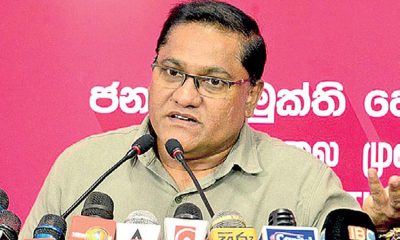
Herath warns prospective migrant workers not to get fleeced by racketeers
-

 News5 days ago
AI concerned over proposed SL military deployment in Haiti
-

 Midweek Review3 days ago
Unexpected focus on ‘pieces of tin’ worn by military men
-
 Latest News4 days ago
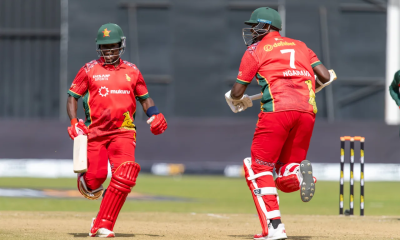
Nyamhuri and Ngarava stun Bangladesh by defending 141
-

 Features6 days ago
The NPP’s New Challenge: Balancing Easter Lawfare and Economic Welfare
-

 News2 days ago
Negombo Prison riot: Ensuring protection of prisoners fundamental responsibility of the state – UN