
Features
Inside the Shadows of China: My Talk with Jasper Becker


That was one of the most concealed nightmares humanity was forced to endure. “In one village a mother was discovered boiling her two-year-old to eat its flesh. In another case, a father was charged with strangling his two sons to consume them; his defence was that they were already dead,” Jasper recounted in his book Hungry Ghosts. The famine of Mao’s era, though China had long been known as a land prone to scarcity, was of an unprecedented magnitude; this man-made calamity claimed at least 30 million lives.
I spoke to Jasper this week, and our hours-long discussion unearthed his profound insights on China—its history, economy, and the deep, often invisible mechanisms that have shaped its trajectory. “I was not an academic,” he told me, “and most of the academic books written in American universities and British universities got the whole picture of China completely wrong.” It was this outsider’s perspective, unencumbered by institutional loyalty, that allowed him to travel freely across rural China and speak directly with peasants, capturing truths that the state sought to conceal.
Jasper Becker is a British journalist, historian, and author whose career has spanned several decades across Asia, with a particular focus on China. Fluent in Chinese, French, and German, Jasper began his career reporting for the Associated Press in Geneva and Frankfurt, before joining The Guardian, where he covered pivotal events across East Asia, including the pro-democracy movements in South Korea and Taiwan, the first pro-independence riots in Lhasa, and developments in North Korea.
From 1995 to 2002, he served as Beijing Bureau Chief for Hong Kong’s South China Morning Post, later becoming China correspondent for The Independent. Jasper has authored nine books on Asia, most notably Hungry Ghosts, the first comprehensive account of China’s Great Leap Forward famine, and Rogue Regime, a study of Kim Jong Il’s North Korea, along with numerous privately published family histories.
Jasper explained that the systemic failures leading to the Great Famine were not merely historical accidents but predictable consequences of authoritarian centralisation and obfuscation. “Because one of the things about China is that it’s very secretive, it’s very authoritarian, and the statistics are unreliable,” he said. During Mao’s era, reporting lines were constructed on fear: “People were given targets. And if you didn’t meet the targets, you were punished. So people told lies to the people above them in the hierarchy, and they then doubled those lies. So you got these inflated reports, which went to the centre.”
This compounding of falsehoods created the terrifying conditions in which policy, divorced from reality, resulted in catastrophe. As Jasper noted, “Eventually then everybody starved, because you couldn’t eat these lies, and you had to import food from abroad. Nobody dared tell the great leader Mao that actually all this was lies and his policies didn’t work. And people who tried to do it were then severely punished.”
China’s long history of famine contextualises the Great Famine within a recurring pattern of environmental stress, social upheaval, and bureaucratic failure. Jasper elaborated on the historical mechanisms: “China was known as the land of famine… the responsibility of the state in Chinese history had been to collect grain in surplus years, hold that in storage, and release it during famine years. That system worked quite well.”
Yet environmental pressures, population expansion, and infrastructure challenges often disrupted these mechanisms. “The geography of China makes it very difficult to move grain around in large quantities, so what China did was they built a grand canal to bring food from the centre of China—from the Yangtze Valley—up to the north on barges.” The north, perpetually threatened by horse-riding invaders, relied on this logistical system to protect both population and state. However, Jasper stressed that, over centuries, human intervention exacerbated vulnerabilities: “People began to move out of the valleys into the mountains and cut down the trees, and that silted up the rivers, and when the rivers silted up there were more and more floods. So there were a succession of rebellions because there wasn’t enough food; the food wasn’t keeping up with the population growth.”
The twentieth century layered additional calamities atop these historical vulnerabilities. Civil wars between the Communists and the Nationalists, Japanese invasion, and regional conflicts created a persistent cycle of destruction. Jasper explained, “Despite the fact that the Chinese were benefiting from all these Western inventions and better crops and better transport, that was negated by all these people moving armies across the country and fighting each other.”
These repeated disruptions meant that, by the time the Great Famine struck under Mao, China’s population was extraordinarily vulnerable. Yet, while the famine itself was catastrophic, Jasper noted that the Communist Party later claimed to have eradicated extreme poverty—a claim he views through a critical lens: “The claim doesn’t really make any sense to me because people were poor when the Chinese Communist Party took over, because the Chinese Party had waged a civil war in order to impose a communist system, which made people worse off.”
The political economy that underpinned the famine and subsequent reforms is complex and, Jasper argued, distinct from other socialist experiments. In the early years of Deng Xiaoping’s reforms, the challenge was to transition from a militarized, state-controlled economy to a consumer-driven one. “When I went there, everybody was dressed in military uniforms… and the military ran everything… So people moved things out of the military into the civilian consumer market.” Jasper emphasized the incremental, step-by-step liberalisation as central to understanding China’s economic evolution.
“Communist countries had a choice between freeing all the prices and privatizing everything in one go, which is what a country like Poland did. Or they could do what China did, which was to do this one commodity at a time.” The initial price liberalizations led to rampant inflation and social frustration, culminating in the student protests of 1989: “Even though living standards were going up, the people wanted to get rid of the Communist Party, because they believed, well, if we’re going to go into a market economy, why do we need a Communist Party?”
Jasper recounted his own experiences reporting during those turbulent times. “I was in Tiananmen, and in Beijing when they sent the army in to suppress the student protest.” The episode revealed the Party’s prioritization of political control over economic reform, a principle that continued to define China’s subsequent trajectory. Upon returning to China in the mid-1990s, Jasper observed the divergence from the Soviet experience: “In the Soviet Union, the Communist Party had been banned. But the Chinese said, well, we’re staying in power. Our children, the children of the revolutionary leaders, are going to stay in control. We are not going to sell off the state factories… But we are going to get foreign investment in.” This hybrid model, combining controlled liberalization with political continuity, underpinned China’s rapid industrial ascent.
Yet Jasper stressed that the extraordinary industrial expansion carries its own contradictions. “China has done everything to excess… which leads to actually a lot of damage.” Overcapacity in housing, steel, and emerging sectors like electric vehicles exemplifies this pattern. “You get a car and the speed limit should be 50 miles an hour. And you say, ‘Oh no, we’re the Chinese Communist Party. We can do things faster.’ And then you drive the car at 100 miles an hour. And then you crash the car. That’s kind of what they do.” This metaphor captures the structural tensions within China’s economic model: rapid production without the corrective mechanisms provided by a truly functioning market.
The modern manifestation of this over-investment is striking. China’s steel production now exceeds one billion tonnes annually, eclipsing the combined output of the next ten countries. Jasper explained, “China produces more than India, Japan, Korea, America, Europe all put together. And now they’re flooding the world with cheap steel. So steel companies all over the world are going bankrupt, because they can’t match the steel prices.”
Similarly, overbuilt housing and infrastructure, while creating employment and stimulating local economies, represent sunk costs unlikely to yield sustainable returns. “You built all this housing, but way too much housing—nobody wants this housing. And so that means the banks, which kind of own the housing because they lend people mortgages, are essentially bankrupt. And lots of industries are like that.”
The structural opacity of the Chinese system exacerbates these issues. Jasper highlighted that “even to this day, the Chinese currency, the renminbi, is not a convertible currency. We don’t know what it’s worth. And they were very fortunate that a lot of foreign companies came into China… but people in the leadership also don’t know the true data.” The reliance on falsified statistics and controlled information channels creates persistent uncertainty in both domestic and global economic planning. “Most of the data coming out of China is fraudulent… the problem we still have today is that most of the data coming out of China is fraudulent; it’s inflated and doesn’t give you a true picture because the political system is still the same.”
This combination of over-centralization, state-directed investment, and opaque governance presents distinct challenges for contemporary analysts and journalists. Jasper lamented the shrinking space for independent reporting: “There are almost no foreign journalists there now… and the Chinese journalists obviously can’t do anything because everything is censored.” Digital technologies, once presumed to guarantee transparency, have been co-opted into mechanisms of control. “You can’t even use a VPN safely in China… that technology story didn’t pan out at all.”
In our discussions, Jasper repeatedly emphasized that the patterns observed historically continue to shape China’s present. The “stimulus programmes” of 2008 and subsequent over-investment, the lack of a convertible currency, and state-directed malinvestment reflect enduring features of a highly centralized system. “One steel mill is a good idea, but ten steel mills is a bad idea… you basically have to write that off.”
Similarly, the economic and demographic legacies of the Great Famine reverberate in persistent rural–urban inequalities. The Hukou system, controlling mobility and access to services, reproduces centuries-old hierarchies: “If you are from a rural area you have no right to live in the city and therefore enjoy better schools or better health care… the difference between the status of an urban resident and a rural resident didn’t change.”
Jasper also offered trenchant observations on China’s geopolitical posture and trade strategies. Overcapacity and export-led industrial growth create structural pressures on other nations, inducing trade tensions. “European and American countries are now moving to basically putting up barriers to Chinese products… because if you’re dumping all this stuff on the market, other people can’t develop their own factories and industries.” He detailed the complex interplay of tariffs, smuggling, and regional industrial relocation: “China has been using countries in Southeast Asia to move factories out of China and try and get round these tariff barriers, and to smuggle these advanced chips through third countries.”
Throughout our conversations, Jasper returned consistently to the historical continuities linking famine, war, and economic mismanagement. Centralized decision-making, secrecy, and excessive intervention created vulnerabilities in the past and continue to shape the present. “Over-centralization is a mistake, having fixed exchange rates is a mistake, having too many subsidies and too much government-directed investment is a mistake, and you’re better relying on market signals than government central planning… They promised everyone they were going to abolish money, abolish markets and abolish private property and they all starved to death.”
His reflections also extended to China’s military–industrial nexus. “It’s certainly building up its military because that’s a way of using up all this steel and all these people… it becomes really difficult to compete.” The intersection of industrial overcapacity, strategic posturing, and centralized planning illustrates how historical patterns of overreach persist into contemporary policy making. Similarly, tensions regarding Taiwan exemplify the political uncertainties that permeate the upper echelons of the Party. “Ever since I’ve been dealing with China, people have been talking about this… I don’t think it’s physically possible for China to invade Taiwan; they would suffer a huge defeat.”
Jasper offered a sobering assessment of the prospects for journalism and historical research in the digital age. The capacity to collect reliable information has been severely curtailed, creating significant blind spots in global understanding: “We certainly know less about China than we used to do… because what China does affects everybody’s economy now, whereas what China did in those days mostly just affected China.” He warned that the combination of over-investment, opaque governance, and restricted information channels will continue to produce systemic challenges, echoing lessons from history.
Reflecting on the entirety of our hours-long dialogue, it becomes evident that the Great Famine, China’s economic trajectory, and its current global positioning are inseparable from the patterns Jasper elucidates. From man-made famine to overcapacity in steel, to censored information and over-centralized planning, the through-line is a system that amplifies both achievement and risk. “Although you get these incredible achievements,” he noted, “you also actually bankrupt yourself doing this… You make lots of electric vehicles, but you lose money when you make them.”
China’s trajectory, as Jasper portrays it, is one of extraordinary paradox: immense industrial and technological prowess coexists with structural fragility; economic growth is accompanied by unsustainable debts and overproduction; centralization ensures both speed and opacity; and censorship preserves the Party’s narrative while masking underlying dysfunctions. In his words, “The manufacturing is real, but underneath things are not very healthy at all… that reversal will be very painful… a lot of the investment will go bad.”
As Jasper reminded me repeatedly, “This is the characteristic of the Chinese system… they do everything to excess, incredibly organized and good at organizing large numbers of people, and getting them to do something very, very quickly, because nobody can oppose it. But this leads to actually a lot of damage.” The tragedy of the famine was not merely the deaths themselves, but the fact that they were preventable. The tragedy of modern China, as Jasper sees it, may lie not in dramatic collapse but in an extended period of stagnation, tension, and dislocation—a slow grinding down of dynamism under the weight of centralized control. The past is not repeating; it is rhyming in ways that are easy to overlook and dangerous to ignore.
by Nilantha Ilangamuwa ✍️

In politics, there is the grand language and the simple words. As they say in North America, you don’t need a $20-word or $50-word where a simple $5-world will do. There is also the formal and the functional. People of different categories can functionally get along without always needing formal arrangements involving constitutional structures and rights declarations. The latter are necessary and needed to protect the weak from the bullies, especially from the bullying instruments of the state, or for protecting a small country from a Trump state. In the society at large, people can get along in their daily lives in spite of differences between them, provided they are left alone without busybody interferences.
There have been too many busybody interferences in Sri Lanka in all the years after independence, so much so they exploded into violence that took a toll on everyone for as many as many as 26 (1983-2009) years. The fight was over grand language matters – selective claims of history, sovereignty assertions and self-determination counters, and territorial litigations – you name it. The lives of ordinary people, even those living in their isolated corners and communicating in the simple words of life, were turned upside down. Ironically in their name and as often in the name of ‘future generations yet unborn’ – to recall the old political rhetoric always in full flight. The current American anti-abortionists would have loved this deference to unborn babies.
At the end of it all came the call for Reconciliation. The term and concept are a direct outcome of South Africa’s post-apartheid experience. Quite laudably, the concept of reconciliation is based on choosing restorative justice as opposed to retributive justice, forgiveness over prosecution and reparation over retaliation. The concept was soon turned into a remedial toolkit for societies and polities emerging from autocracies and/or civil wars. Even though, South Africa’s apartheid and post-apartheid experiences are quite unique and quite different from experiences elsewhere, there was also the common sharing among them of both the colonial and postcolonial experiences.
The experience of facilitating and implementing reconciliation, however, has not been wholly positive or encouraging. The results have been mixed even in South Africa, even though it is difficult to imagine a different path South Africa could have taken to launch its post-apartheid era. There is no resounding success elsewhere, mostly instances of non-starters and stallers. There are also signs of acknowledgement among activists and academics that the project of reconciliation has more roadblocks to overcome than springboards for taking off.
Ultimately, if state power is not fully behind it the reconciliation project is not likely to take off, let alone succeed. The irony is that it is the abuse of state power that created the necessity for reconciliation in the first place. Now, the full blessing and weight of state power is needed to deliver reconciliation.
Sri Lanka’s Reconciliation Journey
After the end of the war in 2009, Sri Lanka was an obvious candidate for reconciliation by every objective measure or metric. This was so for most of the external actors, but there were differences in the extent of support and in their relationship with the Sri Lankan government. The Rajapaksa government that saw the end of the war was clearly more reluctant than enthusiastic about embarking on the reconciliation journey. But they could not totally disavow it because of external pressure. The Tamil political leadership spurred on by expatriate Tamils was insistent on maximalist claims as part of reconciliation, with a not too subtle tone of retribution rather than restoration.
As for the people at large, there was lukewarm interest among the Sinhalese at best, along with strident opposition by the more nationalistic sections. The Tamils living in the north and east had too much to do putting their shattered lives together to have any energy left to expend on the grand claims of reconciliation. The expatriates were more fortuitously placed to be totally insistent on making maximalist claims and vigorously lobbying the western governments to take a hardline against the Sri Lankan government. The singular bone of contention was about alleged war crimes and their investigation, and that totally divided the political actors over the very purpose of reconciliation – grand or simple.
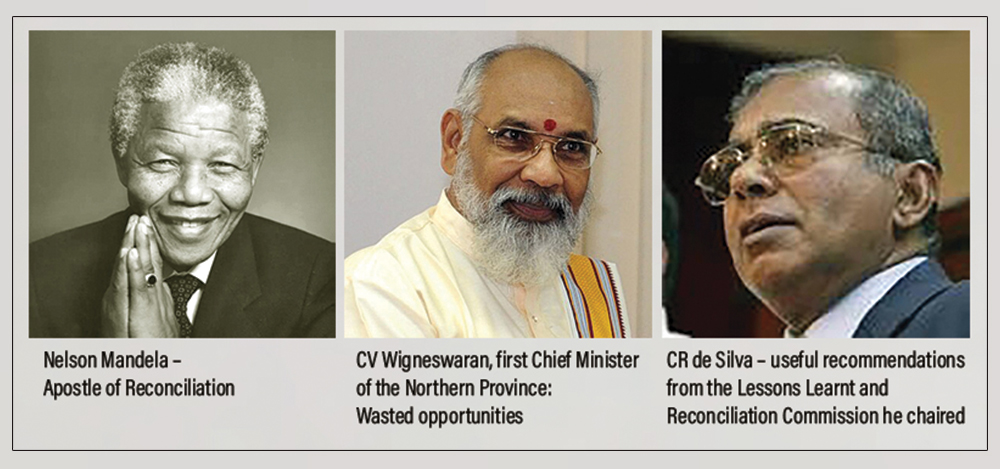
By far the most significant contribution of the Rajapaksa government towards reconciliation was the establishment of the Lessons Learnt and Reconciliation Commission (LLRC) that released its Report and recommendations on December 16, 2011, which turned out to be the 40th anniversary of the liberation of Bangladesh. I noted the irony of it in my Sunday Island article at that time.
Its shortcomings notwithstanding, the LLRC Report included many practical recommendations, viz., demilitarization of the North and East; dismantling of High Security Zones and the release of confiscated houses and farmland back to the original property owners; rehabilitation of impacted families and child soldiers; ending unlawful detention; and the return of internally displaced people including Muslims who were forced out of Jaffna during the early stages of the war. There were other recommendations regarding the record of missing persons and claims for reparation.
The implementation of these practical measures was tardy at best or totally ignored at worst. What could have been a simple but effective reconciliation program of implementation was swept away by the assertion of the grand claims of reconciliation. In the first, and so far only, Northern Provincial Council election in 2013, the TNA swept the board, winning 30 out of 38 seats in provincial council. The TNA’s handpicked a Chief Minister parachuted from Colombo, CV Wigneswaran, was supposed to be a bridge builder and was widely expected to bring much needed redress to the people in the devastated districts of the Northern Province. Instead, he wasted a whole term – bandying the claim of genocide and the genealogy of Tamil. Neither was his mandated business, and rather than being a bridge builder he turned out to be a total wrecking ball.
The Ultimate Betrayal
The Rajapaksa government mischievously poked the Chief Minister by being inflexible on the meddling by the Governor and the appointment of the Provincial Secretary. The 2015 change in government and the duopolistic regime of Maithripala Sirisena as President and Ranil Wickremesinghe as Prime Minister brought about a change in tone and a spurt for the hopes of reconciliation. In the parliamentary contraption that only Ranil Wickremesinghe was capable of, the cabinet of ministers included both UNP and SLFP MPs, while the TNA was both a part of the government and the leading Opposition Party in parliament. Even the JVP straddled the aisle between the government and the opposition in what was hailed as the yahapalana experiment. The experiment collapsed even as it began by the scandal of the notorious bond scam.
The project of reconciliation limped along as increased hopes were frustrated by persistent inaction. Foreign Minister Mangala Samaraweera struck an inclusive tone at the UNHRC and among his western admirers but could not quite translate his promises abroad into progress at home. The Chief Minister proved to be as intransigent as ever and the TNA could not make any positively lasting impact on the one elected body for exercising devolved powers, for which the alliance and all its predecessors have been agitating for from the time SJV Chelvanayakam broke away from GG Ponnambalam’s Tamil Congress in 1949 and set up the Ilankai Tamil Arasu Kadchi aka the Federal Party.
The ultimate betrayal came when the TNA acceded to the Sirisena-Wickremesinghe government’s decision to indefinitely postpone the Provincial Council elections that were due in 2018, and let the Northern Provincial Council and all other provincial councils slip into abeyance. That is where things are now. There is a website for the Northern Provincial Council even though there is no elected council or any indication of a date for the long overdue provincial council elections. The website merely serves as a notice board for the central government’s initiatives in the north through its unelected appointees such as the Provincial Governor and the Secretary.
Yet there has been some progress made in implementing the LLRC recommendations although not nearly as much as could have been done. Much work has been done in the restoration of physical infrastructure but almost all of which under contracts by the central government without any provincial participation. Clearing of the land infested by landmines is another area where there has been much progress. While welcoming de-mining, it is also necessary to reflect on the madness that led to such an extensive broadcasting of landmines in the first place – turning farmland into killing and maiming fields.
On the institutional front, the Office on Missing Persons (OMP) and the Office for Reparations have been established but their operations and contributions are yet being streamlined. These agencies have also been criticized for their lack of transparency and lack of welcome towards victims. While there has been physical resettlement of displaced people their emotional rehabilitation is quite a distance away. The main cause for this is the chronically unsettled land issue and the continuingly disproportionate military presence in the northern districts.
(Next week: Reconciliation and the NPP Government)
by Rajan Philips

Her victory is remarkable, and yet, beyond the arithmetic of seats, it is the audacity, unpredictability, and sheer strategic opportunism of Sanae Takaichi that has unsettled the conventions of Japanese politics. Japan now confronts the uncharted waters of a first female prime minister wielding a super-majority in the lower house, an electoral outcome amplified by the external pressures of China’s escalating intimidation. Prior to the election, Takaichi’s unequivocal position on Taiwan—declaring that a Chinese attack could constitute an existential threat justifying Japan’s right to collective self-defence—drew from Beijing a statement of unmistakable ferocity: “If Japan insists on this path, there will be consequences… heads will roll.” Yet the electorate’s verdict on 8 February 2026 was unequivocal: a decisive rejection of external coercion and an affirmation of Japan’s strategic autonomy. The LDP’s triumph, in this sense, is less an expression of ideological conformity than a popular sanction for audacious leadership in a period of geopolitical uncertainty.
Takaichi’s ascent is best understood through the lens of calculated audacity, tempered by a comprehension of domestic legitimacy that few of her contemporaries possess. During her brief tenure prior to the election, she orchestrated a snap lower house contest merely months after assuming office, exploiting her personal popularity and the fragility of opposition coalitions. Unlike predecessors who relied on incrementalism and cautious negotiation within the inherited confines of party politics, Takaichi maneuvered with precision, converting popular concern over regional security and economic stagnation into tangible parliamentary authority. The coalescence of public anxiety, amplified by Chinese threats, and her own assertive persona produced a political synergy rarely witnessed in postwar Japan.
Central to understanding her political strategy is her treatment of national security and sovereignty. Takaichi’s articulation of Japan’s response to a hypothetical Chinese aggression against Taiwan was neither rhetorical flourish nor casual posturing. Framing such a scenario as a “survival-threatening situation” constitutes a profound redefinition of Japanese strategic calculus, signaling a willingness to operationalise collective self-defence in ways previously avoided by postwar administrations. The Xi administration’s reaction—including restrictions on Japanese exports, delays in resuming seafood imports, and threats against commercial and civilian actors—unintentionally demonstrated the effectiveness of her approach: coercion produced cohesion rather than capitulation. Japanese voters, perceiving both the immediacy of threat and the clarity of leadership, rewarded decisiveness. The result was a super-majority capable of reshaping the constitutional and defence architecture of the nation.
This electoral outcome cannot be understood without reference to the ideological continuity and rupture within the LDP itself. Takaichi inherits a party long fractured by internal factionalism, episodic scandals, and the occasional misjudgment of public sentiment. Yet her rise also represents the maturation of a distinct right-of-centre ethos: one that blends assertive national sovereignty, moderate economic populism, and strategic conservatism. By appealing simultaneously to conservative voters, disillusioned younger demographics, and those unsettled by regional volatility, she achieved a political synthesis that previous leaders, including Fumio Kishida and Shigeru Ishiba, failed to materialize. The resulting super-majority is an institutional instrument for the pursuit of substantive policy transformation.
Takaichi’s domestic strategy demonstrates a sophisticated comprehension of the symbiosis between economic policy, social stability, and political legitimacy. The promise of a two-year freeze on the consumption tax for foodstuffs, despite its partial ambiguity, has served both as tangible reassurance to voters and a symbolic statement of attentiveness to middle-class anxieties. Inflation, stagnant wages, and a protracted demographic decline have generated fertile ground for popular discontent, and Takaichi’s ability to frame fiscal intervention as both pragmatic and responsible has resonated deeply. Similarly, her attention to underemployment, particularly the activation of latent female labour, demonstrates an appreciation for structural reform rather than performative gender politics: expanding workforce participation is framed as an economic necessity, not a symbolic gesture.
Her approach to defence and international relations further highlights her strategic dexterity. The 2026 defence budget, reaching 9.04 trillion yen, the establishment of advanced missile capabilities, and the formation of a Space Operations Squadron reflect a commitment to operationalising Japan’s deterrent capabilities without abandoning domestic legitimacy. Takaichi has shown restraint in presentation while signaling determination in substance. She avoids ideological maximalism; her stated aim is not militarism for its own sake but the assertion of national interest, particularly in a context of declining U.S. relative hegemony and assertive Chinese manoeuvres. Takaichi appears to internalize the balance between deterrence and diplomacy in East Asian geopolitics, cultivating both alliance cohesion and autonomous capability. Her proposed constitutional revision, targeting Article 9, must therefore be read as a calibrated adjustment to legal frameworks rather than an impulsive repudiation of pacifist principles, though the implications are inevitably destabilizing from a regional perspective.
The historical dimension of her politics is equally consequential. Takaichi’s association with visits to the Yasukuni Shrine, her questioning of historical narratives surrounding wartime atrocities, and her engagement with revisionist historiography are not merely symbolic gestures but constitute deliberate ideological positioning within Japan’s right-wing spectrum.
Japanese politics is no exception when it comes to the function of historical narrative as both ethical compass and instrument of legitimacy: Takaichi’s actions signal continuity with a nationalist interpretation of sovereignty while asserting moral authority over historical memory. This strategic management of memory intersects with her security agenda, particularly regarding Taiwan and the East China Sea, allowing her to mobilize domestic consensus while projecting resolve externally.
The Chinese reaction, predictably alarmed and often hyperbolic, reflects the disjuncture between external expectation and domestic reality. Beijing’s characterization of Takaichi as an existential threat to regional peace, employing metaphors such as the opening of Pandora’s Box, misinterprets the domestic calculation. Takaichi’s popularity did not surge in spite of China’s pressure but because of it; the electorate rewarded the demonstration of agency against perceived coercion. The Xi administration’s misjudgment, compounded by a declining cadre of officials competent in Japanese affairs, illustrates the structural asymmetries that Takaichi has been able to exploit: external intimidation, when poorly calibrated, functions as political accelerant. Japan’s electorate, operating with acute awareness of both historical precedent and contemporary vulnerability, effectively weaponized Chinese miscalculation.
Fiscal policy, too, serves as an instrument of political consolidation. The tension between her proposed consumption tax adjustments and the imperatives of fiscal responsibility illustrates the deliberate ambiguity with which Takaichi operates: she signals responsiveness to popular needs while retaining sufficient flexibility to negotiate market and institutional constraints. Economists note that the potential reduction in revenue is significant, yet her credibility rests in her capacity to convince voters that the measures are temporary, targeted, and strategically justified. Here, the interplay between domestic politics and international market perception is critical: Takaichi steers both the expectations of Japanese citizens and the anxieties of global investors, demonstrating a rare fluency in multi-layered policy signaling.
Her coalition management demonstrates a keen strategic instinct. By maintaining the alliance with the Japan Innovation Party even after securing a super-majority, she projects an image of moderation while advancing audacious policies. This delicate balancing act between consolidation and inclusion reveals a grasp of the reality that commanding numbers in parliament does not equate to unfettered authority: in Japan, procedural legitimacy and coalition cohesion remain crucial, and symbolic consensus continues to carry significant cultural and institutional weight.
Yet, perhaps the most striking element of Takaichi’s victory is the extent to which it has redefined the interface between domestic politics and regional geopolitics. By explicitly linking Taiwan to Japan’s collective self-defence framework, she has re-framed public understanding of regional security, converting existential anxiety into political capital. Chinese rhetoric, at times bordering on the explicitly menacing, highlights the efficacy of this strategy: the invocation of direct consequences and the threat of physical reprisal amplified domestic perceptions of threat, producing a rare alignment of public opinion with executive strategy. In this sense, Takaichi operates not merely as a domestic politician but as a conductor of transnational strategic sentiment, demonstrating an acute awareness of perception, risk, and leverage that surpasses the capacity of many predecessors. It is a quintessentially Machiavellian maneuver, executed with Japanese political sophistication rather than European moral theorisation. Therefore, the rise of Sanae Takaichi represents more than the triumph of a single politician: it signals a profound re-calibration of the Japanese political order.
by Nilantha Ilangamuwa
Three months on (February 2026)
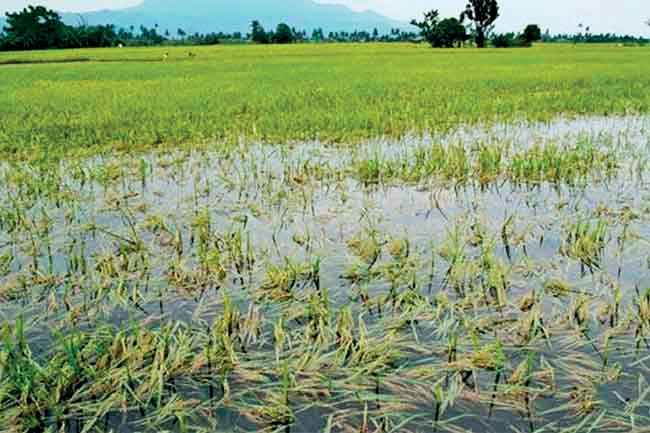
Three months after Cyclone Ditwah swept across Sri Lanka in late November 2025, the headlines have moved on. In many places, the floodwaters have receded, emergency support has reached affected communities, and farmers are doing what they always do, trying to salvage what they can and prepare for the next season. Yet the most important question now is not how quickly agriculture can return to “normal”. It is whether Sri Lanka will rebuild in a way that breaks the cycle of risks that made Ditwah so devastating in the first place.
Ditwah was not simply a bad storm. It was a stress test for our food system, our land and water management, and the institutions meant to protect livelihoods. It showed, in harsh detail, how quickly losses multiply when farms sit in flood pathways, when irrigation and drainage are designed for yesterday’s rainfall, when safety nets are thin, and when early warnings do not consistently translate into early action.
In the immediate aftermath, the damage was rightly measured in flooded hectares, broken canals and damaged infrastructure, and families who lost a season’s worth of income overnight. Those impacts remain real. But three months on, the clearer lesson is why the shock travelled so far and so fast. Over time, exposure has become the default: cultivation and settlement have expanded into floodplains and unstable slopes, driven by land pressure and weak enforcement of risk-informed planning. Infrastructure that should cushion shocks, tanks, canals, embankments, culverts, too often became a failure point because maintenance has lagged and design standards have not kept pace with extreme weather. At farm level, production risk remains concentrated, with limited diversification and high sensitivity to a single event arriving at the wrong stage of the season. Meanwhile, indebted households with delayed access to liquidity struggled to recover, and the information reaching farmers was not always specific enough to prompt practical decisions at the right time.
If Sri Lanka takes only one message from Ditwah, it should be this: recovery spending, by itself, is not resilience. Rebuilding must reduce recurring losses, not merely replace what was damaged. That requires choices that are sometimes harder politically and administratively, but far cheaper than repeating the same cycle of emergency, repair, and regret.
First, Sri Lanka needs farming systems that do not collapse in an “all-or-nothing” way when water stays on fields for days. That means making diversification the norm, not the exception. It means supporting farmers to adopt crop mixes and planting schedules that spread risk, expanding the availability of stress-tolerant and short-duration varieties, and treating soil health and field drainage as essential productivity infrastructure. It also means paying far more attention to livestock and fisheries, where simple measures like safer siting, elevated shelters, protected feed storage, and better-designed ponds can prevent avoidable losses.
Second, we must stop rebuilding infrastructure to the standards of the past. Irrigation and drainage networks, rural roads, bridges, storage facilities and market access are not just development assets; they are risk management systems. Every major repair should be screened through a simple question: will this investment reduce risk under today’s and tomorrow’s rainfall patterns, or will it lock vulnerability in for the next 20 years? Design standards should reflect projected intensity, not historical averages. Catchment-to-field water management must combine engineered solutions with natural buffers such as wetlands, riparian strips and mangroves that reduce surge, erosion and siltation. Most importantly, hazard information must translate into enforceable land-use decisions, including where rebuilding should not happen and where fair support is needed for people to relocate or shift livelihoods safely.
Third, Sri Lanka must share risk more fairly between farmers, markets and the state. Ditwah exposed how quickly a climate shock becomes a debt crisis for rural households. Faster liquidity after a disaster is not a luxury; it is the difference between recovery and long-term impoverishment. Crop insurance needs to be expanded and improved beyond rice, including high-value crops, and designed for quicker payouts. At the national level, rapid-trigger disaster financing can provide immediate fiscal space to support early recovery without derailing budgets. Public funding and concessional climate finance should be channelled into a clear pipeline of resilience investments, rather than fragmented projects that do not add up to systemic change.
Fourth, early warning must finally become early action. We need not just better forecasts but clearer, localised guidance that farmers can act on, linked to reservoir levels, flood risk, and the realities of protecting seed, inputs and livestock. Extension services must be equipped for a climate era, with practical training in climate-smart practices and risk reduction. And the data systems across meteorology, irrigation, agriculture and social protection must talk to each other so that support can be triggered quickly when thresholds are crossed, instead of being assembled after losses are already locked in.
What does this mean in practice? Over the coming months, the focus should be on completing priority irrigation and drainage works with “build-back-better” standards, supporting replanting packages that include soil and drainage measures rather than seed alone, and preventing distress coping through temporary protection for the most vulnerable households. Over the next few years, the country should aim to roll out climate-smart production and advisory bundles in selected river basins, institutionalise agriculture-focused post-disaster assessments that translate into funded plans, and pilot shock-responsive safety nets and rapid-trigger insurance in cyclone-exposed districts. Over the longer term, repeated loss zones must be reoriented towards flood-compatible systems and slope-stabilising perennials, while catchment rehabilitation and natural infrastructure restoration are treated as productivity investments, not optional environmental add-ons.
None of this is abstract. The cost of inaction is paid in failed harvests, lost income, higher food prices and deeper rural debt. The opportunity is equally concrete: if Sri Lanka uses the post-Ditwah period to modernise agriculture making production more resilient, infrastructure smarter, finance faster and institutions more responsive, then Ditwah can become more than a disaster. It can become the turning point where the country decides to stop repairing vulnerability and start building resilience.
By Vimlendra Sharan,
FAO Representative for Sri Lanka and the Maldives

Fairly heavy showers are likely at some places in the Rathnapura, Kalutara, Galle and Matara districts

India vs Pakistan is finally here. Over to cricket now

“We Are Building a Stable, Transparent and Resilient Sri Lanka Ready for Sustainable Investment Partnerships” – PM

US military kills 3 in latest attack on boat in the Caribbean

Prez AKD congratulates BNP’s Tarique Rahman on B’desh election win

Massive Sangha confab to address alleged injustices against monks

‘Dates have the highest sugar content to fight Coronavirus’

Sunday Island 27 December – Headlines

#SundayIsland 17th December – Headlines

Sunday Island – 28th March

Sunday Island Headlines – 21 March

Sunday Island – 21st February – Headlines
-

 Business4 days ago
Autodoc 360 relocates to reinforce commitment to premium auto care
-

 Midweek Review4 days ago
A question of national pride
-

 Opinion3 days ago
Will computers ever be intelligent?
-
 Midweek Review4 days ago
Theatre and Anthropocentrism in the age of Climate Emergency
-

 Editorial6 days ago
The JRJ syndrome
-

 Opinion4 days ago
The Walk for Peace in America a Sri Lankan initiative: A startling truth hidden by govt.
-

 Foreign News6 days ago
Portugal elects Socialist Party’s Seguro as president in landslide
-
 Opinion5 days ago
Beyond 4–5% recovery: Why Sri Lanka needs a real growth strategy