
Midweek Review
India’s Vietnam moment, US pullout and Afghan dilemma

UNP’s call to terminate diplomatic relations with Taliban questionable
By Shamindra Ferdinando
Can the recent US pullout, from Afghanistan, be compared with the Indian withdrawal, from Sri Lanka ,in late March 1990? Some sections of the Western media, at that time ,called the disastrous Indian military intervention here (July 1987-March 1990) India’s Vietnam. Reference was also made to what some called India’s Vietnam moment. The Washington Post report, that dealt with the situation in Sri Lanka, in the wake of ‘Operation Pawan,’ was aptly headlined, India’s Vietnam? The US media giant declared: “One reason that Sri Lanka had been unable to tame the ‘Tamil Tigers’ was the support that an indulgent New Delhi had let flow to them from India’s 50 million Tamils.”
What the Washington Post report, dated Oct 27, 1987, left unsaid, was that New Delhi armed over a half a dozen terrorist groups, in Sri Lanka, on the specific instructions of the then Indian Premier, Indira Gandhi, though Tamil Nadu was routinely blamed for the aggression. No less a person than the late Indian National Security Advisor and veteran diplomat J.N. Dixit, who had been Indian High Commissioner in Colombo (1985-1989) in his memoirs ‘Makers of India’s Foreign Policy’ acknowledged the executive prime ministerial decision to arm terrorists here.
Dixit’s declaration should be examined against the backdrop of Indira Gandhi‘s assassination by her Sikh bodyguards, on Oct 31, 1984. When did Indira Gandhi actually authorise arming of terrorist groups in Sri Lanka?
May be we shouldn’t be so unkind to Mrs. Gandhi, for obviously she was also a victim of circumstances, clearly sowed by the West. Mind you this was a time when the West was clearly lighting separatist fires right across India, be it in Punjab, Assam or Tripura. And the separatist fire that was lit here had, as its final aim, the breakup of India. The July ’83 riots, in the country, were clearly due to manipulation of the police here not to nip it in the bud by powerful interests. We even saw at firsthand how police, in different areas, went round egging the poor, among the Sinhalese and Muslims, to attack Tamils, who were considered the haves. So, in the resultant picture of mob violence, against hapless Tamils, that was created, can we blame Mrs. Gandhi for the counter steps that she took? She wanted to show the huge long restless Tamil population, in Tamil Nadu, that it was not the West that would give succor and protection to Tamils, in Sri Lanka, but mother India. The West even would have had plenty of infiltrators among her intelligence to feed her fears. From the word go, mind you, it was not in India that many of these separatists had their rear bases but in the capitals of the powerful West. For example, the LTTE International Secretariat was based in London, even after the assassination of Rajiv Gandhi by it. Of course, their lame excuse was that the LTTE had not violated British laws!
 She may have even assented to the ambush of a Sri Lankan military patrol, by Tamil terrorists, at Thinnavely, Jaffna, that was used by vested forces to trigger the anti-Tamil violence, in the south, with police not lifting a finger to stop it, let alone even firing a warning shot.
There had been an interesting incident, around 1977, at a cocktail party, in Manila, where a big talking American, who was obviously after one too many, had boasted to our Ambassador there, the late Oliver Perera, that soon there would be an armed rebellion, by Tamils, in Sri Lanka!
Obviously, Indira Gandhi’s assassination didn’t halt the despicable Indian project which culminated with the deployment of the Indian Army here. She was succeeded by son Rajiv, 40, the sixth and the youngest Indian Premier who intensified assistance to terrorist groups here. PM Gandhi also intervened, on behalf of the LTTE ,when the latter faced certain defeat in the hands of the Sri Lankan military.
If Rajiv Gandhi returned at the 1989 general election, the then Sri Lankan President Ranasinghe Premadasa, elected in the previous year, wouldn’t have succeeded in getting rid of the Indian Army. Those who propagated, and justified, New Delhi’s direct intervention, here, following the July 1983 violence, directed at the Tamil community, conveniently ignored the truth that India triggered the riots by causing the deaths of 13 soldiers at Thinnaveli, in Jaffna. There had never been such a devastating attack on the Army, until Indian trained terrorists wiped out the lightly armed mobile patrol.
Can the US invasion of Afghanistan, in the wake of the 9/11 carnage, and the Indian military misadventure, in Sri Lanka, be compared? In the case of Afghanistan, the US invaded that country, on the pretext of going after those responsible for 9/11, receiving refuge there, whereas New Delhi forced Army deployment here to impose a ‘political’ solution. Over 30 years later, the Indian solution is on the Geneva agenda!
On both occasions, powerful foreign forces had pathetically failed to achieve their primary objectives, though the circumstances were totally different. For the US, both Afghanistan and the fall of Saigon, way back, in late April 1975, meant the humiliating failure of Washington’s strategic policy. In other words, the US abandoned South Vietnam and Afghanistan administrations, and here, in Sri Lanka, India gave up a Tamil administration, installed by its Army. India went to the extent of forming, what was dubbed, Tamil National Army (TNA) to protect the NE provincial administration.
The US-led NATO forces, invaded Afghanistan to destroy the Taliban administration, accused of providing safe haven to those responsible for the 9/11 attacks, though, at the end, the US negotiated with them whereas the Indian military mission was meant to disarm Tamil groups, once sponsored by New Delhi. It would be pertinent to mention that the US invaded Afghanistan, though the majority of those involved in the 9/11 attacks, were Saudis. Of the 19 attackers, 15 were Saudi citizens, two were from the United Arab Emirates (UAE), one was from Lebanon, and one from Egypt.
India destabilised Sri Lanka in a bid to create a situation, conducive for deployment of its Army, followed by Provincial Council elections, rigged in favour of the Eelam People’s Revolutionary Liberation Front (EPRLF). With the Indian Army deployed in Sri Lanka, New Delhi forced the then JRJ administration to introduce the 13th Amendment to the Constitution. As the writer pointed out before, the 13th Amendment has ended up in the Geneva agenda.
Perhaps, those who had referred to New Delhi’s military misadventure here as India’s Vietnam may consider calling the US withdrawal, from Afghanistan, America’s Sri Lanka moment. The US pullout caused the immediate collapse of 72-year-old Mohammad Ashraf Ghani’s Afghan administration. Twice President Ghani, with the knowledge of the US, secured political asylum in the UAE. Ghani couldn’t have done so without the blessings of the Biden administration. International media coverage of the pathetic scenes at the Kabul airport must have deeply embarrassed the US. Those who believed the Afghan National Defence and Security Forces — including an 180,000 strong Afghan National Army, and a police force with 150,000 personnel, besides an Air Force, and other security wings — trained by the US military, NATO and India – could face up to the Taliban. They simply folded up like a house of cards, proving utterly unequal to the task of holding on to territory, and containing the Taliban. The Afghan imbroglio cannot be discussed without taking into consideration the US-Taliban agreement, finalised in Doha, in Qatar, in February, last year. In other words, Biden implemented the agreement between his predecessor Trump and the Taliban. Most probably, the US must have sealed the fate of its costly mission by its blind drone strikes there, which would have killed many hundreds, if not thousands, of innocents, thereby turning many more Afghans against the whole false façade of the West, fighting for human rights and fair play for their much-exploited women. Surely, how many times did they strike funeral processions, or weddings, while targeting the Taliban, using their smart missiles? Now, they and their allies have turned tail and run, leaving behind for the Taliban to use billions of dollars’ worth of state-of-the-art weapons!
India also stepped up engagement with Taliban, in the wake of US moves to bring the 20-year-old disastrous Afghan chapter to an end. One shouldn’t be surprised by the Indian strategy, as India cannot lose its relationship with Afghanistan, in the wake of the US pullout. That would be a major blunder on India’s part. Perhaps, the Afghan military received instructions, from those who sponsored them, to quickly give up the fight. That possibility cannot be ruled out. Perhaps, Ghani knew of that likelihood. In spite of being trained and equipped by US and its NATO allies, the Afghan Army didn’t have the guts to face the Taliban, who advanced to Kabul without facing any organised resistance. Quad member India, too, provided training to thousands of Afghan officers, and men, both in Afghanistan as well as at various training facilities, in India, over a period of time. India also provided a range of weapons, including helicopter gunships to Afghanistan. Of several Mi-24 helicopter gunships provided by India, the Taliban seized one as the Afghan Army quickly gave up the fight for Kabul. The swift collapse of the Afghan Army must have definitely embarrassed those who trained them.
India deployed Mi-24s against the LTTE here whereas the Sri Lanka Air Force acquired the same, in 1995, after the LTTE introduced surface-to-air heat seeking missiles.
In 1990, Sri Lanka faced a situation similar to that faced by the Afghan military. The Sri Lankan military struggled to cope up with an unprecedented crisis. The vacuum created by the Indian withdrawal had to be filled quickly but the Army lacked the strength. However, the country’s intrepid armed forces faced the challenge. The military saved the country from a catastrophe, in the wake of the Indian pullout.
The writer was among a group of journalists, invited to board INS Magar,on the morning of March 24, 1990, at the Trincomalee harbour, soon after the last contingent of Indian troops boarded the troop-carrier. The vessel left the port to the farewell strains of Auld lang syne, played by the Sri Lankan military. Before their departure, the Indian Commander, here, Lt. General A.S. Kalkat, declared, on board INS Magar: “We came as a proud force and are leaving as a proud force.” India lost 1,155 IPKF officers, and men, on top of 2,984 personnel wounded. India never bothered to build a monument for those who perished during the conflict here.
The Afghan Army didn’t have the stomach to fight the Taliban though there were some confrontations between them, as the US stepped up withdrawal. India re-trained Tamil terrorists, belonging to several groups, as well as new cadres, including underage children, as a last minute effort to establish, what was then known as the Tamil National Army. The TNA was meant to protect the then North-East administration of EPRLF strongman Varatharaja Perumal. However, the TNA collapsed, even before India completed its withdrawal, under controversial circumstances. India evacuated Perumal, along with those near and dear to him. The LTTE assassinated Rajiv Gandhi over a year later. Gandhi’s crime was sending the Indian Army here. Prabhakaran conveniently forgot how Gandhi saved him, in 1987, when the Sri Lanka Army was advancing on his hideout in the Vadamaratchchy region.
Resumption of hostilities
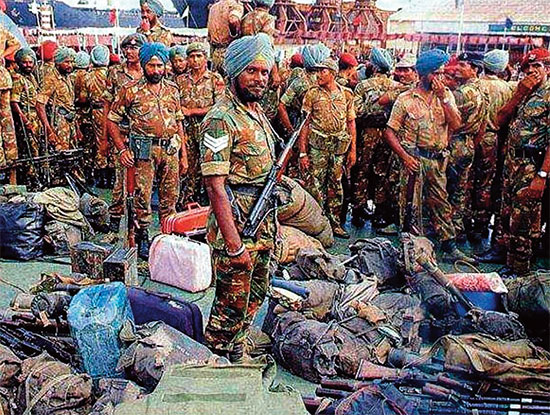
March 24, 1990, Trincomalee harbour: The last batch of Indian Army to leave Sri Lanka at the end of the disastrous mission
Less than three months, after India quit Sri Lanka, the LTTE resumed hostilities. Having gained valuable experience in fighting South Asia’s largest Army, the LTTE obviously believed the relatively smaller Sri Lanka Army could be overwhelmed in a meticulously planned offensive. By the end of June 1990, the LTTE had taken control of the Northern and Eastern Provinces, with the military confined to major bases. The police remained within their stations. When the writer, accompanied a group of journalists, assigned to cover the Indian departure ,from Trincomalee, the eastern port city was under threat. Both police and the military therein had no qualms in acknowledging the growing threat posed by LTTE units, operating just outside the town. Had the LTTE plan succeeded, Sri Lanka would have suffered an irrevocable setback in the Northern theatre of operations. As a result of miscalculations, on the part of the then political leadership, the LTTE had an opportunity to build up the required strength for a major offensive. The LTTE had the wherewithal to neutralise the Army, north of Vavuniya. Destruction, and the vacation of Army detachments, along the Kandy-Jaffna A9 road, isolated the Jaffna peninsula.
The LTTE couldn’t achieve its primary objective as the Army, in spite of being surrounded, managed to hold onto its strategic Elephant Pass base. The public would be surprised to know, at the time the LTTE resumed hostilities, the Army didn’t even have two battalions deployed in the entire Northern and Vanni regions. The then political and military leaderships never bothered to make contingency plans, as the Indians gradually withdrew from the Northern and Eastern regions. The last Indian contingent left by air, and sea, from Trincomalee, leaving the LTTE to isolate and destroy the police and the military. The LTTE realised the difficulties experienced by the military, primarily due to them not being at least engaged in proper patrolling. The armed forces, and the police, had been successful in neutralising the JVP threat (1987-1990) though the conventional LTTE challenge was not anticipated. The military hadn’t been prepared in the immediate aftermath of the Indian pullout.
Once the LTTE resumed hostilities, in the East, where the group massacred several hundred policemen, after they surrendered, on a government directive, the fighting quickly spread to the Northern theatre. The LTTE overran the Kokavil detachment, north of Vavuniya, in June 1990, and swiftly established control over the Vanni region. Successive governments had to move supplies, required by the military, and police, deployed in the Jaffna peninsula, by sea and air. The overland Main Supply Route (MSR) was restored in January 2009, during the final phase of the Vanni offensive.
The military and the police thwarted two JVP insurrections in 1971 and 1987-1990 and defeated conventional military challenges posed by the LTTE.
When the LTTE resumed hostilities, within months after the Indian withdrawal, in March 1990, the total strength of the Army had been 60,596 officers, and men, in both the Regular and Volunteer Forces. They had been deployed in isolated bases, with the majority outside the Northern and Eastern regions and, if not for the bravery of ordinary men and resolute leadership, given by some officers, they would have been overwhelmed in the Northern Province. Of the total strength at that time, the Regular Army comprised 2,221 officers and 36,304 other ranks. The Sri Lanka Army must have found the ground situation extremely difficult to handle as, at the height of the Indian Army deployment here, the IPKF comprised approximately 100,000 officers and men.
TNA’s view on Taliban
Jaffna District Illankai Tamil Arasu Kadchi (ITAK) MP Sivagnanam Sridharan recently compared the spectacularly successful Taliban advance, on Kabul, and the Tamil community’s struggle. Sridharan declared that struggles, undertaken by minority communities, could erupt at any moment. Justifying their struggle, MP Sridharan warned of dire consequences if the community was suppressed. Obviously, the Jaffna District lawmaker believed the Taliban’s return to Kabul boosted the Tamil community. Sridharan should be reminded that his political party served the LTTE’s terror project, from 2001 until the crushing military defeat of the organisation, in May 2009. The TNA believed in the LTTE’s capability to bring its terror project to a successful conclusion. MP Sridharan, expecting Taliban to provide a boost, shouldn’t come as a surprise, as another TNA lawmaker. M.A. Sumanthiran, PC, attempted to exploit the 2019 Easter Sunday attacks. The TNA heavyweight had no doubts in issuing a warning, a week after the Easter Sunday carnage (at the BMICH), when he declared that such attacks should be expected if grievances of minorities weren’t addressed.
Norwegian Anders Behring Breivik, 32, shocked the world, in late July 2011, by massacring 90 and wounding over 300 in two separate incidents. Breivik made references to the LTTE as a role model in his ‘manifesto’ that was released to the web, hours before the devastating bomb attack, in central Oslo, and the subsequent shooting rampage in an island resort. So no one should be surprised over MP Sridharan talking in glowing terms about Taliban’s triumph, or MP Sumanthiran seeing the Easter Sunday massacre as a way to pressure the government over minority rights.
UNP Chairman Vajira Abeywardena’s recent call to terminate diplomatic ties with Afghanistan, in the wake of the Taliban triumph, reminded the writer of UNP leader Ranil Wickremesinghe assuring Japan (now a Quad member) that the LTTE hadn’t been involved with Al Qaeda. The assurance was given at a meeting organised by the Japan Center for Conflict Prevention (JCCP) at the Imperial Hotel. The writer accompanied the GoSL delegation, led by the then Premier Ranil Wickremesinghe whose task was to appreciate the Japanese role in the Oslo-led peace process (LTTE not linked to al-Qaeda, PM tells Japan-The Sunday Island, Dec 8, 2002). The Taliban provided a safe haven for those who had fought the Soviet Union, in the wake of its invasion of Afghanistan, in Dec 1979. Osama bin Laden had been among those who secured the protection of Taliban, having served US interests during the Soviet occupation of Afghanistan. The Western media, and top US officials, have routinely referred to Afghanistan being the Soviet Union’s Vietnam. Decades later, the same fate has befallen the US military.

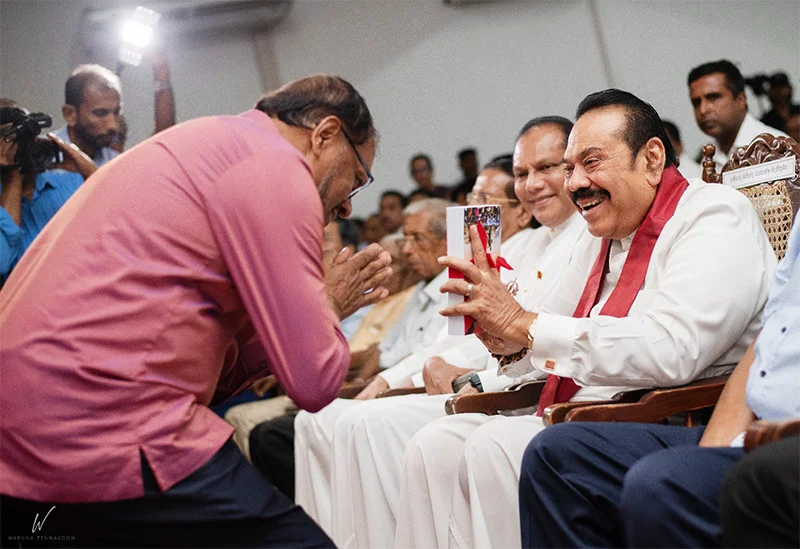
The US has been complicit in the 9 July 2022 assault on the President’s House. A new book, on the regime change project, by renowned political commentator Mohan Samaranayake, examined the then US Ambassador Julie Chung’s role in the operation. Referring to her twitter messages before the final assault, the author pointed out how she warned the government and the military against the advance on the President’s House while reassuring protection for the attacking party.
Throughout the March 31-July 14, 2022 period, Chung blatantly intervened in the government’s response, thereby preventing tangible action being taken to neutralise the growing threat.
Bringing up claims regarding Chung/ Indian High Commissioner Gopal Baglay putting pressure on Speaker Mahinda Yapa Abeywardena to accept the presidency, Samaranayake declared that only Abeywardena could clear the continuing controversy regarding the intervention made by an envoy. Regardless of who visited the Speaker, at his official residenc, as the JVP-led crowds prepared to bring Parliament under their control on 13 May, 2022, what we should keep in mind is that it was a joint US-Indian project. Who definitely met the then Speaker, followed by a delegation consisting of Buddhist and Catholic clergy and civil society, who, too, echoed the foreign instigated agenda, is irrelevant.
By Shamindra Ferdinando
Political and foreign affairs commentator Mohan Samaranayake meticulously deals with the overthrowing of President Gotabaya Rajapaksa in 2022, in a manner that exposed the failure on the part of the then ruling party, the Sri Lanka Podujana Peramuna (SLPP), to recognise the US-Indian plot that was in the making no sooner he assumed office as the President, or even before that. Samaranayake also discusses the pathetic police and armed forces response to the threat (Chapter 7).
Samaranayake dealt with the possibility of at least a section of the Cabinet-of-Ministers, unwittingly contributing to the overall strategy meant to undercut the government and isolate the President.
‘Regime Change project 2022’, authored by one-time UN public communications staffer, at its Colombo office, who also held several government appointments over a period of time, including under Gotabaya Rajapaksa’s tenure, found fault with Ministers Dullas Alahaperuma and Udaya Gammanpila, leader of the SLPP constituent, Pivithuru Hela Urumaya.
Samaranayake shed light on a frightening situation, within the ruling party, that lacked at least a basic plan of action, struggling to cope up with internal strife. He singled out the Basil Rajapaksa-led group as the worst of the offenders. Samaranayake is spot on. The author quite rightly declared that the triumph of the regime change project was nothing but the disintegration of the nationalistic group, within the ruling bloc. Unfortunately, the SLPP seemed to have failed to realise the gravity of that situation.
Pointing out that President Gotabaya Rajapaksa hadn’t been the leader of the ruling party, in one line, the author emphasised how the authoritarian conduct of the Basil Rajapaksa–led section of the parliamentary group caused rapid deterioration. The SLPP secured a near 2/3 majority at the 2020 parliamentary election. Formed in 2016, the SLPP, having won 18 electoral districts, bagged 145 seats. Basil Rajapaksa’s group didn’t tolerate dissent. That group slammed Wimal Weerawansa when he urged the SLFP to create an influential position for President Gotabaya Rajapaksa who ended up sacking Weerawansa and Gammanpila for some other mattter. The author criticised the President’s action.
It would be interesting to ascertain how the conspirators exploited the discord, within the ruling party, as they advanced the anti-Gotabaya strategy. Samaranayake, like others who authored books on overthrowing President Rajapaksa, acknowledged that the economic fallout, caused by the Covid-19 pandemic, and the war in Ukraine, facilitated the operation.
The leader of Jathika Nidahas Peramuna, Wimal Weerawansa, was the first to release a book on the regime change project. “Nine: The Hidden Story,’’ launched in April 2023, caused quite a controversy over claims of direct US intervention. Then US Ambassador Julie Chung denied Weerawansa’s revelation that she asked Speaker Mahinda Yapa Abeywardena to take over the presidency, regardless of constitutional impediments. Later the then Speaker’s indirect admission of what transpired proved much of Weerawansa’s assertions, though there is till controversy over the identity of the envoy who visited the Speaker at his official residence on 13 July, 2022. Remember the old adage that ambassadors are there to lie abroad for their country.
Weerawansa was followed by the much-respected writer, Sena Thoradeniya (Galle Face Protest: Systems Change or Anarchy), ousted President Gotabaya Rajapaksa (The Conspiracy to Oust Me from the Presidency), Maj. Gen. K. B. Egodawela who served on President Rajapaksa’s staff (Aragalaya: From Love to Violence), President Ranil Wickremesinghe’s media chief Prof. Sunanada Madduma Bandara (Aragalaye Balaya), Treasury Secretary Mahinda Siriwardana (Sri Lanka’s Economic Revival – Reflection on the Journey from Crisis to Recovery), and expert current affairs commentator Asanga Abeygunasekera (Winds of Change).
However, Samaranayake obviously has paid extra attention to the SLPP’s inner shortcomings that contributed to the overall success of the regime change operation. At the tail end of the first chapter, Samaranayake raised a spate of questions regarding the terrifying possibility of inside help that enabled the conspirators to carry out the regime change operation. Samaranayake asked whether those within the government caused economic deterioration deliberately, in support of the move against the President.
Referring to economic indicators and comparing the official figures, the author stressed the deterioration of the national economy during the Yahapalana administration (2015 to 2019) contributed to the economic collapse, like borrowing as much as USD12 billion by Wickremesinghe’s regime at high interests, however all that was conveniently put on President Gotabaya Rajapaksa by convenient critics leaving out elements of truth disadvantageous to their agenda. Propagation of false and politically motivated narratives, according to Samaranayake, seemed to have overwhelmed the President and his sharply divided parliamentary group.
On the basis of a disclosure made by the ex-President, Samaranayake highlighted how a far reaching decision to unilaterally suspend debt repayment was taken even without consulting the President.
Swiss Embassy affair
Samaranayake, who served as the Director General of President Gotabaya Rajapaksas’s Media Division, examined the regime change operation, taking into consideration what was dubbed as the Swiss Embassy affair, at the onset of his administration. Having acknowledged President Rajapaksa thwarted a diabolical Swiss plot to tarnish his government, using local Embassy employee Ganiya Bannister Francis (Siriyalatha Perera is her original name/She now lives abroad) from discrediting Sri Lanka, the author asserted that the SLPP’s failure to take the then Swiss Ambassador Hanspeter Mock to task for false flag operation influenced those who planned the regime change to go ahead.
The SLPP should reexamine its response to the Swiss Embassy affair. Perhaps, Sri Lanka should revisit the incident, particularly against the backdrop of accusations that Hanspeter Mock pursued an utterly contemptible agenda targeting Sri Lanka. Among the incidents cited was the Ambassador facilitating Chief Inspector Nishantha de Silva of the Criminal Investigation Department (CID) leaving the country without government authorisation.
Samaranayake’s assertion that the 2022 colour revolution was an extension of the 2015 regime change operation seems controversial to some people, though the writer believes the first such project was mounted in the aftermath of Sri Lanka’s triumph over the Liberation Tigers of Tamil Eelam (LTTE). The US backed UNP-JVP-TNA project to field war-winning Army Commander Sarath Fonseka as the common presidential candidate against incumbent Mahinda Rajapaksa that exposed the US hand. There cannot be any dispute over that.
The seriousness of Samaranayake’s allegation that ex-parliamentarian Hirunika Premachandra (SJB), on behalf of the regime change operation, tested President Gotabaya Rajapaksa’s defences during protest conducted outside the President’s private residence at Pangiriwatta, Mirihana, on 5 March, 2022. The issue at hand is whether the SJB authorised Hirunika’s actions at Pangiriwatta. But, Samaranayake’s criticism of the President and the armed forces, as well as the intelligence services, for failing to take tangible measures against the growing and deepening regime change threat. The author went to the extent of describing them as ,silent onlookers. The accusation that the President refused to believe that he was the target of the regime change operation underscored the SLPP’s pathetic response to the threat.
Samaranayake painted a bleak picture of the situation by quoting Egodawela, who served the Army, like Gotabaya, as having asserted that the March 31, 2022 violent protest was meant to assassinate President Rajapaksa. In post-Aragalaya examination of events/developments, Samaranayake blamed the police and armed forces for not neutralising gangs that unleashed violence in the aftermath of the attack on the Galle Face protesters, on 9 May, 2022. But, unfortunately, Samaranayake failed to pay sufficient attention to the failure on the part of the police and the armed forces to prevent Temple Trees mounting the first attack. There is no doubt that Temple Trees ordered the attack in a desperate bid to break the siege on the Presidential Secretariat, contrary to the instructions issued by President Gotabaya.
Samaranayake, who studied the situation, leading to the overthrowing of President Gotabaya, March 31 to July 14, 2022, period, and subsequent developments for nearly two years, emphasised the alleged bid to kill the President, and several others, and display their bodies on 9 July, 2022, following the storming of the President’s House. Based on social media posts, the author made the shocking claim that a private local and a foreign television channel had been there to telecast the displaying of bodies.
Perhaps, the plot could have succeeded if not for the timely intervention made by the then Navy Commander, Vice Admiral Nishantha Ulugettenne, who deployed SLNS Gajabahu to move the President and First Lady Anoma, who received the appreciation of all for being humble.
Ranil’s role and Yahapalana fault
Wickremesinghe played a crucial role in the project to oust President Rajapaksa. That is the undeniable truth. Beleaguered Gotabaya’s decision to accommodate Wickremesinghe as the Prime Minister, in April 2022, and then elevate him as the President, wouldn’t change the ugly truth. The author didn’t mince his words when he explained the swift collapse of the externally backed operation, soon after Gotabaya’s ouster. Those who funded the regime change project, lawyers/BASL involved in it and men and women who pursued political and religious agendas, according to the author, felt satisfied when Gotabaya stepped down. “They knew when to halt the campaign,” declared Samaranayake whose criticism of the President and the SLPP should attract their attention.
Samaranayake asserted that Wickremesinghe’s readiness to swiftly deploy the military and police to chase away those who remained outside the Presidential Secretariat, and other places, too, after Gotabaya’s ouster, contributed to the normalisation of the situation.
Having provided muscle to the protest campaign at the beginning, the UNP and the SJB cannot, under any circumstances, absolve themselves of the responsibility for the violence unleashed by organised gangs. Samaranayake’s clear stand that such violence cannot be justified, on the basis of Temple Trees allowing some staunch supporters to attack the Galle Face protesters out of sheer desperation, should be commended. SJB leader Sajith Premadasa, who sought political mileage out of the rapidly developing situation on 9 May, 2022, following the attack on the Galle Face protesters, was nearly killed when he visited the protest site. If not for the quick response of his bodyguards, Aragalaya activists could have captured him and other SJB lawmakers. Had that happened, the result could have been catastrophic.
One of the most controversial claims made by the author was the Chinese involvement in the regime change project. Although allegations and claims pertaining to the US, European and Indian interventions are in the public domain, the alleged direct Chinese involvement is a matter of grave concern. The author, without hesitation, named China and Russia in a group that included the US, the UK, EU, Japan and India hell-bent on achieving their political, economic and military objectives at the expense of other countries. Citing Sri Lanka as a case in point, the author methodically discussed post-Second WW regime change operations elsewhere while paying attention to the US-China conflict that undermined Sri Lanka’s sovereignty.
Samaranayake mentioned the US backing for retired General Sarath Fonseka at the 2010 presidential election, less than a year after the eradication of the LTTE as an instance that proved the US determination to achieve its objectives at any cost. Had the author been aware Fonseka was categorised alongside the Rajapaksa brothers as war criminals. It is like the way US treats ISIS as good terrorists and bad terrorist depending on whom they back. WikiLeaks released the then US Ambassador Patricia Butenis’s classified missive to Washington in addition to a spate of other documents which revealed directed US involvement in selecting Fonseka as the common candidate.
Samaranayake squarely differed with those who build their narratives on the basis of the actions of the then US Ambassador Julie Chung (2022 to January 2026) and Under Secretary of State for Political Affairs Victoria Nuland (2021 to 2024). Samaranayake is quite right in his assessment that, like many other US officials, the likes of Chung and Nuland were only tools to achieve overall US objectives. In the case of hapless Sri Lanka, the US strategy was/ is meant to ensure that Colombo remained aligned with the Indo-Pacific doctrine regardless of political changes. The way the US and its partner in crime India embraced and propped up JVP/NPP and again reiterated their approach.
An Act like no other
Samaranayake didn’t even bother to mention Siriwardena’s book that dealt with the developments, essentially with focus on economics leading to President Gotabaya’s ouster. Similarly, there hadn’t been a reference to ‘Winds of Change.’ (https://island.lk/aragalaya-gr-blames-cia-in-asanga-abeyagoonasekeras-explosive-narrative/)
Let me briefly discuss a major difference between Samaranayake’s take on economic crisis and that of Siriwardena who confidently asserted that Gotabaya’s presidency could have been saved if the government secured IMF loan facility. ( https://island.lk/aragalaya-could-have-been-thwarted-and-grs-presidency-saved-mahinda-siriwardana/)
According to Samaranayake’s narrative, the sudden suspension of debt repayment scheme even without consulting President Gotabaya had been a calculated move to entrap Sri Lanka in IMF strategy.
It would be pertinent to mention that President Wickremesinghe, in July, 2024, managed to adopt the Economic Transformation Act without a vote, in line with the overall IMF/other lending agencies’ strategy to ensure Sri Lanka remained aligned with the IMF, regardless of political changes. Having opposed the IMF outwardly over the years, the JVP/NPP pledged its allegiance to the IMF, without any hesitation, once installed in power at the expense of its purported original principles. There had never been such an Act that forbade political parties of pursuing policies contrary to specific IMF dictates.
Samaranayake explained how the JVP/NPP completely changed its approach in the wake of the 2024 national elections. Anura Kumara Dissanayake, who, in his capacity as the leader of the JVP, as well as its parliamentary group, in 2015 October, lashed out in Parliament against unbridled activities of India’s Research and Analysis Wing (RAW) in Jaffna. In April 2025 President Dissanayake entered into seven vital MoUs with Premier Modi. One dealt with defence, and a few months later Sri Lanka allowed Japan to sell controlling interests in the strategic ship builder Colombo Dockyard Limited (CDL), once carefully nursed by late National Security Minister Lalith Athulathmudali who was assassinated by the LTTE, to Mazagon Dock Shipbuilders Limited (MDL) affiliated with the Indian Ministry of Defence.
The way Sri Lanka succumbed to Western powers and India and ended up in their domain, therefore, as Samaranayake predicted, there may never be a comprehensive investigation into the despicable regime change operation. Alleging that Wickremesinghe conveniently allowed those responsible at all levels, including the military and police to go scot-free, the author asserted that Dissanayake, a key beneficiary of that operation, too, may never intervene.
Premier Modi, who sort of gave his blessings to the despicable decapitating operation against Iran, by visiting Tel Aviv, should realise that he is no darling of the West and he, too, will be stabbed in the back as these evil pale faces have done to others if they suspect that his country might be a future threat, both militarily and economically, to them. The US denied visa to Modi in March 2005. The State Department acted in terms of the Immigration and Nationality Act, citing Modi’s alleged responsibility for “particularly severe violations of religious freedom” related to the 2002 Gujarat violence.
Referring to various uprisings and revolutions that shaped the world over the past several centuries and those who propagated lies as they advanced frightening strategy here, the author confidently asserted that the vast majority didn’t realise that they were being used in a high profile regime change project.
Samaranayake’s narrative is a must read, as it is a no holds barred examination of available facts, sometimes ignored by political parties, the judiciary and the media. Having read all books that dealt with regime change projects, except the one by Maj. Gen. Egodawella, the writer is of the view that Samaranayake went to extraordinary lengths to educate the people of the challenges faced by post-war Sri Lanka.
The challenge to the country’s unitary status seems to be growing in the absence of a cohesive strategy regardless of political interests to safeguard national interests. The situation seems so bad and further deteriorating rapidly, the 17tth anniversary of armed forces triumph over separatist Tamil terrorism appears to be irrelevant. Let us hope Samaranayake’s thought-provoking narrative receives public attention and influences the decision-makers to change their direction.
In fact, there had never been such a comprehensive examination of regime change operation, taking into consideration a wide-range of facts/issues to prove the US dominance here, though China still runs many critically important projects. Unassuming Samaranayake, like Thoradeniya, remain among a small group of people who had the strength and courage to tell the truth.
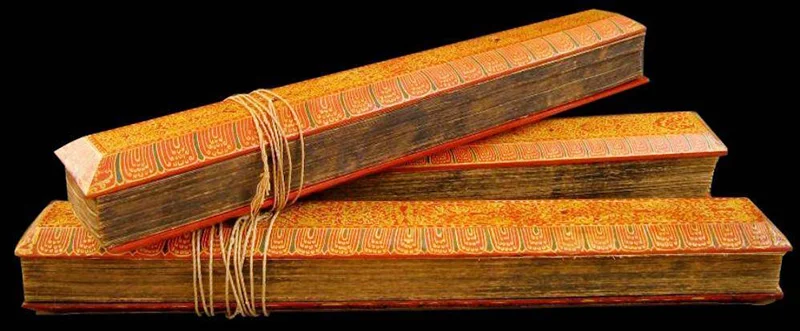
Sirancee Gunawardena, the author of ‘Palm leaf manuscripts of Sri Lanka ‘(1977) met J. Pannila of Artigala south, Hanwella when she was researching palm leaf manuscripts. He was then a village elder and was the descendant of a long line of palm leaf manuscript writers.
Pannila had told Sirancee how the palm leaf is prepared as writing material and she has reproduced the information in her book. It is possible to infer from the knowledge shown by Pannila that palm leaf manuscripts writers were also trained in preparing the palm leaf, and in preserving the manuscript as well as writing on it. I think there may have been others who lacked the skill of writing, but who knew to prepare the item and to preserve it.
In Sri Lanka palm leaf manuscripts were made out of the young fronds of the Talipot palm. Talipot was able to resist the tropical climate of Sri Lanka. Pannila said, before the leaf bud opens, rings of bamboo are put 18 inches apart round the main leaf (sic). After 21 days, the branch is cut and brought down carefully, from the crown of the tree which is usually about 60 feet above ground. The mid rib of each leaf is cut off and the leaves become flexible strips.
The leaves are wound up into rolls. These are put into a large clay pot, with layers of pineapple leaves in between. Pot is filled with water and Kappetiya branches are placed on top, the vessels is sealed with a cloth and heated over a fire. The palm leaves were considered sufficiently boiled when the leaves of the Kappetiya fell off. The rolls were then taken out and washed.
The leaves were polished by rubbing them against a rounded pole of Walla wood, till the strips became flat. They were hung on a coir rope, like a clothes line, and kept outdoors for a week or so, get a fine polished texture. They were now ready for writing. The leaf strip was placed on a piece of soft wood and held in the left hand for writing with the right hand.
Writing was done with the Panhinda. This stylus had a steel tipped quill. The end of the quill was like that of an arrow, both sides were sharp and the edge was pointed to obtain sharp outlines. There were different sized quills. Some broader than others. Sharp, small size stylus was used for drawings. Sirancee owned two stylus, one long stylus with an ornate fan shaped top and another with two decorative metal globules.
The ordinary stylus was traditionally hand made by the village blacksmith. But there were elaborate ones with ornate gold, metal, ivory or carved wooden handles. The gold stylus was made of pure gold except for the stylus which was of steel. The gold stylus was a symbol of prestige. The Ananda Coomaraswamy collection has a golden stylus with royal ensign ‘SrI’. It is said to have been originally given by King Narendrasinha to Alagaboda Nilame.
The stylus was treated with respect. Sirancee pointed out that the Maha Lekammitiya and stylus were carried in the Dalada temple procession in the Esala perahera. The Matale Mahadivase Kadainmpota said “Niharepola Alahakoon Mohottala was appointed lekam of Tunkorale and received the ran Panhinda and flag”.
Inscribing a palm leaf was a skilled task. A scribe had to go through a long period of training before he was allowed to write on ola. Only very experienced writers were allowed to inscribe a major work. The handwriting in a manuscript therefore was very beautiful and were works of art, said Sirancee. Letters were uniform and evenly spaced. Palm leaf drawings were fine line drawings, which required great skill. Circles and shapes were drawn free hand.
The manuscript usually starts with the auspicious word ‘Svasti’, with the latter ‘ka’ below it. The text commenced with traditional salute to the Buddha and ended with a colophon which gave the name of the author and promoter and some times the scribe and the date. But most authors were anonymous.
Palm leaf manuscripts were numbered starting from the Sinhala letter Ka according to the Sinhala alphabet. words were written from left to right. There are no punctuation marks and no spaces between words. There were margins and a symbol to demarcate paragraphs. Most manuscripts only had text, but there were many with illustrations.
The words scratched on the ola had to be made visible. Inking was a special art. The process was called Kalumadima. The palm leaf was rubbed with a soft cloth dipped in Dummala oil and powdered charcoal obtained from the Godama tree. The surface of the leaf was then cleaned with rice bran (Dahaiyya).
The dummala used was a resin derived from a fossilised root of a plant called Hal ((vateria acuminata). It was dug out from paddy fields and river beds, on the two auspicious days, Wednesdays and Saturday. The dummala was distilled in an earthen pot with the outside coated in cow dung and clay. The distilling was done between 6 pm and 2 am in the garden. Ten pounds of Dummala produced about 2 bottles of oil.
When palm leaves were gathered together to form a single text, they resembled books. The manuscripts seen by Sirancee averaged 60-65 folios, but there were many which were larger. One manuscript had 311 folios.
Creating this ‘book’ was also a special process. The leaves were cut into the required size, usually two inches wide and between 8 and 18 inches in length. The inscribed leaves were placed one under the other. Holes were punched with a hot rod, and a cord passed through. The punching of holes was done according to rules given as verse. Fold the leaf into three then into four and make the holes in between the creases at the two ends. One manuscript seen by Sirancee was stitched together and opened like an accordion.
Folios were placed between two covers known as Kamba. Most manuscripts had wooden covers, of ebony, jak, milla, calamander and other hard woods. The covers were decorated in lac with flower designs, such as Jasmin, kadupul, lotus, liya wela,creepers,. Some were decorated with geometric designs, or rope design. Some had ivory inlay, others had contrasting wood in marquetry, tortoise shell was also used. One manuscript had ebony cover inlaid with ivory. the button was of tortoise shell. At Katarangala in Halloluwa they found a pirit pota with covers in dainty design.
Highly venerated manuscripts such as those on Buddhism had covers of ivory or silver, and were decorated with gem stones. These are kept safely. Malwatte temple had a palm leaf manuscript on Abhidamma written in Sinhala, with ivory covers, a border of rubies and blue sapphires and a design of flowers set in gold. Malwatte had another manuscript, with cover in silver and gold and a floral design richly encrusted with white sapphires and zircons. Hanguranketa temple had a manuscript with gem studded covers. Pelmadulla Raja maha vihara also had a manuscript with carved ivory cover. Several other manuscripts had gem studded covers. National Museum library had a manuscript on Abhidamma with an ornamented cover in brass. SWRD Bandaranaike collection had a manuscript with silver cover and gems.
The formula for making oil for preserving manuscripts is a heavily guarded secret, said Sirancee. Pannila had a secret formula which was handed down generation to generation and was known only to a few families. Pannila gave Sirancee the formula in appreciation of her interest in the subject. Sirancee has gven the formula and method, with photographs, in her book on pages 38-40.
Pannila had been commissioned by the National Museum library to apply his secret oil to the palm leaf manuscripts which needed preserving. He was also invited to temple libraries and to the Institute of Indigenous medicine at Rajagiriya to clean and restore their manuscripts.
Sirancee stated that palm leaf manuscripts stored on wooden shelves did not deteriorate despite the humid climate. Manuscripts kept in pettagama tended to disintegrate, she said. But Nagolle Raja Maha vihara was a well-known exception. The olas stored in its pettagama remain well preserved.
The National Library of Sri Lanka has a Preservation and Conservation Centre (PAC) which pays special attention to palm leaf manuscripts. The IFLA PAC Centre was inaugurated on 5th August 2015. The Centre produces “Panhida Herbal Oil”for the conservation of palm leaf manuscripts.
Udaya Cabral, who heads the PAC, with M Ravikumar, and T Ramanan presented a paper titled Developing a strategic program for safeguarding palm-leaf manuscripts in Sri Lanka at IFLA Conference, 2018.In 2021 the National Library issued a report on best practices for the conservation of Palm-Leaf Manuscripts, prepared by Udaya Cabral and R.M Nadeeka Rathnabahu.
Cabraal and Ratnabahu said that a palm leaf manuscript around 200 years old located in National Library of Sri Lanka, regularly treated by Dummala herbal oil was examined under microscope. They found that the traditional oil was not completely effective, some fungus still remained. PAC recommended that after treatment with Dummala oil, the manuscripts be kept in a specially designed ‘fume cupboard ‘made out of neem wood, with a cube of Thymol placed at the bottom.
In my view, it is only in recent times, that ola manuscripts are treated as archival material, to be preserved somehow. My guess is that in ancient times, the original manuscript was kept as long as possible but a copy was made when it was clear that the original was going to perish. This was repeated over and over again. That is how the Mahavamsa came to us. ( continued)
REFERENCES
Sirancee Gunawardana Palm leaf manuscripts of Sri Lanka. 1977 p 14–, 33-. 132, 134, 248-251, 254, 25
https://www.ifla.org/news/pac-sri-lanka-publishes-a-new-report-on-best-practices-for-the-conservation-of-palm-leaf-manuscripts/
http://library.ifla.org/2266/1/124-cabral-en.pdf
https://www.ifla.org/wp-content/uploads/files/assets/pac/Documents/pac_sri_lanka_report_best_practices_for_conservation_of_palm-leaf_manuscripts_.pdf
BY KAMALIKA PIERIS
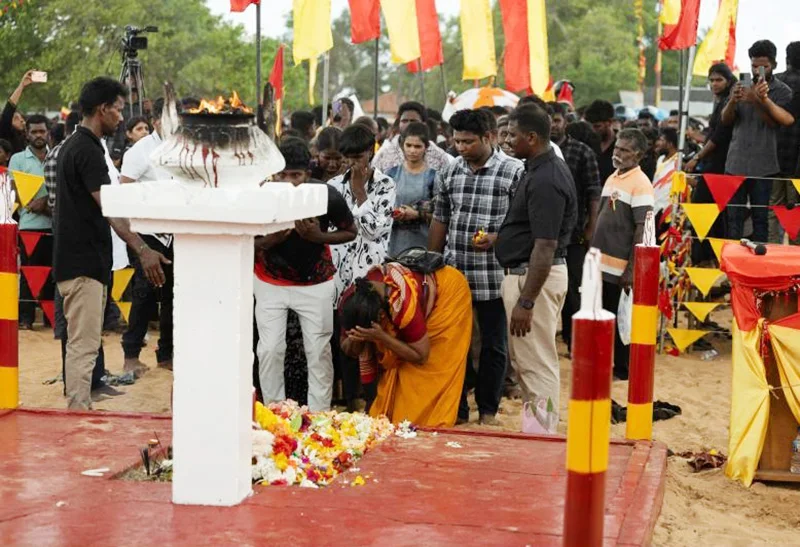
Now in their seventeenth year,
Separate ceremonies are ongoing,
By the Victors and Vanquished of war,
To remember the dead of both halves,
Proving that ‘Two Nations’ exist after all,
Whereas what’s so badly needed by the Isle,
Is a North-South bridge-building project,
That would meld the two sides into one,
On the basis of a spirit of mutual forgiving,
And a law of equality all-embracing.
By Lynn Ockersz

Everest record holder warns of Nepal danger as two Indian mountaineers die

Angkrish Raghuvanshi ruled out of IPL 2026 with concussion, finger fracture

Sunrisers Hyderabad win big but Royal Challengers Bengaaluru, Gujarat Titans seal top two spots

Flood warning issued to the Aththanagalu Oya basin extended until 0600AM on Monday [25]

About 100 mm rainfall likely at some places in the Western and Sabaragamuwa provinces and in Galle and Matara districts

Torrential rains cause havoc countrywide

‘Dates have the highest sugar content to fight Coronavirus’

Sunday Island 27 December – Headlines

#SundayIsland 17th December – Headlines

Sunday Island – 28th March

Sunday Island Headlines – 21 March

Sunday Island – 21st February – Headlines
-
 Features6 days ago
Sri Lankan Airlines Airbus Scandal and the Death of Kapila Chandrasena and my Brother Rajeewa
-
 News6 days ago
Kapila Chandrasena case: GN phone records under court scrutiny
-
 News6 days ago
Rupee slide rekindles 2022 crisis fears as inflation risks mount
-
 Features3 days ago
Octopus, Leech, and Snake: How Sri Lanka’s banks feast while the nation starves
-
 Business6 days ago
Expansion of PayPal services in Sri Lanka officially announced
-
 News2 days ago
Steps underway to safeguard Sri Lanka’s maritime heritage
-

 News6 days ago
Court orders further arrests in alleged USD 42 Mn NDB fraud case
-
 Opinion2 days ago
Murder of Ehelepola family, Bogambara Wewa and Sightings of Wangediya